Request: Axis and Allies Naval Miniatures
-
@rogercooper said in Request: Axis and Allies Naval Miniatures:
@kurtgodel7 TripleA is an engine designed to play games where units are moved by territories and conduct combat when they are in the same area. Axis & Allies Naval Miniatures is game where the units can occupy any position on the map and conduct combat from a distance. There is nothing in common. You can't modify TripleA to play it.
I would like to see a good turn-based naval combat game. There where a number during DOS times, but I don't know of any now.
I don't know if you're a computer programmer. I've taken a few classes in computer programming, but I don't know Java. This being said, you keep saying things can't be done. You are wrong. They absolutely, 100% can be done.
Combat works differently between Axis and Allies/world maps versus Axis and Allies/naval miniatures. Fine. Solving that problem is trivial. Below is some code in BASIC (one of the languages I do know).
Let X = Number_of_Die_Rolls
Let hits = 0
For B = 1 to X
Let Y = rnd()
If Y < 0.5, then let hits = hits + 0
If Y > 0.5, and if Y < 0.833333, then let hits = hits + 1
If Y => 0.833333, then let hits = hits + 2
Next B
If hits >= Vital_armor_value, then target = destroyed
Elseif hits >= armor_value, then -1 to target_hull_points
If target_hull_points = 1, then target = crippled
If target_hull_points = 0, then target = destroyedClean up that code a little, translate it into Java rather than BASIC, and that's enough to make gunnery attacks and dive bombs work. You'd need two other blocks of code also: one for torpedoes, the other for depth charges.
What about the problem you mentioned, of firing from a distance? TripleA very obviously has an object of some sort for detecting range.
Step 1. Determine max_range of selected unit
Step 2. List enemy units within that max range
Step 3. Player selects an enemy unit from the list
Step 4. Determine range to the target the player selected
Step 5. Use the range and the attacker's unit stats to determine the number of die rolls.
Step 6. Feed the number of die rolls into the above-described combat engine, as well as the target's armor value and vital armor value.None of this should be all that hard. You are making a mountain out of a molehill.
-
One way you might be able to deal with the one TTy that everybody is in thing, Is to still divide the map but give everybody a buncha movement.
Idk, I never played it, but you might be able to get close to it.
-
@kurtgodel7 It is possible to write a program to play Axis & Allies Naval Miniatures. The program would have almost no commonality with TripleA. Even Axis & Allies 1914 has not been fully implemented in TripleA.
In addition to the link I showed you before, there is a Vassal module available.
-
@rogercooper said in Request: Axis and Allies Naval Miniatures:
@kurtgodel7 It is possible to write a program to play Axis & Allies Naval Miniatures. The program would have almost no commonality with TripleA. Even Axis & Allies 1914 has not been fully implemented in TripleA.
In addition to the link I showed you before, there is a Vassal module available.
In coding, some tasks are trivial, others non-trivial.
The code I wrote in my earlier post is trivial. It's the sort of thing they teach you to write in computer science 101. Trivial code along those lines is all or most of what's necessary to get Axis and Allies Naval Miniatures to work in the TripleA engine.
A lot of what the TripleA engine does is non-trivial.
Incorporating Naval Miniatures into the TripleA engine has two advantages.
- It would allow software developers to glom off of the non-trivial tasks already achieved in the TripleA engine, instead of having to start from scratch.
- It would bring the naval miniatures people into the TripleA community, instead of separating them off into their own community.
-
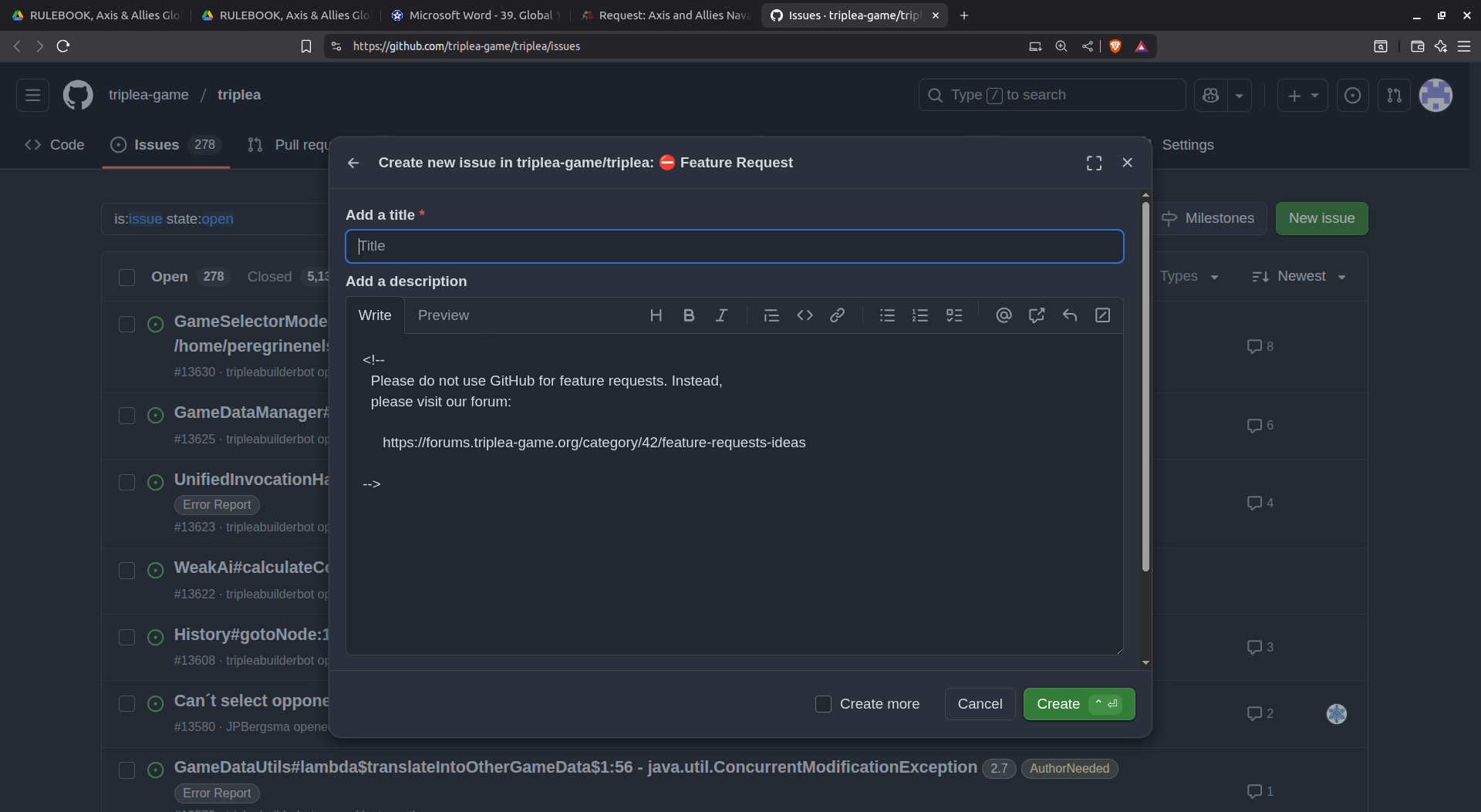
you may want to make a Feature Request at github and link to the discussion here. https://github.com/triplea-game/triplea/issues
Hit "New Issue" then "Feature Request"
Edit
Well they don't want Feature Requests there anymore
-
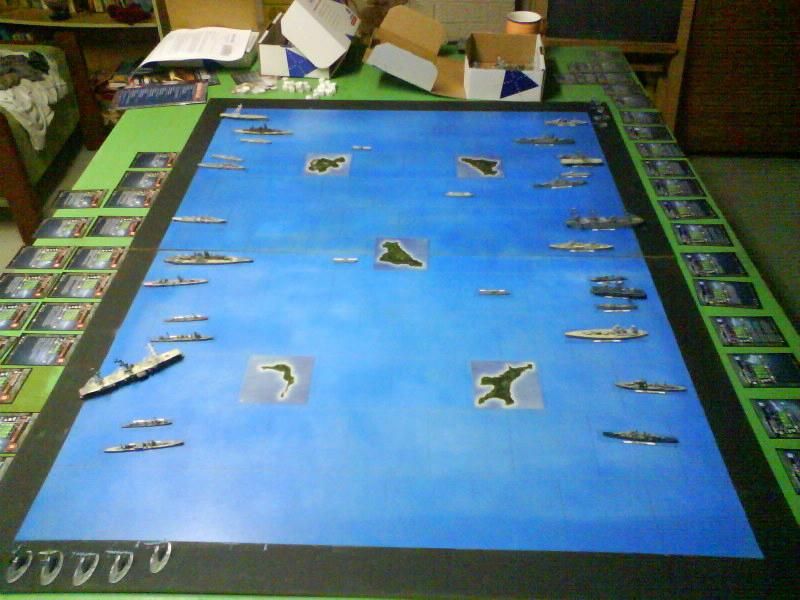
A different customized game board.
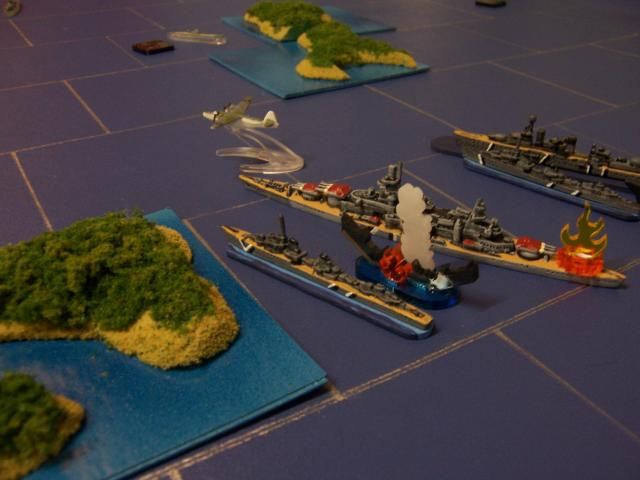
Model railroad techniques were used to make the islands.
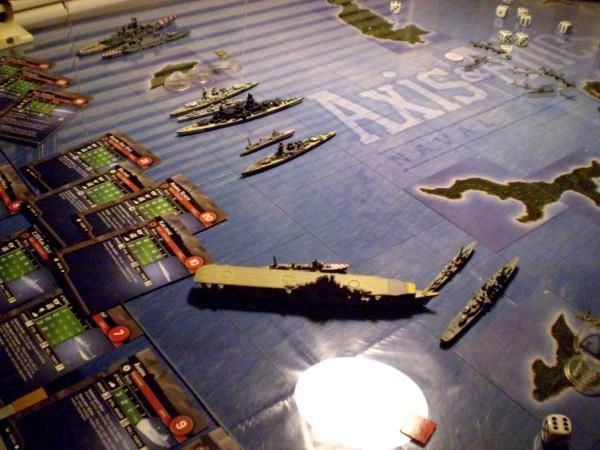
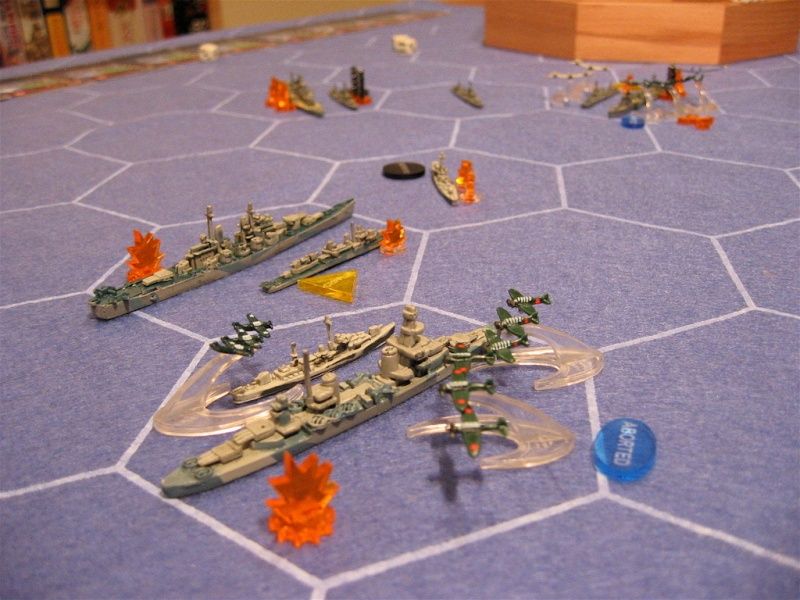
A large fleet battle.
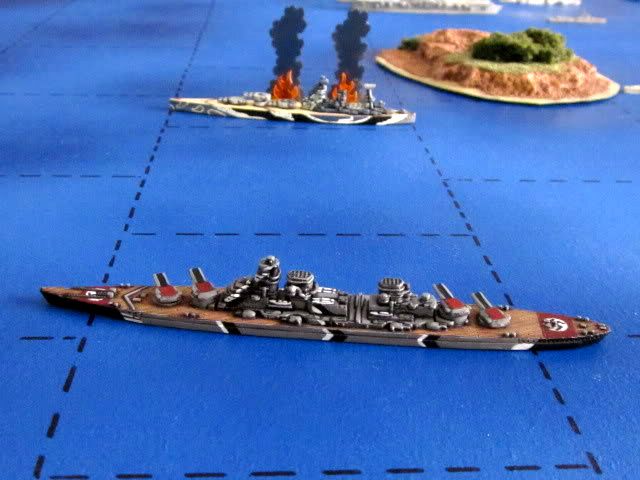
More customization.
-
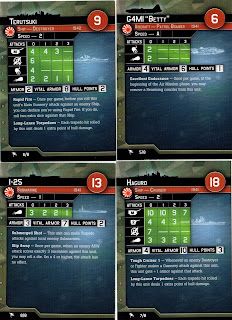
The above cards pertain to battle of the starter set.
Ax excerpt from the above link:
The current Starter Set for the War at Sea Axis & Allies naval miniatures game provides an interesting tactical puzzle for the players as well as being a good introduction to the game system.
At less than 50 points worth of units per side and just a total of 8 pieces it's definitely on the smaller side, but there's a considerable amount of reply value as the Starter shows that you don't need battleships to have a good game.
Each side has its strengths and weaknesses but they're evenly matched and good play will generally prevail even in a game as dicey as WAS. Either side can win, but winning consistently will mean paying close attention to both sides' values and special abilities.
The Axis side is represented by a pair of surface ships supported by one sub and a patrol bomber, giving the Japanese player a wide variety of threats.
The centerpieces of the Japanese force is the Heavy Cruiser Haguro, which fought throughout the Pacific campaign and met its demise in the last surface action fought during the Pacific War.
At 18 points it's the highest valued unit in the set and it justifies that high value with a nice array of powerful attacks. At a range of 0 or 1 the Haguro will roll 10 dice with its main battery gunnery, which is the highest total available in the set. This is 2 more dice than the base roll of the Allied forces' counterpart, the USS Montpelier, and is enough to almost guarantee getting at least a hit on the Montpelier. The Haguro's advantage drops off rapidly with range, however. At range 2 the Haguro only rolls 9 dice, while the Montpelier still rolls 8 and may roll 9 dice if it's still undamaged and has its Radar Fire Control SA. At Range 3 both ships roll 7 base dice and an undamaged Montpelier actually has a 1-die advantage. The American cruiser, if undamaged, also has a Range 4 shot of 8 dice. So the Haguro generally wants to close the range if possible. The Haguro's secondary gunnery factors of 4-4-3 are adequate to pose a threat to either of the enemy destroyers, but its AA value of 7 is only enough to occasionally abort the American Avenger and it will take a very good roll to shoot it down.
The Haguro's nastiest punch rests with its torpedo battery.
-
@kurtgodel7 Interestingly, the Haguro was sunk in the last surface naval action of WW2 by 5 British destroyers. https://en.wikipedia.org/wiki/Battle_of_the_Malacca_Strait. That would in interesting battle to play out.
-
Some thoughts on fleet building (Allied)
Battleships (70 points)
If you're the Allies, you have one option here. The Iowa. The Iowa has the best main guns and armor of any Allied battleship. Also the most hull points. In general, American ships have slightly better anti-air defense than their Japanese counterparts. That's certainly the case here, with the Iowa having better antiaircraft fire than the Yamato. Also the Iowa is the only ship in the game with extended range 5. When undamaged, its main guns have a range of 5. After taking damage, its maximum range is reduced to 3.Battleships (50 - 55 points)
Some good options for the Allies here, most of which are American. There are also some non-American options, such as the French battleship Richelieu or the British battleship Rodney. Battleships at this price point will generally have extended range 4. When undamaged, they have a range of 4. On taking damage, their max range is reduced to 3. In general, battleships at this price point are like slightly weaker versions of battleships at 70 points. 5 hull points instead of 6, for example. A little less armor, making it a bit easier for opposing units to land a hit. A bit weaker main guns, making it a little less likely to land a hit of your own.Battleships (40 - 45 points)
Also good options for the Allies here. A number of which are British. In many cases the British battleship will have something wrong with it. Slow 1 or 2, which can reduce your movement speed for a turn depending on die roll. Fatal flaw, making the ship potentially easier to destroy. Stuff like that. But these are still powerful ships, and at a lower price point than above.Battleships (below 40 points)
As the price of a battleship continues to decline, it becomes in some ways less like a battleship and more like a strong cruiser. More vulnerable to damage. Less able to use its main guns to inflict hits on heavily armored opponents. But ships at this price point still have their uses. They're good at attacking weaker ships. Also, any surface ship can take an objective, or deny an objective to an opponent. There's always the chance of getting lucky, and using your main guns to inflict damage on even a heavily armored enemy. That chance increases as you reduce the range.Cruisers
It's probably not a great idea to use cruisers as your counter to enemy battleships. But you can still use them to attack other enemy ships, such as cruisers, destroyers, and carriers.Destroyers
These are useful against subs. Also they can have torpedoes. Torpedoes ignore armor, which means they can inflict damage upon even the most heavily armored of battleships.Aircraft Carriers
If I'm building an aircraft carrier, the three things I most want to know are: how much does the carrier cost? How many planes does it hold? What bonuses does it provide to planes? Most Allied aircraft carriers are American, and American carriers trend toward providing bonuses to dive bombers rather than torpedo bombers.Aircraft
For aircraft I'm assuming a cutoff date of 1942 or earlier. Four different categories of aircraft from which to choose: fighters, dive bombers, torpedo bombers, and patrol bombers. Of those, patrol bombers are strictly land-based, whereas the other three types can be based on carriers or on the land. You're going to want some fighters. These will help fight off enemy air attacks, while occasionally killing enemy aircraft outright. As for dive bombers vs. torpedo bombers: you have good options for both, but you might be better off emphasizing dive bombers. Especially with bonuses from carriers, American dive bombers have the ability to inflict damage even upon the mighty Yamato. That said, torpedo bombers can play a good role as well. The U.S. and Britain have some good options for patrol bombers. Often, the patrol bombers available to you will be inexpensive, capable of packing a good punch, but also vulnerable to being aborted or destroyed.Subs
Your options here are decent and reasonably priced. -
Fleet building (Axis)
Battleships (70 points or so)
The Yamato (70 points) and Musashi (66 points) give you the most brute power of any ships in the game. They're a little weaker at anti-air than the Iowa. Also they only have extended range 4, instead of extended range 5 for the Iowa. Nevertheless these ships are an outstanding way to provide surface combat power.Battleships (50 - 55 points)
You have some good options here, including Japan's Nagato, Germany's Bismarck, and Italy's Vittorio Veneto. Ships at this price point generally have extended range 4. Good overall stats, making them strong at surface combat.Battleships (40 - 45 points)
As with Allied battleships, Axis battleships at this price point tend to decline a bit in power, as compared to their more expensive counterparts. Weaker armor, making it easier to score hits on them. Weaker main guns, making it more difficult for them to penetrate the armor of the game's heaviest units. But you're still looking at powerful units here.Battleships (below 40 points)
Some interesting Japanese options here, as well as some battleships which aren't Japanese. The things I wrote about the Allied battleships at this price point apply also to Axis battleships.Cruisers
Japan has some interesting options for cruisers, especially considering the long range of their torpedoes. Torpedoes ignore armor, allowing them to inflict damage on any surface ship. However, cruisers are more vulnerable to surface guns than are battleships. In fact, cruisers are more vulnerable in general than are battleships.Destroyers
Axis destroyers are broadly similar to their Allied counterparts.Aircraft carriers
Japan has some very good options with respect to its aircraft carriers. While its carriers apply various types of bonuses, they are especially good at providing bonuses to torpedo bombers. Or, you might choose a slightly less expensive carrier which provides fewer bonuses.Aircraft
Assuming a cutoff date of 1942 or earlier, the Zero is a reasonably powerful fighter, at a good price. The Val is a good option as a dive bomber. But where Japan shines is the Kate: an excellent torpedo bomber. Not only is the Kate good at attacking heavily armored ships, it can also provide anti-sub war if that's something you need. Considering the bonuses Japanese carriers often provide to torpedo bombers, it's as though you're being warmly encouraged to build at least some Kates. Not that there's anything wrong with including some Val dive bombers into your unit mix. As for patrol bombers: you have some good Japanese options, such as the Betty. Also some good non-Japanese options, like the German Kondor.Subs
Japanese subs are often a bit more powerful than their American counterparts. But, their price point reflects that.

Hello! It looks like you're interested in this conversation, but you don't have an account yet.
Getting fed up of having to scroll through the same posts each visit? When you register for an account, you'll always come back to exactly where you were before, and choose to be notified of new replies (either via email, or push notification). You'll also be able to save bookmarks and upvote posts to show your appreciation to other community members.
With your input, this post could be even better 💗
Register Login