Flames and Steel (official thread)
-
The new air system. Note that the Japanese carriers now have 8 torpedo bombers and 4 fighters.
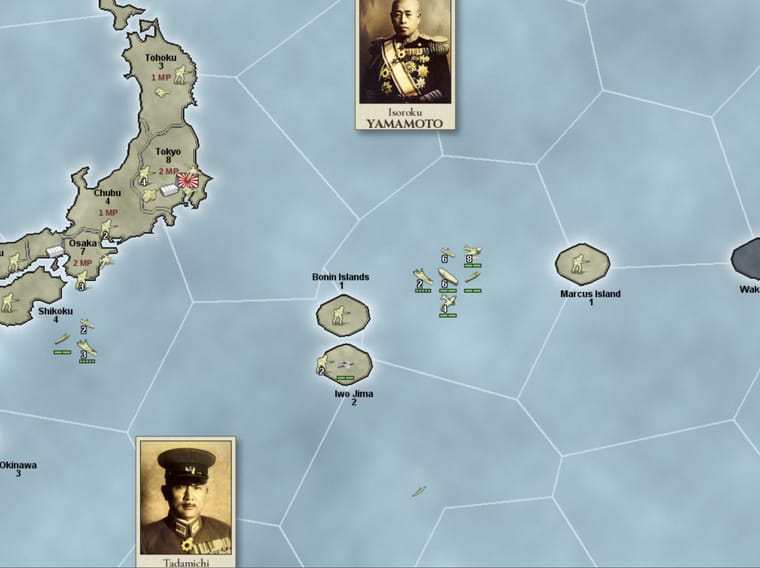
There are still tweaks to the GUI to be made, but unfortunately I've used well over 90% of my weekly limit, even though I'm only halfway through the week.
The opening of the game.
-
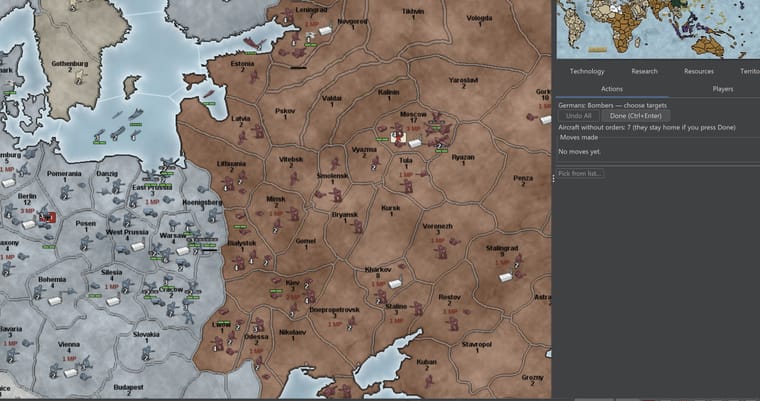
The American fleet at Pearl Harbor. The U.S. is at peace for rounds 1 - 2. This means it has a reduced income, and is unable to move its units. Which means the Pearl Harbor fleet gets hit on Japan's third turn.
-
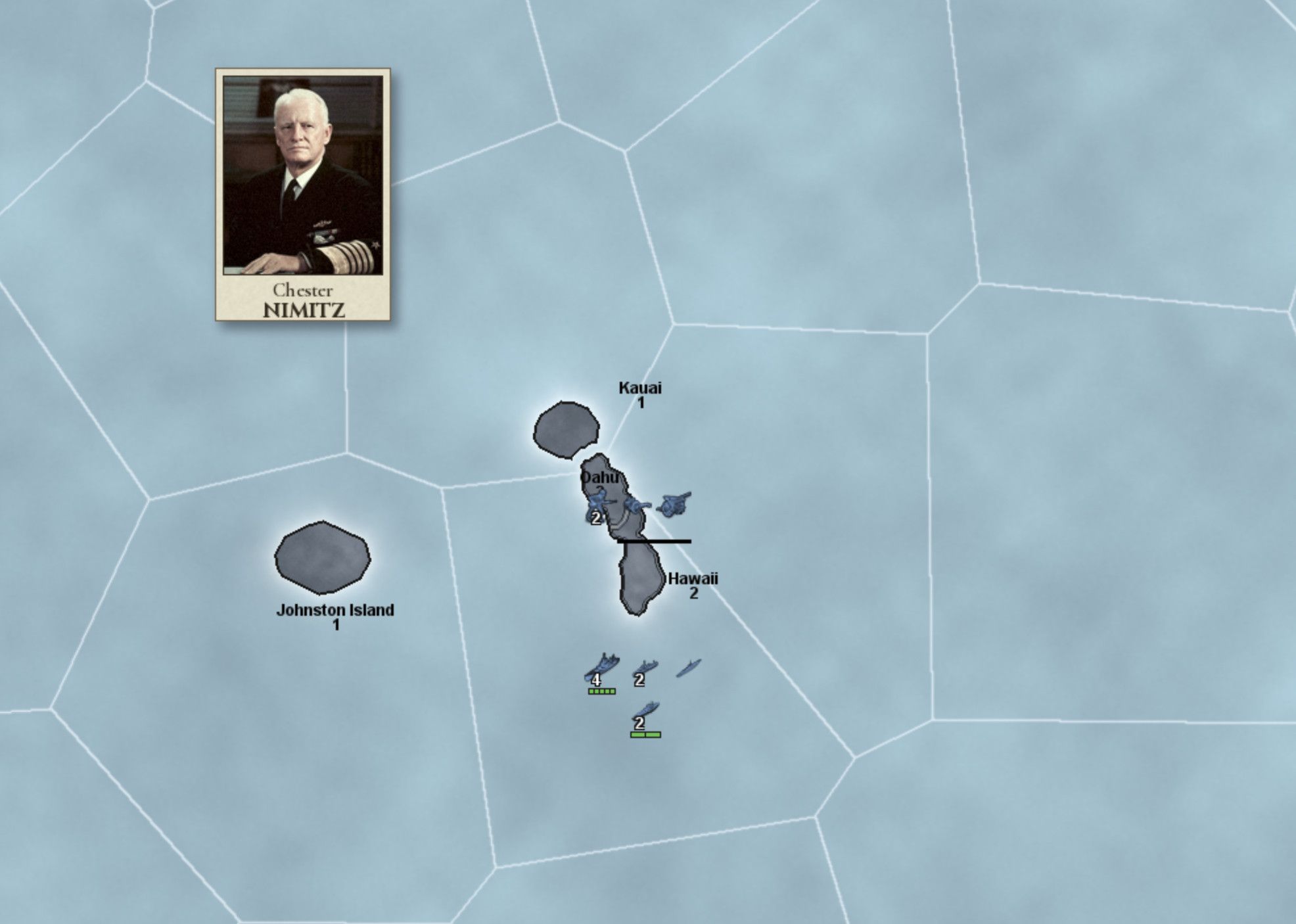
@KurtGodel7 West Prussia and Posen should trade names on your map. Vienna's border is also drawn kind of wacky, that strip at the north should probably be part of Bohemia.
-
The German research screen. I'm making piston aircraft tech more nation-specific.
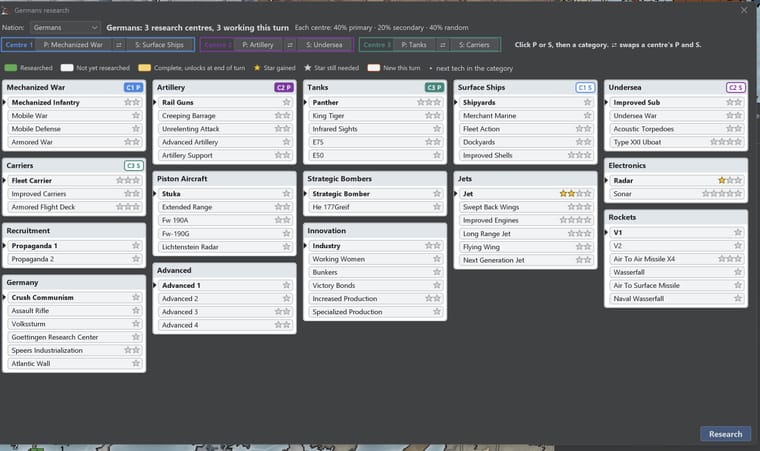
The Stuka tech improves German dive bombers against land targets. Fw 190 A unlocks advanced fighter for Germany. Fw 190 G improves German dive bombers. Lichtenstein Radar improves the interception value of heavy fighters.
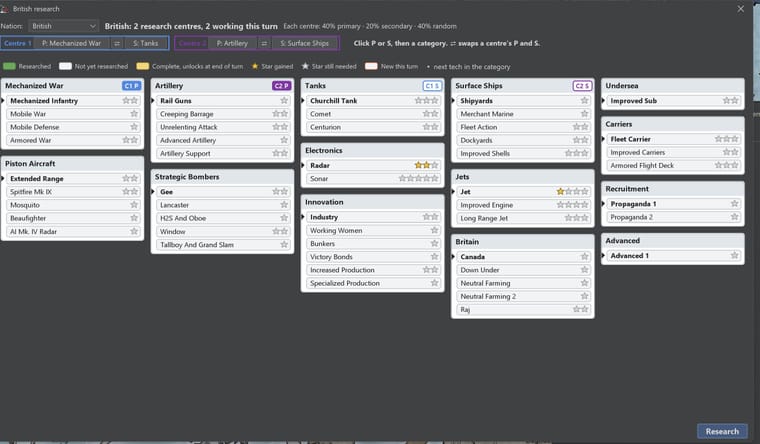
The British research screen. Note that techs like Tallboy and Grand Slam make British strategic bombers the hardest-hitting in the game, while Window tech reduces the interception value of enemy fighters by 1. As for British piston techs, the Spitfire Mk IX unlocks the advanced fighter. Mosquito tech improves British medium bombers against land targets. The Beaufighter gives Britain better torpedo bombers. The A1 Mk 4 Radar is the British equivalent of Lichtenstein.
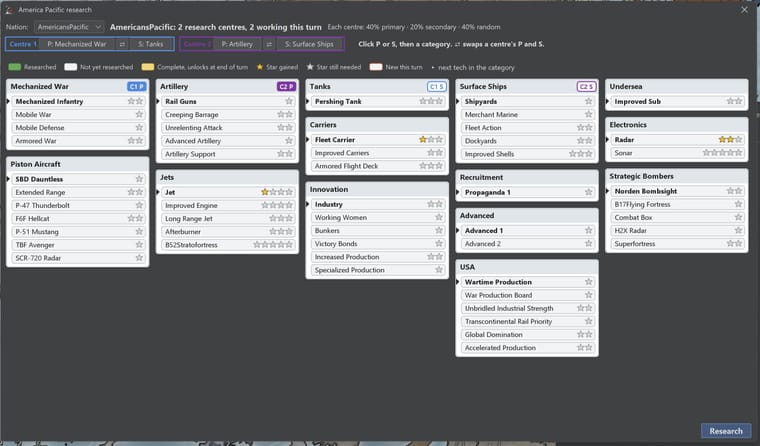
The research screen for America Pacific. Even though these techs are the exact same as America Atlantic, some of the names are different. American strategic bombers don't do as much damage as their British counterparts. But American strategic bombers fight back against interception better than their British counterparts. For Piston Air, the Dauntless tech improves dive bombers in naval combat. The P-47 Thunderbolt adds +1 hitpoint to American dive bombers. The Hellcat unlocks advanced fighters. The P-51 Mustang tech adds +2 to range for American advanced fighters and allows them to escort bombers on strategic bombing raids. (Max 4 escorts per factory targeted.) The TBF Avenger tech gives the U.S. some of the best torpedo bombers in the game. SCR-720 Radar is the American equivalent of Lichtenstein.
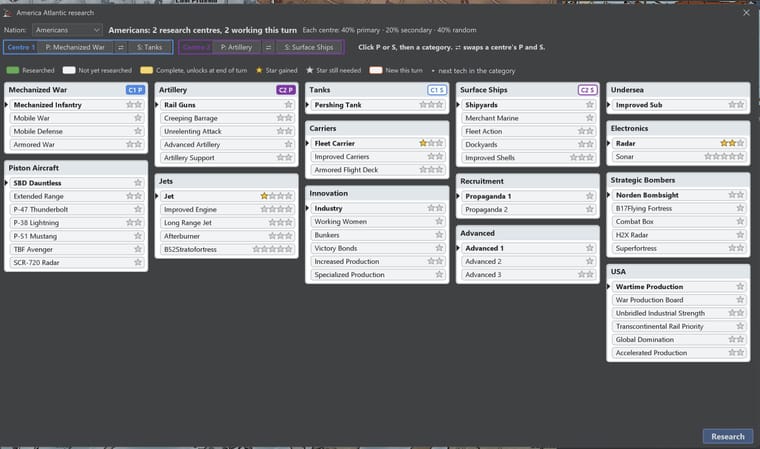
The research screen for America Atlantic. The techs themselves are the same, but one of the names has changed. Notice that the name for the advanced fighter is P-38 Lightning.
-
@KurtGodel7 Before I truly reply, it would be good to clarify if the dogfight phase of your system lasts until only the fighters of one side remains, or it is just a single round of fire in which fighters hit each other (so there may be fighters surviving on both sides) before the surviving fighters proceed hitting the bombers.
What I guess is that it is the latter. Am I right?
To keep it simpler, let's assume that one side has fighters and bombers and the other side has only fighters.
This way, all fighters of the side with only fighters are interceptors (at least after the first phase), and all fighters on the opposite side are escorts.
If my guess is correct, what your system is depicting is that there is a first phase during which the bombers are still far away, and fighters try to kill each other in fighters-only engagements (dog-fights) until this phase ends, I guess because they eventually reach the bombers or to represent that fighters can slip through and get to attack the bombers without having to down all opposing fighters first. When they reach the bombers, the dogfight phase ends because the escorting fighters stop firing once and after the enemy fighters reach the bombers, whereas the now intercepting fighters now fight against the bombers alone and get fired back by the bombers only.
Of course, I get that the fact that the escorting fighters do not fight when the bombers fight is just because their previous fight is meant to cover this too for simplicity instead of having them firing twice (like the interceptors instead do, because they first fire in the dogfight and then again against the bombers). Right?
In this simplified example, are the escorting fighters at least firing with a higher power than the fighters on the other side during the dogfight phase, in order to balance the fact that they are later doing nothing while the interceptors fire against the bombers (and I would say also because of the fact that the other fighters have to worry about getting to the bombers while they are fully focused only on downing the fighters should give them some tactical advantage)? My understanding is that they do not (right?), which would be arguably fine in a more symmetrical example like the case in which both sides have the same number of fighters and bombers.
I think your system needs at the very least a dynamic by which fighters which are not going to be interceptors after the dogfight have a higher power during the same than the fighters which do, and I believe it is missing this.
Is my understanding all correct?
-
@KurtGodel7 West Prussia and Posen should trade names on your map. Vienna's border is also drawn kind of wacky, that strip at the north should probably be part of Bohemia.
I've added these things to my list. No more work on the list for the next 3 - 4 days, because I'm at 94% of my weekly usage limit.
-
@KurtGodel7 Before I truly reply, it would be good to clarify if the dogfight phase of your system lasts until only the fighters of one side remains, or it is just a single round of fire in which fighters hit each other (so there may be fighters surviving on both sides) before the surviving fighters proceed hitting the bombers.
What I guess is that it is the latter. Am I right?
To keep it simpler, let's assume that one side has fighters and bombers and the other side has only fighters.
This way, all fighters of the side with only fighters are interceptors (at least after the first phase), and all fighters on the opposite side are escorts.
If my guess is correct, what your system is depicting is that there is a first phase during which the bombers are still far away, and fighters try to kill each other in fighters-only engagements (dog-fights) until this phase ends, I guess because they eventually reach the bombers or to represent that fighters can slip through and get to attack the bombers without having to down all opposing fighters first. When they reach the bombers, the dogfight phase ends because the escorting fighters stop firing once and after the enemy fighters reach the bombers, whereas the now intercepting fighters now fight against the bombers alone and get fired back by the bombers only.
Of course, I get that the fact that the escorting fighters do not fight when the bombers fight is just because their previous fight is meant to cover this too for simplicity instead of having them firing twice (like the interceptors instead do, because they first fire in the dogfight and then again against the bombers). Right?
In this simplified example, are the escorting fighters at least firing with a higher power than the fighters on the other side during the dogfight phase, in order to balance the fact that they are later doing nothing while the interceptors fire against the bombers (and I would say also because of the fact that the other fighters have to worry about getting to the bombers while they are fully focused only on downing the fighters should give them some tactical advantage)? My understanding is that they do not (right?), which would be arguably fine in a more symmetrical example like the case in which both sides have the same number of fighters and bombers.
I think your system needs at the very least a dynamic by which fighters which are not going to be interceptors after the dogfight have a higher power during the same than the fighters which do, and I believe it is missing this.
Is my understanding all correct?
Okay. I will give an example.
Germany sends four fighters and four dive bombers to attack a Soviet territory. The Soviets defend with 4 fighters. Neither nation can send more because they are both at the cap. (The attacker is limited to four bombers + four escorts; the defender is limited to 4 fighters.)
Step 1: a dogfight between German and Soviet fighters. This lasts two combat rounds. Each side's fighters fire at their dogfight value.
Step 2: Any Soviet fighters which survived the dogfight get to attack the German dive bombers. The Soviet fighters fire at their interception value, the dive bombers fire back at their air defense value. Destroyed units are removed.
Step 3: if there are Soviet aa guns present in the territory these get to fire. Each aa gun gets one shot only regardless of the number of aircraft. It fires on a 2. Destroyed aircraft are removed from play.
Step 4: If a German dive bomber was destroyed previously it doesn't get to attack. If it was damaged but not destroyed, it is aborted and doesn't get to attack. But if it's still at full health it gets to attack the land units present.This next part is very new, as in today. If a dive bomber is strafing a land target it gets a +1 bonus. Depending on the nation this can be upgraded to at least +2 with tech. Maybe +3. Likewise, a torpedo bomber gets a +1 bonus when attacking naval targets and, depending on the nation, it can be upgraded to +2 or even +3 with tech.
Normally an air battle would have a maximum of four fighters and four bombers for the attacker, and four fighters for the defender. There are two situations in which the four air maximum does not apply: air defense against strategic bombing raids, and naval battles. If it's a strategic bombing raid, the attacker is limited to 4 bombers and 0 fighters. The defender can send fighter type aircraft to the raid without restriction. For a naval battle there are no restrictions on either side's air participation. If you want to sink a big fleet and you have 20 air, send all 20!
The United States (both halves) has a tech called P-51 Mustang, which adds +2 to the range of its advanced fighters, and allows it to send a maximum of four advanced fighters as escorts for each factory it wants to strategically bomb. This does not make American bombing raids invincible, but it does make them a lot tougher.
-
Germany sends four fighters and four dive bombers to attack a Soviet territory. The Soviets defend with 4 fighters. Neither nation can send more because they are both at the cap. (The attacker is limited to four bombers + four escorts; the defender is limited to 4 fighters.)
Step 1: a dogfight between German and Soviet fighters. This lasts two combat rounds. Each side's fighters fire at their dogfight value.
Step 2: Any Soviet fighters which survived the dogfight get to attack the German dive bombers. The Soviet fighters fire at their interception value, the dive bombers fire back at their air defense value. Destroyed units are removed.In this case, if you want to have all Soviet fighters firing both at the German fighters and (if surviving) at the German bombers and do not want to have different dogfight values for escorts and would-be interceptors, then I would say that the change which I would suggest to this system is having the surviving German fighters firing during step 2 too, meaning that (during step 2) the surviving German fighters fire against the Russian fighters with their dogfight value at the same time as the German bombers fire with their air defence value (meaning that this time any fighter downed by other fighters get to fire at the bombers anyway).
To achieve this, the rule may be that on phase 2 up to as many surviving fighters as the number of enemy bombers fire at bombers with their interception value and the rest of the surviving fighters (if the surviving fighters are more than the enemy bombers, meaning them all if the other side has no bombers) fire at fighters with their dogfight value (or do nothing if there are no more enemy fighters at this point). Alternatively, the rule may be that all surviving fighters fire at bombers if one or more bombers are present and fire at fighters otherwise. I think the best would be having a prompt to decide how many fighters are firing at enemy bombers (the prompt being given only if the enemy has both bombers and fighters at this point).
If both sides have fighters but no bombers, this would be the same as having an additional dogfight round.
(The attacker is limited to four bombers + four escorts; the defender is limited to 4 fighters.)
I really don't like the number limit and don't understand why having it.
-
I'm starting to create tech differences between America Pacific and America Atlantic.
America Atlantic's strategic bomber is the Flying Fortress. America Pacific's strategic bomber is the Liberator. A Liberator has longer range than a Flying Fortress, but isn't as good at defending itself against enemy air.
America Pacific has received a new unit. The marine. A marine costs 2 PUs and 1 MP, attacks and defends on a 2, and can receive support. In contrast, an infantry costs 1 PU and 1 MP, attacks on a 1 and defends on a 2, and can also receive support.
America Atlantic has also received a new unit. The M7 Priest. A Priest is unlocked with tech. It is an artillery-type unit, costs 7 PUs, movement of 2, attacks and defends on a 2, and provides support on attack only. In contrast, a field gun attacks and defends on a 2, costs 5 PUs, has a movement of 1, and provides support on attack. An M7 Priest could pair well with mobile infantry because it provides the support the mobile infantry would need.
Only America Pacific can build Superfortresses.
Unique Piston Air techs for America Pacific
SBD Dauntless: +1 naval combat value of your dive bombers
Skip bombing: +1 naval combat for your medium bombers
TBF Avenger: +2 to your torpedo bombers' naval combatUnique Piston Air techs for America Atlantic
P-47 Thunderbolt: +1 hitpoints for your dive bombers
HVAR Rockets: +1 land combat for your dive bombers
FIDO: +1 bonus when your torpedo bombers are targeting subsCarriers tech for America Pacific
Combat air patrol: All your carriers fire during the air interception phase.Electronics tech for America Pacific
VT Proximity Fuze. Adds +1 to your ships' fire when defending against enemy air.Innovation tech for America Pacific
Seabees: -1 PU cost for your trenchesArtillery tech for America Atlantic
M7 Priest: allows you to build M7 Priests
(Creeping barrage tech now adds +1 to the attack of both field guns and M7 Priests)
Fire Direction Center: each M7 Priest now supports two units on attackThe above is a summary of the differences between the tech trees of America Pacific and America Atlantic. It is not a summary of either nation's total tech tree.
Hello! It looks like you're interested in this conversation, but you don't have an account yet.
Getting fed up of having to scroll through the same posts each visit? When you register for an account, you'll always come back to exactly where you were before, and choose to be notified of new replies (either via email, or push notification). You'll also be able to save bookmarks and upvote posts to show your appreciation to other community members.
With your input, this post could be even better 💗
Register Login