Flames and Steel (official thread)
-
Gibraltar was only 6.8 square kilometres and certainly not plain.
This means that, depending on roughly how much your infantry is supposed to be in terms of infantrymen and stuff, and assuming that artillery, armour and so on are similarly limited, you can have a very low units limit.
This would be both realistic and helping with keeping low the needed area of Gibraltar for showing units in there.
I asked the "AI Mode" of Google "What is the maximum number of infantrymen which could have been defensively deployed in Gibraltar during 1941?"
This was the answer:
During 1941, the maximum number of infantrymen defensively deployed in Gibraltar was approximately 7,000 soldiers, organized into two brigades.
This infantry element formed the backbone of the overall 16,000-man total defensive garrison stationed on the Rock at the time, which also included large numbers of artillerymen, anti-aircraft crews, and Royal Engineers.If the question is framed around structural capacity rather than actual troop counts, the British military dramatically expanded the Rock's underlying infrastructure during this period. Royal Engineers and Canadian engineers excavated an extensive 25-mile network of underground tunnels, living spaces, and hidden fortresses.
Upon its completion, this massive subterranean complex was designed with a maximum theoretical capacity to fully house, protect, and sustain a force of 30,000 men for up to 16 months without external resupply.You could say that the physical land area Britain actually owned for Gibraltar was small. Too small to station a large army there. Okay, you're probably right about this.
But suppose a nation wanted to station a large army in or near Gibraltar. Because of the lack of room for the army, it would need to take some nearby land from Spain. Germany invades Spain on its very first turn. The concept of taking land away from Spain is hardly far-fetched for this map.
A better example of a space constraint is Midway. Unlike Gibraltar, there is no nearby land for someone to seize if they need more space. The American government stationed planes on Midway--but only a limited number, because space was constrained. If I wanted to simulate this source of realism--which I don't--I would create a small island rule. If something is categorized as a "small island" its garrison must be limited in size.
It's easy to create a lot of rules, exceptions, and special cases, all in favor of realism. Individually each may seem relatively harmless. Their collective weight burdens the player. Before I say yes to anything like this, I ask, "How does this improve game play?" Suppose the answer is, "this was never intended to benefit game play. Its only purpose was to make the game more realistic." At that point, the idea can be dropped. Added complexity is never justified by realism for the sake of realism.
WWII saw enormous technological progress. Production capacity greatly increased. Nations' armies were limited by their available manpower. There was an air war. Losing the air war meant your enemy could strafe your armies and bomb your factories. Flames and Steel is intended to do a much better job of simulating all of this than a normal TripleA map would. I embraced realism in those specific areas because I thought it would improve game play. Adding those things would give the player a richer array of strategic choices.
If Gibraltar's garrison is limited, that means it can't be defended against Allied attack. Which means that America Atlantic's fleet could enter the Mediterranean. Allowing America Atlantic's fleet access to the Mediterranean is a decision about game play. Currently, I believe that the better decision for game play is to allow the Axis to harden Gibraltar, and thus keep the Allies out. If I'm persuaded otherwise--if it turns out that allowing the Allies into the west Mediterranean really would lead to a better game--then I will change rules to allow that to more easily happen.
-
If Gibraltar's garrison is limited, that means it can't be defended against Allied attack.
To be clear, if you can have at most X land units in Gibraltar (which would need to be decided based on a guess of how many infantrymen is an infantry units and the broad assumption that the other land units take about the same space when deployed or in reserve but ready for immediate deployment), you can also attack Gibraltar with at most X land units. (No other rules for land units here.) This would make Gibraltar actually more defensible, possibly much more defensible.
(Obviously, this is an approximation: you should realistically be able to attack with infinite land units but only Y at the same time, with Y lower than X, then, when you win, every land unit exceeding X goes back to the transports (because it never left them), but I'm not proposing front-line based limits or anything else other than a max X both stacking and attacking for a few very small territories like Gibraltar and Midway. Ideally, every territory for which X would be greater than 10 gets infinite - so no limit - for simplicity (yes, an arbitrary upper limit over which not to bother): this would likely include Malta and every island bigger than Malta depending on how many men an infantry unit is representing.)
Moving on to air limits, Gibraltar would also have a maximum air unit limit to land (like an aircraft carrier) (again, arbitrary and limited only to a few extremely small territories like Midway etc.). In this case, however, there is no limit for attacking air units over Gibraltar. (Again, I'm not claiming this is very realistic.)
Practically, the land limit would favour the defenders, and the air limit would favour the attackers.
In case of paratroopers, the limit would be total on land units. For example, if Gibraltar has a land unit limit of 2, you can offload 2 land units, or para-drop 2 land units or 1 of each, no more. (Again, a simplification.)
My point is not that this would be highly realistic, just that it would be more realistic than nothing, everything else being the same (and it is meant to be limited to Gibraltar, Midway and at most a few other similar cases if not just these two).
Whether or not something like Gibraltar could be attacked with paratroopers at all is of course a disputable matter. Personally, I would say that a simple rule that Gibraltar can never be attacked with paratroopers unless completely undefended would be a good special rule to add for Gibraltar and anything else about as small as Gibraltar (as an approximation of how insanely borderline suicidal would such a thing be). An arguably more realistic rule would be limiting it to the unused stacking limit. For example, if Gibraltar has a limit of 2, then you cannot para-drop if there are 2 defenders, can paradrop at most 1 if there is 1 defender and can paradrop at most 2 if it is undefended by land units. In any case, the total attacking land units would never be more than 2.
-
This all beside the fact that, of course, a sea borne assault of Gibraltar would be suicidal with land units only: the guns at Gibraltar would sink whatever thing which can transport land units before it reaches the shoreline. (I'm not an expert, so I do not know if there is any blind spot anywhere, but I doubt that there is any one or that would make a difference in this case.)
The question, in this case, would be whether or not the guns can be silenced with battleships and/or huge bombs, to make the landings possible at all.
Of course, this would be even more special rules for Gibraltar: I'm not proposing them, just saying.
-
To answer your per se sensible objection (but touching something I did not meant to touch), Malta, Rhodes and most of the Pacific islands would have no limit because, as a matter of space, you could fit more than enough number of men and stuff in there. For example, the area of Malta (only the main island) is 36 times that of Gibraltar. Yes, if we set a limit at 2 for Gibraltar, we could set a limit at 72 (or whatever) for Malta and not have limits for whatever other territory having bigger limits: this would keep the number of territories needing this special rule fairly low (practically only islands as big as Malta or smaller).
The support capacity of many islands was tied more to how much drinkable water was available rather than just land area. Malta, for instance, is much larger than Gibraltar, but also had a large civilian population to support, which limited the size of its garrison to about 20,000-30,000 men - not that much more than a maxed out Gibraltar. And that caused heavy strain on the water supply that necesssitated extremely strict rationing and the importing of fuel to pump water out of very deep reservoirs. So full realism demands a lot of case by case research on the geography of every particular location, which is beyond the scope of what is fundamentally a beer and pretzels kind of war game.
And anyway, we can’t even really quantify what “1 infantry unit” means in Axis and Allies. Is the Infantry piece supposed to be one division? In that case, the math breaks down at both the micro and the macro ends of the scale - a full division is too large to represent most of the garrisons that were involved in island fighting, while Germany and the USSR have far too few infantry units to represent the full scale of their armies. If you say it’s a brigade, that reduces the micro problem but increases the macro one, if you say it’s a corps, it does the reverse.
Same with planes, if you judge by aircraft carrier deck capacity, a single Fighter or Tactical Bomber unit must represent around 40-50 planes at maximum, but you would need need dozens and dozens of such units on the board at a time to represent the full extent of major power air forces.
The game has always been “vibes based” in that regard. The force mix each country gets is meant to be evocative of their real capabilities, but not literally representative of them. So that only adds to the futility of assigning unit limits to specific territories - now you have to assign an arbitrary value to how many men or machines a particular unit represents, which is not likely to hold up consistently when you start considering every different circumstance on the board.
-
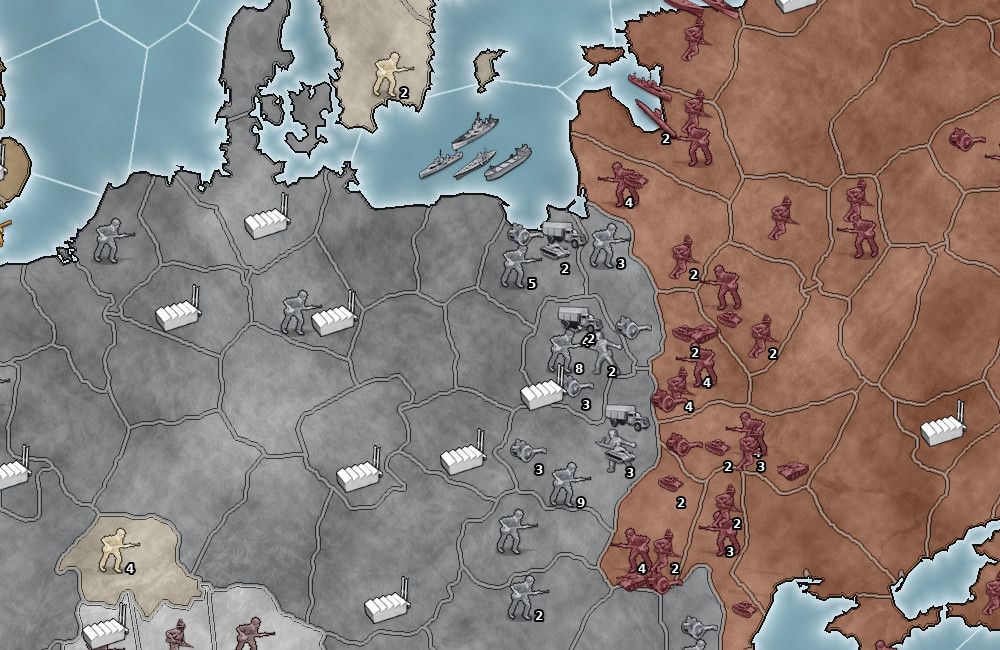
@KurtGodel7 Much better on the maps now. The Gibraltar box looks exactly how I pictured. That could also be a good way to depict other small enclaves like Singapore, Hong Kong, etc at their proper size if you choose.
With regard to coloring Vichy, I understand the logic of simplicity there. But it still looks wrong visually just because France was an actual wartime belligerent and its territories were major historical theaters of operations, so it feels off to see them in the same colors as Spain or Portugal (and also makes it look like they’re all owned by the same power).
I guess part of what’s off-putting about it is that Flames & Steel has generally added more detail and depth versus the base G40 scenario, while this is one of the few cases where it feels like it’s consciously downgrading from the original.
-
If Gibraltar's garrison is limited, that means it can't be defended against Allied attack.
To be clear, if you can have at most X land units in Gibraltar (which would need to be decided based on a guess of how many infantrymen is an infantry units and the broad assumption that the other land units take about the same space when deployed or in reserve but ready for immediate deployment), you can also attack Gibraltar with at most X land units. (No other rules for land units here.) This would make Gibraltar actually more defensible, possibly much more defensible.
(Obviously, this is an approximation: you should realistically be able to attack with infinite land units but only Y at the same time, with Y lower than X, then, when you win, every land unit exceeding X goes back to the transports (because it never left them), but I'm not proposing front-line based limits or anything else other than a max X both stacking and attacking for a few very small territories like Gibraltar and Midway. Ideally, every territory for which X would be greater than 10 gets infinite - so no limit - for simplicity (yes, an arbitrary upper limit over which not to bother): this would likely include Malta and every island bigger than Malta depending on how many men an infantry unit is representing.)
Moving on to air limits, Gibraltar would also have a maximum air unit limit to land (like an aircraft carrier) (again, arbitrary and limited only to a few extremely small territories like Midway etc.). In this case, however, there is no limit for attacking air units over Gibraltar. (Again, I'm not claiming this is very realistic.)
Practically, the land limit would favour the defenders, and the air limit would favour the attackers.
In case of paratroopers, the limit would be total on land units. For example, if Gibraltar has a land unit limit of 2, you can offload 2 land units, or para-drop 2 land units or 1 of each, no more. (Again, a simplification.)
My point is not that this would be highly realistic, just that it would be more realistic than nothing, everything else being the same (and it is meant to be limited to Gibraltar, Midway and at most a few other similar cases if not just these two).
Whether or not something like Gibraltar could be attacked with paratroopers at all is of course a disputable matter. Personally, I would say that a simple rule that Gibraltar can never be attacked with paratroopers unless completely undefended would be a good special rule to add for Gibraltar and anything else about as small as Gibraltar (as an approximation of how insanely borderline suicidal would such a thing be). An arguably more realistic rule would be limiting it to the unused stacking limit. For example, if Gibraltar has a limit of 2, then you cannot para-drop if there are 2 defenders, can paradrop at most 1 if there is 1 defender and can paradrop at most 2 if it is undefended by land units. In any case, the total attacking land units would never be more than 2.
In the early part of WWII, Japan's best tank was the Chi Ha. It later created an upgraded version of that tank: the Kai Shinhoto Chi Ha. But even this upgraded version proved inferior to America's Sherman tanks: inferior armor, inferior main gun. Even a Kai Shinhoto Chi Ha could not successfully attack a Sherman from the front, and so needed to attack from the side or rear. Japan had a tank under development which it believed would equal or exceed the Sherman. Meanwhile, the United States was looking to upgrade from the Sherman, and towards the end of the war a small number of Pershing heavy tanks were produced.
To what extent is this dynamic captured by Flames and Steel? The game starts off with Japan and Italy being able to produce light tanks only. A light tank attacks on a 2, defends on a 1, and has one hitpoint. Whereas, the U.S.S.R., U.K., U.S., and Germany all start with the ability to produce either light tanks or medium tanks. A medium tank attacks and defends on a 3 and takes two hits to kill. Japan and Italy can research tanks tech, which would allow them to produce this kind of tank also. But they have other techs they would rather research first, so it probably won't be until rather deep into the game when they gain the ability to produce medium tanks.
All five of Germany, Japan, the U.S.S.R., the U.K., and the U.S. are able to build special production centers (SPCs). All except Japan are able to use SPCs to produce heavy tanks (or Panthers for Germany, which are basically heavy tanks by another name). A heavy tank attacks and defends on a 4, and has four hitpoints. Late game, Germany can research the King Tiger. This tank fires on a 4 + 4 and has six hitpoints. All of these heavy tanks, Panthers, and King Tigers are considered advanced units. They cannot be purchased with PUs, but can only be received by building SPCs. Your normal units--those purchased with PUs or with manpower points--will generally be much larger in number than your advanced units.
Flames and Steel does not have, and will not have, either coastal guns or paratroopers. If you impose a unit cap for Gibraltar, that unit cap means that it's no longer a competition of unit quantity, and turns into a competition of unit quality. In the latter type of competition Italy would be at a distinct disadvantage due to its inferior tanks tech. To hold Gibraltar, the Axis would need, say, two German tanks there. (Later in the game these could be replaced with Panthers, and eventually King Tigers.) Suppose Britain attacks these two German tanks with two tanks of its own. If amphibious, the two attacking tanks wouldn't get to fire on the first combat round. But Britain would get battleship bombardment instead.
Suppose that conflict ended with a German victory: Germany has one damaged tank left at the end of the battle. Injured units heal at the end of the game round. This means that for now, Germany's tank is still injured. Italy goes after Britain, so it uses the opportunity to ship in a heavy gun. A heavy gun defends on a 4, and has one hitpoint. So now America Atlantic attacks with two tanks, plus battleship bombardment. It brings four hitpoints to this battle, compared to only two hitpoints for the Axis. The Axis has a slight advantage in firepower due to the heavy gun, but America Atlantic is still very likely to win. Injured units heal at the end of the game round. In this case that benefits America Atlantic: any injured units it has will heal immediately after its turn.
On Germany's next turn it ships in two tanks to retake Gibraltar. At first this seems like the cycle starting all over again. But there is a problem. America Atlantic has enough strength to at least damage one of the invading German tanks, if not to kill it outright. This means that Britain will be facing a somewhat weaker defender when it launches its own two tank attack. Which allows Britain to win the battle with its two tank attack. Italy must now retake. It is barely able to do this, and then only because the British force got weakened in the attack. America Atlantic then takes it with two tanks, one tank takes damage, and that damage heals immediately after the end of the round.
I fail to see how any of this makes the game better. It does not increase the strategic depth of the game. It does not make the game more fun. What all this does do is make the game a lot more luck-based. Die rolls in the Gibraltar battle really start to matter. As far as I can tell, you are not actually arguing that a space limitation for Gibraltar makes the game more fun, or adds strategic depth. The sole argument in favor of this which you have made is that a space limitation increases realism.
I would argue that a space limitation decreases the strategic element of the game. If there is a space limitation for Gibraltar, and if it's contested, then on any given turn a nation should send the max number of its best unit to Gibraltar. No thought or strategy needed. Whereas if there is no space cap, then Italy must decide how many resources to use to harden Gibraltar, versus how many resources to use elsewhere. That is absolutely the kind of strategic choice I would want a player to have to make. A space limitation denies the game this strategic choice.
-
@Vendetta I think I've overly clarified very well that this limit is mean to be on par with the limits for transports being unable to load infinite land units and aircraft carriers being unable to land infinite aircraft.
Also in those case, we do not know how much is a land unit or how much is a transport (even worse for carriers and aircraft), so it is an approximation just like that. Gibraltar (and such) would be more or less the same thing.
Similarly, transports have (usually) zero water source, yet men can be loaded into them and stay into them forever: they do not need to drink, ever. It's the same concept.
Just think of Gibraltar like an immobile transport-to-transport platform unit or an immobile carrier unit.
This is an extension to extremely small land zones of already existent (and, yes, largely overly approximative) limits currently applying to units only based purely on available space (in one case, the area of the zone and, in the other case, the space inside and/or on the units). Not the addition of any other kind of OVER-TIME limits. So, this has nothing to do with starvation, water-deprivation, etc.
As I said:
If you then would still prefer no stacking limits at all over a very limited and arbitrary stacking limit system for a very few extremely small territories, that is fine. It's your preference.
This means that I get your point that having a 30,000 men limit for Gibraltar based on area makes little sense in the moment we should also have a similar limit for Malta and other realities (especially the Pacific islands) based on other different constraints (water, food...).
If your point is, I prefer no stacking limits over an incomplete stacking system, that's fine. I get that. It's your preference and is a resonable preference to have.
One could even go further with that and ask for transports to be able to load infinite units and carriers to be able to land infinite aircraft based on the same objections which you are making to have a stacking limit for extremely area-limited realities like Gibraltar and Midway. (Yes, obviously carrier deck capacity compared to aircraft on land is already way off (meaning excessive) in TripleA games in general.)
-
As far as I can tell, you are not actually arguing that a space limitation for Gibraltar makes the game more fun, or adds strategic depth. The sole argument in favor of this which you have made is that a space limitation increases realism.
Correct. The increase in realism starting from infinite stack limit would be huge even if we have no idea about what a land unit is but could be made substantially greater by trying to define at least how many men an infantry unit is supposed to be on average around the map. (This concept is just the same as when deciding how many infantry units can be loaded into a transport (1, 2, 3...?) and how many aircraft can land on a carrier: it is not mean to be full realism, just reducing the relative irrealism range.)
If deciding how many infantry units can load onto a transport is based on absolutely nothing, also a stacking limit for Gibraltar can be based on absolutely nothing: in both cases, it would be (or at least feel) more realistic than the limit being infinite.
On the other hand, as @vendetta says, I can see that having stacking limits in a few cases for some reasons but not in many other cases for many other reasons can be seen as insufficient, so it would look arguably better not having stacking limits at all.
-
@KurtGodel7 Much better on the maps now. The Gibraltar box looks exactly how I pictured. That could also be a good way to depict other small enclaves like Singapore, Hong Kong, etc at their proper size if you choose.
With regard to coloring Vichy, I understand the logic of simplicity there. But it still looks wrong visually just because France was an actual wartime belligerent and its territories were major historical theaters of operations, so it feels off to see them in the same colors as Spain or Portugal (and also makes it look like they’re all owned by the same power).
I guess part of what’s off-putting about it is that Flames & Steel has generally added more detail and depth versus the base G40 scenario, while this is one of the few cases where it feels like it’s consciously downgrading from the original.
Okay, here is the direction I'm leaning.
Vichy France will get its own color. Of the income from Vichy French territories, half (rounded down) goes to Germany. The other half disappears. Income from Vichy French territory in Indochina goes to Japan, again reduced by 50% and rounded down. Anyone can attack Vichy French territory at any time, with no diplomatic repercussions whatever. This adds 10 PUs to Germany and 3 PUs to Japan, at least at the start of the game. As Vichy French territory gets conquered this will decrease over time.
I've consumed 90% of my weekly usage despite being only halfway through my usage week. So the implementation of Vichy France may need to wait a few days.
-
Anyone can attack Vichy French territory at any time, with no diplomatic repercussions whatever.
Pointing out that whatever rule for Vichy France is going to be not very realistic or very complex or both (so please nobody comes at me for not being "fully realistic"), I think it would be somewhat more realistic that there are no diplomatic repercussions for the Allies and the Japanese, whereas the Germans and the Italians attacking any part of Vichy France would cause all Vichy France to activate as a full fledged Allied power.
I also think that income giving can be simplified to Vichy France giving all its European production to Germany and nothing of the rest. There were some important shipments from North Africa, but, as a matter of agreements, losing any part of the empire would not have lowered the agreed payments due to Germany.
-
It can also be something less than its entire European production: I don't have much knowledge about how much the Germans were making in "real" terms after capturing the Free Zone as compared to before or whether or not they would have gotten more if they just conquered all European France instead of leaving French civil control and agreeing on a constant payment. Considering that the payments were reduced at some point (already happened if I understand the game starts right at the start of Barbarossa), it would make sense that Vichy France gives something less than its total European production (so long as this does not induce Germany to attack the Free Zone too early).
Hello! It looks like you're interested in this conversation, but you don't have an account yet.
Getting fed up of having to scroll through the same posts each visit? When you register for an account, you'll always come back to exactly where you were before, and choose to be notified of new replies (either via email, or push notification). You'll also be able to save bookmarks and upvote posts to show your appreciation to other community members.
With your input, this post could be even better 💗
Register Login