Flames and Steel (official thread)
-
China's best infantry units were the ones trained and equipped by the Germans prior to WW2, not by the Soviets. There were three elite divisions that were fully organized and equipped along European lines, and twelve others that had been reorganized and trained by them but didn't get the full array of imported artillery and equipment.
I know of those, but I just assumed that little enough remained of them by 1941 (I mean as the actual then German trained and equipped men, not the divisions themselves as names), but I don't actually know.
Asking Google AI "How many men of the Chinese divisions trained and equipped by the Germans prior to WW2 were still organically fielded in those divisions or elsewhere in mid 1941 in absolute terms and as a percentage of the Chinese army?", I'm answered
In absolute terms, the number of original pre-war German-trained and equipped Chinese soldiers still organically fielded in mid-1941 was statistically negligible, approaching zero, representing effectively 0% (less than 0.01%) of the overall Chinese National Revolutionary Army (NRA).
The Lifespan of the Elite Divisions
Prior to the outbreak of the Second Sino-Japanese War in 1937, Sino-German military cooperation had successfully produced a core elite of roughly 80,000 fully trained troops spread across 8 frontline divisions (most famously the 36th, 87th, and 88th Divisions, along with the Training Unit). An additional 12 to 20 divisions were in various secondary stages of partial training and reorganization.
However, their preservation was incredibly short-lived due to Chiang Kai-shek’s strategic decisions in 1937:
• The Shanghai "Exsanguination" (August–November 1937): Desperate to draw international intervention and halt the Japanese, Chiang committed his absolute best German-trained assets to brutal, Stalingrad-style urban warfare in Shanghai. Within just the first few weeks, these divisions suffered catastrophic attrition rates of 60% to 70%. By October 1937, only 20% to 30% of the men remaining in the 88th Division were original pre-war veterans—the rest were raw, hasty replacements.
• The Routine Destruction at Nanjing (December 1937): What remained of these elite formations retreated to defend the capital, Nanjing. Following the chaotic retreat and subsequent massacre, these units were completely shattered. For example, the 88th Division was reduced to barely 1,000 survivors out of its original 10,000+ man complement.The Situation by Mid-1941
By June 1941, four years of relentless war had completely transformed the Chinese military fabric:
• Complete Turnover of Personnel: While the legendary structural designations (like the 36th, 87th, and 88th Divisions) still existed on paper and were legally active, they were "elite" in name only. The frontline infantrymen had been entirely replaced multiple times over by uneducated, locally conscripted provincial peasants who lacked foreign tactical training.
• Depletion of Equipment: The high-quality German equipment—such as the standard M1935 Stahlhelm, imported Mauser rifles, and Pak 36 anti-tank guns—was largely destroyed, lost, or exhausted of ammunition by 1938–1939. By mid-1941, the divisions were equipped with erratic combinations of domestic Chinese browning copies, Soviet supplies, and captured Japanese gear.
• Dilution within a Mass Army: By mid-1941, the National Revolutionary Army had expanded into a massive, decentralized force of roughly 3.8 to 4 million nominal soldiers spread across upwards of 300 under-strength divisions.
Consequently, barring a minute handful of surviving high-ranking officers who had climbed the command ladder out of harm's way, the original, organically fielded pre-war German-trained rank-and-file soldiers had been entirely wiped out by mid-1941. -
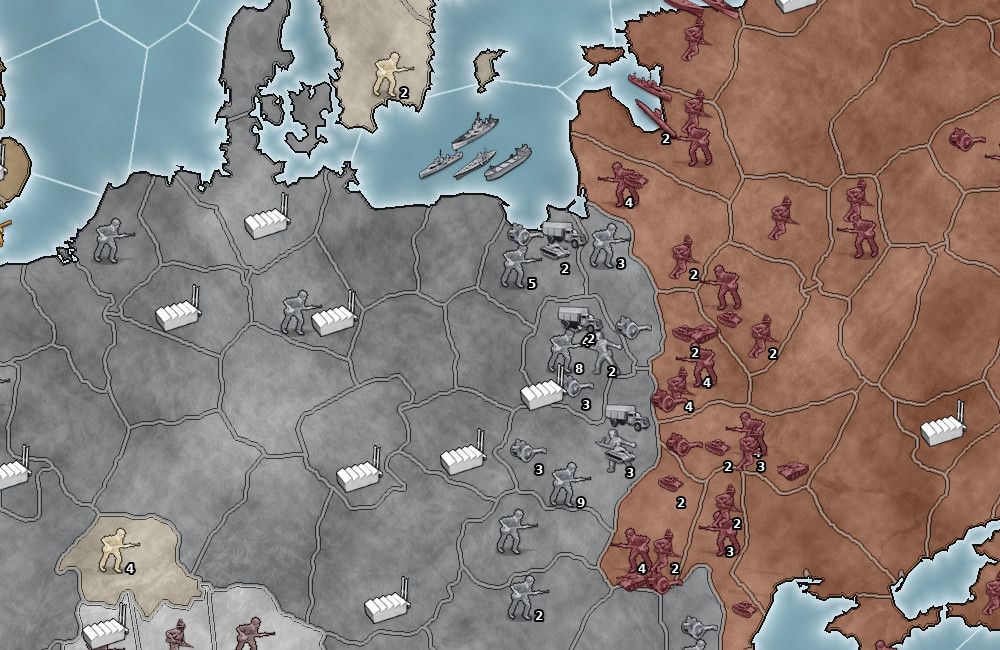
I implemented Guards Infantry and Shock Armies as Soviet unlockable bonuses in my TRO outline. Guards was a promotion mechanic where you replace up to two regular Infantry per turn with Elite Infantry for free if you win a battle. Shock Armies was one where Elite Infantry would pair with the Assault Gun and allow the AG to get one pre-battle bombardment shot at the enemy.
I guess sounds about right (as long as you can also buy elite infantry directly (not only by upgrading them with the guard promotion mechanic)).
-
Two subjects here: light tanks ( @vendetta ) and Soviet infantry ( @cernel ). This post is my thoughts on infantry.
Currently there are three tiers of infantry
Tier 1: conscript. China, USSR, Italy
Tier 2: infantry. All nations except China.
Tier 3: Sturmtruppen. Germany only.I could go to a four tier system
Tier 1: Chinese conscripts
Tier 2: USSR, maybe Japan
Tier 3: infantry, Revolutionary Guards for USSR, maybe an elite unit for Japan
Tier 4: SturmtruppenThis four tier system would be more accurate historically. Chinese conscripts could cost 1 MP and 0 PUs to reflect the fact that they are poorly armed. Soviet infantry would cost 1 MP and 1 PU. The 1 PU reflects the fact they received better weapons than the Chinese, and they would also be more combat-effective.
Let's look at how this could work in practice
Tier 1: Chinese conscripts. 1 MP, 0 PU. Attack 0, defend 1.
Tier 2: Soviet infantry. 1 MP, 1 PU. Attack 1, defend 2.
Tier 3: infantry. 1 MP, 1 PU. Attack 2, defend 3
Tier 4: Sturmtruppen. Attack 3, defend 4All infantry types can receive support on both offense and defense. Note that if a Sturmtruppen is on defense and is supported, that Sturmtruppen defends on a 5.
In my current iteration, a Sturmtruppen attacks on a 2 and defends on a 3. The Assault Rifle tech adds +1 to attack and defense. So, Sturmtruppen with assault rifles, and receiving support on defense, would defend on a 5.
If I'm going with this four tier system, the assault rifle would cause Sturmtruppen to attack on a 4 and defend on a 3 + 2. That would be upgraded to a 3 + 3 if the Sturmtruppen were to receive support on defense.
For Japan, I'm thinking start Japan off at tier 2 infantry. This would reflect the fact that Japanese infantry were significantly less combat-effective than their American counterparts, at least in 1942 and 1943. But then Japan could research a tech which upgrades all its infantry to tier 3. I believe that Italy's infantry should be at tier 2. Normal Soviet infantry should be at tier 2; Revolutionary Guards at tier 3.
-
@KurtGodel7 said:
I could go to a four tier systemLet's look at how this could work in practice
Tier 1: Chinese conscripts. 1 MP, 0 PU. Attack 0, defend 1.
Tier 2: Soviet infantry. 1 MP, 1 PU. Attack 1, defend 2.
Tier 3: infantry. 1 MP, 1 PU. Attack 2, defend 3
Tier 4: Sturmtruppen. Attack 3, defend 4All infantry types can receive support on both offense and defense. Note that if a Sturmtruppen is on defense and is supported, that Sturmtruppen defends on a 5.
This seems rather dangerous to me. Infantry is the basic building block the whole combat system in A&A is balanced around. If you're giving the basic Infantry double the attack and 50% more defense for the same price, it immediately devalues every single unit that's more expensive than the infantry (in other words, almost all of them). So then you have to go and figure out new values for all those other units and rebuild the whole balance from scratch.
It's also turning the Sturmtruppen into a god unit (your existing version already gets the same combat stats as a Fighter from the base game once it's upgraded, and it costs less, and it gets even better with artillery). Rolling a second dice (if that's what 3+2 / 3+3 means) is a big power boost.
D3+D2: 33% double miss, 50% single hit, 17% double hit
D4: 33% miss, 67% hitD3+D3: 25% double miss, 50% single hit, 25% double hit
D5: 17% miss, 83% hitI would recommend keeping the base infantry at 1A/2D.
If you want other nations to have elite units that are better than the standard infantry but not as good as the Sturmtruppen, make those 2A/2D.
Or you could make them 2A/3D and on par with Sturmtruppen, but they don't get access to that assault rifle upgrade.
If you want certain countries to have lower tier infantry than the standard, just make them 1A/1D. You can give Italy, Japan, etc a tech to research them up to 1A/2D like everyone else's.
One other thing you can do if you want to make the major powers have stronger infantry than the minors is not to change the infantry stats at all, but the effectiveness of their support.
For instance, everyone gets 1A/2D basic infantry, but the USA, UK, and Germany start with a tech that allows each artillery to support two infantry, while Italy, Japan, and the Soviets need to research it.
-
Sturmtruppen
Those were a World War 1 thing. Surely, World War 2 German infantry was deeply inspired to them (to the extent you could argue that the normal World War 2 German infantryman was a Sturmtrupp man), but I'm not seeing much fitting calling Nazi German infantry elite as Sturmtruppen.
However, I'm not sure what would be a good term for World War 2 Germany elite infantry in general. I guess the most obvious pick would be the Waffen-SS, but that is questionable (especially with respect to non-SS elite like the Großdeutschland) and it would be weird that you have Waffen-SS infantries but not all other kind of Waffen-SS units (motorized, mechanized and armoured).
In general, I do not think that elite infantry fits very well in a World War 2 scenario, as they tended to be motorized, mechanized or armoured if they were elite in the first place. Like the Großdeutschland starting as infantry and becoming Panzergrenadier.
Even if you do not have paratroopers (right?), I guess you can have the Fallschirmjäger as the name for the elite German infantry, as they are maybe the most obvious case of what an arguably purely elite infantry may be. The problem with that, however, is that they were very few in numbers in 1941. They became an actual main thing as an elite infantry of Germany late in the war.
I guess you can use the anachronistic term Sturmtruppen in a World War 2 game to sum up all the different kind of elite infantries, but I do not think it is a good idea. The concept was really that in World War 2 all German infantry was supposed to be Sturmtruppen (and also the Italians had this idea regarding their arditi).
-
@Cernel Sturmtruppen wasn't really a formal title anymore, but it does work as a functional role description.
Waffen-SS would be a poor fit, some of their units were elite, some were definitely not.
Fallschirmjager is paratrooper specific and the unit doesn't have any special abilities related to airborne attacks, so also a poor fit.
Only alternative I can think of that might be fitting is Grenadier.
-
Cernel said:
Even if you do not have paratroopers (right?), I guess you can have the Fallschirmjäger as the name for the elite German infantry, as they are maybe the most obvious case of what an arguably purely elite infantry may be. The problem with that, however, is that they were very few in numbers in 1941. They became an actual main thing as an elite infantry of Germany late in the war.
To be clear, not having paratroopers and having Fallschirmjäger as elite infantry would be perfectly fine starting in June 1941 because almost all of them would actually never fight as paratroopers (some major exceptions), so they were actually much more elite infantry than paratroopers.
I'm not sure how many of them were even trained as paratroopers from 1942 onwards, so I'm going to ask Google AI right now "What was the percentage of Fallschirmjäger actually trained as paratroopers from 1942 to 1944?" The answer is
There is no single, exact official percentage recorded for the entire Fallschirmjäger branch between 1942 and 1944, as jump-qualification rates varied drastically by division and year. However, historical records show a steep collapse from nearly 100% jump-qualified in early 1942 to under 10% in newly formed divisions by mid-1944.
-
Only alternative I can think of that might be fitting is Grenadier.
I agree, but from late 1942 onwards every infantryman was formally a grenadier. That would work if Germany can only buy elite as its "cheapest" infantry (which would be fine if we want to picture the assumed basic German tactical superiority). A game starting in mid 1941 could have "grenadier" as the cheapest German infantry (but with cost and values of an elite infantry), meaning that Germany can only buy elite (called "grenadier") as infantry units, anticipating by a little more than 1 year the formal naming and picturing the German army as an all-elite infantry thing. That would be arguably fine, but it is a choice. It's disputable how much elite the basic German infantryman was with respect to others.
-
@Cernel Acceptable departures from reality, I think. Having Germany only able to buy elite infantry that are better than everyone else's is a far bigger violation of realism (as well as game balance) than playing a bit fast and loose with the unit names.
Germany's average level of unit effectiveness was indeed higher than anyone else's, and if you were narrowing down a list of the most accomplished divisions in the entire war, the Germans would command a very outsized share of it, but still, the German army varied a lot in quality, just like everyone else's, and they raised their own share of mediocre to badly performing units too.
-
Having Germany only able to buy elite infantry that are better than everyone else's is a far bigger violation of realism (as well as game balance) than playing a bit fast and loose with the unit names.
I tend to agree, but then we cannot use "grenadier" as name for a German elite infantry on the account that, from late 1942 onwards, that was the name for the basic infantry, and we are back on square one for what is a good name for a German infantry elite.
At this point, maybe it is better just to call it "elite_infantry". I would suggest that over "sturmtruppen" at least.
Hello! It looks like you're interested in this conversation, but you don't have an account yet.
Getting fed up of having to scroll through the same posts each visit? When you register for an account, you'll always come back to exactly where you were before, and choose to be notified of new replies (either via email, or push notification). You'll also be able to save bookmarks and upvote posts to show your appreciation to other community members.
With your input, this post could be even better 💗
Register Login