TripleA Logo TripleA Forum
    • TripleA Website
    • Categories
    • Recent
    • Popular
    • Users
    • Groups
    • Tags
    • Register
    • Login

    How would you rate countries and territories considering realism in big WWII maps.

    Scheduled Pinned Locked Moved Player Help
    141 Posts 8 Posters 94.8k Views 8 Watching
    Loading More Posts
    • Oldest to Newest
    • Newest to Oldest
    • Most Votes
    Reply
    • Reply as topic
    Log in to reply
    This topic has been deleted. Only users with topic management privileges can see it.
    • C Offline
      Cernel Moderators @Cernel
      last edited by

      @cernel Ok, I found what appears to be a fairly reliable reference (Princeton University, New Jersey):
      https://irs.princeton.edu/sites/irs/files/Rebasing Maddison_May_2017.pdf
      An important implication of using different relative price levels is that the poverty level may change. With the 1990 price levels, the subsistence level income was estimated at between 350 and 400 international dollars per year (Maddison, 2003). The poverty line was equal to around $ 1 per day, and was based on the first international poverty line which was set at $1.01 per day using 1985 PPP’s, which was later updated to $ 1.08 per day using the 1993 PPP’s (Ravallion, Datt and van de Walle, 1991; Chen and Ravallion, 2001). This made the interpretation of historical income series very intuitive. By using other relative prices, this subsistence level of income changes. The price level (in US dollars, the standard used in these calculations) increased by 59% between 1990 and 2011, bringing the poverty line to 636 dollars of 2011. Moreover, The World Bank slightly raised the absolute poverty line to 1,90 US dollars a day or 694 dollars per year, expressed in 2011 prices.

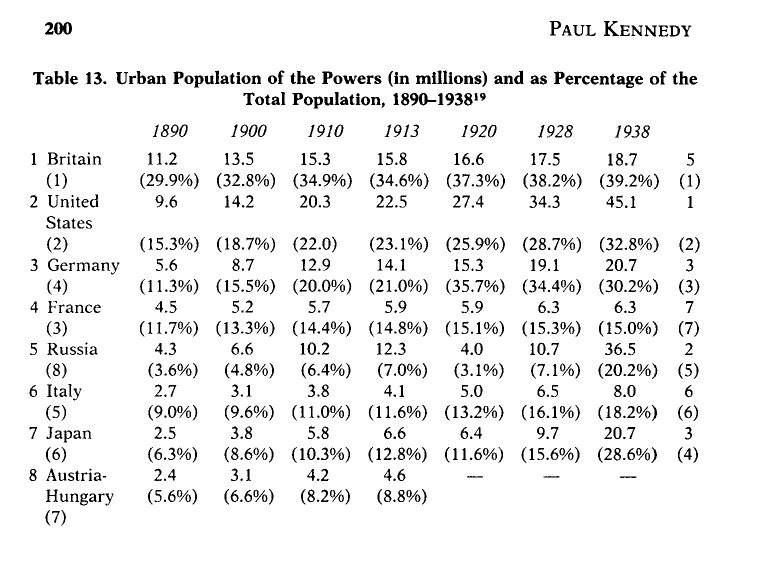
      694 United Statesian dollars looks about what I had in mind; so, in this case, the approach that I suggest you using is to calculate what I would call the "GDP Above Subsistence" (practically, the "usable" GDP), by the equation (assuming using 2011US$):

      GDPAS = (cgdppc - 694$) ⋅ pop

      Still, India is going to be overvalued, since it was a country with a lot of people and that was somewhat decently productive (surely in a better shape than China), but that, at the end, contributed relatively little to the war effort of the British Empire (and had some major famines, as well), at least economically.

      1 Reply Last reply Reply Quote 0
      • C Offline
        Cernel Moderators @RogerCooper
        last edited by

        @rogercooper I see there is a major problem for South Africa. There is no population value for all years from 1914 to 1949!? How is it possible they give the GDP per capita but not the population!? South Africa is pretty important for WW2. How to get around this? I really don't understand how the population value can be missing in the moment you have to divide by that to get a per capita value. Getting the GDP for South Africa cannot be skipped for WW2.

        C RogerCooperR 2 Replies Last reply Reply Quote 0
        • C Offline
          Cernel Moderators @Cernel
          last edited by

          @cernel My period atlases give the following values for the Union of South Africa:
          1936: 9,589,898
          1937: 9,800,000
          1941: 10,521,000
          (but the 1937 and 1941 ones are merely estimates)
          (only about 2 millions Europeans)
          I'm sure better data can be easily obtained somewhere on the internet, if not in the Maddison database itself.

          1 Reply Last reply Reply Quote 0
          • RogerCooperR Offline
            RogerCooper @Cernel
            last edited by RogerCooper

            Here are the 1938 values for GDP above subsistence ( I am using 700 as a base)

            country Value
            Argentina 19
            Australia 16
            Austria 5
            Belgium 9
            Brazil 4
            Bulgaria 3
            Canada 18
            Chile 3
            China 30
            Colombia 4
            Cuba 2
            Denmark 6
            Finland 3
            France 46
            Germany 95
            Greece 5
            Guatemala 1
            Hungary 3
            India 64
            Indonesia 13
            Ireland 2
            Italy 22
            Japan 41
            Korea 2
            Malaysia 2
            Mexico 5
            Myanmar 1
            Netherlands 9
            New Zealand 3
            Norway 3
            Peru 1
            Philippines 4
            Poland 14
            Portugal 3
            Spain 16
            Sri Lanka 1
            Sweden 8
            Switzerland 5
            Taiwan, Province of China 2
            Thailand 1
            Turkey 5
            United Kingdom 82
            United States 263
            Uruguay 2
            USSR 150
            Venezuela 1
            Yugoslavia 1

            I didn't work out the figures for the African colonies, but even South Africa would come to about 5.

            RogerCooperR SchulzS C 3 Replies Last reply Reply Quote 0
            • RogerCooperR Offline
              RogerCooper @RogerCooper
              last edited by

              @rogercooper Please note that the Maddison figures generally use modern boundaries. This means that Manchuria is counted as Chinese rather than Japanese.

              1 Reply Last reply Reply Quote 0
              • RogerCooperR Offline
                RogerCooper @Schulz
                last edited by

                @schulz said in How would you rate countries and territories considering realism in big WWII maps.:

                @rogercooper

                1941 data's actually does not really show that German war economy was terribly run because;

                1. Until the defeat of Stalingrad, the Germans had not exerted war economy unlike the Soviets which had exerted war economy in the initial stages of operation barbarossa.

                2. Germany didn't have plenty of oil and other natural resources if they had they could have produced more armours, artilleries ets...

                3. Germany increased its GDP during wwii in spite of constant allies bombings, and they have produced much more armours in 1943 and 1944

                Yes, Germany failed to mobilize properly until they had been at war for 2-1/2 years. That defines poor performance.

                Oil was not a an important as you might think. Electricity was generated with coal (even now Germany produces 1/3 of its electricity from coal). Trains also ran with coal. Once, Germany got organized production increased, but it didn't matter. Victory was not possible after Summer of 1942.

                For a thorough discussion of these issue, I suggest Ovitz, Why The Allies Won.

                1 Reply Last reply Reply Quote 1
                • SchulzS Offline
                  Schulz @RogerCooper
                  last edited by

                  @rogercooper

                  Look very realistic to me. Where is Romania?

                  1 Reply Last reply Reply Quote 1
                  • SchulzS Offline
                    Schulz
                    last edited by

                    Imho Axis had no chance to win wwii, Allies could have even defeated European Axis powers without USA.

                    1 Reply Last reply Reply Quote 0
                    • C Offline
                      Cernel Moderators @RogerCooper
                      last edited by

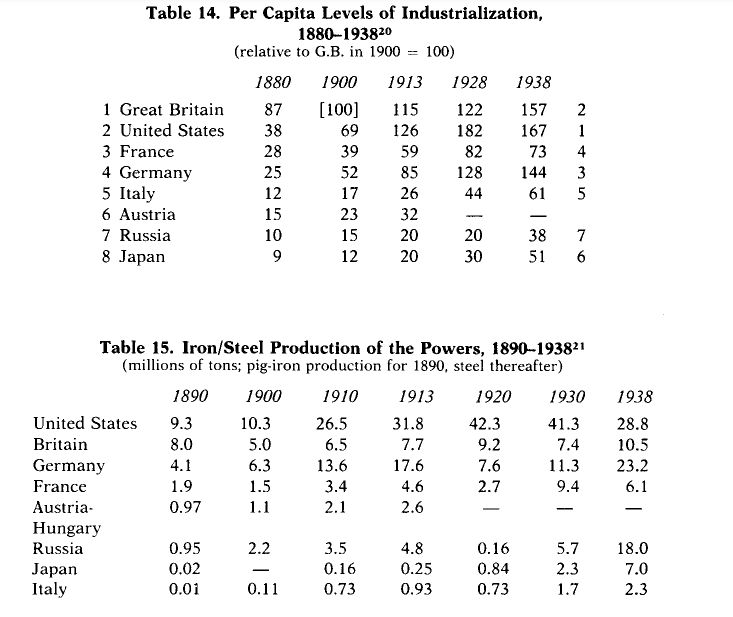
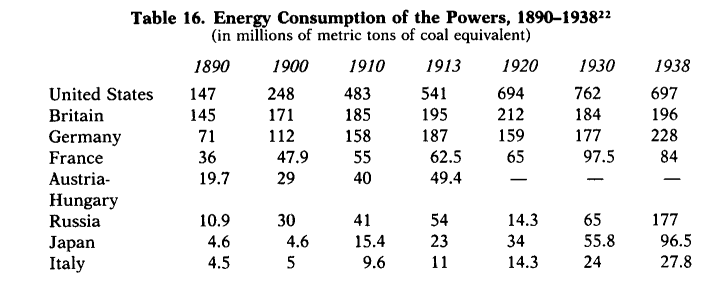
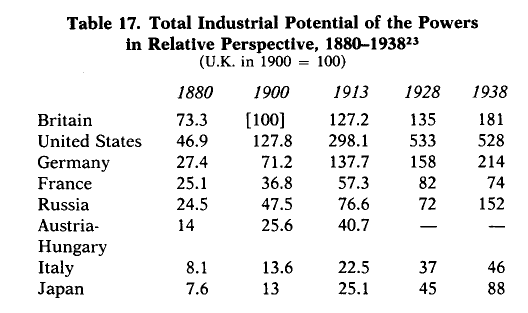
                      @rogercooper I'm actually thinking that this looks pretty good, and better than the energy consumption values, that were probably boosting heavily industrialized countries a little too much. Also, while not as rigged as the steel production, energy consumption favours countries that specialize in energy intensive products (for example, an aeroplane is more energy intensive but less steel intensive than a battleship).

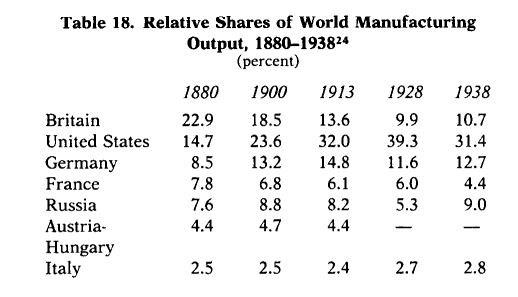
                      China being some more powerful than Canada seems about right, as well as Italy being about twice as powerful as Poland, or Belgium, and half as powerful as Japan.

                      Netherlands and Belgium being equal seems alright, while the energy consumption was giving a huge superiority to Belgium, since it has a lot more heavy industry (producing steel etc.).

                      Also the Soviet Union being almost as powerful as the whole British Empire seems alright, tho after Barbarossa (losing Ukraine, Belarus and the Baltic Countries) the Soviet Union would go down a lot, then, being about 60% the power of the British Empire.

                      Of course, India gets valued very generously, since, when you go for the GDP, the population matters. I don't think India being more powerful than Japan and France and only a little less powerful than the United Kingdom is really what you would guess out of WW2 contributions, but the value is not strictly wrong, as they were a very populous country with some productive ability (surely economically stronger than China, and China held off against Japan alone for several years), and it may give some more chances to Axis, under the what-if scenario of Japan conquering India.

                      It's kinda weird to see Argentina more powerful than Canada, but back then Argentina was one of the richest countries in the world, and practically similar to Australia (just overproducing agricultural products a lot). Mapmakers may want to represent a small bonus income for being able to trade with Argentina, in some ways (historically a little important for the United Kingdom supplies).

                      I see Brazil is still weaker than Denmark here too (and a lot weaker than Argentina), and I don't have a problem with that, as having a lot of people living at subsistence level is not making you really stronger (really Brazil was equipped and maintained mostly by the United States of America, during WW2).

                      The main deviation, in statically representing WW2 PUs productions, I guess, is that the United States of America are undervalued. As I said, 1937 should be the pre WW2 year that undervalues USA the least, but whatever value before WW2 would have them consistently undervalued, as they had a lot of wasted potential, before WW2. However, 1938 is particularly bad a year, on this regard, as it is the worst year of the second great depression the USA had. For example, I see the United Kingdom income increases by 18% between 1938 and 1944, while the United States income increases by 67% during the same period (not surprised).

                      Are there values for the African countries? Sadly, what I see is that they are pretty much all missing for WW2. Nigeria shows up in 1950 and Congo as well. Algeria, Tunisia, Egypt and Morocco have entries for 1913 but, then, nothing more until 1950. The biggest problem for the continent is the absurd lack of population data for South Africa until 1950. The second biggest problem is that Algeria is missing. With 1 million Europeans out of 8 millions population, Algeria was the South Africa of France, and it is quite bad lacking a production value to assign to it for WW2 (tho, of course, not as important as South Africa). The complete absence of WW2 data for all the North African countries, summed to the absence of WW2 population data for South Africa, as well as missing everything else in Africa, as well, is seriously degrading the usefulness of this Maddison database. Rather than totally missing them, I would rather suggest, then, somehow to interpolate the given 1913 and 1950 values (getting the 1913 one as a ratio of the 1913 word total; doing the same with the 1950 one; then getting the average, but weighted based on how the year is close to one and the other one references).

                      For South Africa, unless you want to get more reliable data, taking the 1938 value, using a base of 700$, and multiplying by 9.980.000 pop, I believe you would get 33,662 million dollars. Don't have the total, but I believe that if Greece is 5, then South Africa should be about 8 (if I'm correct, just divide 33,662 million $ by your total plus 33,662 million $).

                      There are data for Romania; I guess the list is simply missing it (better adding). An more important country missing I see is Czechoslovakia (half the population of Poland, but twice the income per person). On this point, I suggest adding Bolivia, Switzerland, Costa Rica, Ecuador, Guatemala, Honduras, Nicaragua, and Panama too, since I see the data for these ones are available (tho, of course, Egypt, Algeria, etc. would be more important to have).

                      Is there somewhere an actual map that shows what territories the Maddison database is referring to? For example, do they consider the Baltic Countries as part of the Soviet Union or not? I believe the United States of America never recognized the Baltic Countries as part of the Soviet Union (almost sure).

                      RogerCooperR 1 Reply Last reply Reply Quote 0
                      • RogerCooperR Offline
                        RogerCooper @Cernel
                        last edited by

                        @cernel The Maddison database uses 1991 boundaries. Except when it doesn't. I will cleanup/interpolate the data to make it more usable for game designers.

                        I will give the data with pre-war boundaries except for the colonies where I will use contemporary boundaries.

                        Maddison has no information on the Baltic states from before 1973. There is lot of extrapolating to be done. I don't know if the Soviet Union figures include Baltic states before their conquest in 1940, but I suspect they do.

                        redrumR C 2 Replies Last reply Reply Quote 0
                        • SchulzS Offline
                          Schulz
                          last edited by

                          How playable would be Pacific front with realistic values since whole of Pacific becomes worhless and it would not be very representative of WWII. No matter how worhless these islands but at least there should be somethings that attrack USA to go Pacific in a realistic map.

                          C 1 Reply Last reply Reply Quote 0
                          • C Offline
                            Cernel Moderators @Schulz
                            last edited by

                            @schulz Indonesia at 13 (mostly in Sumatra and Java) and Australia at 16 seem fairly interesting to me, in the moment Japan is 41, plus there may be also the item of trying to stop Japan from taking the 64 points of India, as long as that cannot be done from India and China alone. Obviously, in a realistic map, Philippine should be worth very little and anything east of them should be worth nothing or almost nothing (almost nothing being the Carolines and the Hawaii; virtually nothing the rest, comprising Alaska).

                            1 Reply Last reply Reply Quote 0
                            • redrumR Offline
                              redrum Admin @RogerCooper
                              last edited by

                              @rogercooper The biggest issues I have with that data are:

                              1. Large, less developed countries seem over represented (India, China, Argentina, etc) as they were mostly agriculture so you'd need some sort of industrialized factor
                              2. USA is just way too powerful if you stuck with those numbers and makes any game too easy for the Allies

                              Besides that, I think if you give Germany most/all of the value from the countries it ends up quickly conquering (Poland, France, Belgium, Netherlands, etc) then its probably somewhat reasonable.

                              TripleA Developer with a Passion for AI: https://forums.triplea-game.org/topic/105/ai-development-discussion-and-feedback

                              C 1 Reply Last reply Reply Quote 0
                              • C Offline
                                Cernel Moderators @redrum
                                last edited by Cernel

                                @redrum said in How would you rate countries and territories considering realism in big WWII maps.:

                                1. Large, less developed countries seem over represented (India, China, Argentina, etc) as they were mostly agriculture so you'd need some sort of industrialized factor

                                Yeah, I can see people raising eyebrows in the moment they would open a map in which India is given as stronger than Japan, and this is why I gave the (accepted) suggestion of cutting the income by the subsistence level, as otherwise both India, and much more so China, would be even way stronger than these values, if looking at the pure GDP. However, I wouldn't consider not industrialized nations as inherently inferior, just rather dependent; so representing their limits would be better made with placement limits, if feasible, rather than by lowering their PUs production (and, besides, for that we would need to fetch an index giving the ratio of the secondary sector for each economy). That would be true also for countries that have very important raw materials, but little to say on their own (South Africa, Indonesia, Chile, the Guayanas, Venezuela, etc.).

                                1. USA is just way too powerful if you stuck with those numbers and makes any game too easy for the Allies

                                I assume here you are talking for gameplay only, as I believe having the United States of America at 1/4 of world's production is already underestimating them, and I think it should rather be 1/3 or more. I'm not sure if balance can even be a target at all in the moment you give somewhat priority to realism, but I think this would be better made by having victory conditions that allow Axis to get a win well before having to conquer the entire world (assuming that being virtually impossible to achieve). A good victory condition may be Allies having no European territories west of the "AA" line.
                                https://en.wikipedia.org/wiki/A-A_line

                                1 Reply Last reply Reply Quote 0
                                • SchulzS Offline
                                  Schulz
                                  last edited by Schulz

                                  I don't think India is more valauble than Japan, the database is debatable. California's GDP is higher than Russia can you claim that California could have defeated Russia in a war if she was independent country? No. Is California richer than Russia in terms of natural resources? No. Could California have produced every Russian military assets by it's own? No. The answer is clear. California should not be more valued than Russia like India should not be more valued than Japan.

                                  My proposal would be giving air base to Pacific Islands and they give air units to +1/+2 movement power.

                                  C 1 Reply Last reply Reply Quote 0
                                  • C Offline
                                    Cernel Moderators @Schulz
                                    last edited by

                                    @schulz I suppose here you are not talking about World War 2. In 1940 California had 6,837,688 people, that is about 5.2% of the 131,669,275 people for the entire United States of America (by period borders (thus without Hawaii, etc.), but the difference is less than half a million). Assuming the California income is average with the rest of its country, starting with 263 for the United States of America, this would put California at 14, that is lower than Argentina at 19, let alone the Soviet Union at 150.

                                    The problem with India is that India was about the same deal as China, except that India was a lot better than China. So, whatever value you give India, you should give less to China. By those values, China is 30, but since that is all of China, comprising Manchuria, that means that China in 1940 would have a production of 10 to 15, already (and Japan would have 15 to 20 additional production from occupied China). If you cut India to half, then you have to cut China to half too, to 5 to 7 production remaining, and then you will be left with the China push over, v3 1941 style, that makes no sense (since China fought Japan alone for years, to almost standstill, from 1939 until 1944, and increased the size of its army a lot over the period).

                                    1 Reply Last reply Reply Quote 0
                                    • SchulzS Offline
                                      Schulz
                                      last edited by

                                      Yes my example was based on the current GDP's just intented to show GDP's are not reliable alone. Also agree making India more valuable does not make sense to me. Maybe better to mix playability and realism.

                                      RogerCooperR 1 Reply Last reply Reply Quote 0
                                      • RogerCooperR Offline
                                        RogerCooper @Schulz
                                        last edited by

                                        @schulz India's military contribution was not insignificant. India mobilized 2.6 million men, more than Australia, Canada & South Africa combined. It's military contribution would have been greater if the British had made more efficient use of its resources. However Churchill wanted to hold India after the war and did not want to give local politicians control of the government and have them have a powerful military, Whatever resources are available, governments can use them with less than 100% efficiency (and 0% efficiency is possible),

                                        China had a lot more commitment to the war. It mobilized 14 million men.

                                        C 1 Reply Last reply Reply Quote 0
                                        • C Offline
                                          Cernel Moderators @RogerCooper
                                          last edited by

                                          @rogercooper Still I doubt that can put India at more than half of United Kingdom and about 50% more than Japan, for WW2 PUs production. However, India was poor, yet not as poor as we tend to think, based mostly on images we have from the seventies, eighties or such (like when Mother Teresa won the Nobel Peace Prize or Dominique Lapierre wrote City of Joy).
                                          The Maddison database shows it; for example, you can see the following "cgdppc":
                                          1931: 1520
                                          1941: 1532
                                          1951: 1426
                                          1961: 1378
                                          1971: 1237
                                          1981: 1109
                                          1991: 1297
                                          2001: 2086

                                          According to Maddison, the nadir was in 1985 at 1021, while, previous to that, the zenith was in 1943 at 1559; exactly the year when millions of Indians died of hunger (but the bad harvests were in the previous year; the 1943 ones were good).

                                          So, India kept going down and down after WW2, until the eighties, when it reached that widespread level of poverty (almost as bad as China during WW2) that we usually associate to it before the nineties.

                                          Of course, India's contribute to the war effort in term of share of its own GDP was much lower than that of the United Kingdom, and cutting the subsistence income out of the GDP is a way to represent it, tho it might be still not quite enough. On the other hand, the value for China looks good enough to me, in the moment you have to consider you also need to cut it by about half (since about half of that GDP is in Japanese hands (merely making a guess here)).

                                          A thing that is surprising me is to see these values:
                                          cgdppc:
                                          1937: 1478
                                          1938: 1466
                                          1939: 1483
                                          1940: 1516
                                          1941: 1532
                                          1942: 1512
                                          1943: 1559
                                          1944: 1531
                                          1945: 1494
                                          1946: 1404

                                          I was expecting the value for 1942 to be a lot lower than 1941 (like at least 100 points), since that is the year of the crop failures that lead to the famine of 1943, but it seems to be only slightly lower. No idea if this means that those crops failures don't actually impact that much or Maddison is taking the side of those that say that the famine was mostly man-made or that same year industrial output compensated the agricultural one or what.

                                          C 1 Reply Last reply Reply Quote 1
                                          • C Offline
                                            Cernel Moderators @RogerCooper
                                            last edited by

                                            @rogercooper said in How would you rate countries and territories considering realism in big WWII maps.:

                                            @cernel The Maddison database uses 1991 boundaries. Except when it doesn't. I will cleanup/interpolate the data to make it more usable for game designers.

                                            I will give the data with pre-war boundaries except for the colonies where I will use contemporary boundaries.

                                            If it is true that Maddison uses the 1991 borders, the value you are giving for India would exclude Bangladesh and Pakistan. Thus, for WW2, you would need to increase it by about 19%, in this case becoming as high as 76, that would mean India being almost as powerful as the United Kingdom, and almost twice as powerful as Japan, even after cutting the subsistence income at 700 (without doing that, India would be almost 50% more powerful than the United Kingdom and more than 160% more powerful than Japan). Practically, giving the WW2 value for India, you would need to get India + Bangladesh + Pakistan, but these last two have values only starting from 1950 (so, I guess the only way is extrapolating them).

                                            1 Reply Last reply Reply Quote 0

                                            Hello! It looks like you're interested in this conversation, but you don't have an account yet.

                                            Getting fed up of having to scroll through the same posts each visit? When you register for an account, you'll always come back to exactly where you were before, and choose to be notified of new replies (either via email, or push notification). You'll also be able to save bookmarks and upvote posts to show your appreciation to other community members.

                                            With your input, this post could be even better 💗

                                            Register Login
                                            • 1
                                            • 2
                                            • 3
                                            • 4
                                            • 5
                                            • 6
                                            • 7
                                            • 8
                                            • 7 / 8
                                            • First post
                                              Last post
                                            Copyright © 2016-2018 TripleA-Devs | Powered by NodeBB Forums