Flames and Steel (official thread)
-
@Cernel I think you overthinking this. Remember that an air battle in TripleA is supposed to be the sum of numerous encounters, not a single sortie.
-
@Cernel I think you overthinking this. Remember that an air battle in TripleA is supposed to be the sum of numerous encounters, not a single sortie.
Maybe I'm over-explaining it.
If you only consider the 8 points (steps) which I've detailed, my system is actually only a little more complex than the one implied by @kurtgodel7. His system would have 6 steps (2 for the fighters firing at fighters on attack and defence, 2 for the fighters firing at bombers on attack and defence and 2 for the bombers returning fire on attack and defence) and actually the same number of combat steps: the 2 steps less are the fact of not having to select which fighters are performing interception instead of escort (as his fighters are all escort, and then the ones surviving the dogfight become all interceptors).
-
Interesting, but I don't think it was actually quite working this way. If I understand correctly that dogfight (which was really more of a WW1 thing and much less of a WW2 thing) is something preliminary which involves every fighter, so the fighters surviving the dogfight are the only ones then also intercepting the bombers (Is there a limited combat round or can only the fighters of one side survive?), I think this is not much simulating WW2 aerial warfare. WW2 aerial warfare was much more linear and mostly consisted in intercepting fighters attacking the bombers while bomber-escorting fighters were attacking the fighters attacking the bombers (often in a punishing role rather than a pre-emptive one) and interceptor-escorting fighters were attacking the fighters attacking the fighters attacking the bombers, this going on then having fighters attacking the fighters attacking the fighters attacking the fighters attacking the bombers, and so on.
Practically, the typical fighter would not engage in dogfight but rather go directly for attacking the bomber (with a number of other fighters behind him and behind one another in a sort of a train) while hoping not to be shot down by the escorting fighters while doing so. After attacking the bomber, the fighter would dive (and make evasive manoeuvrers but mostly just relying on speeding up and getting the hell out in a mostly straight trajectory rather than going in circles like in WW1 dogfights) to try to survive the fighters attacking him while expecting friendly fighters following (escorting) him to attack from behind the fighters which are attacking him from behind.
(I'm not an expert, and this is just based on my general knowledge of WW2, so do not ask me to provide references to prove what I'm saying. Also, if an expert of WW2 aerial warfare comes here and says otherwise, I'm not going to say that I'm necessarily right.)
I would have it working more like this:
Let's assume a normal battle with the attacker having fighters and bombers and the defender also having fighters and bombers. To keep it simple, let's assume for now that there are fighters and bombers and no aircraft which can operate as either.
- The attacker decides how many attacking fighters are intercepting (non-modifiable auto-selection to none of them or all of them respectively if the defender has only fighters or if the defender has only bombers). (The non-selected ones are escorting/dogfighting.)
- The defender decides how many defending fighters are intercepting (non-modifiable auto-selection to none of them or all of them respectively if the attacker has only fighters or if the defender has only bombers). (The non-selected ones are escorting/dogfighting.)
- The attacking intercepting fighters roll dice and one defending bomber is taken as casualty (not removed) for every hit.
- The defending intercepting fighters roll dice and one attacking bomber is taken as casualty (not removed) for every hit.
- The attacking bombers (comprising the ones taken as casualties) roll dice and one defending intercepting fighter is removed for every hit. Then the attacking bombers taken as casualties are removed.
- The defending bombers (comprising the ones taken as casualties) roll dice and one attacking intercepting fighter is removed for every hit. Then the defending bombers taken as casualties are removed.
- The attacking non-intercepting fighters roll dice and one defending fighter (either intercepting or not: it does not matter) is removed if it is an intercepting one or taken as casualty (not removed) if it is not an intercepting one for every hit.
- The defending non-intercepting fighters (comprising the ones taken as casualties) roll dice and one attacking fighter (either intercepting or not: it does not matter) is removed for every hit. Then the defending fighters taken as casualties are removed.
Every fighter has an "anti-bomber" and "anti-fighter" strength. The former is used for fighters chosen or auto-selected as intercepting and the latter for the rest.
Of course, this is ignoring the jabos, and this is quite unacceptable, but I'm trying to keep it simple. Let's just not forget that rules for allowing fighters to load some bombs or rockets on their wings and/or belly are quite a necessary addition to what I just detailed. The added complexity about that is that such a fighter is able to go back being a fighter any time it wants by just dropping the bombs (though there are limits to this: it will not be as good as a pure fighter) and will most likely do so as soon as it is about to be attacked by other fighters or even as soon as it can see them coming. To some extent, also bombers can get rid of their bombs to defend themselves better and/or avoid going down after being damaged. Of course, you cannot add rules for everything: it will always be a trade-off between complexity and coverage.
This system is completely removing from the table the ability of fighters to prevent interceptors from attacking bombers, and I believe this is fine as such ability is minor. If wanted also to cover cases in which the air superiority of a side is so overwhelming that the other side cannot even get to attack the bombers because its fighters are shot down before reaching them, it would be possible to add an other layer by which you can select fighters as either intercepting or sweeping (The non-selected ones are escorting/dogfighting.). Sweeping fighters attack or defend before any other aircraft and their casualties are removed before starting the interception steps (so that they do not get to fire at bombers at all) but do so at "sweep" strength (which should be set lower - arguably much lower - than the "anti-fighter" strength and the "anti-fighter" strength renamed to "escort" because both "sweep" and "escort" is "anti-fighter").
The other even more minor element is that one may want the bomber fire not to be merely punishing but to have a pre-emptive element, meaning an ability to shot down the fighter before the fighter can have a chance to shot down the bomber or an ability to disrupt the fighter fire so that its chances to shot down the bomber are lower the more effectively the bomber can shot at it. I did not provide for this, and I don't think it's too important to do so. This can be partially done by having the air combat going on for multiple rounds, so that the fighters shot down a round before will not be able to fire at the bomber again or more consistently by splitting the bomber fire between pre-emptive and non-pre-emptive or having a negative support from bomber to fighter, the higher the support the more the bomber is powerful at firing. However, this would also open all the matter that some bombers are much more vulnerable than others because of passive (armour) defence too (for example, a British Avro Lancaster being enormously inferior to a B-17 both as a matter of fire-power and as a matter of armour so much so that having the Avro Lancaster doing the bombers-only day-time bombings which the B-17 performed would have been suicidal).
Good post, and I see you've put solid thought into this. Nevertheless I'm going to disagree with some of what you've written.
Erich Hartmann was the highest scoring ace in history. During WWII, he shot down 352 Allied aircraft, almost all of which were Soviet. Of those, 260 were fighter-type aircraft, and 92 were ground attack aircraft. I do not believe that the dogfight was a relic of WWI.
In early 1944, Doolittle ordered American fighters to fly ahead of the stream of strategic bombers. This allowed American fighters to engage in dogfights with German fighters before German fighters could engage with American bombers. The earlier tactic was for American fighters to fly close escort. That led to the situation you described, where German fighters would attack American bombers before the escorting fighters could engage. If the American fighters are flying ahead of the bomber stream, you could say that in your proposed rules this is a "sweep" mission. While the Doolittle order may have been a sweep mission as your rules envision such, American fighters did not dogfight at a reduced combat value, and experienced no sweep mission penalty.
That stuff aside, my main point is this. A player's attention and clicks are a limited resource. Almost always, I will choose a good solution that consumes, say, 20 units of that resource, instead of a perfect solution which consumes 100 units. The difference between good and perfect almost never justifies the consumption of those 80 additional units.
Your system requires mission assignment. If I understand correctly, fighters are either intercepting, non-intercepting, or sweeping. Your system also has weapons loading, to where fighters can be loaded up with bombs, and where dive bombers or torpedo bombers can dogfight better after they've dropped their bombs or torpedoes. This is an increase in complexity, and an increase in the player's investment in attention and clicks. There's a time and a place for an approach like that.
There's a lot of stuff I've deliberately rejected for this map because I wanted to avoid bogging the player down in details. No terrain effects. No winter turns. No oil. No materials. No supply lines. I've chosen to say no to a lot of things, driven by my view that the player's attention and clicks are very finite. I need to be parsimonious in how that finite resource is expended. The reason I've maxed out my weekly Claude usage for four weeks straight is largely due to my wish to make the interface simpler. Fewer clicks. Easier to understand. Less time per turn so the game flows faster.
-
Adding two more decision breaks for players sounds like a recipe for doubling the amount of time spent on resolving air battles, especially in live multiplayer. Would avoid that.
@KurtGodel7 said:
Yeah that sounds good. I'm curious to see the tech system you've come up with.I did finish writing that up, started the TRO thread for it.
-
The new air system. Note that the Japanese carriers now have 8 torpedo bombers and 4 fighters.
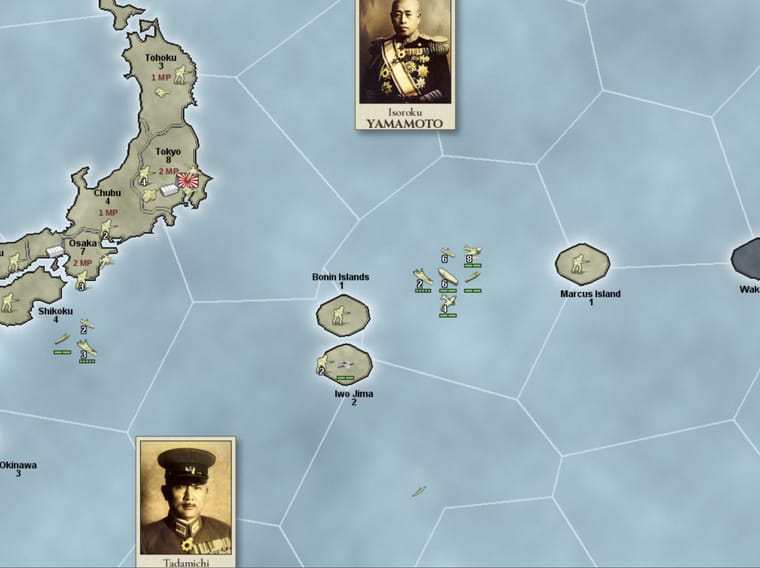
There are still tweaks to the GUI to be made, but unfortunately I've used well over 90% of my weekly limit, even though I'm only halfway through the week.
The opening of the game.
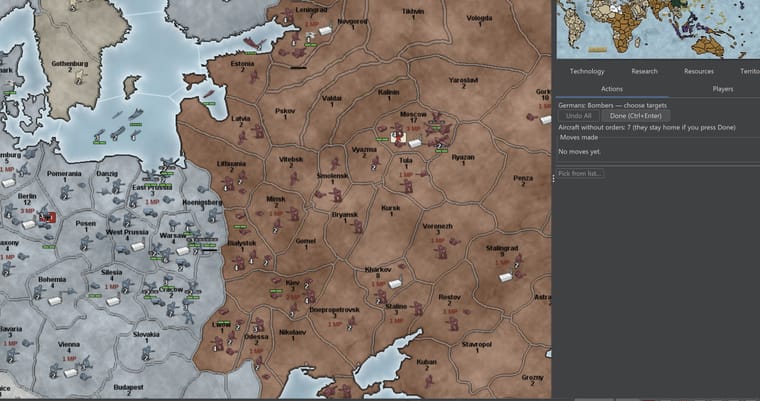
-
The American fleet at Pearl Harbor. The U.S. is at peace for rounds 1 - 2. This means it has a reduced income, and is unable to move its units. Which means the Pearl Harbor fleet gets hit on Japan's third turn.
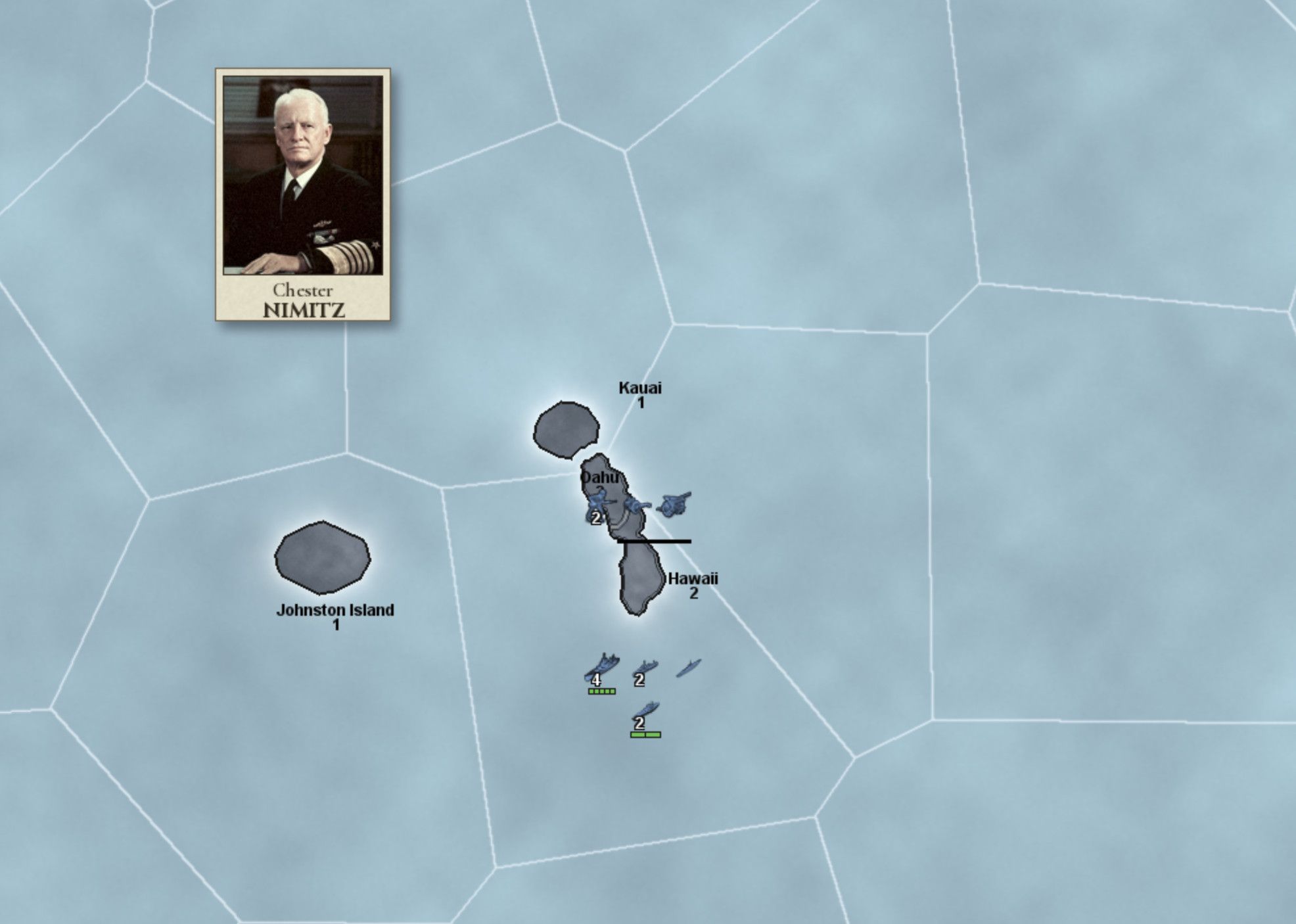
-
@KurtGodel7 West Prussia and Posen should trade names on your map. Vienna's border is also drawn kind of wacky, that strip at the north should probably be part of Bohemia.
-
The German research screen. I'm making piston aircraft tech more nation-specific.
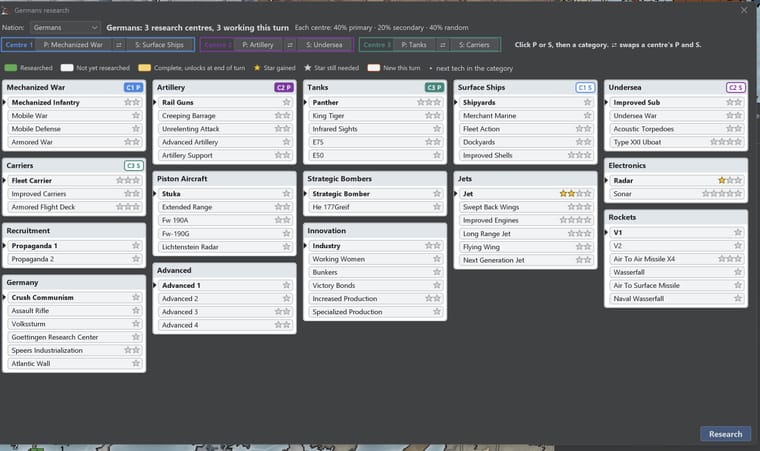
The Stuka tech improves German dive bombers against land targets. Fw 190 A unlocks advanced fighter for Germany. Fw 190 G improves German dive bombers. Lichtenstein Radar improves the interception value of heavy fighters.
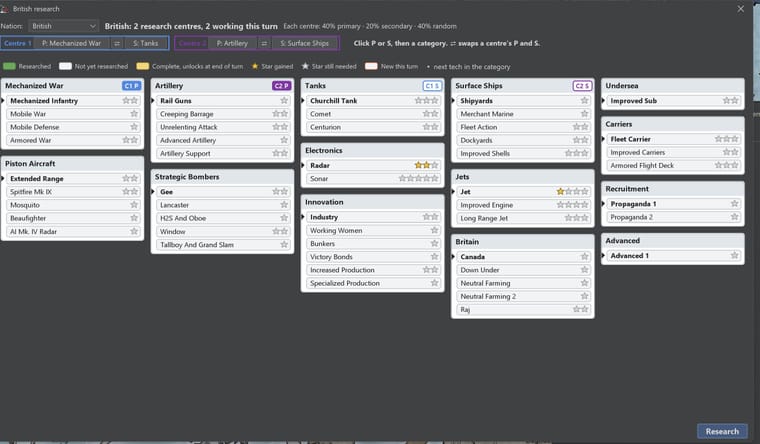
The British research screen. Note that techs like Tallboy and Grand Slam make British strategic bombers the hardest-hitting in the game, while Window tech reduces the interception value of enemy fighters by 1. As for British piston techs, the Spitfire Mk IX unlocks the advanced fighter. Mosquito tech improves British medium bombers against land targets. The Beaufighter gives Britain better torpedo bombers. The A1 Mk 4 Radar is the British equivalent of Lichtenstein.
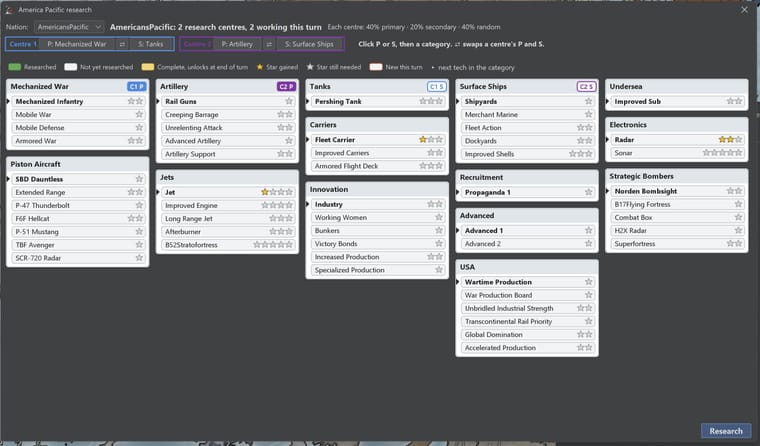
The research screen for America Pacific. Even though these techs are the exact same as America Atlantic, some of the names are different. American strategic bombers don't do as much damage as their British counterparts. But American strategic bombers fight back against interception better than their British counterparts. For Piston Air, the Dauntless tech improves dive bombers in naval combat. The P-47 Thunderbolt adds +1 hitpoint to American dive bombers. The Hellcat unlocks advanced fighters. The P-51 Mustang tech adds +2 to range for American advanced fighters and allows them to escort bombers on strategic bombing raids. (Max 4 escorts per factory targeted.) The TBF Avenger tech gives the U.S. some of the best torpedo bombers in the game. SCR-720 Radar is the American equivalent of Lichtenstein.
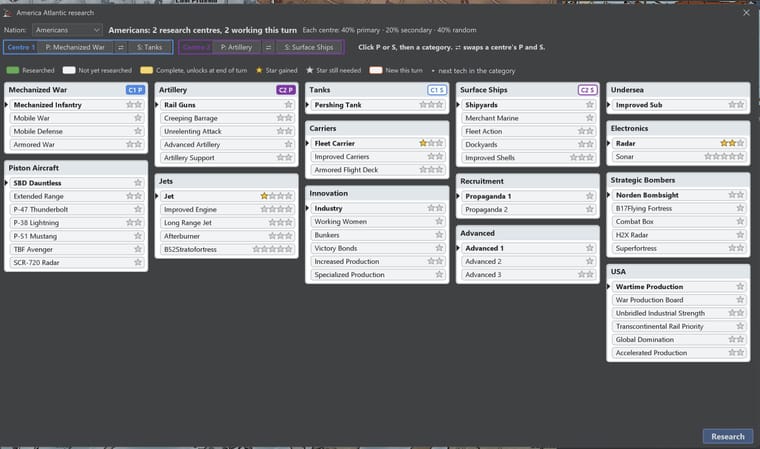
The research screen for America Atlantic. The techs themselves are the same, but one of the names has changed. Notice that the name for the advanced fighter is P-38 Lightning.
-
@KurtGodel7 Before I truly reply, it would be good to clarify if the dogfight phase of your system lasts until only the fighters of one side remains, or it is just a single round of fire in which fighters hit each other (so there may be fighters surviving on both sides) before the surviving fighters proceed hitting the bombers.
What I guess is that it is the latter. Am I right?
To keep it simpler, let's assume that one side has fighters and bombers and the other side has only fighters.
This way, all fighters of the side with only fighters are interceptors (at least after the first phase), and all fighters on the opposite side are escorts.
If my guess is correct, what your system is depicting is that there is a first phase during which the bombers are still far away, and fighters try to kill each other in fighters-only engagements (dog-fights) until this phase ends, I guess because they eventually reach the bombers or to represent that fighters can slip through and get to attack the bombers without having to down all opposing fighters first. When they reach the bombers, the dogfight phase ends because the escorting fighters stop firing once and after the enemy fighters reach the bombers, whereas the now intercepting fighters now fight against the bombers alone and get fired back by the bombers only.
Of course, I get that the fact that the escorting fighters do not fight when the bombers fight is just because their previous fight is meant to cover this too for simplicity instead of having them firing twice (like the interceptors instead do, because they first fire in the dogfight and then again against the bombers). Right?
In this simplified example, are the escorting fighters at least firing with a higher power than the fighters on the other side during the dogfight phase, in order to balance the fact that they are later doing nothing while the interceptors fire against the bombers (and I would say also because of the fact that the other fighters have to worry about getting to the bombers while they are fully focused only on downing the fighters should give them some tactical advantage)? My understanding is that they do not (right?), which would be arguably fine in a more symmetrical example like the case in which both sides have the same number of fighters and bombers.
I think your system needs at the very least a dynamic by which fighters which are not going to be interceptors after the dogfight have a higher power during the same than the fighters which do, and I believe it is missing this.
Is my understanding all correct?
-
@KurtGodel7 West Prussia and Posen should trade names on your map. Vienna's border is also drawn kind of wacky, that strip at the north should probably be part of Bohemia.
I've added these things to my list. No more work on the list for the next 3 - 4 days, because I'm at 94% of my weekly usage limit.
-
@KurtGodel7 Before I truly reply, it would be good to clarify if the dogfight phase of your system lasts until only the fighters of one side remains, or it is just a single round of fire in which fighters hit each other (so there may be fighters surviving on both sides) before the surviving fighters proceed hitting the bombers.
What I guess is that it is the latter. Am I right?
To keep it simpler, let's assume that one side has fighters and bombers and the other side has only fighters.
This way, all fighters of the side with only fighters are interceptors (at least after the first phase), and all fighters on the opposite side are escorts.
If my guess is correct, what your system is depicting is that there is a first phase during which the bombers are still far away, and fighters try to kill each other in fighters-only engagements (dog-fights) until this phase ends, I guess because they eventually reach the bombers or to represent that fighters can slip through and get to attack the bombers without having to down all opposing fighters first. When they reach the bombers, the dogfight phase ends because the escorting fighters stop firing once and after the enemy fighters reach the bombers, whereas the now intercepting fighters now fight against the bombers alone and get fired back by the bombers only.
Of course, I get that the fact that the escorting fighters do not fight when the bombers fight is just because their previous fight is meant to cover this too for simplicity instead of having them firing twice (like the interceptors instead do, because they first fire in the dogfight and then again against the bombers). Right?
In this simplified example, are the escorting fighters at least firing with a higher power than the fighters on the other side during the dogfight phase, in order to balance the fact that they are later doing nothing while the interceptors fire against the bombers (and I would say also because of the fact that the other fighters have to worry about getting to the bombers while they are fully focused only on downing the fighters should give them some tactical advantage)? My understanding is that they do not (right?), which would be arguably fine in a more symmetrical example like the case in which both sides have the same number of fighters and bombers.
I think your system needs at the very least a dynamic by which fighters which are not going to be interceptors after the dogfight have a higher power during the same than the fighters which do, and I believe it is missing this.
Is my understanding all correct?
Okay. I will give an example.
Germany sends four fighters and four dive bombers to attack a Soviet territory. The Soviets defend with 4 fighters. Neither nation can send more because they are both at the cap. (The attacker is limited to four bombers + four escorts; the defender is limited to 4 fighters.)
Step 1: a dogfight between German and Soviet fighters. This lasts two combat rounds. Each side's fighters fire at their dogfight value.
Step 2: Any Soviet fighters which survived the dogfight get to attack the German dive bombers. The Soviet fighters fire at their interception value, the dive bombers fire back at their air defense value. Destroyed units are removed.
Step 3: if there are Soviet aa guns present in the territory these get to fire. Each aa gun gets one shot only regardless of the number of aircraft. It fires on a 2. Destroyed aircraft are removed from play.
Step 4: If a German dive bomber was destroyed previously it doesn't get to attack. If it was damaged but not destroyed, it is aborted and doesn't get to attack. But if it's still at full health it gets to attack the land units present.This next part is very new, as in today. If a dive bomber is strafing a land target it gets a +1 bonus. Depending on the nation this can be upgraded to at least +2 with tech. Maybe +3. Likewise, a torpedo bomber gets a +1 bonus when attacking naval targets and, depending on the nation, it can be upgraded to +2 or even +3 with tech.
Normally an air battle would have a maximum of four fighters and four bombers for the attacker, and four fighters for the defender. There are two situations in which the four air maximum does not apply: air defense against strategic bombing raids, and naval battles. If it's a strategic bombing raid, the attacker is limited to 4 bombers and 0 fighters. The defender can send fighter type aircraft to the raid without restriction. For a naval battle there are no restrictions on either side's air participation. If you want to sink a big fleet and you have 20 air, send all 20!
The United States (both halves) has a tech called P-51 Mustang, which adds +2 to the range of its advanced fighters, and allows it to send a maximum of four advanced fighters as escorts for each factory it wants to strategically bomb. This does not make American bombing raids invincible, but it does make them a lot tougher.
-
Germany sends four fighters and four dive bombers to attack a Soviet territory. The Soviets defend with 4 fighters. Neither nation can send more because they are both at the cap. (The attacker is limited to four bombers + four escorts; the defender is limited to 4 fighters.)
Step 1: a dogfight between German and Soviet fighters. This lasts two combat rounds. Each side's fighters fire at their dogfight value.
Step 2: Any Soviet fighters which survived the dogfight get to attack the German dive bombers. The Soviet fighters fire at their interception value, the dive bombers fire back at their air defense value. Destroyed units are removed.In this case, if you want to have all Soviet fighters firing both at the German fighters and (if surviving) at the German bombers and do not want to have different dogfight values for escorts and would-be interceptors, then I would say that the change which I would suggest to this system is having the surviving German fighters firing during step 2 too, meaning that (during step 2) the surviving German fighters fire against the Russian fighters with their dogfight value at the same time as the German bombers fire with their air defence value (meaning that this time any fighter downed by other fighters get to fire at the bombers anyway).
To achieve this, the rule may be that on phase 2 up to as many surviving fighters as the number of enemy bombers fire at bombers with their interception value and the rest of the surviving fighters (if the surviving fighters are more than the enemy bombers, meaning them all if the other side has no bombers) fire at fighters with their dogfight value (or do nothing if there are no more enemy fighters at this point). Alternatively, the rule may be that all surviving fighters fire at bombers if one or more bombers are present and fire at fighters otherwise. I think the best would be having a prompt to decide how many fighters are firing at enemy bombers (the prompt being given only if the enemy has both bombers and fighters at this point).
If both sides have fighters but no bombers, this would be the same as having an additional dogfight round.
(The attacker is limited to four bombers + four escorts; the defender is limited to 4 fighters.)
I really don't like the number limit and don't understand why having it.

Hello! It looks like you're interested in this conversation, but you don't have an account yet.
Getting fed up of having to scroll through the same posts each visit? When you register for an account, you'll always come back to exactly where you were before, and choose to be notified of new replies (either via email, or push notification). You'll also be able to save bookmarks and upvote posts to show your appreciation to other community members.
With your input, this post could be even better 💗
Register Login