Flames and Steel (official thread)
-
@KurtGodel7 Before I truly reply, it would be good to clarify if the dogfight phase of your system lasts until only the fighters of one side remains, or it is just a single round of fire in which fighters hit each other (so there may be fighters surviving on both sides) before the surviving fighters proceed hitting the bombers.
What I guess is that it is the latter. Am I right?
To keep it simpler, let's assume that one side has fighters and bombers and the other side has only fighters.
This way, all fighters of the side with only fighters are interceptors (at least after the first phase), and all fighters on the opposite side are escorts.
If my guess is correct, what your system is depicting is that there is a first phase during which the bombers are still far away, and fighters try to kill each other in fighters-only engagements (dog-fights) until this phase ends, I guess because they eventually reach the bombers or to represent that fighters can slip through and get to attack the bombers without having to down all opposing fighters first. When they reach the bombers, the dogfight phase ends because the escorting fighters stop firing once and after the enemy fighters reach the bombers, whereas the now intercepting fighters now fight against the bombers alone and get fired back by the bombers only.
Of course, I get that the fact that the escorting fighters do not fight when the bombers fight is just because their previous fight is meant to cover this too for simplicity instead of having them firing twice (like the interceptors instead do, because they first fire in the dogfight and then again against the bombers). Right?
In this simplified example, are the escorting fighters at least firing with a higher power than the fighters on the other side during the dogfight phase, in order to balance the fact that they are later doing nothing while the interceptors fire against the bombers (and I would say also because of the fact that the other fighters have to worry about getting to the bombers while they are fully focused only on downing the fighters should give them some tactical advantage)? My understanding is that they do not (right?), which would be arguably fine in a more symmetrical example like the case in which both sides have the same number of fighters and bombers.
I think your system needs at the very least a dynamic by which fighters which are not going to be interceptors after the dogfight have a higher power during the same than the fighters which do, and I believe it is missing this.
Is my understanding all correct?
Okay. I will give an example.
Germany sends four fighters and four dive bombers to attack a Soviet territory. The Soviets defend with 4 fighters. Neither nation can send more because they are both at the cap. (The attacker is limited to four bombers + four escorts; the defender is limited to 4 fighters.)
Step 1: a dogfight between German and Soviet fighters. This lasts two combat rounds. Each side's fighters fire at their dogfight value.
Step 2: Any Soviet fighters which survived the dogfight get to attack the German dive bombers. The Soviet fighters fire at their interception value, the dive bombers fire back at their air defense value. Destroyed units are removed.
Step 3: if there are Soviet aa guns present in the territory these get to fire. Each aa gun gets one shot only regardless of the number of aircraft. It fires on a 2. Destroyed aircraft are removed from play.
Step 4: If a German dive bomber was destroyed previously it doesn't get to attack. If it was damaged but not destroyed, it is aborted and doesn't get to attack. But if it's still at full health it gets to attack the land units present.This next part is very new, as in today. If a dive bomber is strafing a land target it gets a +1 bonus. Depending on the nation this can be upgraded to at least +2 with tech. Maybe +3. Likewise, a torpedo bomber gets a +1 bonus when attacking naval targets and, depending on the nation, it can be upgraded to +2 or even +3 with tech.
Normally an air battle would have a maximum of four fighters and four bombers for the attacker, and four fighters for the defender. There are two situations in which the four air maximum does not apply: air defense against strategic bombing raids, and naval battles. If it's a strategic bombing raid, the attacker is limited to 4 bombers and 0 fighters. The defender can send fighter type aircraft to the raid without restriction. For a naval battle there are no restrictions on either side's air participation. If you want to sink a big fleet and you have 20 air, send all 20!
The United States (both halves) has a tech called P-51 Mustang, which adds +2 to the range of its advanced fighters, and allows it to send a maximum of four advanced fighters as escorts for each factory it wants to strategically bomb. This does not make American bombing raids invincible, but it does make them a lot tougher.
-
Germany sends four fighters and four dive bombers to attack a Soviet territory. The Soviets defend with 4 fighters. Neither nation can send more because they are both at the cap. (The attacker is limited to four bombers + four escorts; the defender is limited to 4 fighters.)
Step 1: a dogfight between German and Soviet fighters. This lasts two combat rounds. Each side's fighters fire at their dogfight value.
Step 2: Any Soviet fighters which survived the dogfight get to attack the German dive bombers. The Soviet fighters fire at their interception value, the dive bombers fire back at their air defense value. Destroyed units are removed.In this case, if you want to have all Soviet fighters firing both at the German fighters and (if surviving) at the German bombers and do not want to have different dogfight values for escorts and would-be interceptors, then I would say that the change which I would suggest to this system is having the surviving German fighters firing during step 2 too, meaning that (during step 2) the surviving German fighters fire against the Russian fighters with their dogfight value at the same time as the German bombers fire with their air defence value (meaning that this time any fighter downed by other fighters get to fire at the bombers anyway).
To achieve this, the rule may be that on phase 2 up to as many surviving fighters as the number of enemy bombers fire at bombers with their interception value and the rest of the surviving fighters (if the surviving fighters are more than the enemy bombers, meaning them all if the other side has no bombers) fire at fighters with their dogfight value (or do nothing if there are no more enemy fighters at this point). Alternatively, the rule may be that all surviving fighters fire at bombers if one or more bombers are present and fire at fighters otherwise. I think the best would be having a prompt to decide how many fighters are firing at enemy bombers (the prompt being given only if the enemy has both bombers and fighters at this point).
If both sides have fighters but no bombers, this would be the same as having an additional dogfight round.
(The attacker is limited to four bombers + four escorts; the defender is limited to 4 fighters.)
I really don't like the number limit and don't understand why having it.
-
I'm starting to create tech differences between America Pacific and America Atlantic.
America Atlantic's strategic bomber is the Flying Fortress. America Pacific's strategic bomber is the Liberator. A Liberator has longer range than a Flying Fortress, but isn't as good at defending itself against enemy air.
America Pacific has received a new unit. The marine. A marine costs 2 PUs and 1 MP, attacks and defends on a 2, and can receive support. In contrast, an infantry costs 1 PU and 1 MP, attacks on a 1 and defends on a 2, and can also receive support.
America Atlantic has also received a new unit. The M7 Priest. A Priest is unlocked with tech. It is an artillery-type unit, costs 7 PUs, movement of 2, attacks and defends on a 2, and provides support on attack only. In contrast, a field gun attacks and defends on a 2, costs 5 PUs, has a movement of 1, and provides support on attack. An M7 Priest could pair well with mobile infantry because it provides the support the mobile infantry would need.
Only America Pacific can build Superfortresses.
Unique Piston Air techs for America Pacific
SBD Dauntless: +1 naval combat value of your dive bombers
Skip bombing: +1 naval combat for your medium bombers
TBF Avenger: +2 to your torpedo bombers' naval combatUnique Piston Air techs for America Atlantic
P-47 Thunderbolt: +1 hitpoints for your dive bombers
HVAR Rockets: +1 land combat for your dive bombers
FIDO: +1 bonus when your torpedo bombers are targeting subsCarriers tech for America Pacific
Combat air patrol: All your carriers fire during the air interception phase.Electronics tech for America Pacific
VT Proximity Fuze. Adds +1 to your ships' fire when defending against enemy air.Innovation tech for America Pacific
Seabees: -1 PU cost for your trenchesArtillery tech for America Atlantic
M7 Priest: allows you to build M7 Priests
(Creeping barrage tech now adds +1 to the attack of both field guns and M7 Priests)
Fire Direction Center: each M7 Priest now supports two units on attackThe above is a summary of the differences between the tech trees of America Pacific and America Atlantic. It is not a summary of either nation's total tech tree.
-
Germany sends four fighters and four dive bombers to attack a Soviet territory. The Soviets defend with 4 fighters. Neither nation can send more because they are both at the cap. (The attacker is limited to four bombers + four escorts; the defender is limited to 4 fighters.)
Step 1: a dogfight between German and Soviet fighters. This lasts two combat rounds. Each side's fighters fire at their dogfight value.
Step 2: Any Soviet fighters which survived the dogfight get to attack the German dive bombers. The Soviet fighters fire at their interception value, the dive bombers fire back at their air defense value. Destroyed units are removed.In this case, if you want to have all Soviet fighters firing both at the German fighters and (if surviving) at the German bombers and do not want to have different dogfight values for escorts and would-be interceptors, then I would say that the change which I would suggest to this system is having the surviving German fighters firing during step 2 too, meaning that (during step 2) the surviving German fighters fire against the Russian fighters with their dogfight value at the same time as the German bombers fire with their air defence value (meaning that this time any fighter downed by other fighters get to fire at the bombers anyway).
To achieve this, the rule may be that on phase 2 up to as many surviving fighters as the number of enemy bombers fire at bombers with their interception value and the rest of the surviving fighters (if the surviving fighters are more than the enemy bombers, meaning them all if the other side has no bombers) fire at fighters with their dogfight value (or do nothing if there are no more enemy fighters at this point). Alternatively, the rule may be that all surviving fighters fire at bombers if one or more bombers are present and fire at fighters otherwise. I think the best would be having a prompt to decide how many fighters are firing at enemy bombers (the prompt being given only if the enemy has both bombers and fighters at this point).
If both sides have fighters but no bombers, this would be the same as having an additional dogfight round.
(The attacker is limited to four bombers + four escorts; the defender is limited to 4 fighters.)
I really don't like the number limit and don't understand why having it.
I see two ideas in your post.
-
An idea that would make interception more difficult, by permitting escorting fighters to continue to fight after the dogfight phase has ended.
-
The belief that there should not be a cap of four aircraft per territory.
Your idea 1) depends on play testing. Suppose for example interception proved too easy. Not enough dive bombing, not enough torpedo bombing, because those bombers were too easy to intercept. If such were the case, your idea 1 could be a solution to the problem, because idea 1) nerfs interception. At this point, however, I don't actually know that interception needs to be nerfed.
The four aircraft per territory cap came about as a result of the following. In my play testing, I noticed that it was rare for air to be contested. Instead, one side would dominate each air theater while the other side would abstain from conflict in that theater. The side with the weaker air force had strong incentives to opt out of air conflict instead of participating against a superior air force.
When dominance of an air theater shifted, it was sudden. Not gradual. The side with the formerly weaker air force would come in with enough air to assert dominance in the theater.
The idea of limiting it to four air per territory was borrowed from Axis and Allies Naval Miniatures. The idea was to allow the side with the weaker air force the option of strong local participation in air conflict. This should generate a meaningful air war even when one side's overall air presence in a theater is significantly stronger than the other's.
-
-
Will these be the final forms of the base map and the territories?
The curvature on the maps does not look good. It is better to use Mercator as a base and then reshape manually wherever needed.
Enlarge Europe from dawn to the 60th parallel while keeping the shapes and surrounding sea shapes intact as much as possible. Shrink anything beyond the 60th parallel until Finland stops looking way bigger than Britain.
Enlarge the Pacific islands while preserving their shape.
Shrink the Atlantic and Pacific oceans depending on how you want to position the US.
The New World, sub-Saharan Africa, and Australia could be shrunk as well.
AI can do it too, but for a map to be pleasing to look at, it is still better to draw manually.
If you're volunteering for this task, I'd be appreciative of the help!
If you're not volunteering that's fine too. But in that case, I will need to wait until my weekly usage limit resets. (It is now at 100%.) Also the usage limit for the upcoming week is already going to be spent in other ways, such as weeding out some problems with the GUI, changing some techs, etc. It's one thing to make a tweak or two to the map, and I hope I'm able to get that West Prussia thing fixed. But what you're describing is usage-intensive, at least if done for the whole map.
-
I have 2 sketch maps (just ignore the WWI borders); feel free to use them as a baseline if you like.
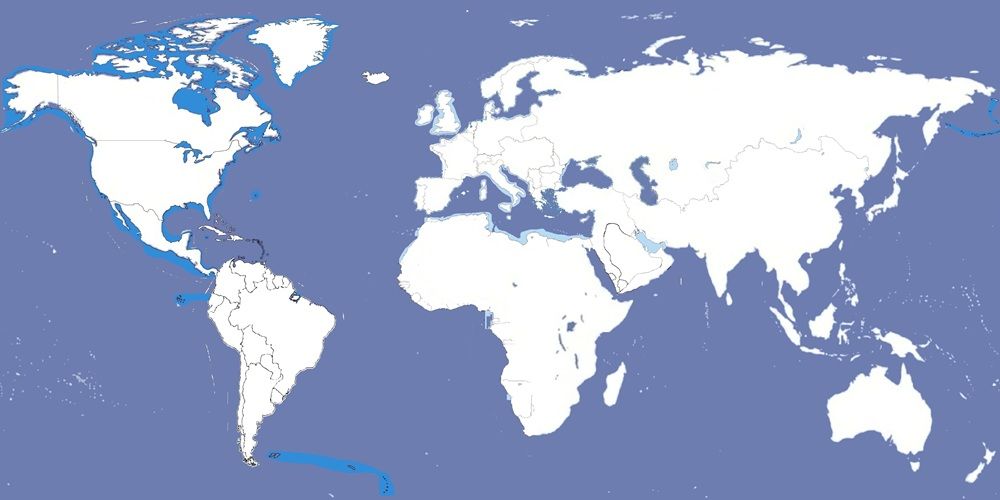
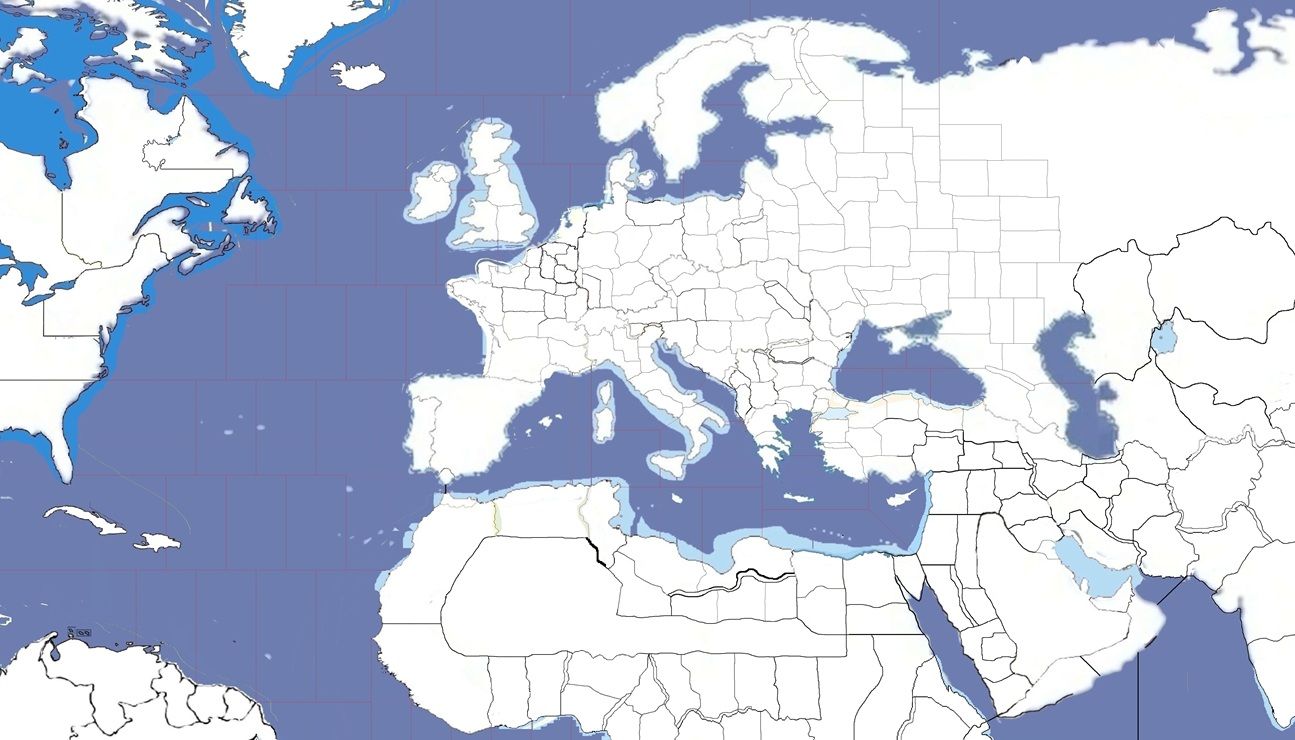
-
I have 2 sketch maps (just ignore the WWI borders); feel free to use them as a baseline if you like.
Thanks for this.
-
@Cernel said:
For example, the restriction can be that the US cannot invade any enemy territory so long as any part of the US plus Hawaii (so not comprising Alaska) is in enemy hands. This way, while going for KGF, the United States is forced to do the minimum necessary to keep Hawaii (need splitting it in more than one island to avoid this being done just by piling up land defence, or you can add that also warship presence near the West Coast counts as a no-no as well). Not a big fan of political restrictions though.Sounds like an obnoxious rule to play with, and it still wouldn't compel the US to do anything beyond stacking defense in Hawaii - they can still hang China, India, and Australia out to dry while dogpiling Germany.
I would continue to look at the bonus objectives as the right way to incentivize a mixed strategy. Besides messing around with Germany and Japan's bonuses to make them more dangerous if left unchecked, there's an alternative option, which is to tie the US objectives to sets of goals located in both the European and the Pacific theaters. And not just little ones. If the US is still getting something like that big 30 IPC bonus from Global 1940 just for being at war, break that bonus up into chunks, say, three bonuses worth 10 IPC each.
Match each of those 10 to a target in the west and a target in the east.
For example:
10 if the Allies hold both India and London
10 if the Allies hold both Canberra and Egypt
10 if the Allies hold both Hawaii and MoscowThe bar should be set pretty high for the Axis, so the targets should be objectives the Axis never actually managed to take in real life.
But you see what happens if the US ignores one theater now? Germany or Japan have the opportunity to slice a huge chunk of income away from the US player. The Axis dominating either theater reduces US power across the entire globe, so the US player must commit to fighting both.
Your economies have much different base values from the vanilla G40 game, of course, so you'd have to adjust accordingly to account for the relative difference.
If my goal was to keep the U.S. united, while preventing it from allocating nearly all its strength to one front in particular, I believe the option you've described gives me the best chance of achieving both. Yours is a solid, well thought-out idea.
Currently there are two obstacles to me embracing it.
- I believe that splitting the U.S. in half gives me an even stronger way of preventing KGF/KJF.
- I'm starting to actively embrace the differences between the two halves of the U.S.
More on this latter point. I've started bestowing unique unit types on each half of the U.S. The marine and the Superfortress for America Pacific, the M7 Priest for America Atlantic. I've also started giving them nation-specific techs to differentiate each from the other. Flying fortress-based strategic bombing techs for America Atlantic, Liberator-based techs for America Pacific. America Pacific's late game torpedo bombers are better against surface ships due to TBF Avenger tech. But America Atlantic's late game torpedo bombers are better against subs due to FIDO.
I've also created a mechanism by which the two halves of America can shift resources back and forth between each other. If the goal is to emphasize the Pacific, America Atlantic can buy munitions and send them west. Munitions cost 4 PUs each. As currently structured, each half of America can absorb two munitions per turn. (Upgradable to four per turn with tech.)
An approach like this makes the game both more and less historically accurate. The inaccurate part is implying that, "Ooh wow, we're west of the Mississippi. Obviously we can only produce Liberators here. No Flying Fortresses." Both bomber types could be built in American aircraft factories regardless of where in the U.S. you were. But, the U.S. built large numbers of both bomber types during the war. The Liberator was used mostly in the Pacific and the Flying Fortress was used mostly in Europe. Splitting the U.S. accurately represents stuff like this.
I would like to see multiple maps created using my rules set. I believe the well-thought out idea you have presented could form the seed for one such map.
-
@KurtGodel7 I wonder if you could accomplish that by giving USA East and USA West a split economy like the UK in the base game instead of bisecting them into completely separate nations?
Then you could still give each economy its own SPCs and unique units lists they can buy, but USA would be able to make all its moves on the same turn and dynamically shift forces between theaters without you having to program special rules for transfers.
And yeah, if you were aiming for maximum realism, Boeing’s main plant was in Seattle while most of the B-24’s production run came out of Willow Run near Detroit… so USA East and West would both be building the other half’s unique units here XD
But A&A is a simple game at its heart, it’s not meant to be Hearts of Iron 5, so a certain level of abstraction is to be expected, and is fully acceptable.
-
Years ago, I was very much looking forward to Christmas morning. I was going to be receiving a very cool WWII board game. It was designed by Alan Emrich. Emrich had gone from writing a strategy guide for Master of Orion, to designing his own WWII game called Totaler Krieg. I liked Master of Orion, and was hoping Emrich's own game would be equally good.
Christmas morning arrived and I was all excited to open that particular present. But the more I read the rules, the more complicated that game seemed. Mud turns, with their own special rules. Snow turns, with a different set of special rules. Supply checks, with rules about what happens when you fail those. Individually each of these rules made the game more realistic. Collectively, they made the game difficult, tedious, and technical to play.
The plan had been for my brother, father and I to play each other in this game. That never happened. The game sat on a shelf collecting dust, without having been played deep into even one game. We played other military strategy games against each other. But never that one. Games like Samurai Swords or Revised were more fun to play.
On TripleA, I will sometimes be a spectator for Total World War (TWW). I saw the exact same type of thinking which led to Totaler Krieg. Terrain effects. Lots of special rules. I've been told that TWW takes about 2 - 3 times longer to play than Domination 1914 No Man's Land (NML). But, a game of TWW doesn't give you any more strategic depth than NML. TWW asks for double or triple the player's time, without providing anything more in exchange for all that extra time.
If someone has an idea for adding more complexity + realism to my game, my default answer to that is always going to be no. A hard no. For an increase in complexity to justify itself, it needs to provide an increase in strategic depth.
Flames and Steel needs to be no more complicated than Revised, except in very specifically chosen areas. Those areas are: the research system, the new resource type (Manpower Points), sticky hits/multiple hitpoint units, and the alterations to air combat. My approach to air combat creates multiple distinct roles for different types of air. All four of these things interact with each other to create an increase in strategic depth for the game. This increase is the sole basis upon which any increase in game complexity can possibly be justified.
-
@KurtGodel7 I wonder if you could accomplish that by giving USA East and USA West a split economy like the UK in the base game instead of bisecting them into completely separate nations?
Then you could still give each economy its own SPCs and unique units lists they can buy, but USA would be able to make all its moves on the same turn and dynamically shift forces between theaters without you having to program special rules for transfers.
And yeah, if you were aiming for maximum realism, Boeing’s main plant was in Seattle while most of the B-24’s production run came out of Willow Run near Detroit… so USA East and West would both be building the other half’s unique units here XD
But A&A is a simple game at its heart, it’s not meant to be Hearts of Iron 5, so a certain level of abstraction is to be expected, and is fully acceptable.
Several thoughts on this.
The reason for the munitions unit is because I'm not a fan of ahistorical multinational forces. If Britain and the U.S. each have armies stationed on Britain, okay, fine. That's historical. But if both nations are sending troops to the Soviet Union, that's ahistorical and displeasing. In my rules, non-Soviet Allied units are not allowed onto Soviet-owned soil. Likewise, non-Chinese Allied units are not allowed onto Chinese-owned soil. If the U.S. or Britain want to send aid to the Soviet Union or China they still can--using munitions units. Munitions cost 4 PUs to build, and are converted into Soviet or Chinese PUs at the end of the Soviet or Chinese player's turn.
After I split the U.S. in half, I had the thought of using munitions to allow production transfers from one half to the other. But only within limits. Munitions existed anyway, so why not put them to use for that task?
In response to your suggestion, suppose I were to take the UK/UK Pacific game mechanics and apply them to the U.S. in Flames and Steel. This would fall short of what I'm trying to achieve in several ways.
-
The U.S. could still max out on one front. For example, America Atlantic could build air units. These would fly to the carriers being built by America Pacific. A KJF strategy.
-
I would lose some of the special distinctions I'm trying to create. For example, I'd need a new unit type to distinguish Liberators from Flying Fortresses. Okay, maybe I could swallow that. But what about torpedo bombers? Currently America Pacific's late game torpedo bombers are better at attacking surface ships, and America Atlantic's late game torpedo bombers are better at attacking subs. Giving America both types of torpedo bombers as an additional unit type would be a bridge too far. You could say that American torpedo bombers should get the TBD Avenger tech and the FIDO tech. But then that's just making the U.S. more technologically powerful, without drawing distinctions between the two halves.
-
-
@Cernel said:
For example, the restriction can be that the US cannot invade any enemy territory so long as any part of the US plus Hawaii (so not comprising Alaska) is in enemy hands. This way, while going for KGF, the United States is forced to do the minimum necessary to keep Hawaii (need splitting it in more than one island to avoid this being done just by piling up land defence, or you can add that also warship presence near the West Coast counts as a no-no as well). Not a big fan of political restrictions though.Sounds like an obnoxious rule to play with, and it still wouldn't compel the US to do anything beyond stacking defense in Hawaii - they can still hang China, India, and Australia out to dry while dogpiling Germany.
I would continue to look at the bonus objectives as the right way to incentivize a mixed strategy. Besides messing around with Germany and Japan's bonuses to make them more dangerous if left unchecked, there's an alternative option, which is to tie the US objectives to sets of goals located in both the European and the Pacific theaters. And not just little ones. If the US is still getting something like that big 30 IPC bonus from Global 1940 just for being at war, break that bonus up into chunks, say, three bonuses worth 10 IPC each.
Match each of those 10 to a target in the west and a target in the east.
For example:
10 if the Allies hold both India and London
10 if the Allies hold both Canberra and Egypt
10 if the Allies hold both Hawaii and MoscowThe bar should be set pretty high for the Axis, so the targets should be objectives the Axis never actually managed to take in real life.
But you see what happens if the US ignores one theater now? Germany or Japan have the opportunity to slice a huge chunk of income away from the US player. The Axis dominating either theater reduces US power across the entire globe, so the US player must commit to fighting both.
Your economies have much different base values from the vanilla G40 game, of course, so you'd have to adjust accordingly to account for the relative difference.
I understand what you are getting at, and I agree with it from a game-play stand-point, but that is just completely or largely ahistorical, just to force the game into some direction.
Generally speaking, I'm not a big fan of national objectives unless they are actually representing something like "Monopoly": two or more territories which are worth more than the sum of their productions if the same player or alliance owns them all.
Let's take as an example "10 if the Allies hold both Hawaii and Moscow". I assume that this is a +10 PUs per turn for the United States. What would that be based on? My answer is absolutely nothing.
If Hawaii already has a production value, that is all that it is needed to represent the ability of Hawaii to increase the productive capacity of the United States. Back then, Hawaii (even only as a matter of relative population) was nearly insignificant: losing Hawaii would not have reduced in any significant measure the ability of the United States to produce stuff and raise armies. (And, no, the political shock of losing Hawaii to the Japanese would not have caused the United States to produce less. At most, you might argue the opposite.)
Obviously, Moscow does not matter for the ability of the United States to produce more of anything.
Is it representing trade advantages? No, it is not: there was no significant trade to the United States at that point (after the loss of Philippines and Dutch East Indies) needing Hawaii as a hub (as far as I know). Besides, that would be better represented giving production values to those (indeed valuable) territories.
Is it representing some sort of beneficial link between the Soviet Union and the United States which is granted or facilitated by the United States controlling Hawaii? No, it is not: the only link would be the Lend-Lease from the United States to Vladivostok (and that would be need Vladivostok in the objective amongst others), and Hawaii does not matter for that because transports flying Soviet flag were completely free to move through the Pacific without being attacked by the Japanese anyway. On top of that, the Lend-Lease would be a loss of income for the United States in exchange for a bonus of income for the Soviet Union, certainly not a bonus income for the United States.
As I said: I agree with it from a game-play stand point, but you don't actually need National Objectives: you can just give high production values to Midway, Hawaii, the Solomons and so on to incentive just the right amount of Pacific play without forcing the United States to go full Pacific to get Japan itself or something hard to conquer which would impose an all-or-nothing approach. The problem with that is just on the level of realism: none of the territories which I've mentioned actually had any significant production vale, meaning that none of them would have changed the ability of the United States to produce anything (beside the Dutch East Indies, which were very valuable to the United States especially for the rubber and are a good candidate to add some not too hard to get income in the Pacific) to any significant level. (Hawaii and Alaska back then were way more backward and underpopulated than they are now and amounted to almost nothing compared to the population and economy of the United States and did not produce anything important. Yes, sugar and other stuff is nice to have, so Hawaii should have a little bit of production value because it did have some relatively very small productive value.)
This said, a realistic way by which it is possible to force a moderate amount of Pacific play exists: as per your first objective, it is called India. Using National Objectives is not necessary. Making India very valuable (to a limit) as a matter of normal territory production is quite realistic (India was economically important back then: it was economically about as important as all of China, actually, contrary by far to what every TripleA game is depicting.).
The way this can be done is by making India very valuable and balancing everything so that a modest amount of United States effort in the Pacific is all that is required to avoid Japan taking India (which would be critical if India is valuable enough and Japan is powerful enough to take it if the United States do nothing in Pacific), so that the United States have advantage in just spending on Pacific the minimum necessary to avoid the fall of India (or assuring the British or the Soviets to be able to take it back) while investing the rest in the Atlantic against Germany and Italy.
Can I point to a map which does this. Sorry, no. India's production being (ahistorically) much lower than China's production is pretty much a given in every map I know.
For example, using Maddison, China for 1937 is given as 528 something GDP (GDPpC multiplied by Population) and India as 400 something GDP, so there is all the margin to have the production of India anywhere between 50 and 100% of the production of China (and by China I'm saying summing up all the production of Chinese as well as all Chinese territories occupied by Japanese comprising Manchuria. I guess not Formosa/Taiwan, but I'm not sure if Maddison's China comprises it).
-
Of course, the United States being needed to avoid the fall of India would also require that India starts with very few factories (or anyway placement ability), that factories are very expensive and that the British player (if unified with India) already has enough factories in Atlantic efficiently to place all or almost all its production there without any need to purchase new factories (or anyway not being able to defend India efficiently without help from the United States). If it would become better for the United States fully to focus Atlantic while British focus on defending India successfully, that would obtain exactly the opposite effect than inducing the United States to split play between Atlantic and Pacific.
-
Hi Guys
Just to chime in, I'd say it depends on what you want the IPC value to represent. A purely historical production value would differ from a strategic and tactical one.
This is from the Captains Global 40 Mod page 25
https://drive.google.com/file/d/1SRDOsOwlO4Aa13cULwkWrorrXEmCmiN-/view?pli=1
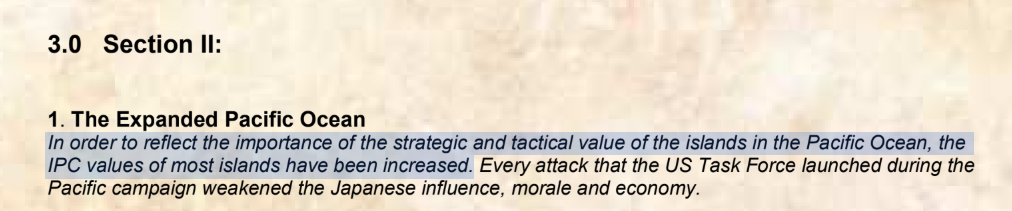
just a thought

-
It's simple to make the Pacific War work.
"Give the USA a Pacific fleet and marines worth 2–3 rounds of the entire country's income, and make sure they are far enough away to take at least 5–6 rounds to reach Europe."
Hence, the US would be unable to take advantage of these units for a very long time if they try to move the entire navy to execute KGF.
To prevent KJF, as I said an unstoppable Germany without US commitment is enough.
-
@Cernel said:
For example, the restriction can be that the US cannot invade any enemy territory so long as any part of the US plus Hawaii (so not comprising Alaska) is in enemy hands. This way, while going for KGF, the United States is forced to do the minimum necessary to keep Hawaii (need splitting it in more than one island to avoid this being done just by piling up land defence, or you can add that also warship presence near the West Coast counts as a no-no as well). Not a big fan of political restrictions though.Sounds like an obnoxious rule to play with, and it still wouldn't compel the US to do anything beyond stacking defense in Hawaii - they can still hang China, India, and Australia out to dry while dogpiling Germany.
I would continue to look at the bonus objectives as the right way to incentivize a mixed strategy. Besides messing around with Germany and Japan's bonuses to make them more dangerous if left unchecked, there's an alternative option, which is to tie the US objectives to sets of goals located in both the European and the Pacific theaters. And not just little ones. If the US is still getting something like that big 30 IPC bonus from Global 1940 just for being at war, break that bonus up into chunks, say, three bonuses worth 10 IPC each.
Match each of those 10 to a target in the west and a target in the east.
For example:
10 if the Allies hold both India and London
10 if the Allies hold both Canberra and Egypt
10 if the Allies hold both Hawaii and MoscowThe bar should be set pretty high for the Axis, so the targets should be objectives the Axis never actually managed to take in real life.
But you see what happens if the US ignores one theater now? Germany or Japan have the opportunity to slice a huge chunk of income away from the US player. The Axis dominating either theater reduces US power across the entire globe, so the US player must commit to fighting both.
Your economies have much different base values from the vanilla G40 game, of course, so you'd have to adjust accordingly to account for the relative difference.
I understand what you are getting at, and I agree with it from a game-play stand-point, but that is just completely or largely ahistorical, just to force the game into some direction.
Generally speaking, I'm not a big fan of national objectives unless they are actually representing something like "Monopoly": two or more territories which are worth more than the sum of their productions if the same player or alliance owns them all.
Let's take as an example "10 if the Allies hold both Hawaii and Moscow". I assume that this is a +10 PUs per turn for the United States. What would that be based on? My answer is absolutely nothing.
If Hawaii already has a production value, that is all that it is needed to represent the ability of Hawaii to increase the productive capacity of the United States. Back then, Hawaii (even only as a matter of relative population) was nearly insignificant: losing Hawaii would not have reduced in any significant measure the ability of the United States to produce stuff and raise armies. (And, no, the political shock of losing Hawaii to the Japanese would not have caused the United States to produce less. At most, you might argue the opposite.)
Obviously, Moscow does not matter for the ability of the United States to produce more of anything.
Is it representing trade advantages? No, it is not: there was no significant trade to the United States at that point (after the loss of Philippines and Dutch East Indies) needing Hawaii as a hub (as far as I know). Besides, that would be better represented giving production values to those (indeed valuable) territories.
Is it representing some sort of beneficial link between the Soviet Union and the United States which is granted or facilitated by the United States controlling Hawaii? No, it is not: the only link would be the Lend-Lease from the United States to Vladivostok (and that would be need Vladivostok in the objective amongst others), and Hawaii does not matter for that because transports flying Soviet flag were completely free to move through the Pacific without being attacked by the Japanese anyway. On top of that, the Lend-Lease would be a loss of income for the United States in exchange for a bonus of income for the Soviet Union, certainly not a bonus income for the United States.
As I said: I agree with it from a game-play stand point, but you don't actually need National Objectives: you can just give high production values to Midway, Hawaii, the Solomons and so on to incentive just the right amount of Pacific play without forcing the United States to go full Pacific to get Japan itself or something hard to conquer which would impose an all-or-nothing approach. The problem with that is just on the level of realism: none of the territories which I've mentioned actually had any significant production vale, meaning that none of them would have changed the ability of the United States to produce anything (beside the Dutch East Indies, which were very valuable to the United States especially for the rubber and are a good candidate to add some not too hard to get income in the Pacific) to any significant level. (Hawaii and Alaska back then were way more backward and underpopulated than they are now and amounted to almost nothing compared to the population and economy of the United States and did not produce anything important. Yes, sugar and other stuff is nice to have, so Hawaii should have a little bit of production value because it did have some relatively very small productive value.)
This said, a realistic way by which it is possible to force a moderate amount of Pacific play exists: as per your first objective, it is called India. Using National Objectives is not necessary. Making India very valuable (to a limit) as a matter of normal territory production is quite realistic (India was economically important back then: it was economically about as important as all of China, actually, contrary by far to what every TripleA game is depicting.).
The way this can be done is by making India very valuable and balancing everything so that a modest amount of United States effort in the Pacific is all that is required to avoid Japan taking India (which would be critical if India is valuable enough and Japan is powerful enough to take it if the United States do nothing in Pacific), so that the United States have advantage in just spending on Pacific the minimum necessary to avoid the fall of India (or assuring the British or the Soviets to be able to take it back) while investing the rest in the Atlantic against Germany and Italy.
Can I point to a map which does this. Sorry, no. India's production being (ahistorically) much lower than China's production is pretty much a given in every map I know.
For example, using Maddison, China for 1937 is given as 528 something GDP (GDPpC multiplied by Population) and India as 400 something GDP, so there is all the margin to have the production of India anywhere between 50 and 100% of the production of China (and by China I'm saying summing up all the production of Chinese as well as all Chinese territories occupied by Japanese comprising Manchuria. I guess not Formosa/Taiwan, but I'm not sure if Maddison's China comprises it).
I've been researching some of the things you're saying, and I think you've done a good job of adding increased realism to this discussion.
At least according to AI, India may have actually had more military production than China during WWII. China's military production was reduced due to Japanese occupation, and because of its civil war. Whereas, the Raj served to increase India's military production due to the organizational efforts of the British empire.
Likewise, you've correctly stated that Japan's military production should be significantly less than Germany's. Here is a link to military aircraft production during WWII.
Military aircraft production can be used as a decent proxy for overall military production. This metric will understate British and American military production, because both nations produced a significant portion of heavy bombers. A heavy bomber, with its four engines, is more difficult to produce than a one - two engine fighter.
Interestingly enough, the Japanese Zero (obsolete later in the war) required 10,000 hours to manufacture. Whereas, Japan's late war Ki-84 Hayate plane (modern by the standards of 1944) required only 4,000 man hours to manufacture. The Zero had not been designed with large scale mass production in mind. It had a lot of custom work needed for it. Whereas, the Ki-84 Hayate--the "Frank"--was designed to be more easily manufactured in large numbers. A total of 3,500 Ki-84s were built, compared to nearly 11,000 Zero carrier aircraft.

Hello! It looks like you're interested in this conversation, but you don't have an account yet.
Getting fed up of having to scroll through the same posts each visit? When you register for an account, you'll always come back to exactly where you were before, and choose to be notified of new replies (either via email, or push notification). You'll also be able to save bookmarks and upvote posts to show your appreciation to other community members.
With your input, this post could be even better 💗
Register Login