Flames and Steel (official thread)
-
Flames and Steel is a completely different approach to a WWII map. My goals were to give the map strategic depth and simplicity. It's easy to do one or the other of these things, very difficult to do both!
Air Combat
There is an air combat phase at the beginning of each game round.- Each side moves their aircraft
- A dogfight occurs, with aircraft firing at their dogfight values
- Surface attacks and strategic bombing raids occur
Types of Aircraft
Air superiority. These include fighters, advanced fighters, and jets. Aircraft of this type can only destroy enemy aircraft. Never land or naval targets. But in this role they excel. These are your main defense against enemy bombing attacks.
Dive bombers. These planes are excellent at destroying land targets, and are normal at destroying enemy surface ships. If you gain air superiority, you can use your dive bombers to do serious damage to an enemy army.
Torpedo bombers. These planes are excellent at destroying enemy surface ships, and are normal at destroying enemy land targets or subs. Gain control of the skies, and you can use your torpedo bombers to sink enemy ships and subs.
Medium bombers. These planes are a jack of all trades, master of none. They are normal at attacking enemy land units, surface ships, or subs. They do 2 PUs of damage when strategically bombing. They allow you to strike targets beyond the range of your torpedo bombers or dive bombers.
Strategic bombers. These planes do 5 PUs of damage when strategically bombing. This is their primary intended purpose. If an enemy lacks sufficient fighter protection, you can use your strategic bombers to impose real economic damage.The map is not finished yet, but here are some pictures.
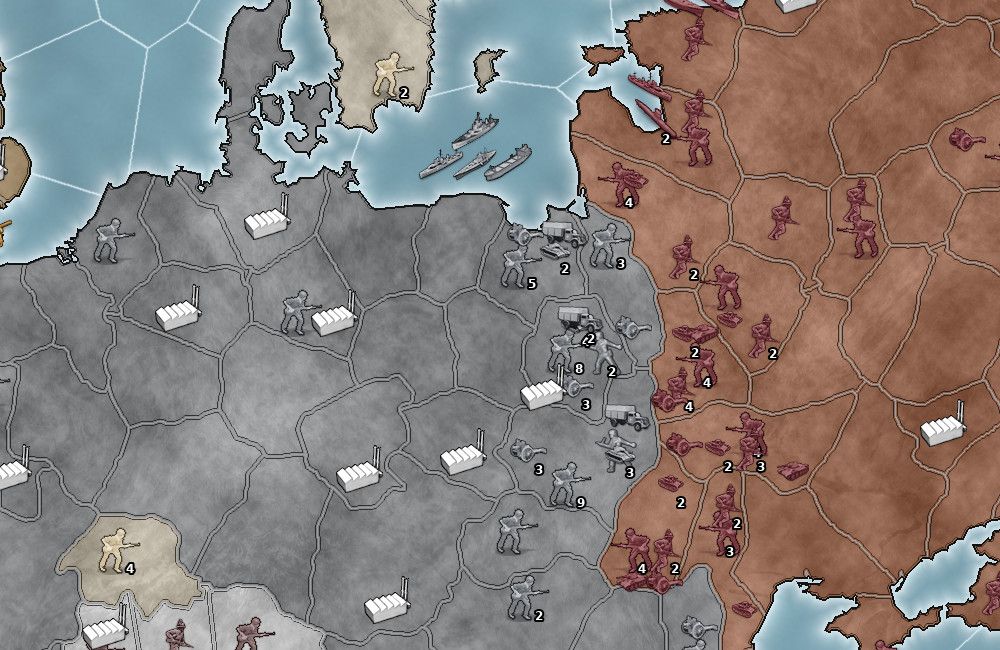
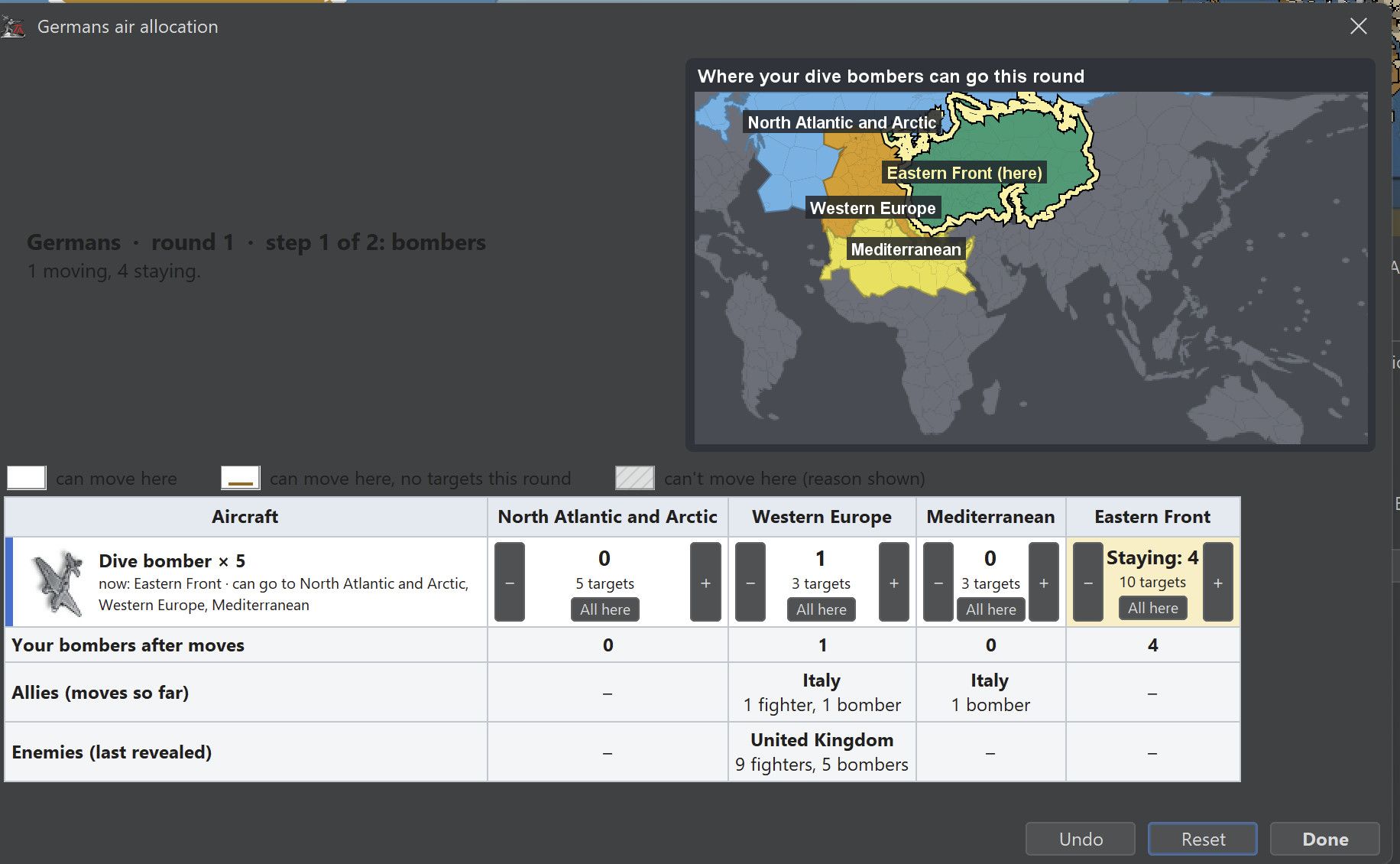
-
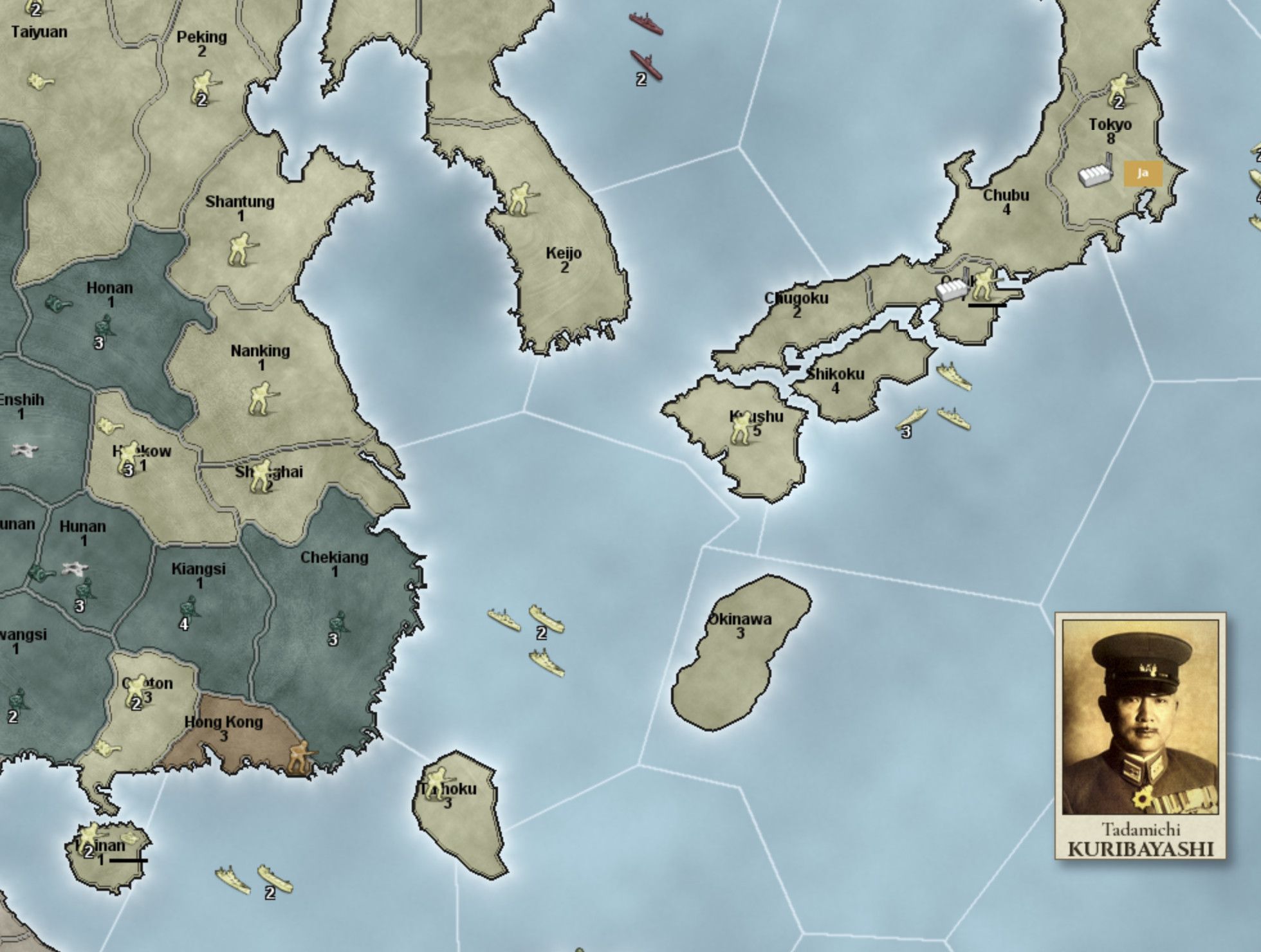
Below is a photo of the map. I've given two photos per nation for the major participants, one photo per nation for minor participants.
One of Japan's photos went to Yamamoto. The other went to Tadamichi Kuribayashi.
Now, I know what you're thinking. Who on Earth was Yamamoto?
Just kidding.
In 1914, the French believed they could beat the Germans with superior French fighting spirit, élan. The epitome of élan was the bayonet charge. The French learned the hard way why it was a bad idea to charge machine gun posts with bayonets.
Japan didn't participate in European trench warfare. It didn't gain the institutional knowledge the European and North American nations had gained during WWI. A Japanese banzai charge in 1942 had a lot in common with a French élan bayonet attack in 1914. Consequently, the U.S. Army achieved favorable exchange rates in its battles against Japan.
Tadamichi Kuribayashi broke with Japan's old tactics. If a Japanese-held island was being invaded, Kuribayashi would not contest it at the water's edge. He forbade banzai charges or suicide attacks. His men dug an extensive tunnel network and defended in depth. Iwo Jima was the only major Pacific land battle in which U.S. casualties exceeded those of Japan. Kuribayashi represents Japan's army, just as Yamamoto represents Japan's navy.
-
Research system
Most nations have between 1 - 3 research centers. For each research center, you select an area of primary and secondary focus. Each turn, every research center achieves a breakthrough. There is a 40% chance of it being in the center's primary focus, a 20% chance of it being in the research center's secondary focus, and a 40% chance of the advance being chosen at random, from among the tech categories you have not yet completed.
Technologies are associated with dull grey stars. Each time you get an advance, a dull grey star becomes a bright yellow star. Once you replace the last dull grey star with a bright yellow star, you unlock the tech. New techs are unlocked at the end of your turn.
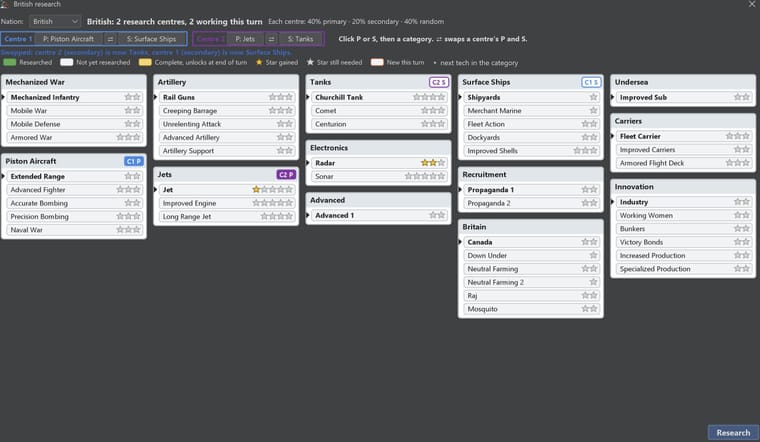
In this example, Britain's first research centre has a primary focus of piston aircraft, and a secondary focus of surface ships. Its second research centre has a primary focus of jets and a secondary focus of tanks.
This is Britain's first turn. Note that even before it's done any research, it already has one star towards jet tech, and two stars towards radar. These represent Britain's technological achievements in those areas as of June 1941. Also, jets are special units. (More on that later.) Jets do not replace piston aircraft. Late game, expect to have lots of piston aircraft with some jets mixed in. Piston aircraft research is a good choice for Britain.
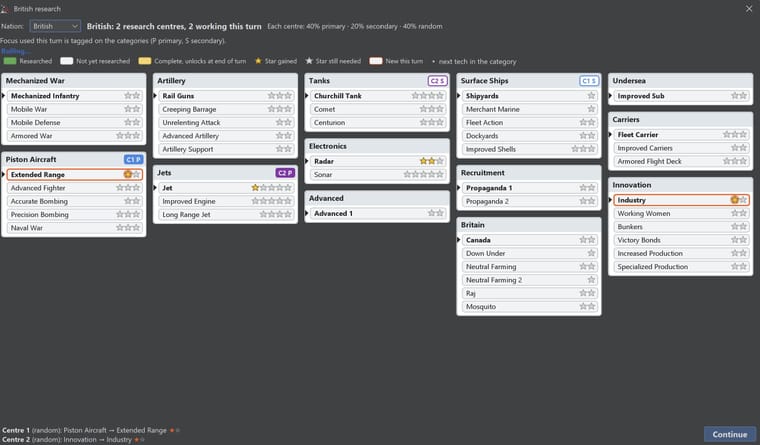
Research results are now in. Center 1 got a star towards extended range. Fighters, dive bombers and torpedo bombers start off with a range of 3. But once you get extended range, that increases to 4. Britain's research center 2 got a random tech advance: one star towards industry. Industry tech adds +2 to the unit placement capacity of your factories. The underlying territory must be worth at least 2 to qualify for the bonus.
-
Sticky Hits
Sticky hits are a deliberate nerf to units with multiple hitpoints. Once a unit has taken one hit, additional hits are automatically assigned to that unit until it is dead, or until combat ends.
My goal was to make units with multiple hitpoints more common. Hence the need for the nerf.
Light tank: 1 hitpoint
Tank: 2 hitpoints
Heavy tank or Panther: 4 hitpoints
King Tiger: 6 hitpointsFighter: 2 hitpoints
Dive bomber: 2 hitpoints
Torpedo bomber: 2 hitpoints
Medium bomber: 2 hitpoints
Strategic bomber: 3 hitpoints
Advanced fighter: 3 hitpoints
Early jet: 3 hitpoints
Jet: 5 hitpoints
Superfortress: 5 hitpoints, does 13 PUs of damage for strategic bombing
Flying wing: 7 hitpoints, does 6 PUs of damage for strategic bombing -
Special Units
Special units cannot be purchased with PUs. Each Advanced Production Center (APC) you own produces one special unit a turn. You must research tech to be able to build APCs in the first place. Also, you must research the tech for the units you would like to build.In the above lists, heavy tanks, Panthers, King Tigers, early jets, jets, Superfortresses, and flying wings are all special units. Superfortresses and flying wings take 2 turns to build.
Whose tank tech tree is the best? That all depends on what you want. If your focus is on building tanks with PUs, Britain's tank tech is probably the best. Its Comet tank tech adds +1 to the attack and defense of British tanks. (A Comet was rather similar to a Firefly.) If your focus is on special unit tanks, Germany's King Tiger tech allows you to build the best special unit tank in the game. With the right tech, each German APC can produce a free Panther each turn in addition to its normal production. Expect late game German armies to have their share of Panthers, and the occasional King Tiger. The Soviet player has access to good tank tech. He or she can research the ability to buy tanks at reduced cost. The IS-2 tech gives an upgrade to Soviet heavy tanks. Japan is the odd man out. At the start of the game it can build light tanks only (no medium tanks). It can research tank tech to let it buy normal tanks. But no heavy tanks for Japan.
As if to make up for this, Japan's Yamato battleships are the most expensive and the most powerful in the game. A Yamato battleship gives you more bang for the buck than a normal battleship would.
-
@KurtGodel7 How are you going to enforce "Sticky Hits"?
-
It seems very interesting.
A lot of posts yesterday but you must be working on it since you were born !

-
@KurtGodel7 How are you going to enforce "Sticky Hits"?
I've used AI to make a few tweaks to the engine. The modified version of the engine lives only on my computer. The modified engine allows me to do the following:
-
Reinterpretation of air combat. The map is divided into air theaters. You assign fighters and bombers to each theater. For example, eastern Germany and the western Soviet Union are part of the Germany vs USSR theater. During the dogfight phase, air units shoot at each other, using their dogfight values. Note that air superiority aircraft, such as fighters, advanced fighters, and jets are excellent during the dogfight phase. Then, you pick targets for your surface attack. Maybe you have German dive bombers strafing a couple Soviet territories, and Soviet dive bombers strafing a German territory or two. During the surface attack phase, the armies getting strafed do not fire back, except for aa guns.
-
Sticky hits are automatically enforced.
-
Research system. Each nation has a fixed number of research centers, with each research center generating one tech advance per turn. There is a 40% chance of the tech advance being in its primary focus, a 20% chance of it being its secondary focus, and a 40% chance of it being chosen at random. Each advance causes a dull grey star to be replaced by a bright yellow star. For example, heavy tanks tech starts you out with four dull grey stars. Each advance you get in tanks tech replaces a dull grey star with a bright yellow star. Once you have all four bright yellow stars you unlock heavy tanks.
-
Advanced Production Centers (APCs). Special units, such as heavy tanks, fleet carriers, jets, or Superfortresses cannot be built with PUs. They can only be produced with APCs. Each APC produces one special unit per turn. However, it takes two turns to produce a Superfortress or flying wing.
-
Manpower points, or MPs. These are an additional resource type. Imagine a purely hypothetical nation rich in manpower points, but poor in PUs. This nation "China" can have a large infantry force. But it will not have very many non-infantry units due to low PUs. The Soviet Union can have the world's biggest infantry force, as well as plenty of PUs for non-infantry units. Territories produce MPs only for their original owner.
-
Lend-lease. British and American units are not allowed onto Soviet or Chinese soil. As if to make up for this, the British and American players can build munitions. Munitions are allowed onto Soviet or Chinese soil. Upon the end of the Soviet or Chinese player's turn, they are converted into Soviet or Chinese PUs. If a transport with munitions aboard gets sunk, the munitions are destroyed. If the Axis captures a territory with munitions present, those munitions are immediately converted into PUs for that Axis nation.
-
-
To add to my earlier post:
- Strategic bombing. This now does a fixed amount of damage, instead of involving die rolling. Damage is in PUs, and is capped at double the territory value. The air phase only happens once per game round, so a 4 PU territory can cost you, at most, 8 PUs in strategic bombing value per game round.
Strategic bombing damage
Medium bomber: 2 PUs
Strategic bomber: 5 PUs
Superfortress: 13 PUs
Flying wing: 6 PUsTo give an example of this, suppose Japan wants to wage a strategic bombing campaign against China. Separately, Japan wants to use dive bombers to strafe the Chinese Army. China can allocate its limited fighter force to the "Japan vs. China" air zone to try to defend against the dive bombers. Or it can allocate its fighters to the "bomb China" air zone to defend against the strategic bombing raids.
Other than the U.S. and Britain, no one starts the game with the tech needed to build strategic bombers. Japan can always research that tech. In the meantime, however, it can use medium bombers for its strategic bombing campaign. China can defend against this by building fighters and aa guns.
-
Also:
-
AA guns now work differently. AA guns fire after the dogfight phase. They fire on a 2. Each aa gun gets one shot only, without regard to the number of enemy air units present. With three aa guns, you are guaranteed one hit. If there is a particular factory you want to defend, you could pile a lot of aa guns into the territory with the factory. Defending your army from being strafed is more difficult, because the dive bombers could always choose to attack a territory where your aa guns aren't. AA guns don't fire during ground combat, but they can be taken as casualties.
-
Dive bombers fire at twice their normal combat value when attacking land targets. Likewise, torpedo bombers fire at twice their normal combat value when attacking surface ships. Imagine attacking a fleet of 10 ships with your torpedo bombers. Only the ships damaged or destroyed by your torpedo bombers would get to fire at aircraft. The rest of your fleet was considered too far away from the action to be able to use its aa guns. The way to defend against enemy torpedo bombers is with fighters and jets.
-
Air zones come in three flavors: land, coastal waters, and open ocean. For a land zone, you need a landing base within range of your aircraft. For coastal waters, you need either a landing base or aircraft carriers. For open ocean, only carriers will suffice. When using carriers, the number of aircraft you can have in a zone is limited by carrier capacity.
-
-
I would recommend a name swap for the Advanced Production Centers, since APC is an acronym that every wargamer is going to associate with armored personnel carrier.
Special Production Center / SPC should be a pretty easy substitute to avoid the overlap.
Your Europe map looks beautiful, from what I can see. Taiwan and Okinawa are a bit off-putting on the Asia one, they’d look better if they swapped sizes with one another. Okinawa being placed that close to the edge of the sea zone also leaves me wondering whether it should be shifted onto the boundary line instead.
Your combat system ventures far enough from any version of the game I’ve played that I can’t really offer any judgement about it at this point. Hopefully, once you’re far enough along in development, you can share a play by play of a test game as a demonstration.
-
- Naval combat now works differently.
Step 1: destroyers fire. Enemy subs are taken as casualties first. Only after all subs are dead can surface ships be hit. Enemies killed during this phase do get a casualty shot.
Step 2: Subs fire. Anything hit during this phase does not receive a casualty shot. Only surface ships can be taken as casualty.
Step 3: Surface ships fire, except for destroyers. Enemies killed during this phase receive a casualty shot. Only surface ships can be taken as casualty during this phase.
-
I would recommend a name swap for the Advanced Production Centers, since APC is an acronym that every wargame is going to associate with armored personnel carrier.
Special Production Center / SPC should be a pretty easy substitute to avoid the overlap.
Your Europe map looks beautiful, from what I can see. Taiwan and Okinawa are a bit off-putting on the Asia one, they’d look better if they swapped sizes with one another. Okinawa being placed that close to the edge of the sea zone also leaves me wondering whether it should be shifted onto the boundary line instead.
Your combat system ventures far enough from any version of the game I’ve played that I can’t really offer any judgement about it at this point. Hopefully, once you’re far enough along in development, you can share a play by play of a test game as a demonstration.
Good feedback on APCs and Okinawa.
One of the places from which I drew inspiration was Axis and Allies Naval Miniatures. With that game, you use fighters to gain air superiority. Bomber type aircraft to benefit from air superiority. It's normal for units to have multiple hitpoints. The mighty Yamato was given 6 hitpoints. Cruisers, battleships, and dive bombers are unable to hit enemy subs. There was a very good paper-rock-scissors dynamic to that game which I wanted to bring into an Axis and Allies style map.

Hello! It looks like you're interested in this conversation, but you don't have an account yet.
Getting fed up of having to scroll through the same posts each visit? When you register for an account, you'll always come back to exactly where you were before, and choose to be notified of new replies (either via email, or push notification). You'll also be able to save bookmarks and upvote posts to show your appreciation to other community members.
With your input, this post could be even better 💗
Register Login