Flames and Steel (official thread)
-
@Cernel said:
For game-play (realistic or not - and I would say not too much if not), it would be necessary for India to have very low placement ability (factories) (and being able to place little TUV, meaning being restricted to placing infantry (a good number but not too many of them - whether realistic or not, I know there were many Indians in the British army) and hardly anything else - kind of like China even though the situation was not as bad as China after 1937), while having fairly high production (income) and being part of the British Empire - meaning sharing its income with the United Kingdom - so that India is mostly a British cash-cow that Japan can take and the British cannot defend alone, thus pressure from the United States in Pacific is needed, or the Japanese take India.I think Kurt actually set himself up to handle this pretty easily if he wants since he split MP and PU into two different resources. He can do something like the conscript model he has for Italy/USSR/China (call it Colonial Infantry instead of Conscript for flavor here) where it’s a unit that only costs MP but is limited to only being produced in India, and India has high MP resources but relatively low PU.
-
Also, some planes were harder to shoot down than others, and this is reflected in me giving some airplanes more hitpoints than others.
I guess your are not doing it, but it would be good if you split the heavy bombers available since start game at least into two different units, one mainly representing the Avro Lancaster and the other one mainly representing the B-17 (and the B-24 too if you don't want to split in 3) (I'm not talking about other future/tech ones like the B-29). The B-17 should have more hit-points and more defensive power than the Avro Lancaster, but the Avro Lancaster should have a slightly bigger bombing power (not much). This can be balanced by making the Avro Lancaster cheaper (whether or not this is the case) or just letting the United States have an advantage in heavy bombers over Britain.
The initial strategic bomber is the same for all nations. The final version is different for each. (This includes America Pacific vs. America Atlantic.)
America Pacific's final strategic bomber is the Liberator. America Atlantic's is the Flying Fortress. And Britain's is the Avro Lancaster. Of the three, the Avro Lancaster has the hardest hitting power, due to the "Tall Boy and Grand Slam" tech. Uniquely among the three, it can benefit from Window tech, which adds -1 to the interception value of enemy air. The Flying Fortress has the most ability to defend itself against interception. The Liberator has a longer range than a Flying Fortress. Germany, Japan, and the Soviet Union each also get their own final version of strategic bombers, though their final versions are below those of the U.K. and U.S. Japan's version is a little better than Germany's version or the Soviet Union's version.
-
@Cernel said:
For game-play (realistic or not - and I would say not too much if not), it would be necessary for India to have very low placement ability (factories) (and being able to place little TUV, meaning being restricted to placing infantry (a good number but not too many of them - whether realistic or not, I know there were many Indians in the British army) and hardly anything else - kind of like China even though the situation was not as bad as China after 1937), while having fairly high production (income) and being part of the British Empire - meaning sharing its income with the United Kingdom - so that India is mostly a British cash-cow that Japan can take and the British cannot defend alone, thus pressure from the United States in Pacific is needed, or the Japanese take India.I think Kurt actually set himself up to handle this pretty easily if he wants since he split MP and PU into two different resources. He can do something like the conscript model he has for Italy/USSR/China (call it Colonial Infantry instead of Conscript for flavor here) where it’s a unit that only costs MP but is limited to only being produced in India, and India has high MP resources but relatively low PU.
I like this idea.
I could see this going in one of two different ways.
-
Let's say I give India 5 MPs. These are used to buy five colonial militia per turn, which are placed on India. A colonial militia would be a conscript by another name.
-
I give India five MPs. These MPs are added to Britain's general pool of MPs. They don't necessarily get spent in India. Britain could use them to buy more infantry for London, for example, with which to prepare an invasion of Europe. Britain could have used the MPs for colonial militia for India. It just chose not to.
I like 1) a lot more than 2). Once my weekly usage limit resets, I could have a conversation with Claude about this.
-
-
KurtGodel7 said:
@Cernel said:
For game-play (realistic or not - and I would say not too much if not), it would be necessary for India to have very low placement ability (factories) (and being able to place little TUV, meaning being restricted to placing infantry (a good number but not too many of them - whether realistic or not, I know there were many Indians in the British army) and hardly anything else - kind of like China even though the situation was not as bad as China after 1937), while having fairly high production (income) and being part of the British Empire - meaning sharing its income with the United Kingdom - so that India is mostly a British cash-cow that Japan can take and the British cannot defend alone, thus pressure from the United States in Pacific is needed, or the Japanese take India.I think Kurt actually set himself up to handle this pretty easily if he wants since he split MP and PU into two different resources. He can do something like the conscript model he has for Italy/USSR/China (call it Colonial Infantry instead of Conscript for flavor here) where it’s a unit that only costs MP but is limited to only being produced in India, and India has high MP resources but relatively low PU.
I like this idea.
I could see this going in one of two different ways.
-
Let's say I give India 5 MPs. These are used to buy five colonial militia per turn, which are placed on India. A colonial militia would be a conscript by another name.
-
I give India five MPs. These MPs are added to Britain's general pool of MPs. They don't necessarily get spent in India. Britain could use them to buy more infantry for London, for example, with which to prepare an invasion of Europe. Britain could have used the MPs for colonial militia for India. It just chose not to.
I like 1) a lot more than 2). Once my weekly usage limit resets, I could have a conversation with Claude about this.
Okay, I feel silly. The obvious way of solving this problem is: don't allow India to give Britain MPs. Instead, Britain receives free bonus units for India. These bonus units will be colonial militia. I should probably make Britain research tech to unlock the free units.
In fact I have something like this in the game already, except that Britain is getting free infantry for India. I need to change that to colonial militia and increase their number.
-
-
Also, some planes were harder to shoot down than others, and this is reflected in me giving some airplanes more hitpoints than others.
I guess your are not doing it, but it would be good if you split the heavy bombers available since start game at least into two different units, one mainly representing the Avro Lancaster and the other one mainly representing the B-17 (and the B-24 too if you don't want to split in 3) (I'm not talking about other future/tech ones like the B-29). The B-17 should have more hit-points and more defensive power than the Avro Lancaster, but the Avro Lancaster should have a slightly bigger bombing power (not much). This can be balanced by making the Avro Lancaster cheaper (whether or not this is the case) or just letting the United States have an advantage in heavy bombers over Britain.
The initial strategic bomber is the same for all nations. The final version is different for each. (This includes America Pacific vs. America Atlantic.)
America Pacific's final strategic bomber is the Liberator. America Atlantic's is the Flying Fortress. And Britain's is the Avro Lancaster. Of the three, the Avro Lancaster has the hardest hitting power, due to the "Tall Boy and Grand Slam" tech. Uniquely among the three, it can benefit from Window tech, which adds -1 to the interception value of enemy air. The Flying Fortress has the most ability to defend itself against interception. The Liberator has a longer range than a Flying Fortress. Germany, Japan, and the Soviet Union each also get their own final version of strategic bombers, though their final versions are below those of the U.K. and U.S. Japan's version is a little better than Germany's version or the Soviet Union's version.
Wait. I saw that you had the "Superfortress" as "Strategic Bombers" tech. That would be the B-29. How is the "Flying Fortress" the final strategic bomber? That is the B-17, right?
Ok for the Avro Lancaster and the B-24 I guess, but the B-17 in mid-to-late 1941 should be already available for purchase. I mean, I certainly agree with the United States starting with zero of them (since they were very few before Pearl Harbour) but with the ability to purchase them (unless maybe you have a progressive tech and the B-17 is like at 95% development completion or something).
I guess you are taking into account the possibility of USA Pacific sending B-24 to fight in Atlantic, right? They have been quite important in the Mid-Atlantic gap and very important in bombing Germany.
-
About bombers, a cool new feature would be allowing for bombers to travel longer distances at the expense of lowering their bombing/attack power. Just an idea.
-
Also, some planes were harder to shoot down than others, and this is reflected in me giving some airplanes more hitpoints than others.
I guess your are not doing it, but it would be good if you split the heavy bombers available since start game at least into two different units, one mainly representing the Avro Lancaster and the other one mainly representing the B-17 (and the B-24 too if you don't want to split in 3) (I'm not talking about other future/tech ones like the B-29). The B-17 should have more hit-points and more defensive power than the Avro Lancaster, but the Avro Lancaster should have a slightly bigger bombing power (not much). This can be balanced by making the Avro Lancaster cheaper (whether or not this is the case) or just letting the United States have an advantage in heavy bombers over Britain.
The initial strategic bomber is the same for all nations. The final version is different for each. (This includes America Pacific vs. America Atlantic.)
America Pacific's final strategic bomber is the Liberator. America Atlantic's is the Flying Fortress. And Britain's is the Avro Lancaster. Of the three, the Avro Lancaster has the hardest hitting power, due to the "Tall Boy and Grand Slam" tech. Uniquely among the three, it can benefit from Window tech, which adds -1 to the interception value of enemy air. The Flying Fortress has the most ability to defend itself against interception. The Liberator has a longer range than a Flying Fortress. Germany, Japan, and the Soviet Union each also get their own final version of strategic bombers, though their final versions are below those of the U.K. and U.S. Japan's version is a little better than Germany's version or the Soviet Union's version.
Wait. I saw that you had the "Superfortress" as "Strategic Bombers" tech. That would be the B-29. How is the "Flying Fortress" the final strategic bomber? That is the B-17, right?
Ok for the Avro Lancaster and the B-24 I guess, but the B-17 in mid-to-late 1941 should be already available for purchase. I mean, I certainly agree with the United States starting with zero of them (since they were very few before Pearl Harbour) but with the ability to purchase them (unless maybe you have a progressive tech and the B-17 is like at 95% development completion or something).
I guess you are taking into account the possibility of USA Pacific sending B-24 to fight in Atlantic, right? They have been quite important in the Mid-Atlantic gap and very important in bombing Germany.
Some thoughts on this.
-
For America Pacific, the final strategic bombing tech is the Superfortress. A Superfortress is a special unit: an SPC produces one every two turns. For normal bombers--i.e., those which can be purchased with PUs--the final bomber is the Liberator for America Pacific and the Flying Fortress for America Atlantic.
-
Some of my techs have anachronistic names. Japan needs to research "Kate" tech, even though it already had Kates as of June 1941. The U.S.S.R. needs to research "KV-2" tech, even though it had KV-2s in June 1941. I hate wasting opportunities to give players tech to research. In any case, and in answer to your question, both halves of America are able to build strategic bombers at the start of the game. But those strategic bombers don't get upgraded into Flying Fortresses or Liberators until the U.S. has researched tech. Another anachronism, granted.
-
-
@KurtGodel7 Do you have the full tech trees written up yet or are they still work in progress?
-
@KurtGodel7 Do you have the full tech trees written up yet or are they still work in progress?
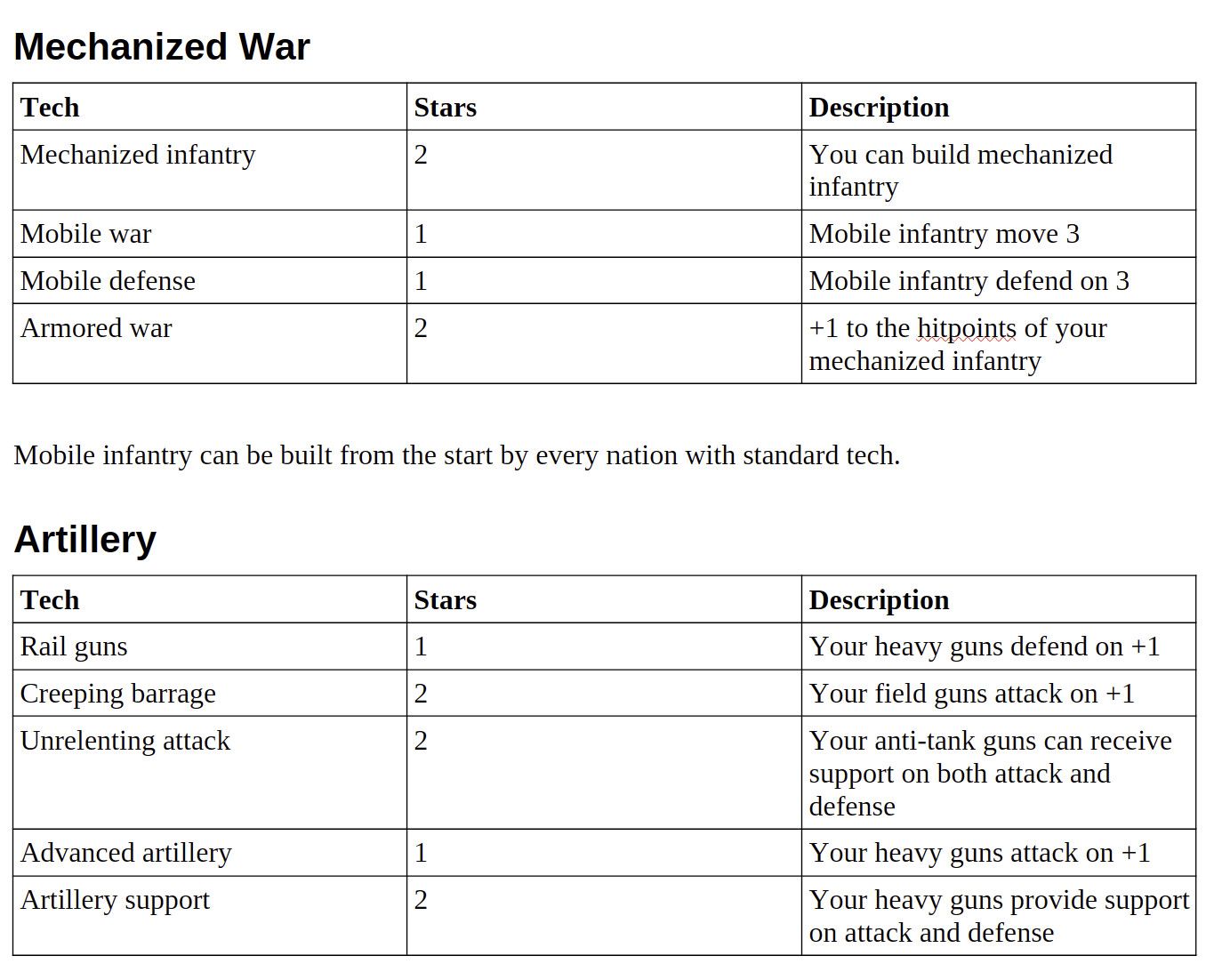
-
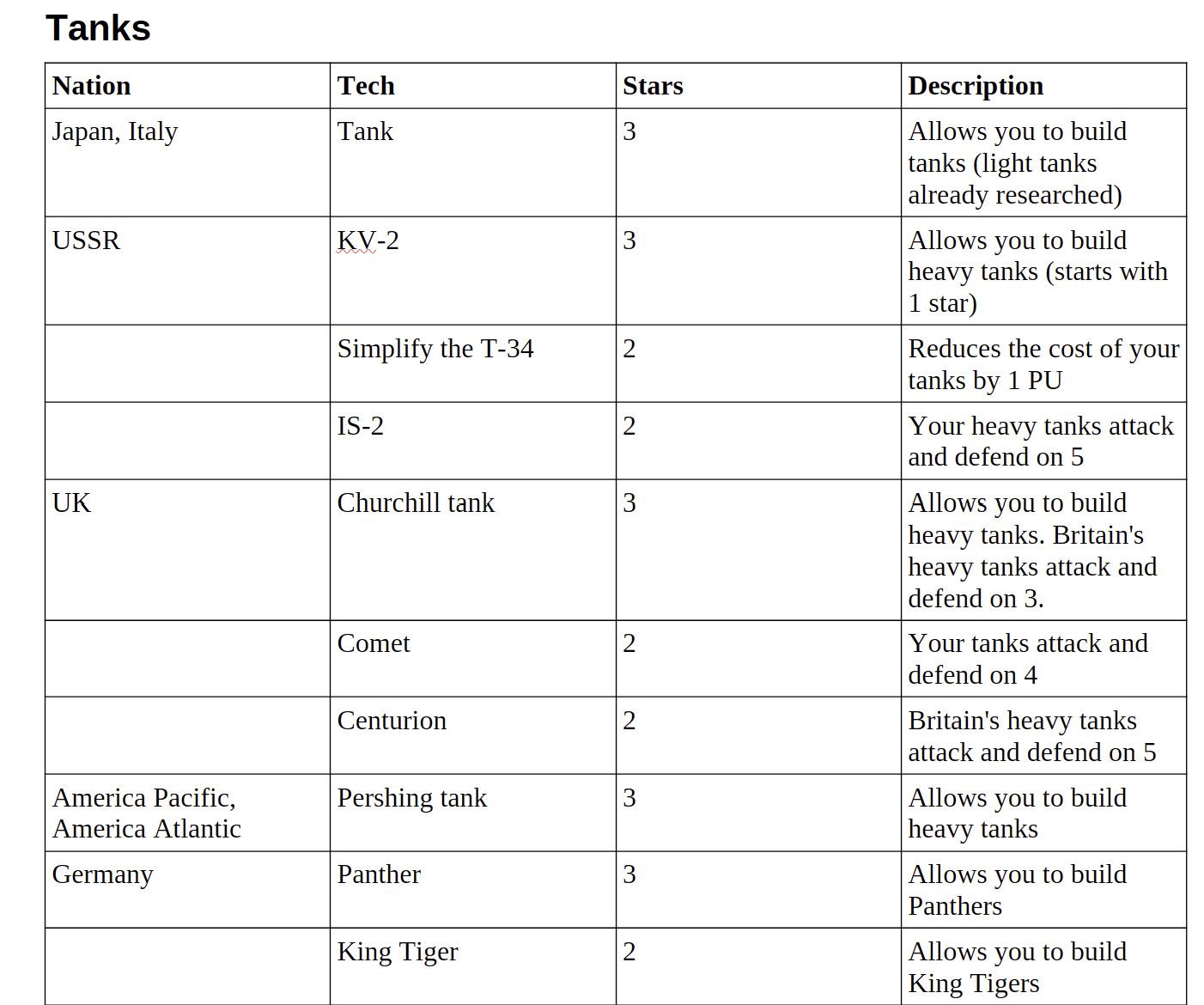
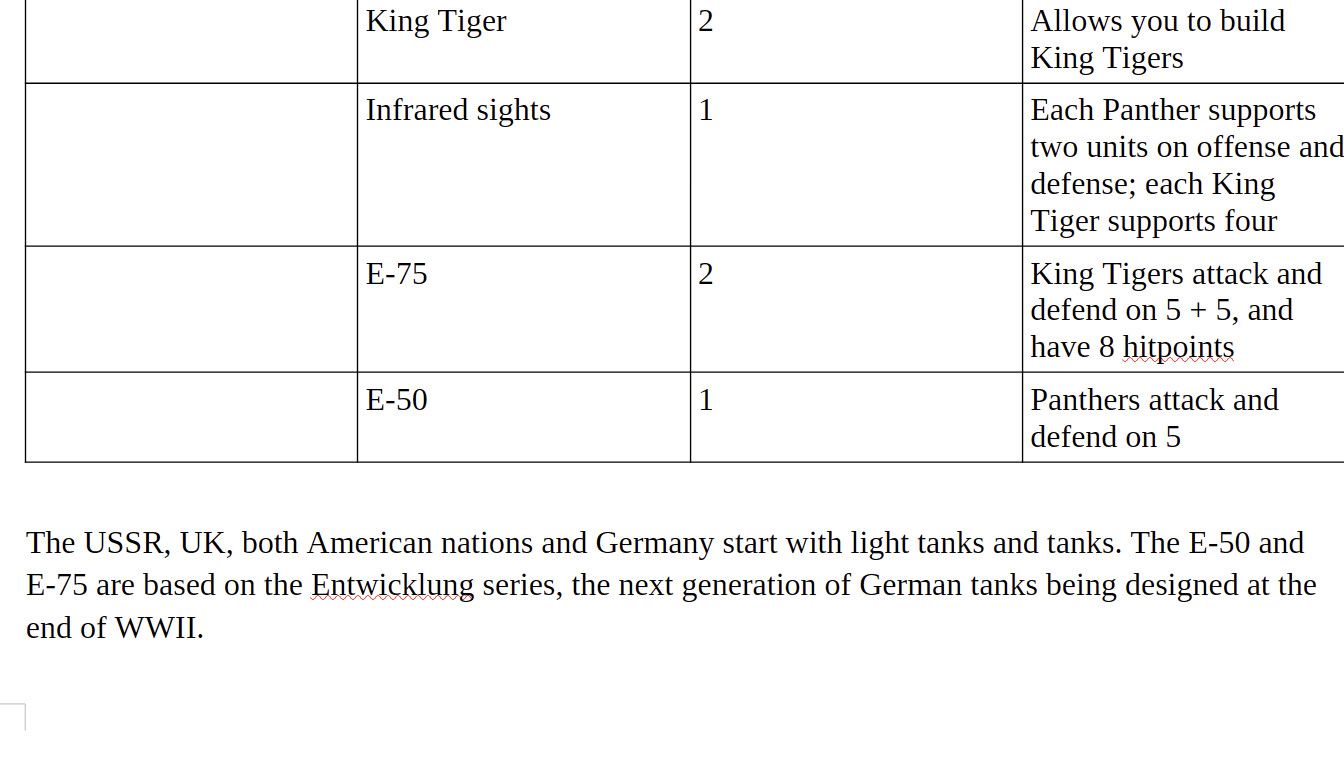
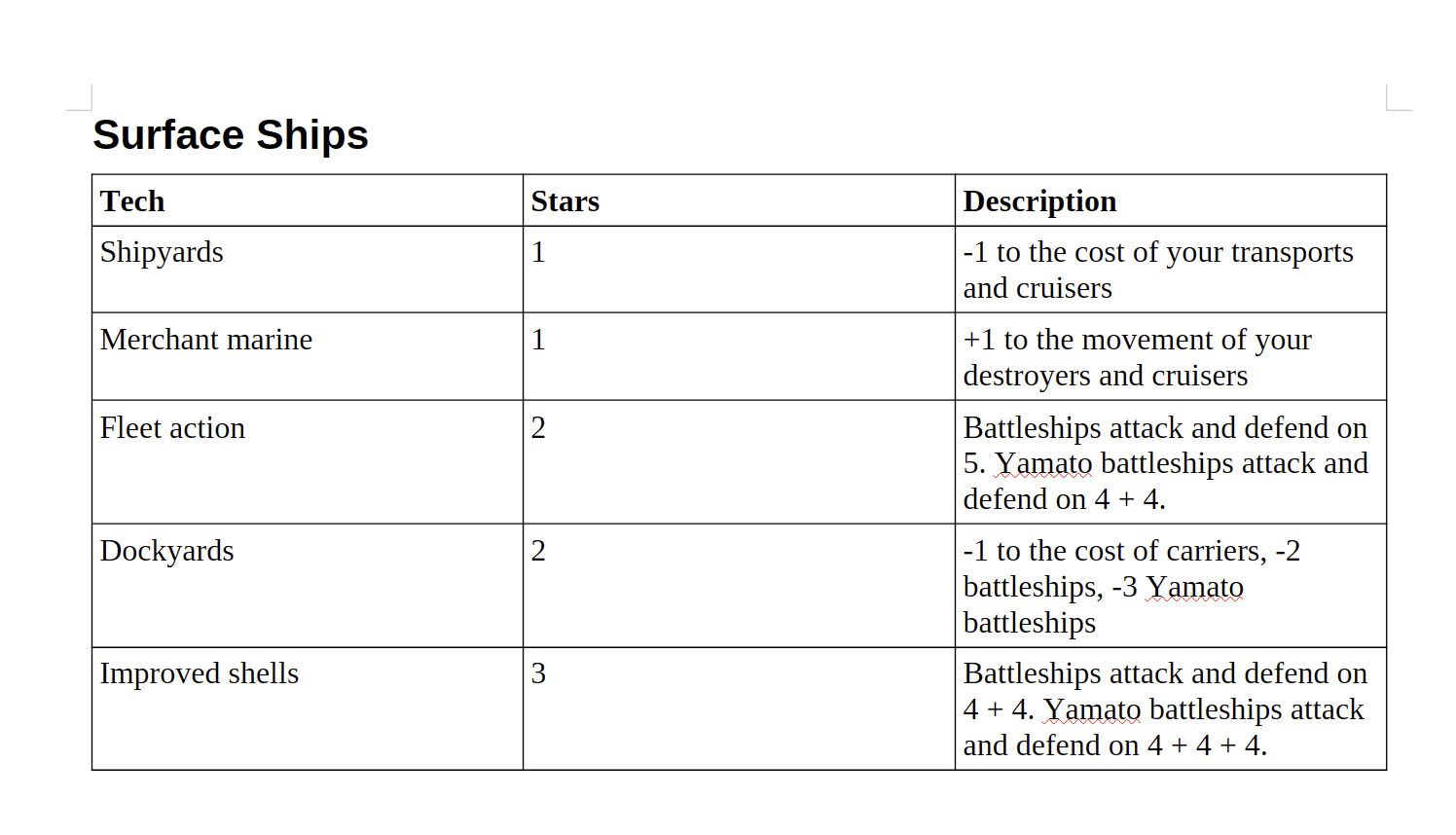
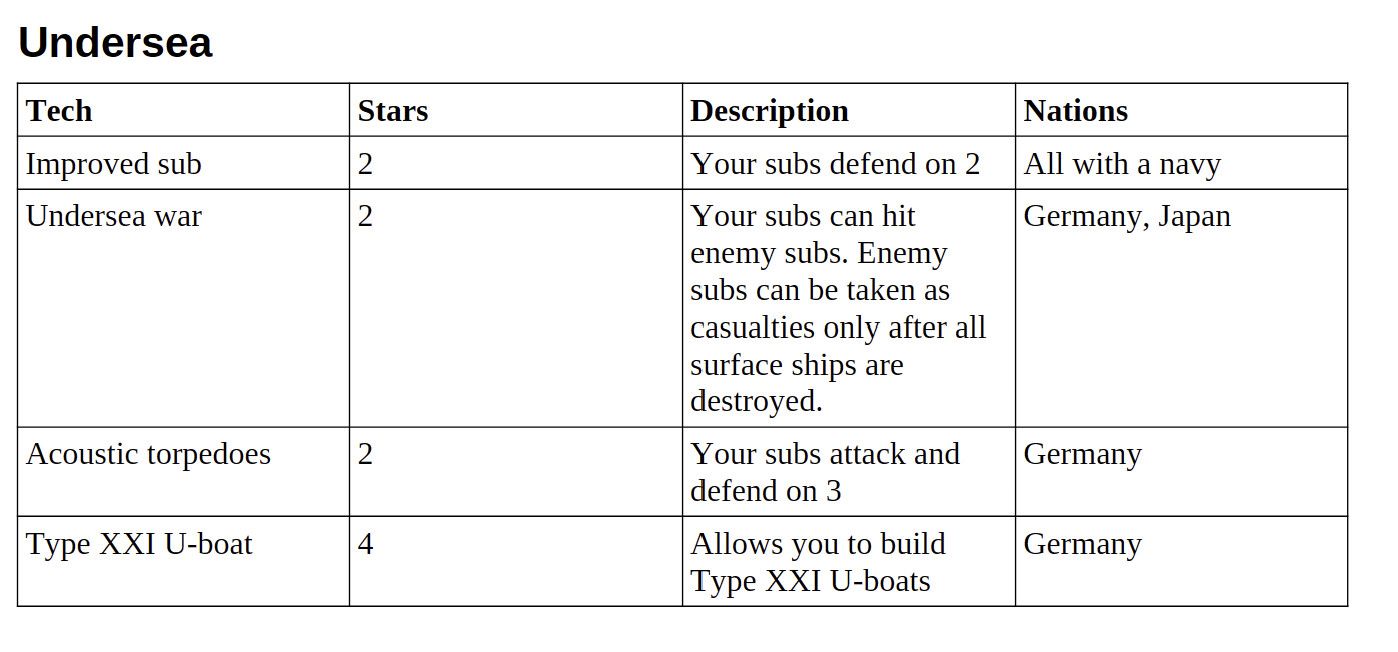
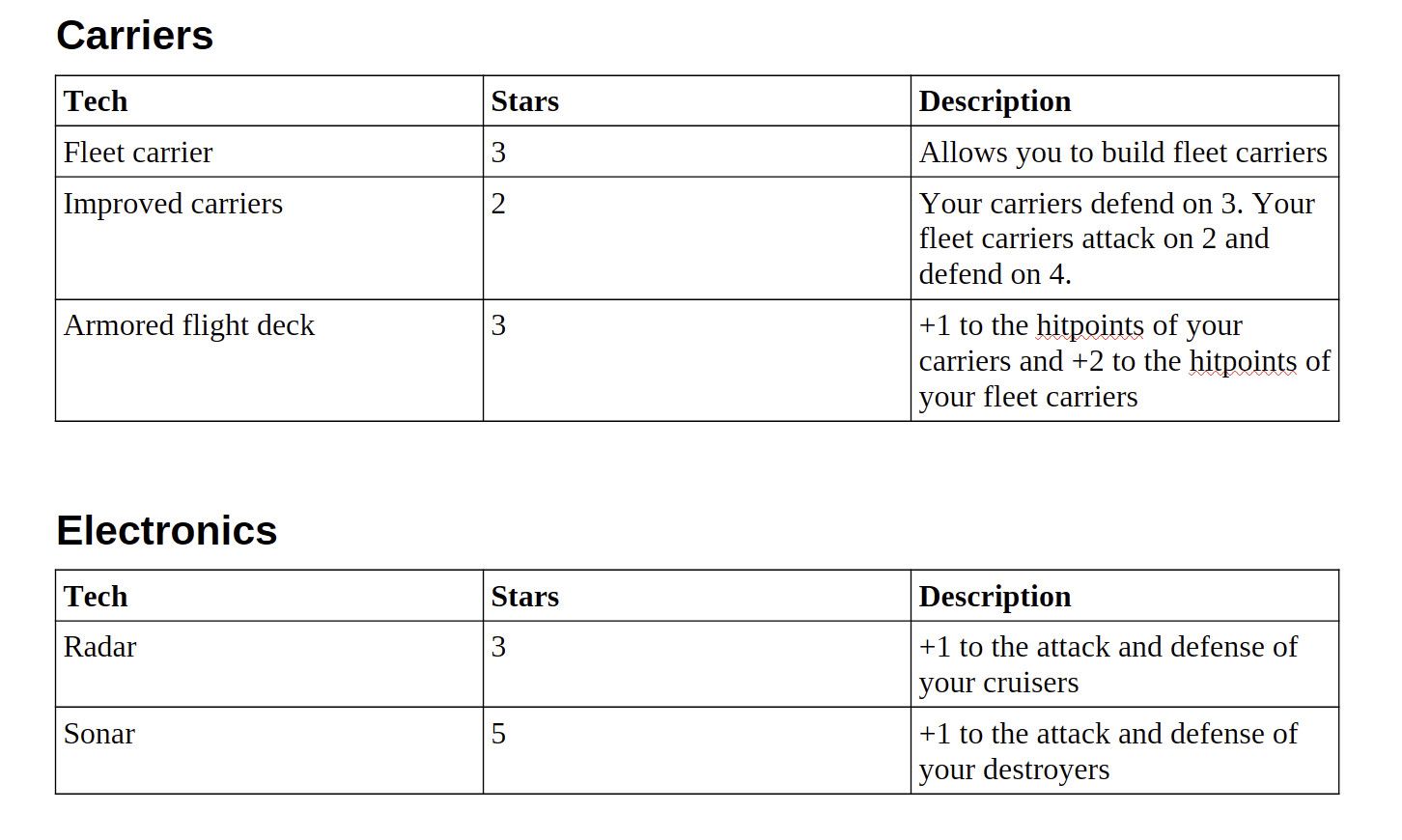
-
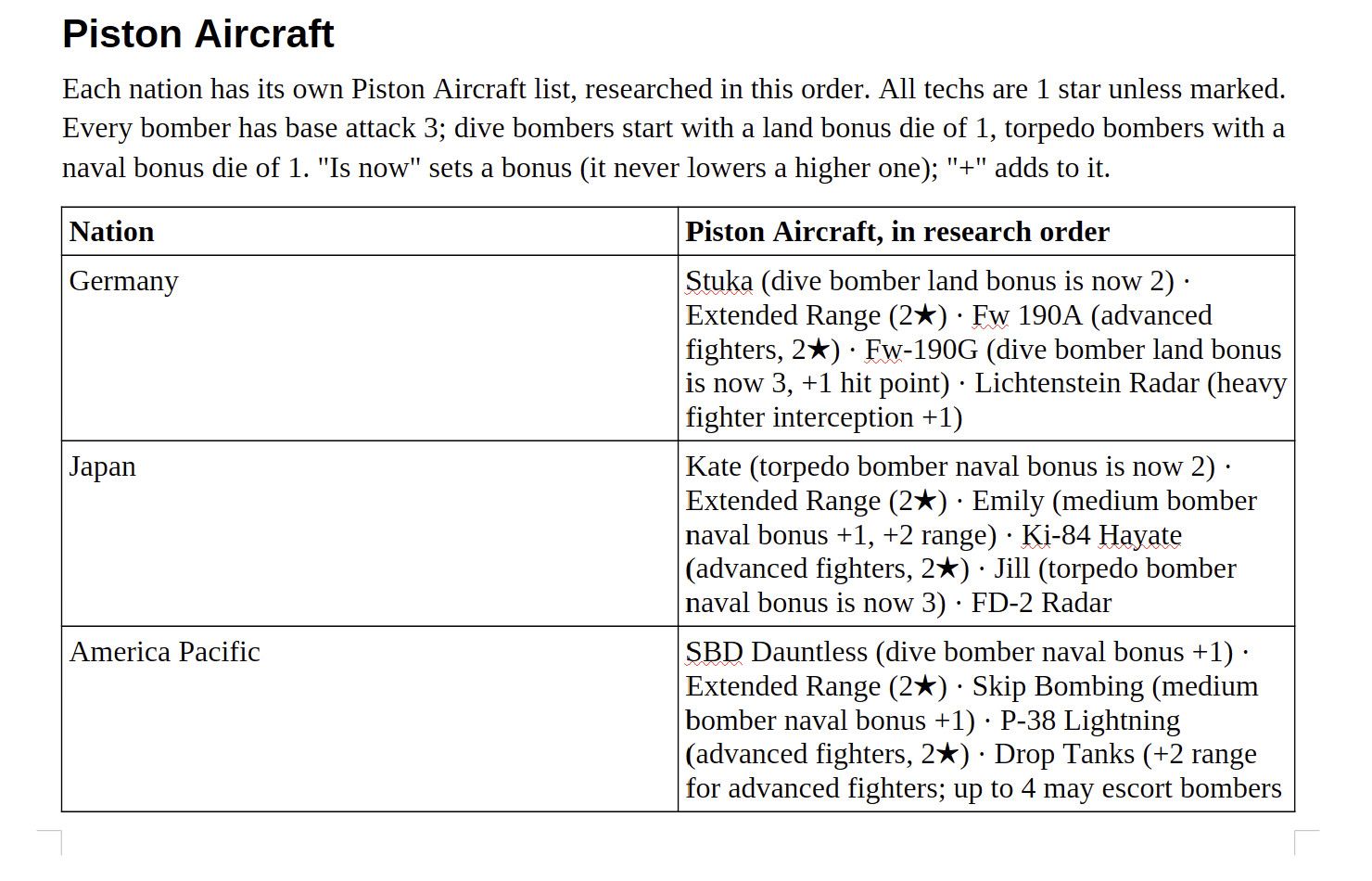
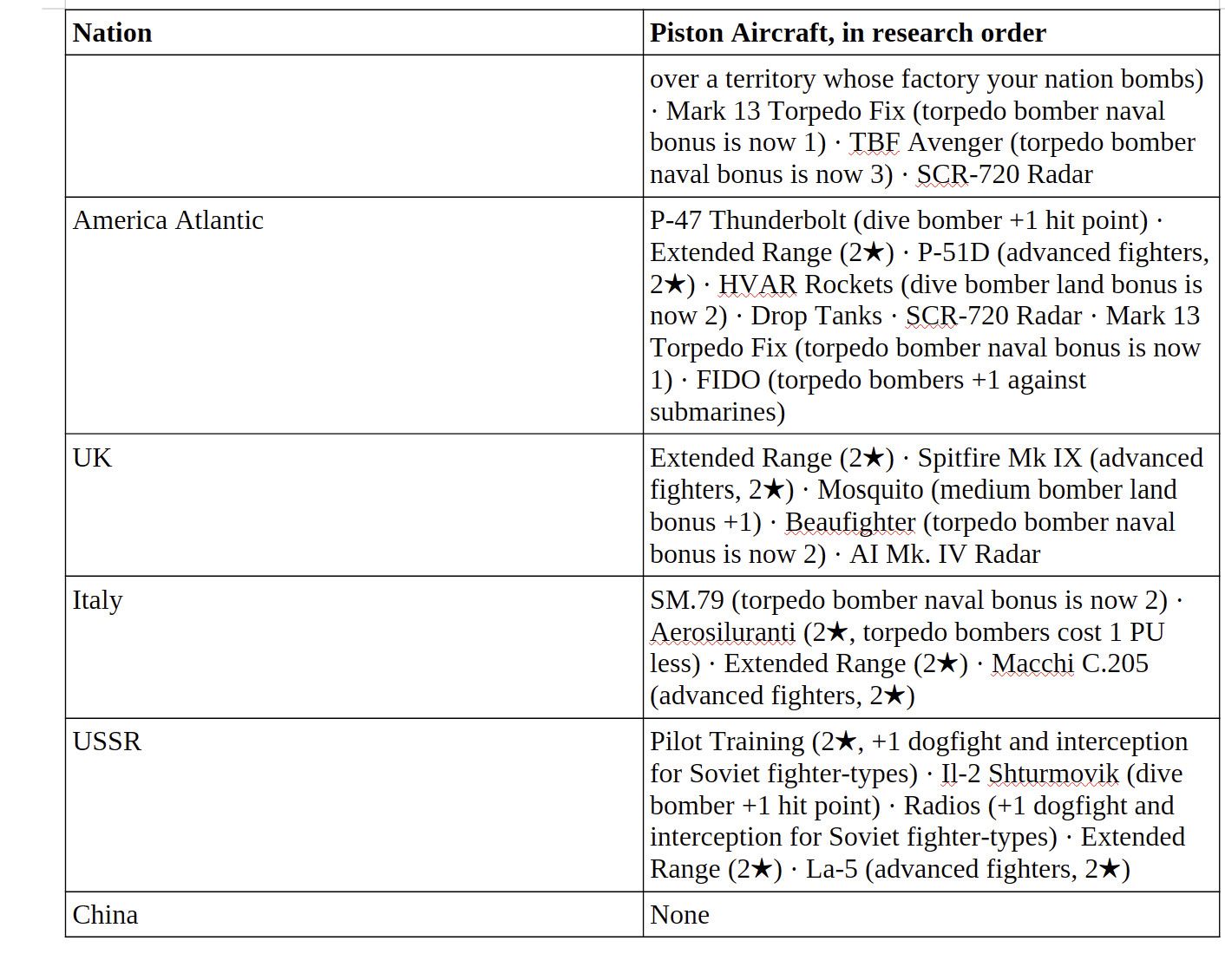

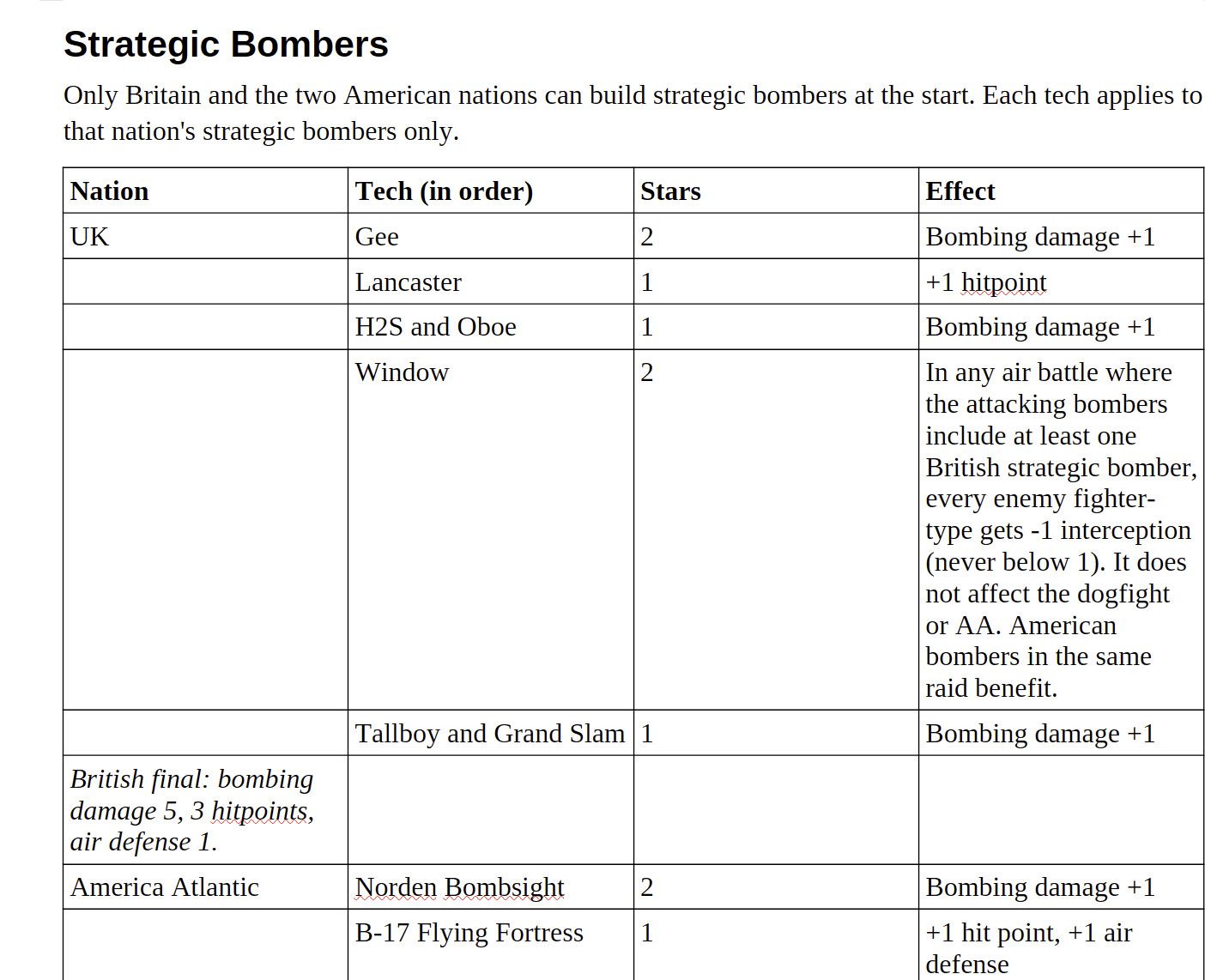
-
@KurtGodel7 Maybe having an option like in Classic (but historical) that the game can be started with techs already got? Meaning that, if that option is enabled, United States start with the B-17 tech already in the bag, and other players also have tech too if those tech were already got or mostly developed by the time the game starts?
(Even though the B-17 did very little in Pacific, it feels a bit wrong that is not going to be there as part of the Pacific forces, though I guess USA Atlantic can send B-17 in Pacific if wanted.)
-
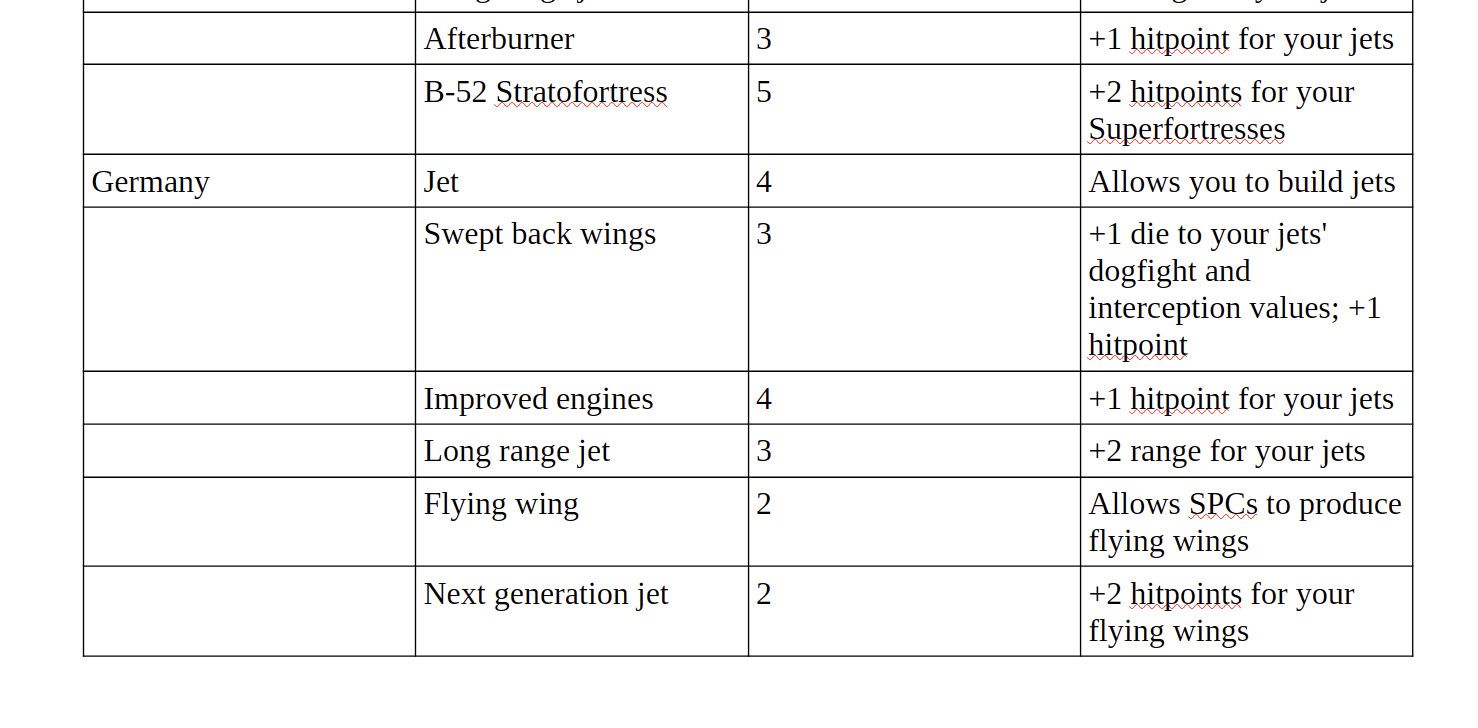
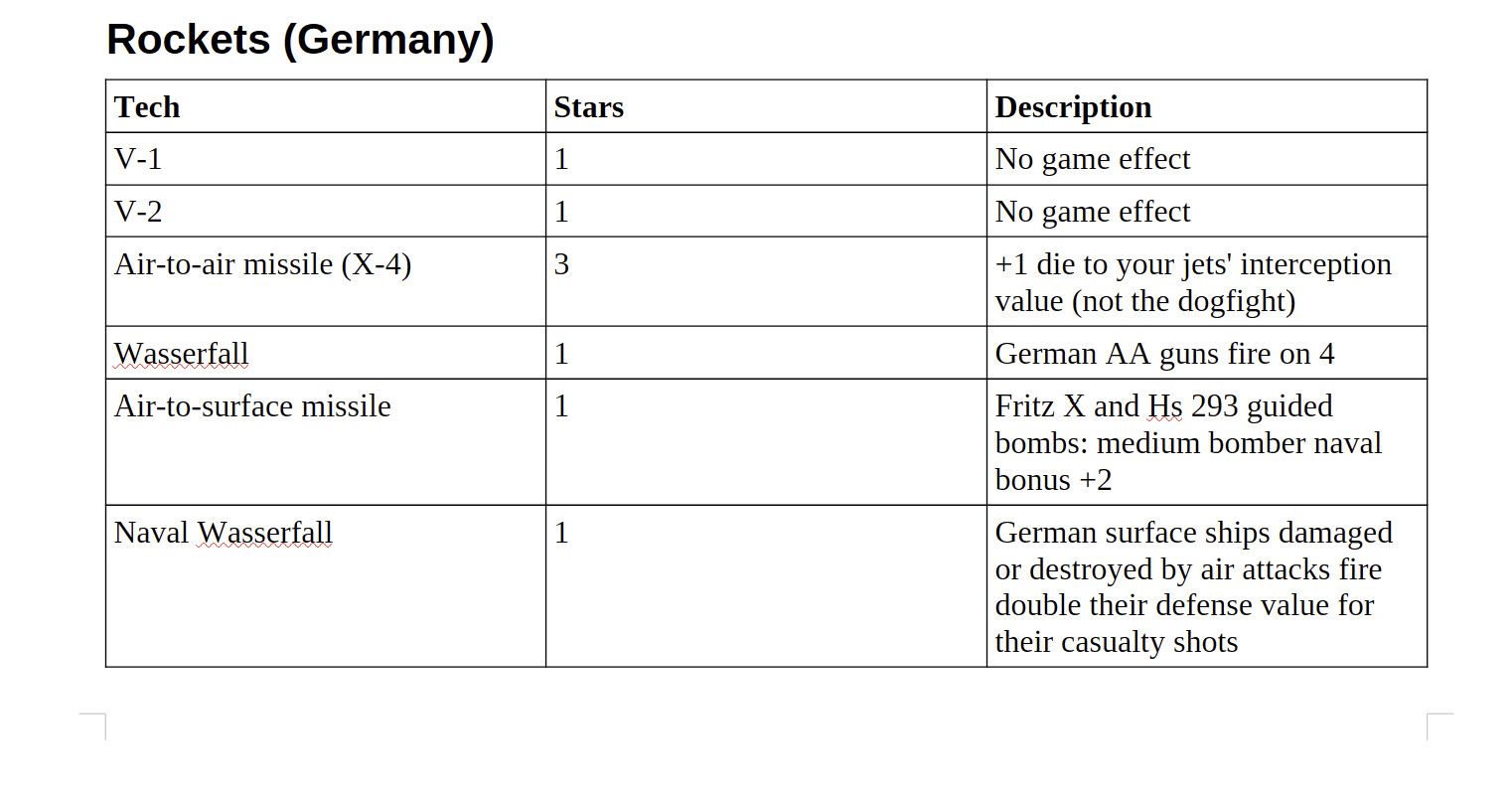
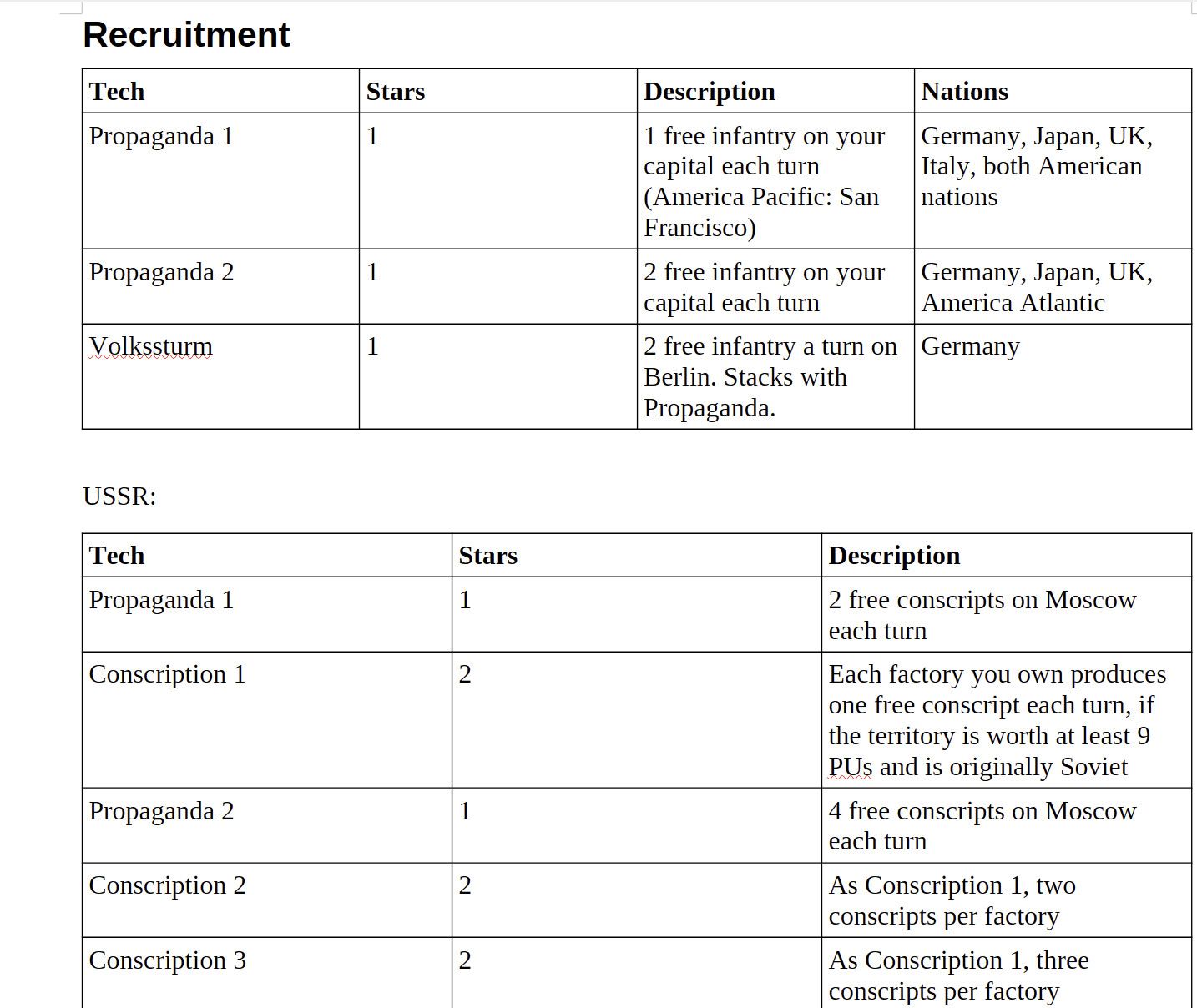
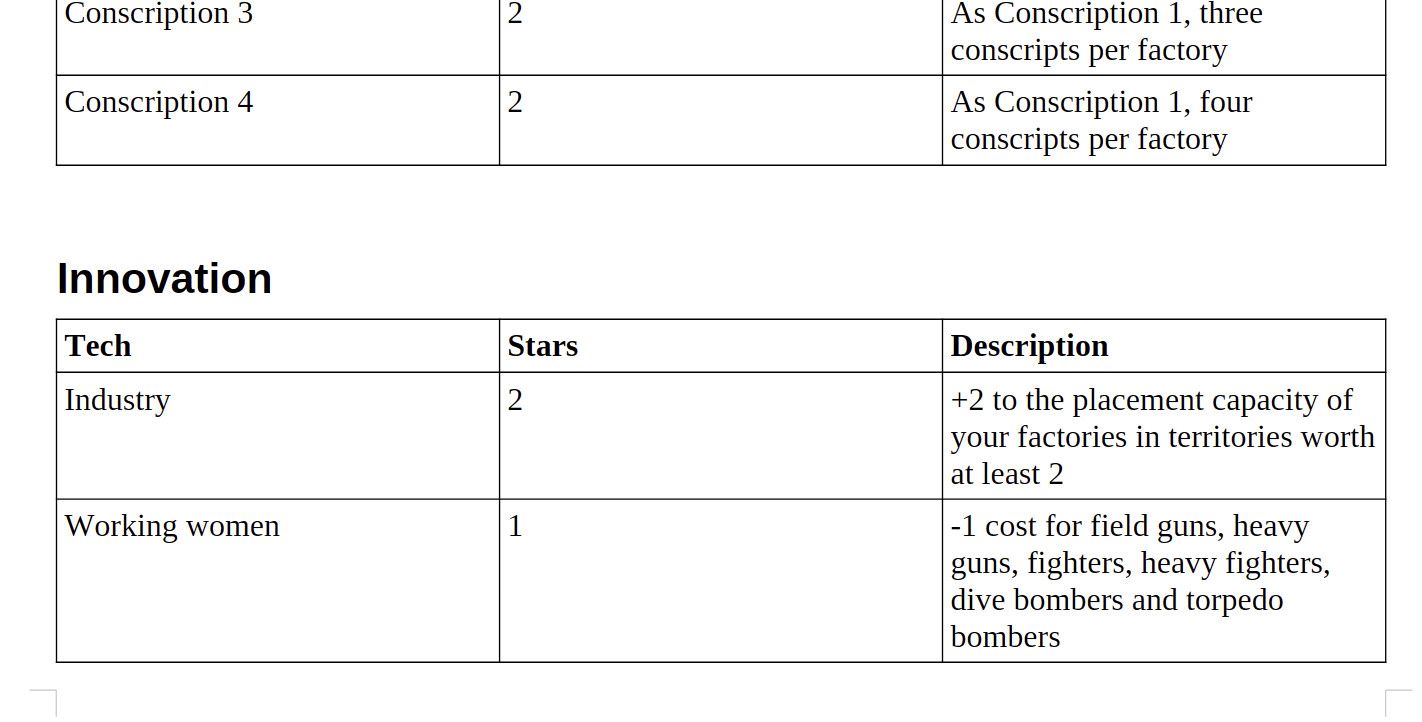
Apparently I've uploaded too many files at one time and should try again later. But the above is a lot of the techs.
-
@KurtGodel7 Sorry to repeat, but the B-17 was way more protected and protective than the Avro Lancaster. It was way harder to down a B-17 than an Avro Lancaster. I suggest it having +2 hit-points. (Also, the B-17 was some more of a fortress than the B-24, but the difference here is much less than with the much weaker Avro Lancaster.)
-
Apparently I've uploaded too many files at one time and should try again later. But the above is a lot of the techs.
Cool.
Rail Guns should definitely be Railway guns - they’re two rather different things

Mobile warfare and armored warfare make those two sound a little better
If you want some flavor on the Italian/Japanese tank unlock tech, use Carro Armato for Italy and Sensha for Japan (just means tank but in the local language).
Pershing tank could be M26 Pershing and Britain could use their A numbers (A22 Churchill, A34 Comet, A41 Centurion) if you want them to look a little more polished. KV-1 is a better fit than KV-2, lot more of the -1 were built.
Merchant Marine -> Propulsion Advancements (merchant marine sounds like transport tech)
Fleet Action -> Advanced Fire Control
Improved Sub -> Improved Submarines
Shipyards -> Shipyard Improvements
Dockyards -> Dockyard Expansion
Undersea War -> Undersea WarfareKate -> B5N Kate
Jill -> B6N Jill
Emily -> H8K Emily -
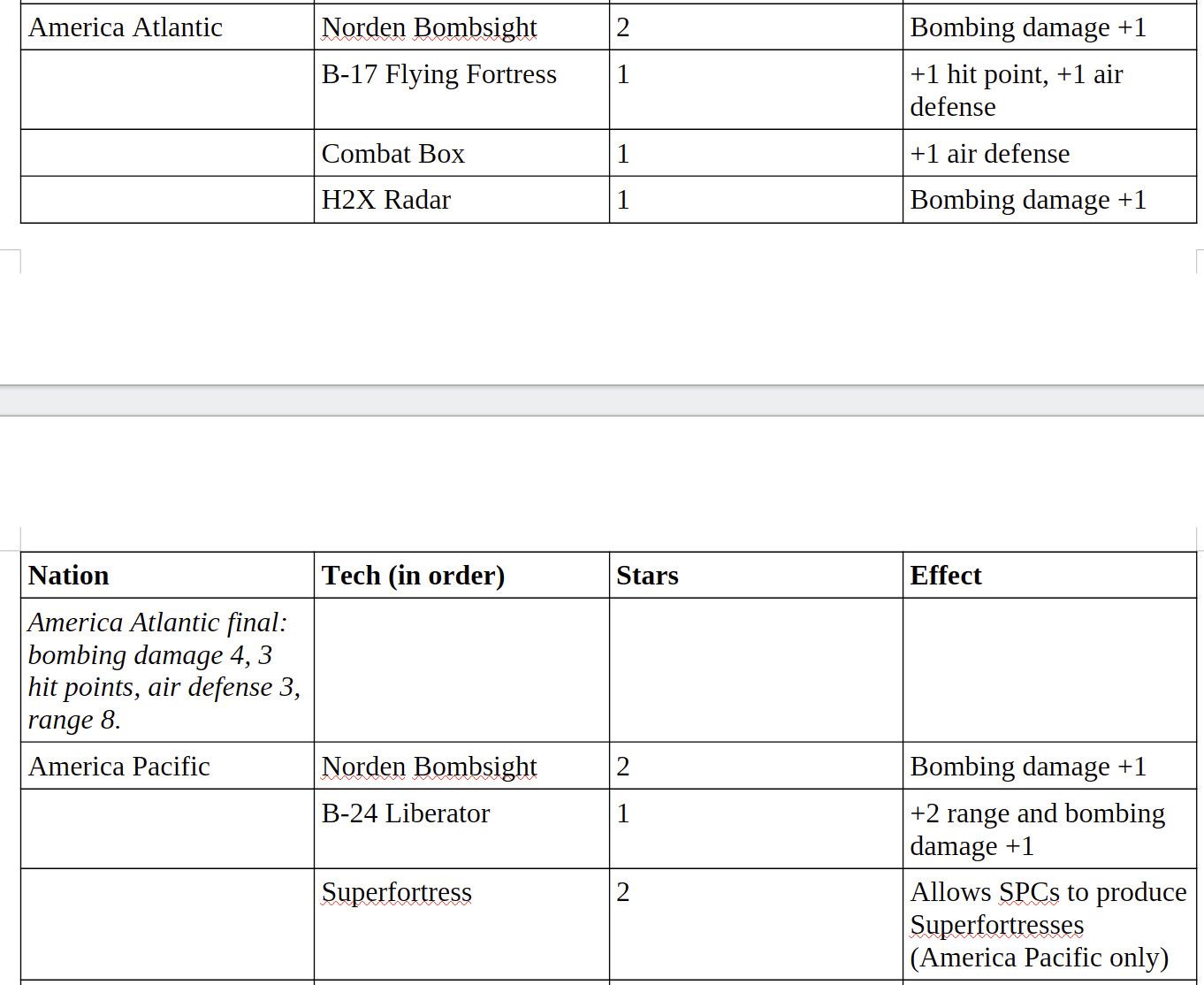
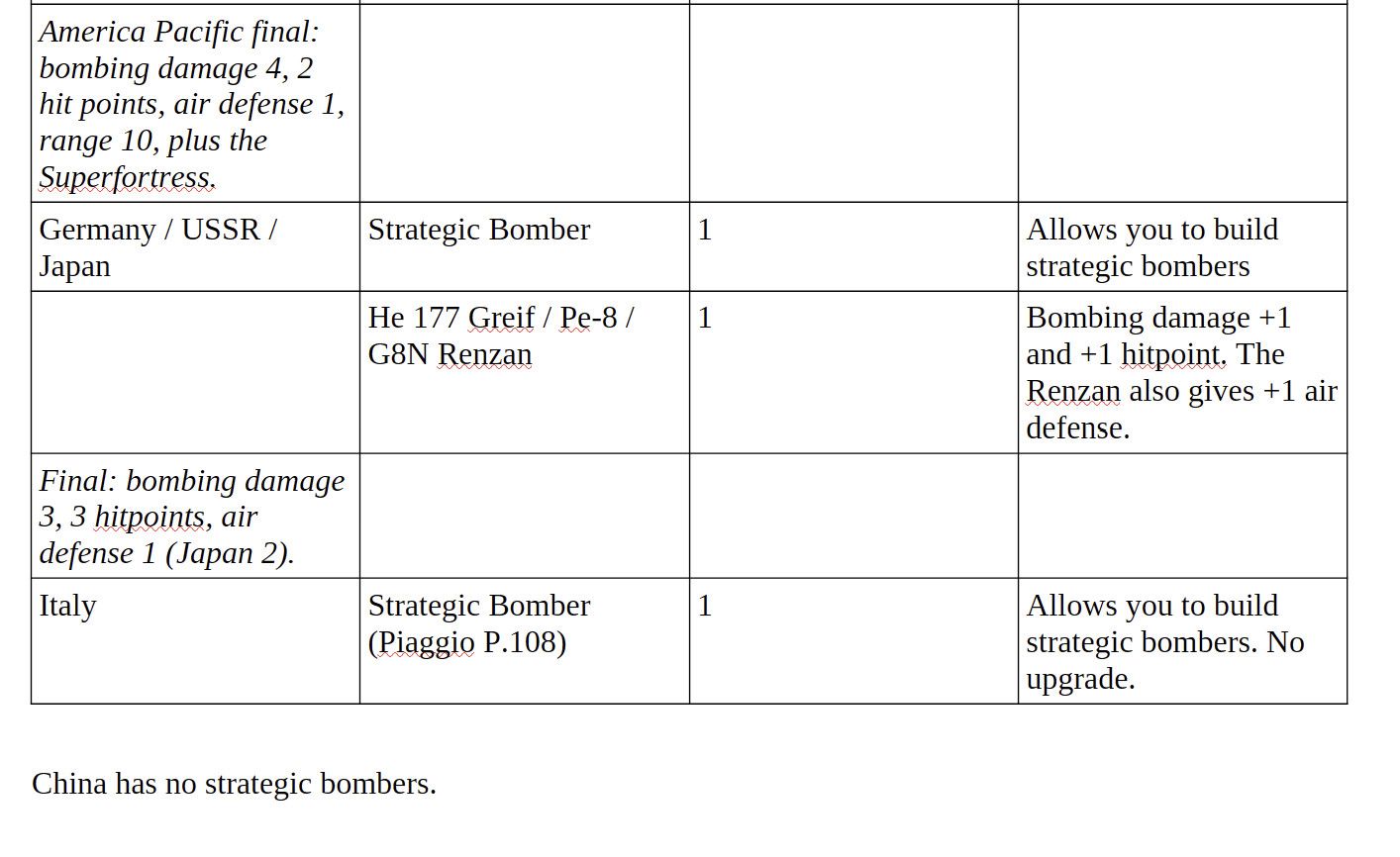
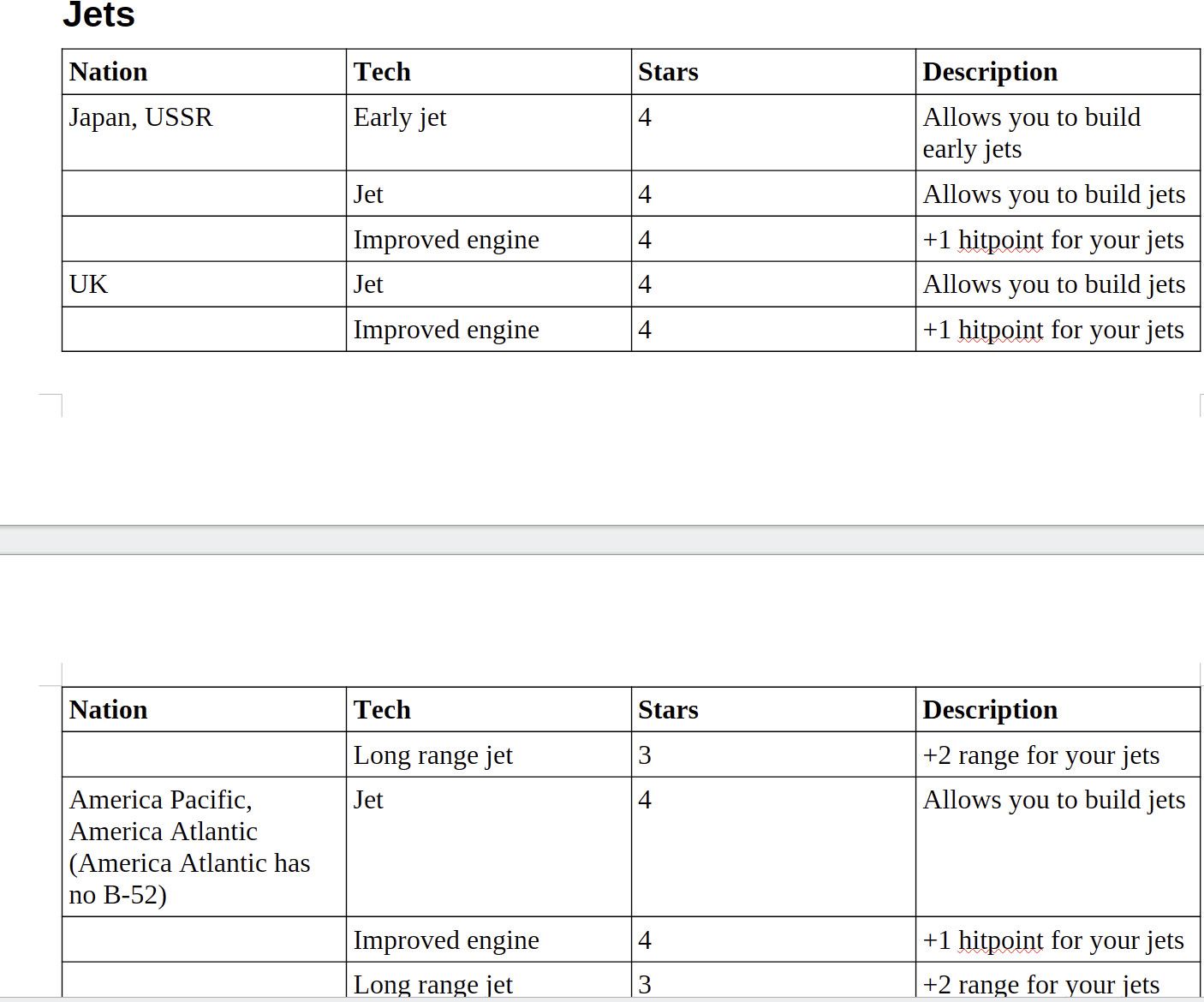
-
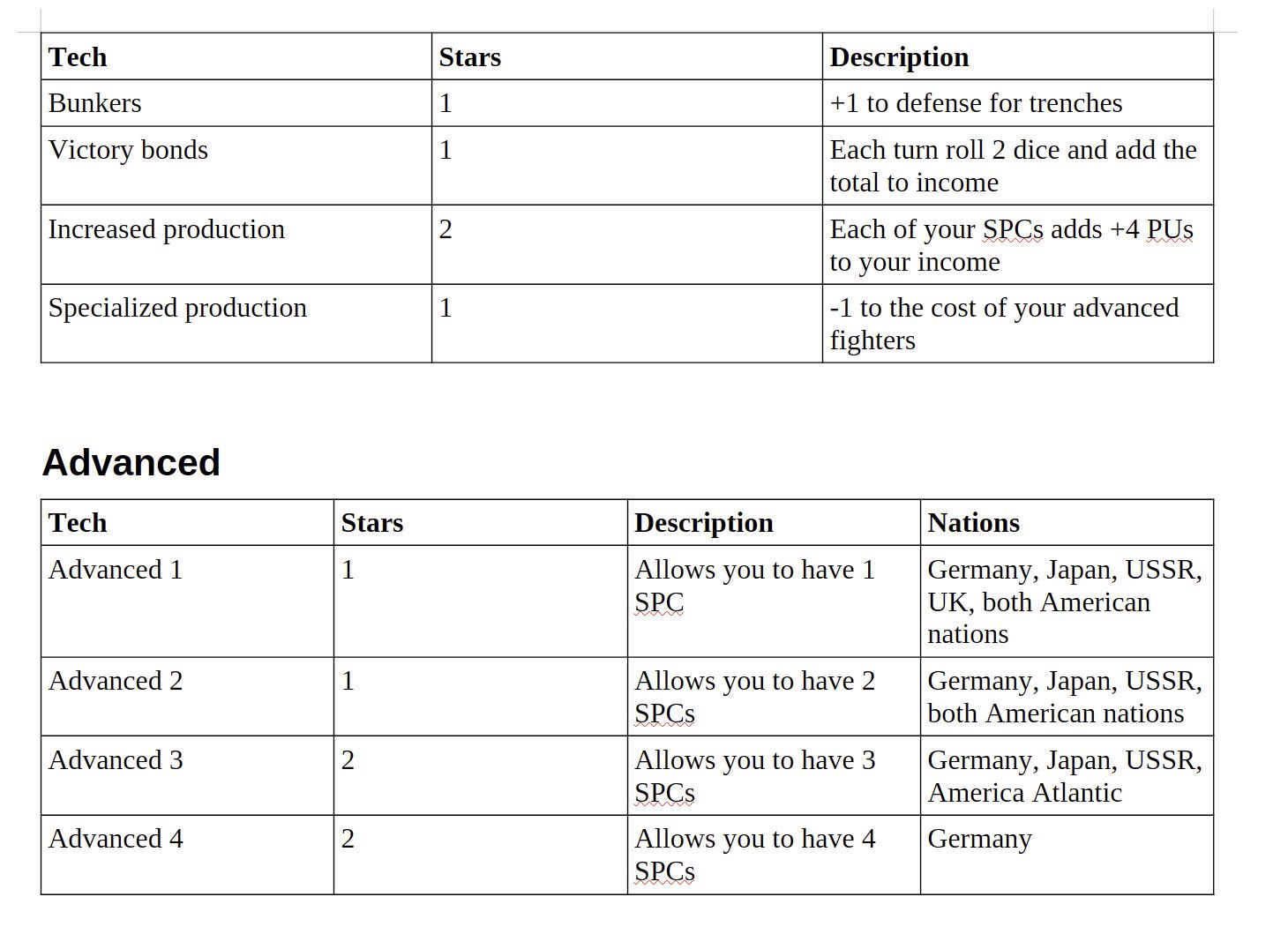
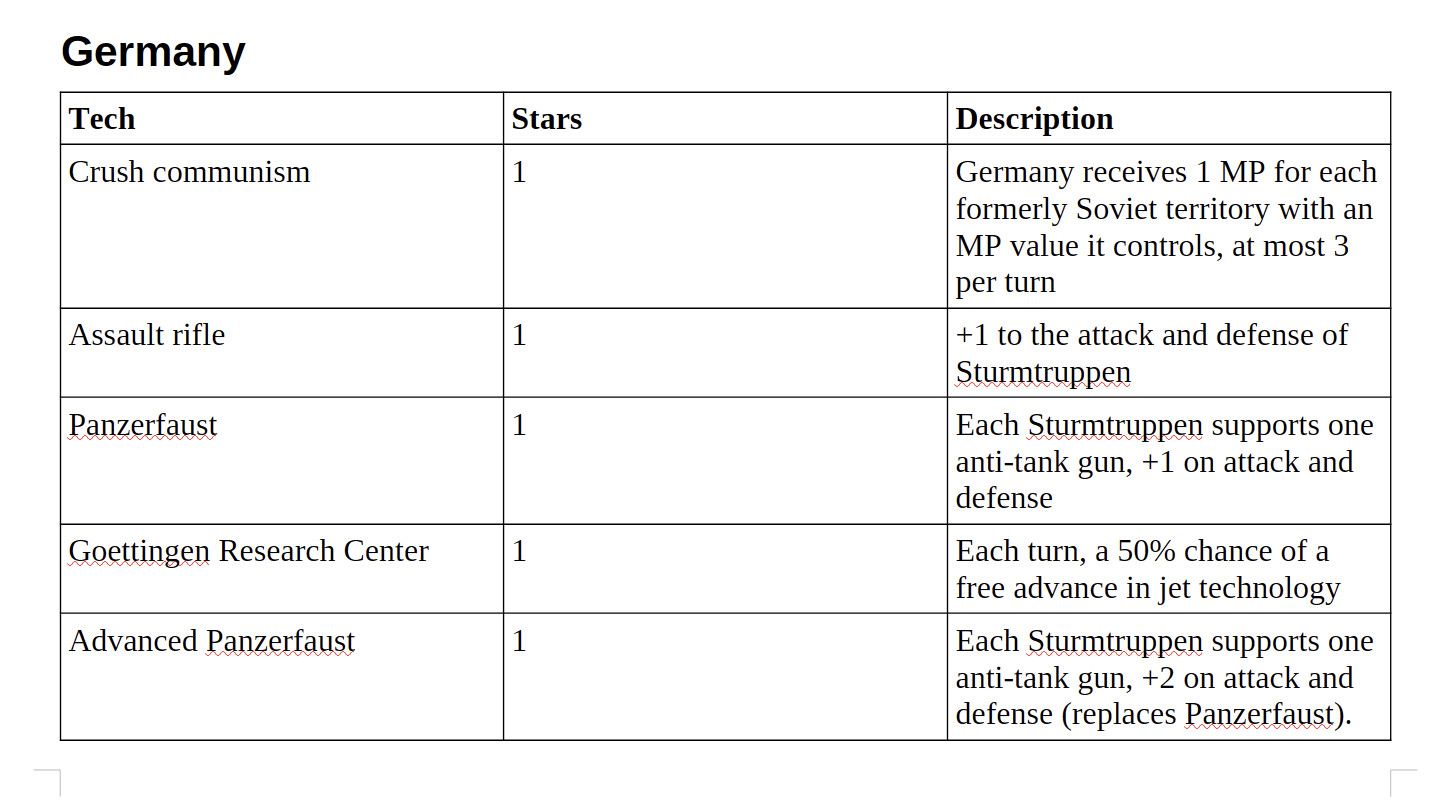
Upload limit reached.
-
Recent changes:
Created the "colonial militia" unit. This is for Britain only, and is basically a conscript by another name. Britain cannot build this unit. But by researching tech it receives this unit for free for India. Three per turn with the Raj tech. Once Britain researches Expand India Army (or whatever I decided to call that tech) it gets six of these a turn for free, on India.
@vendetta suggested better names for some of the techs. Rail guns tech is now railway guns. (Good call on that, btw.) Other tech names have changed as well, reflective Vendetta's suggestions.
@cernel suggested the idea of starting the game with certain techs already researched, much like Classic would do depending on the option you chose. I have this on my list of needed changes.
@schulz suggested changes to the map itself, and provided example maps to use. I devoted precious weekly usage to this task. (Even though I was already at 40% of weekly usage just 24 hours into my week.) I have had AI alter the Europe/Mediterranean/West Russia part of my map using the example Schulz provided.
Earlier in this thread someone mentioned an incorrect border in Europe, which I think is now fixed. But there is also the problem of territory labels: West Prussia, Posen, etc. The problem I'm running into is that I want a territory to have the name Danzig, given the importance of Danzig to the start of the war. Labeling a territory Danzig maybe displaces where you might want the West Prussia label, so then the latter finds its way into the second-best location.
@cernel wants the differences between the Lancaster, Flying Fortress, and Liberator to be accurately reflected in the stats for those three bomber types. Claude believes this is already achieved by current unit stats. I will have to double check Claude on this. America Pacific gets the Liberator, America Atlantic gets the Flying Fortress, and Britain of course gets the Lancaster.
Light tanks were too easily confused with tanks, so I've used scout car logo art for light tanks. I hate doing that, but if I'm confused by a light tank icon versus a normal tank icon, other people will be confused too.
The reason why I consumed so much weekly usage so quickly was in large part to fix GUI problems associated with changes to the air system. Those GUI problems appear to be solved.
-
@KurtGodel7
Hilfswilliger was the name for the local auxiliaries that Germany recruited in Russia, would be a good fit for "Crush communism."Panzerschreck for Advanced Panzerfaust?
Sturmgewehr for assault rifle
The B-52 is way too far ahead of the timeline, didn't enter service until the 1950s. Use the B-45 Tornado, that was America's earliest jet bomber.
Go 229 is the flying wing model.
-
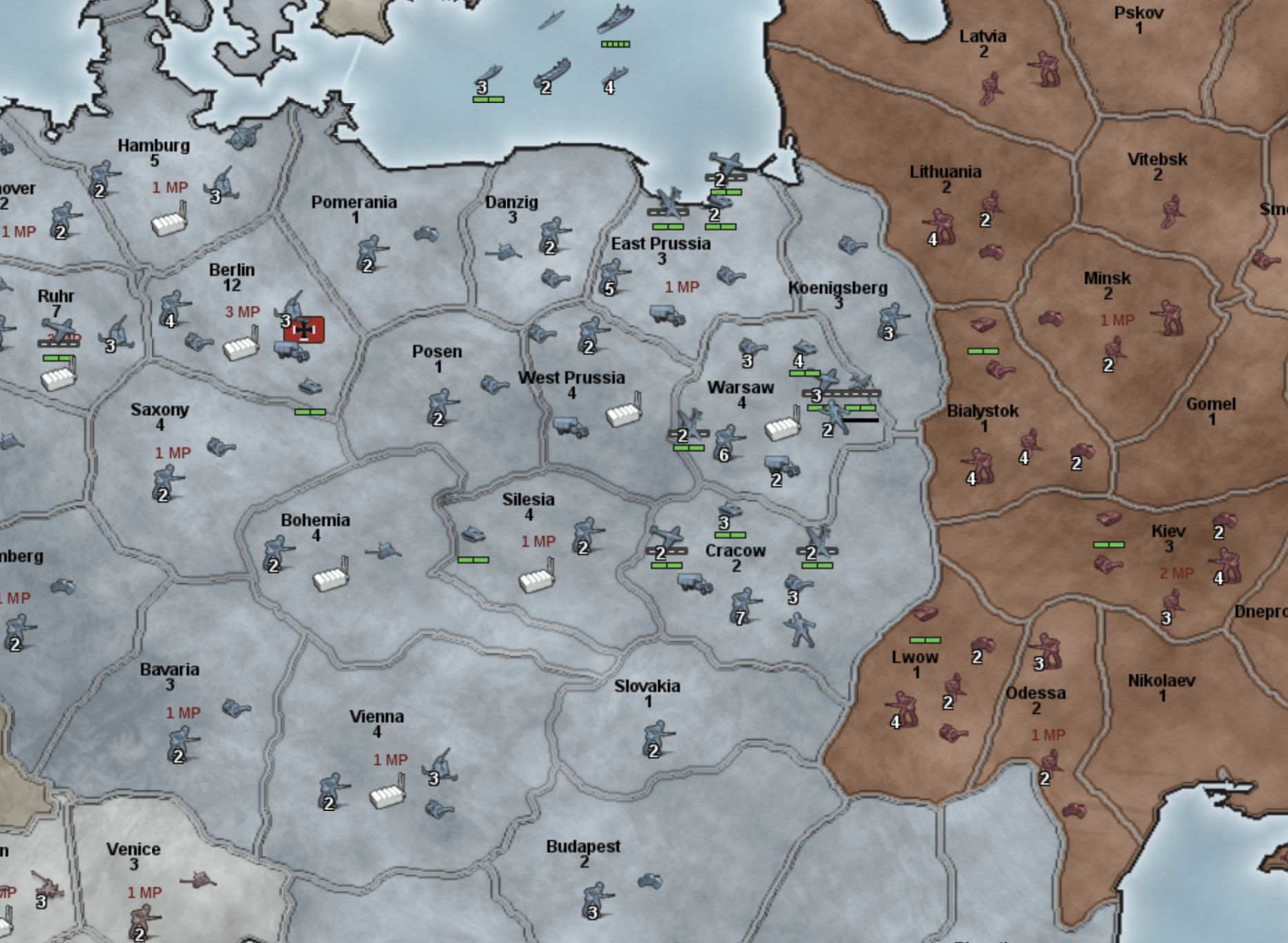
What Claude had to say about territory names:
Renaming Pomerania to West Prussia: I’d advise against it. Your map’s Pomerania sits on the coast just northeast of Berlin and west of Danzig. That’s the Stettin–Köslin area, which really was the Prussian province of Pomerania. West Prussia was the Vistula region around Danzig, Thorn and Bromberg, south of Danzig and west of Warsaw. That’s exactly where your West Prussia territory already is. Only one of your names is debatable: the coastal strip between Danzig and Koenigsberg (Elbing, Marienburg) was West Prussian before 1920 and became part of East Prussia from 1920. For a 1941 map, “East Prussia” is right.
Hello! It looks like you're interested in this conversation, but you don't have an account yet.
Getting fed up of having to scroll through the same posts each visit? When you register for an account, you'll always come back to exactly where you were before, and choose to be notified of new replies (either via email, or push notification). You'll also be able to save bookmarks and upvote posts to show your appreciation to other community members.
With your input, this post could be even better 💗
Register Login