Flames and Steel (official thread)
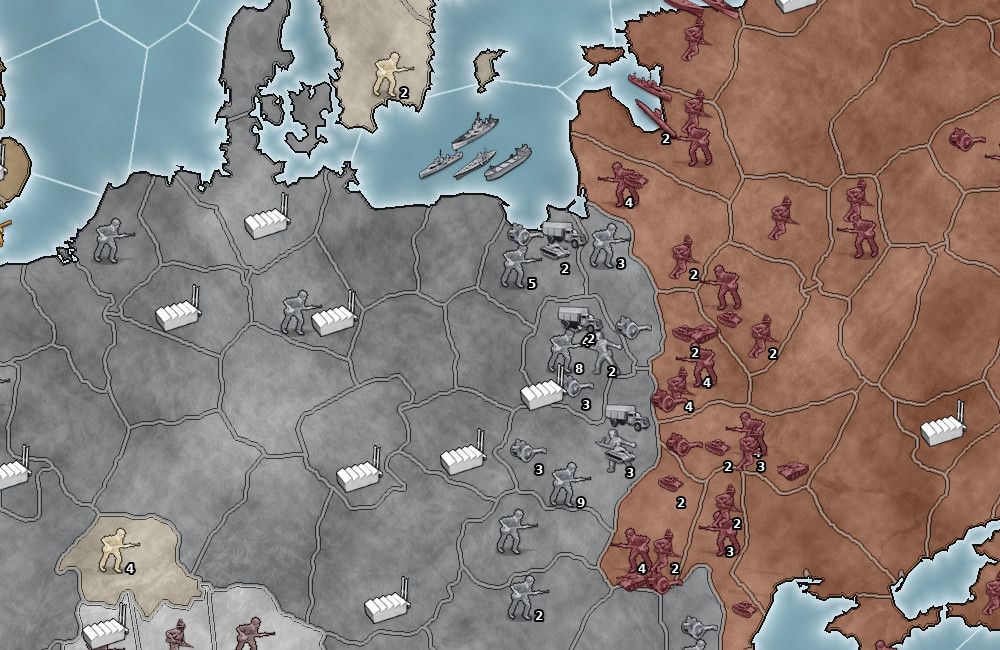
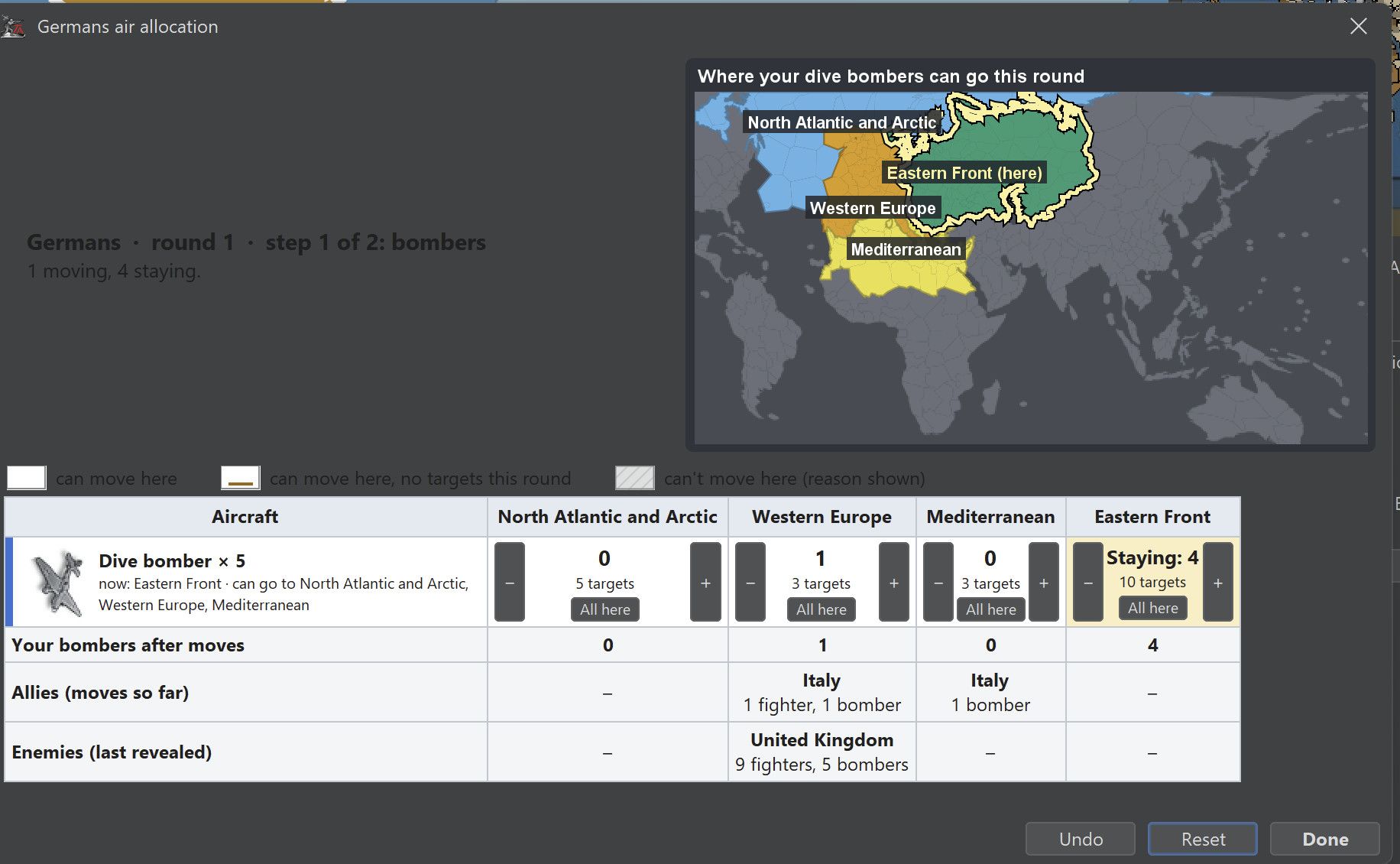
-
If I recall correctly, he doesn't have an actual Bunker unit, it's a Trench one that takes hits adds defense to other units, but it doesn't actually shoot.
Giving land units the ability to hit ships is something that has to be handled very carefully because of the cost ratios. If they can be built cheaper and spammed faster than warships, anti-ship defenses will end up becoming unassailable.
The only case in TRO where I decided to give a land unit a ship-hitting ability was Italy's Marines with a Decima MAS tech, where it's an offensive action they can only do on their turn, not an anti-invasion defense.
If you want to have any sort of coastal artillery unit that hits ships, it needs to be balanced by either high price, low hit probability, or a strict stacking limit per territory that allows fleets to outscale it.
The Europe map honestly looks pretty good at this point, I think it would probably be more productive to move on to improving other WIP areas since you're relying heavily on Claude usage.
In a recent test game, Britain had a large fleet of transports. Germany had four hard points to prevent invasion. Britain didn't need to overcome a hard point to invade: there were other places along the coast for it to unload its units.
But, let's say I introduced coastal guns, as well as the associated game mechanic. That creates a race between Germany and Britain. If Germany wins the race (that is, if its coastal guns are stronger than Britain's battleships), Britain will just unload/invade a territory that isn't a hard point. Problem solved. Germany just tied down a lot of PUs into coastal guns which could otherwise have been spent on its eastern front. But, suppose Britain builds a strong battleship fleet, and those battleships can exert more force than the coastal guns at a given hard point. Britain's response should be to unload one unit as an invasion. The goal would be to trigger a combat between the battleships and the coastal guns, with the British player knowing this would do more PU damage to Germany than to Britain.
To avoid this problem, some would say I should limit the number of battleships which can fire at coastal guns to the number of units actually invading. Drop off only one infantry? Only one battleship gets to fire at the coastal guns, but all the coastal guns get to fire at the battleships.
Suppose Britain has 10 battleships, and drops off 10 infantry. This triggers full combat between the battleships and the coastal guns. Germany loses some coastal guns, Britain doesn't lose any battleships. Then there is combat. The infantry don't get to fire on the first round (arriving amphibiously), and they won't survive until the second round. But, the battleships get to bombard. Assume those 10 battleships inflict 6 hits. Sticky hits, so those 6 hits kill 3 German trenches. At the cost of 10 infantry, Britain has taken away 3 trenches plus some coastal guns.
Don't get me wrong. All of this would be a cool thing to add to the game. I just don't know that the game needs any additional complexity at this point.
-
@KurtGodel7 The coastal guns honestly sound like more more trouble than they're worth in order to get the balance right. Unless you think it'd be a really fun enhancement to the gameplay that you're determined to see through, it's probably safe to skip it and just give the invaders the round one penalty you have in mind.
Off the top of my head, the only major WWII warships I can recall being sunk by coastal forts were the cruisers Blücher and Königsberg during the invasion of Norway. Realistically, coastal defense batteries should be able to deter small raids, but not pose a serious threat on their own to a large invasion fleet.
But, suppose Britain builds a strong battleship fleet, and those battleships can exert more force than the coastal guns at a given hard point. Britain's response should be to unload one unit as an invasion. The goal would be to trigger a combat between the battleships and the coastal guns, with the British player knowing this would do more PU damage to Germany than to Britain.
If you want to avoid this kind of cheese, you might be able to turn the Coastal Battery into a building instead that doesn't get shot at in combat but does get captured if the province is taken. That would also be a natural way to put a one per zone limit on its placement. It could have AA style fire (1 die each at up to 3 ships, or however many targets you think is right).
If you think Claude can write some more complex rules, you could have the BBs take bombardment shots at the Coastal Battery first - if they score enough hits, they don't destroy it, but instead suppress it, and prevent it from firing. You could have the degree of suppression scaled to the number of hits it takes.
For instance, you've given the Coastal Battery shots at 4 targets by default. The British BBs arrive and bombard first - they score 2 hits, so now the Battery only takes 2 shots at enemy ships.
Making it a building also allows it to be a strategic bombing target, giving the enemy an alternative way to deal with it instead of just sending their ships in to slug it out head to head.
-
America Atlantic's turn, round 7.
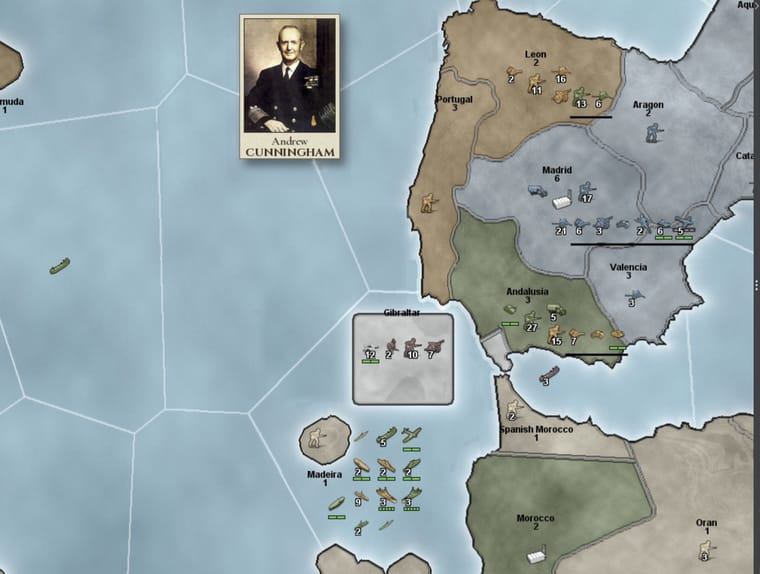
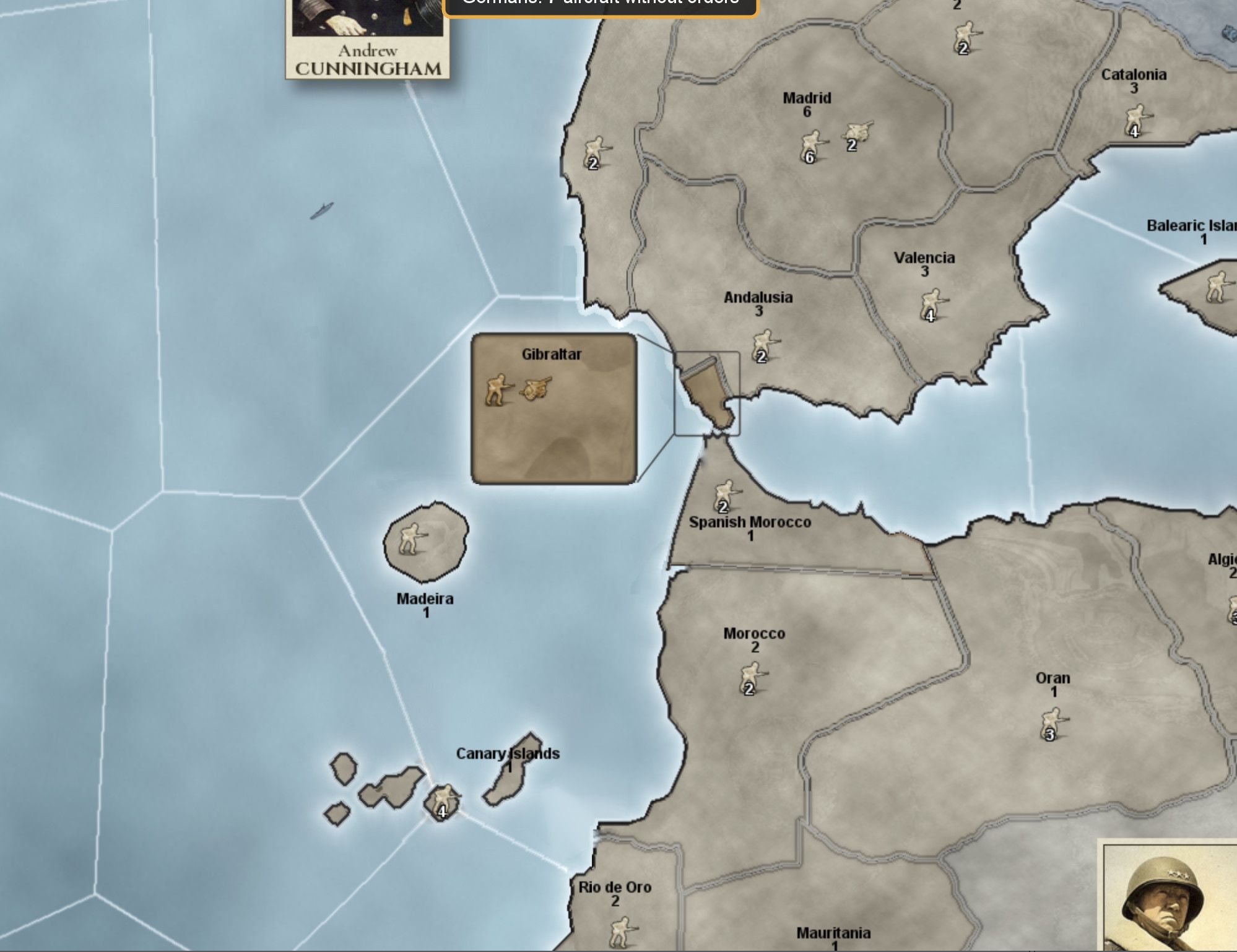
Note that the British and Atlantic Americans are exerting good pressure on Spain. Italy has turned Gibraltar into a hard point. The Gibraltar territory itself was too small for many unit stacks, so there is a box to the left of the Gibraltar territory to indicate its units. Note that Italy's units are defensive: trenches, heavy guns, a few infantry or conscripts. America Atlantic gets an income nerf. It receives 30% of its true income on round 3, 40% on round 4, and so forth, until eventually growing to 100% of its income.
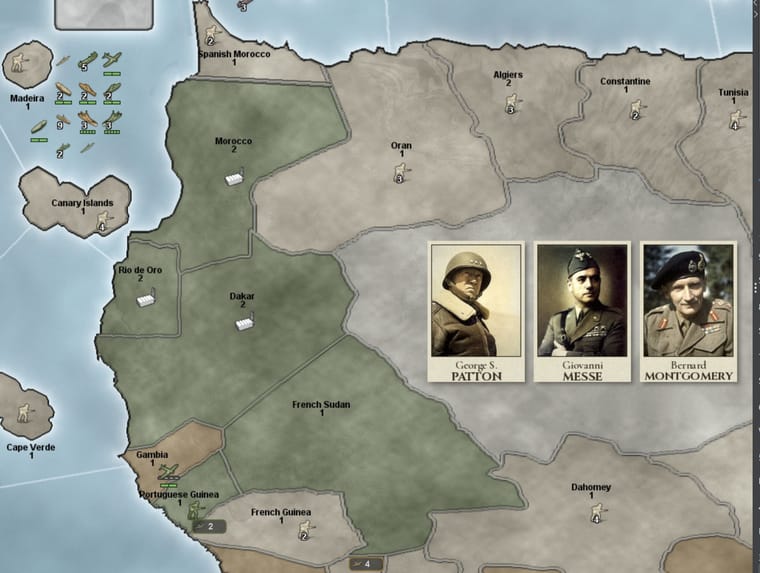
The thing to note of this screen shot is that America Atlantic already has three factories in northwest Africa. Also it has discovered Industry tech. That means that each factory has +2 to its unit placement capacity, so long as the underlying territory is worth at least 2.
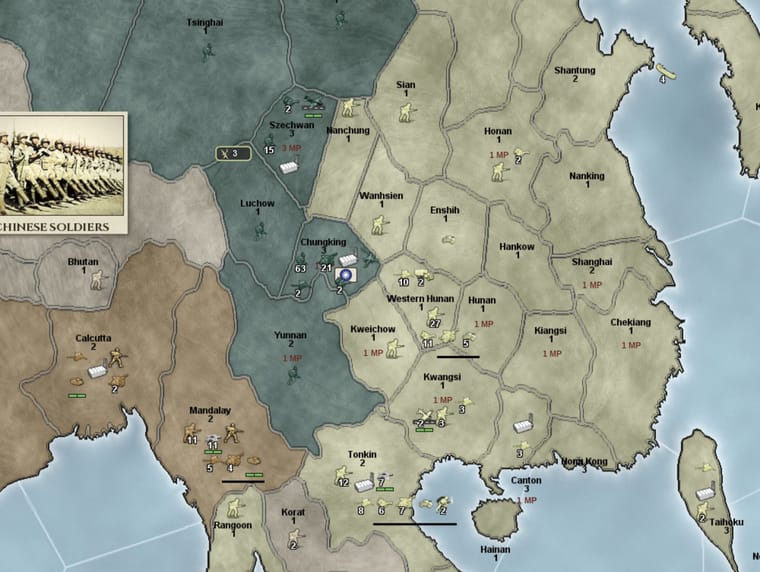
Over in Asia, things seem to have gotten a little stagnant. Japan has thoughts of breaking through in China or against the British, but both tasks are proving tougher than expected.
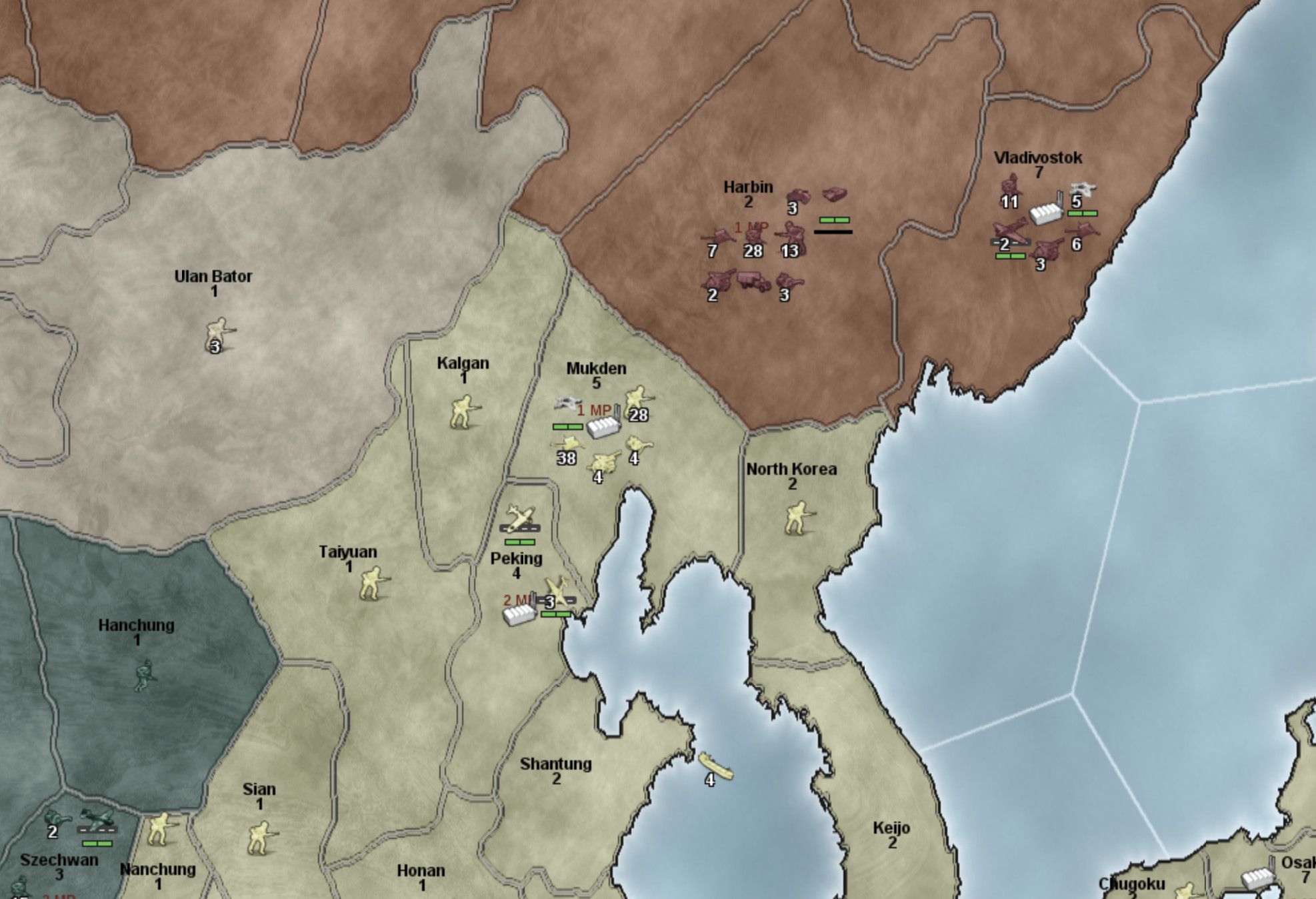
The source of Japan's problems in the north is the Soviet factory in Vladivostok. If Japan could crack that, it could conquer significant land area in the eastern Soviet Union. But that will be a tough nut to crack.
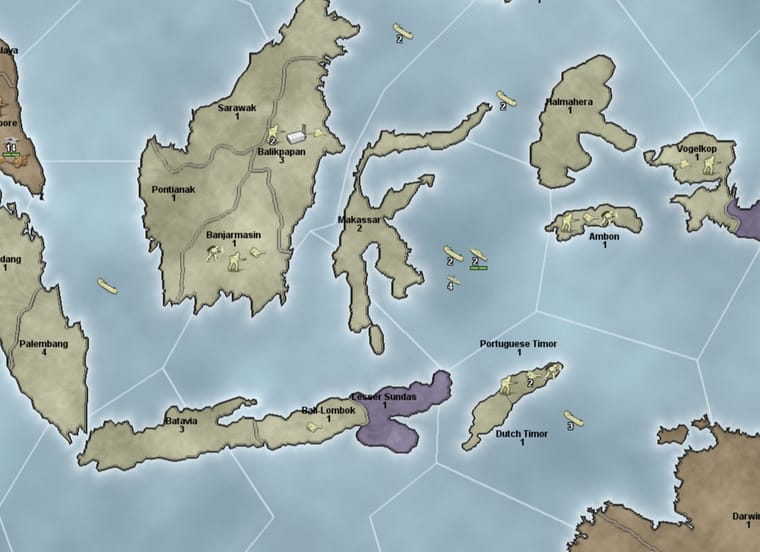
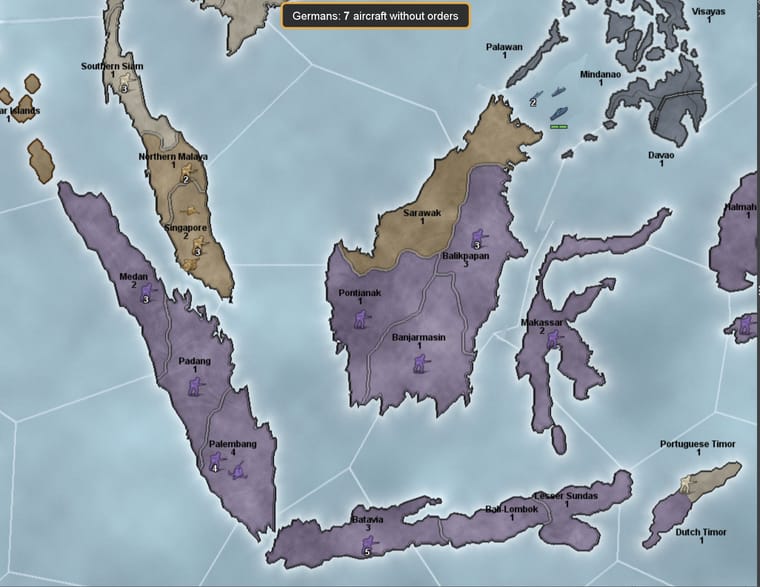
Japan has conquered most of the East Indies. It hopes this income will let it achieve a breakthrough on at least one of its fronts.
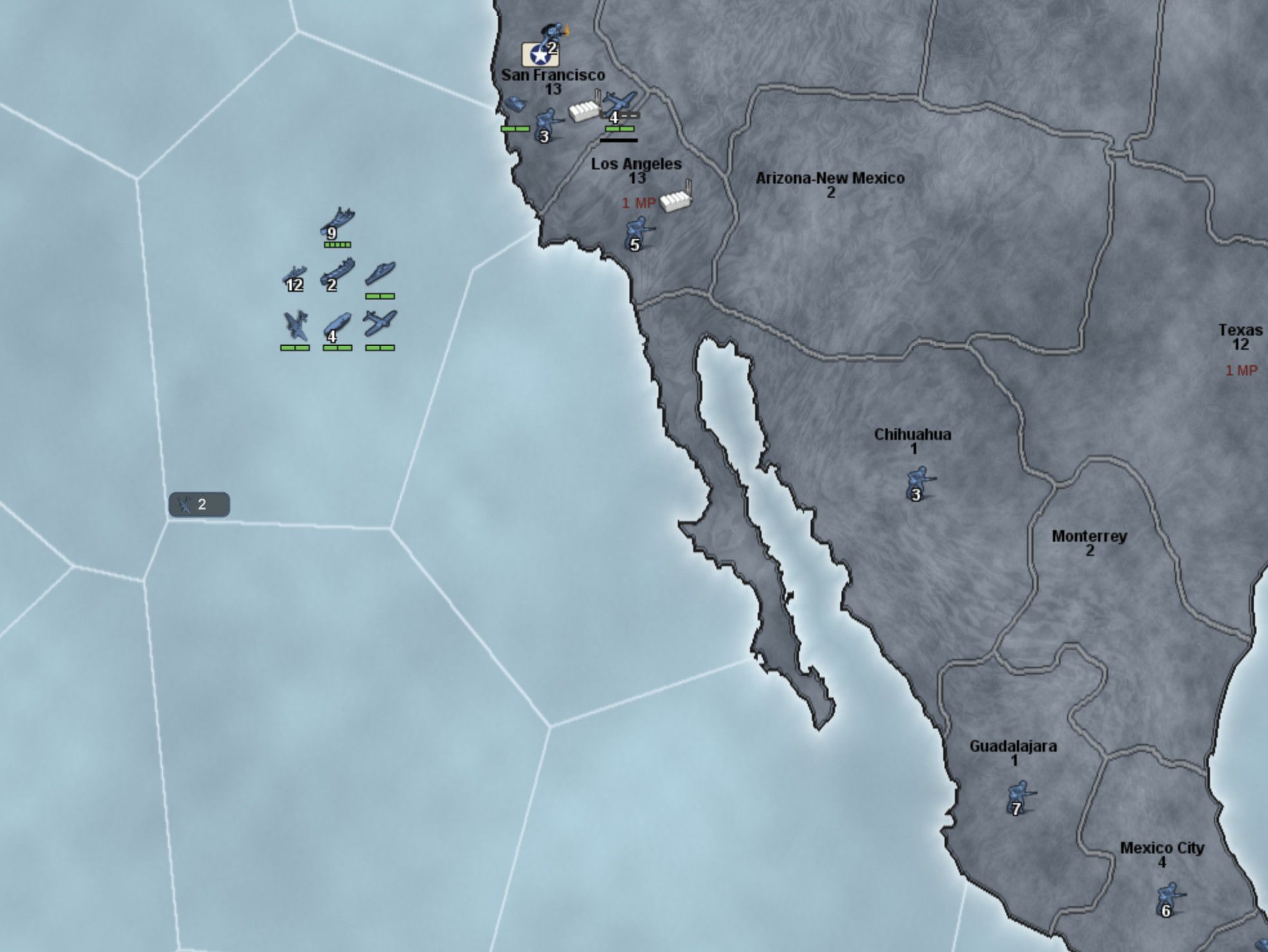
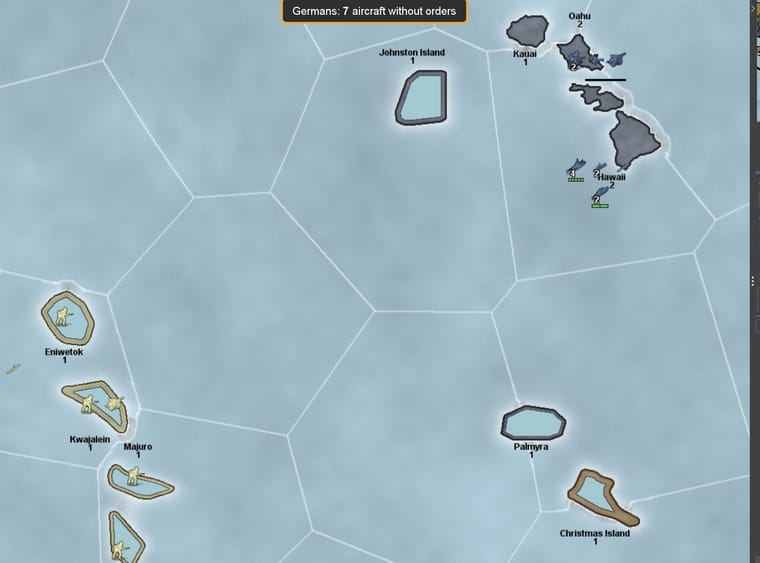
America Pacific has built a good fleet, and it has neutral farmed Mexico. Its neutral farming ambitions do not stop there. Next up: Honduras.
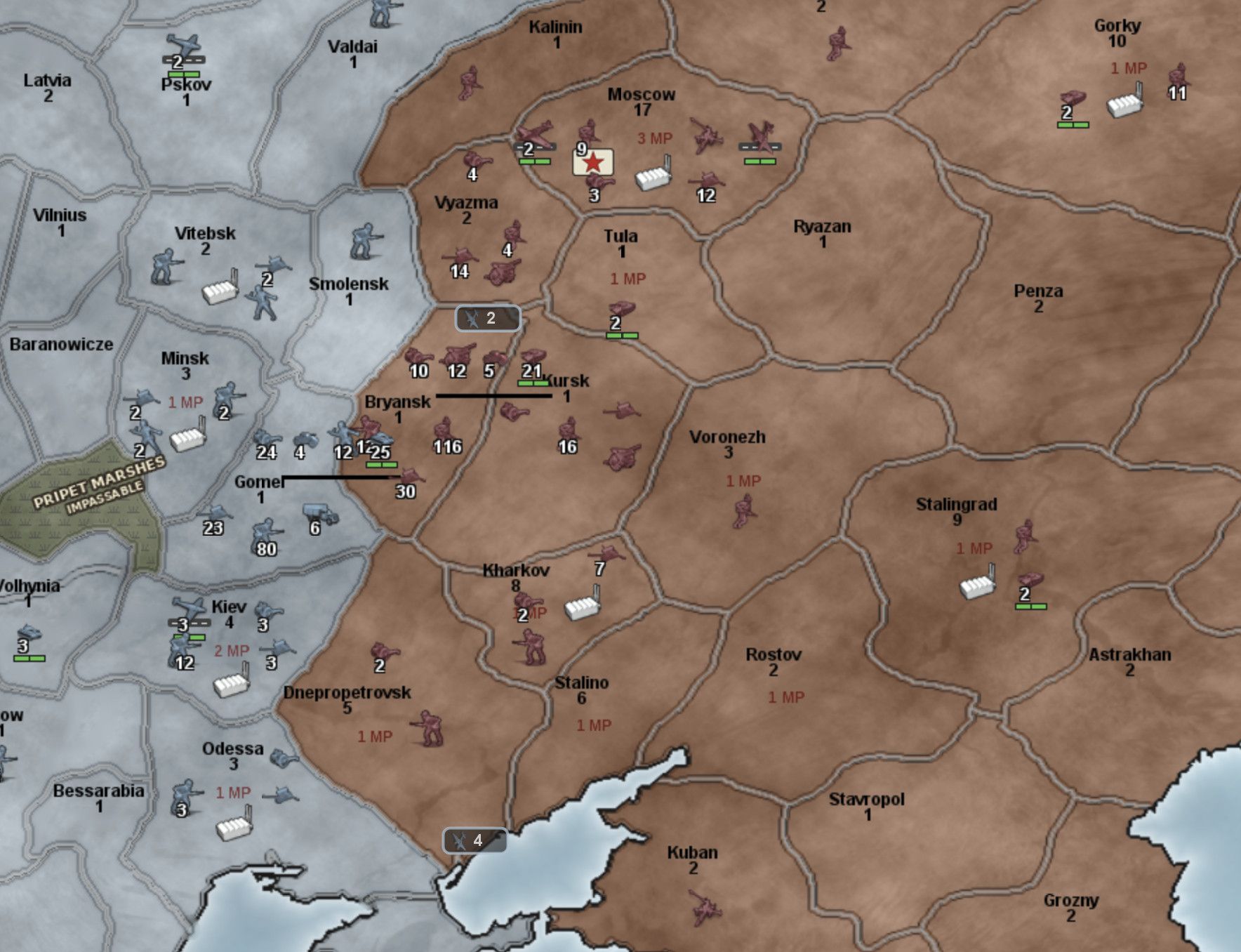
In the east, the German force in Gomel is locked with the Soviet force in Bryansk.
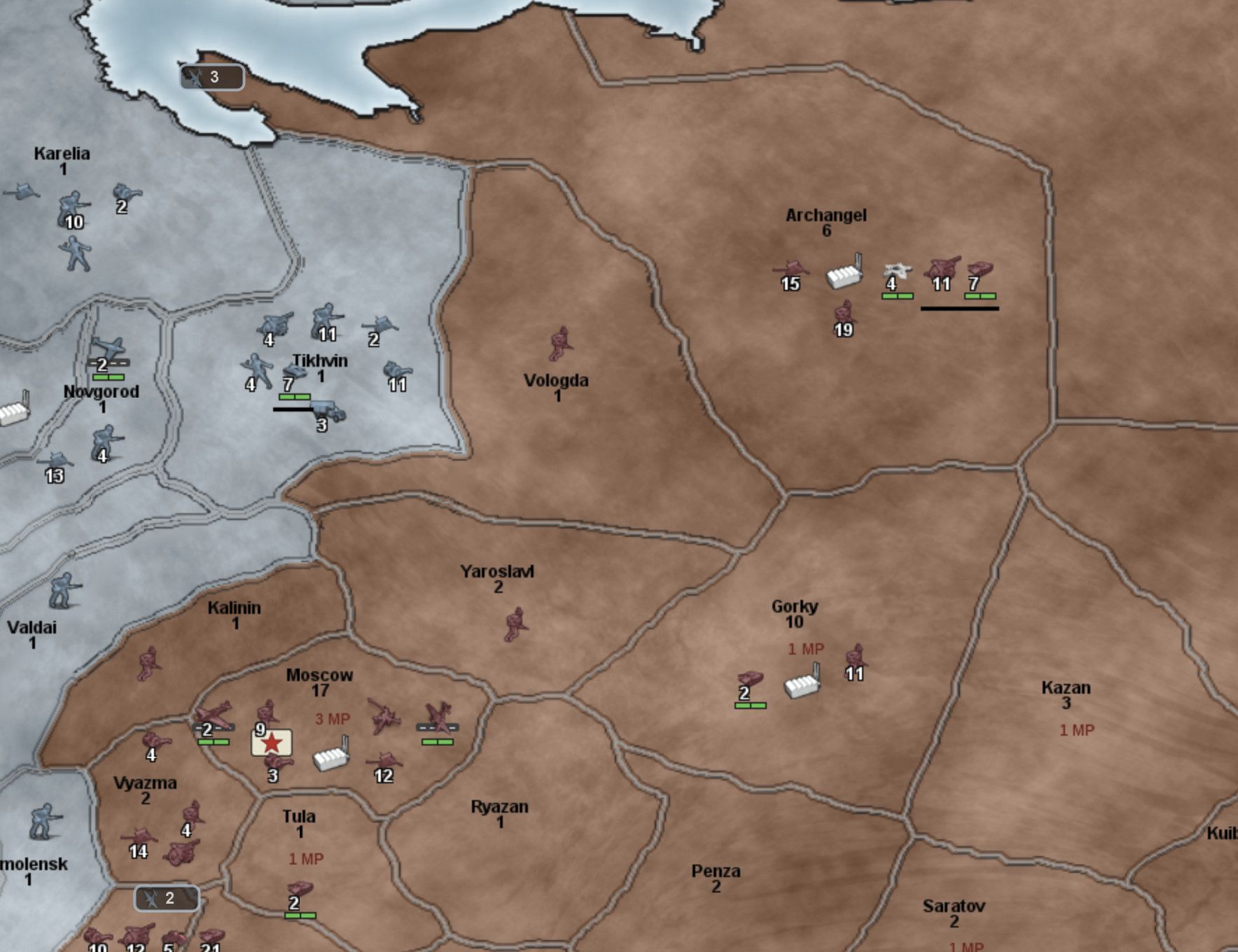
The Soviets had been neglecting their northern front a little. The Germans punished that by destroying the Soviet force at Tikhvin. The Soviets appear to be able to hold at Archangel.
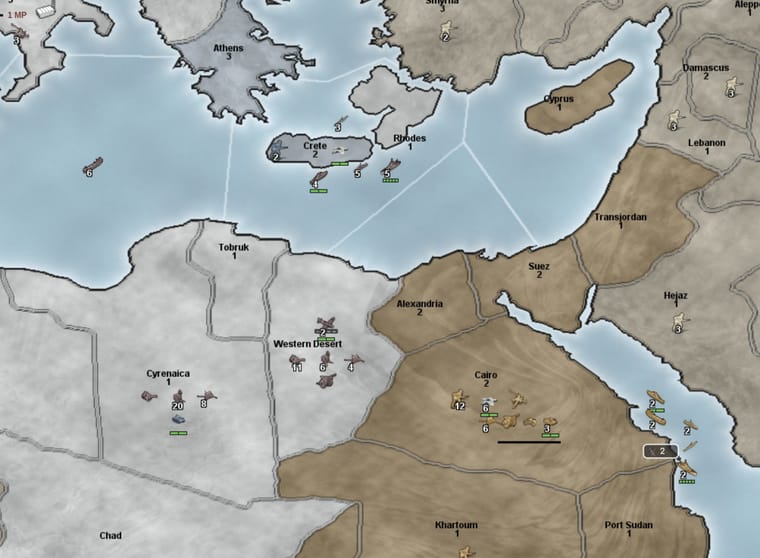
Italy could envision itself as the proud new owner of Cairo. While the Italians have an offensive posture on that front, the British have been putting up a very good defense. Britain has been helped by industry tech (more unit placement) and recently gained Raj tech (3 free colonial militia per turn for India).
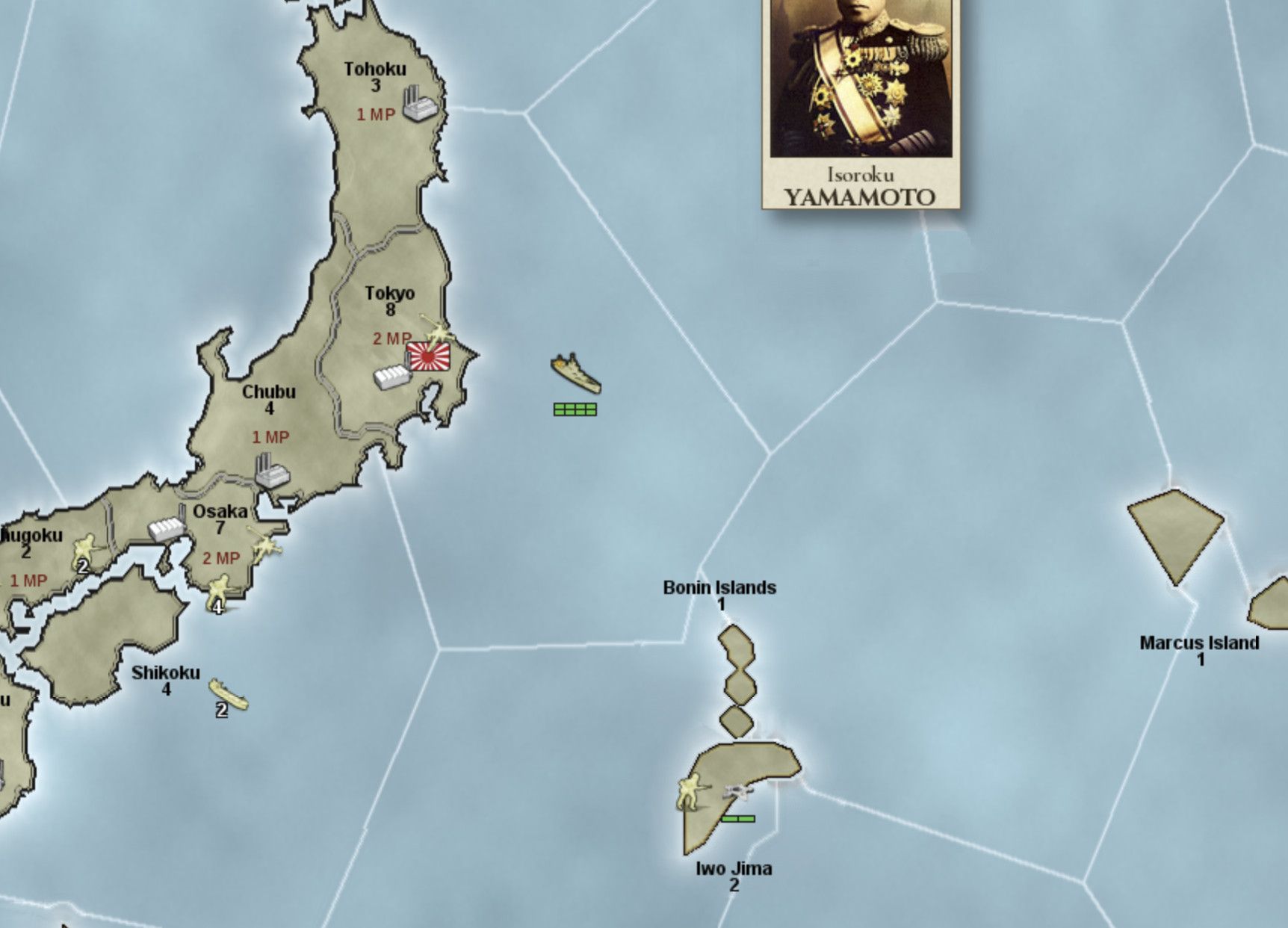
Japan has proudly built its first Yamato battleship! Also it built two SPCs. Each will produce a new fleet carrier every other turn.
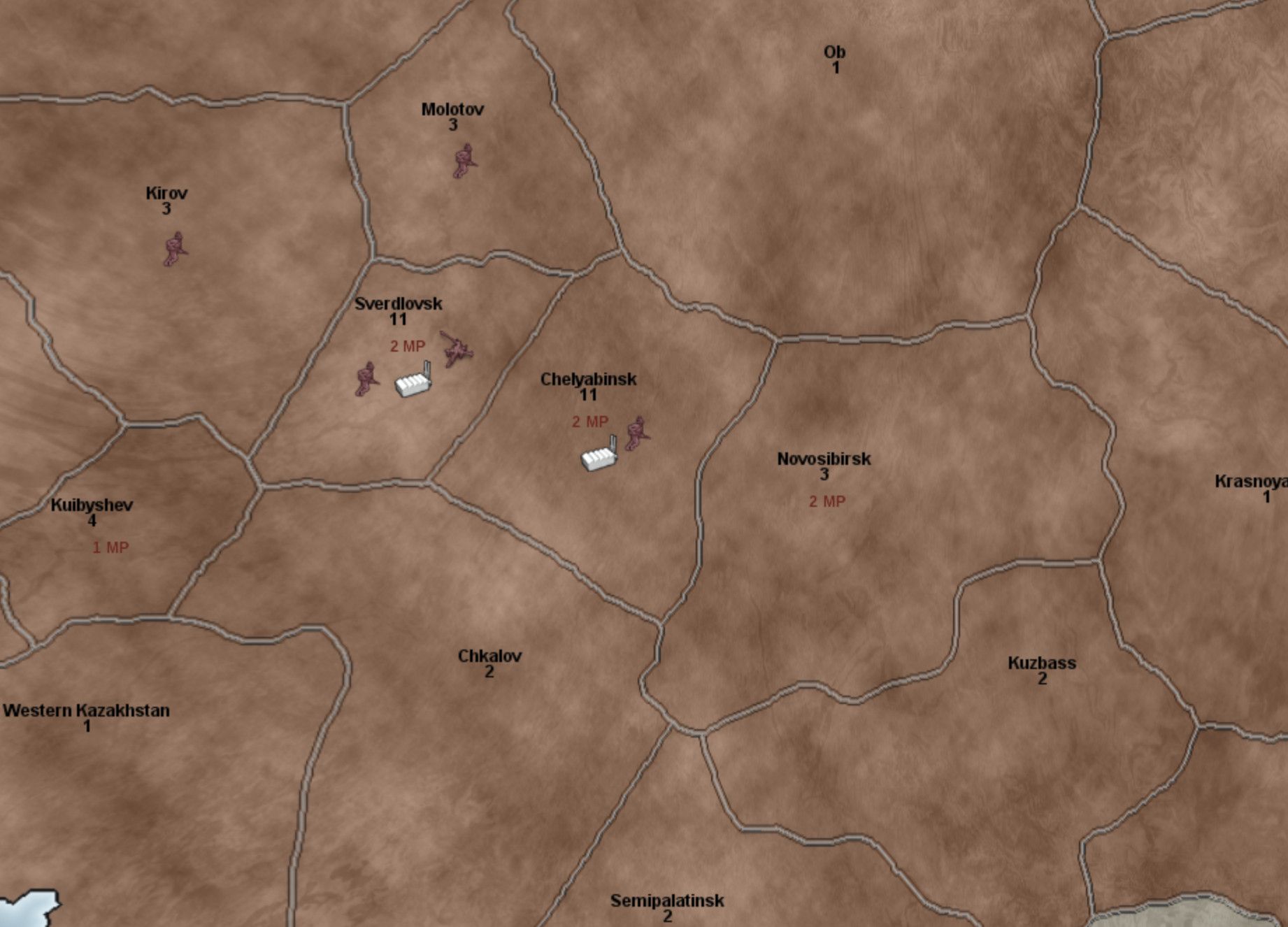
Why are there random conscripts here? Because the Soviet Union unlocked Conscription 1 tech. Now, each Soviet factory produces 1 free conscript per turn, as long as the underlying territory is worth at least 9 PUs. This is good for five conscripts per turn. The Soviet Union would very much like to gain more techs in this category. It looks forward with eagerness to getting Conscription 4 tech--although that won't come for a long time. The Soviet player has prioritized the conscripts over getting free KV-1 tanks (although it would like to receive those also).
The Allies have opportunities to shift forces between the European and Pacific theaters. The Soviet Union decides how much to allocate to its eastern front. Britain decides how much to place on its factories in India, Africa, and Australia, versus how much to place in Britain itself. Units built in western India can be shipped west to fight Italy in Africa, or they can go east to fight Japan. Neutral farming is also a decision about front allocation. If America Pacific farms the Latin America neutrals, that is a decision to allocate more to the Pacific. If America Atlantic neutral farms them, that's a decision to go more heavy after Europe.
-
@KurtGodel7 The coastal guns honestly sound like more more trouble than they're worth in order to get the balance right. Unless you think it'd be a really fun enhancement to the gameplay that you're determined to see through, it's probably safe to skip it and just give the invaders the round one penalty you have in mind.
Off the top of my head, the only major WWII warships I can recall being sunk by coastal forts were the cruisers Blücher and Königsberg during the invasion of Norway. Realistically, coastal defense batteries should be able to deter small raids, but not pose a serious threat on their own to a large invasion fleet.
But, suppose Britain builds a strong battleship fleet, and those battleships can exert more force than the coastal guns at a given hard point. Britain's response should be to unload one unit as an invasion. The goal would be to trigger a combat between the battleships and the coastal guns, with the British player knowing this would do more PU damage to Germany than to Britain.
If you want to avoid this kind of cheese, you might be able to turn the Coastal Battery into a building instead that doesn't get shot at in combat but does get captured if the province is taken. That would also be a natural way to put a one per zone limit on its placement. It could have AA style fire (1 die each at up to 3 ships, or however many targets you think is right).
If you think Claude can write some more complex rules, you could have the BBs take bombardment shots at the Coastal Battery first - if they score enough hits, they don't destroy it, but instead suppress it, and prevent it from firing. You could have the degree of suppression scaled to the number of hits it takes.
For instance, you've given the Coastal Battery shots at 4 targets by default. The British BBs arrive and bombard first - they score 2 hits, so now the Battery only takes 2 shots at enemy ships.
Making it a building also allows it to be a strategic bombing target, giving the enemy an alternative way to deal with it instead of just sending their ships in to slug it out head to head.
I agree that I should not add coastal guns. I'm at the point where I need to not add more complexity to the map. The sample games I've been playing flow smoothly, and are not bogged down by complexity.
If I did want to add more complexity--which I don't--but if I did, one way to achieve that would be the Battle of the Atlantic. The Battle of the Atlantic would exist as an abstraction. Each turn, Germany could send subs into the Battle of the Atlantic. Britain and America Atlantic could send destroyers in. Any units sent to the Battle of the Atlantic are there permanently. They cannot return to the main map. At the beginning of each game round, the German subs in the Battle of the Atlantic would fight the Allied destroyers. Combat would last for two rounds. Destroyed units would be removed from play. Any German subs that survived that combat would impose an economic penalty on Britain and America Atlantic. There would be a cap as to how much of a penalty each nation would receive. If, say, Britain's cap is 15 and America Atlantic's penalty cap is 20, then the first 15 PUs of economic damage done would hit Britain, and the next 20 Pus of economic damage would hit America Atlantic.
Later on, Germany gains the ability to have Type XXI U-boats as a special unit. Sending those to the Battle of the Atlantic would be very cool. Maybe each normal sub would impose a penalty of 2 PUs, and each Type XXI would impose a penalty of 5 PUs. Something like that.
But, I have no plans to actually implement this idea, because it would be added complexity.
-
Or, you can scrap the coastal battery idea entirely and make the air units more cost effective against the ships.
-
KurtGodel7 said:
I agree that I should not add coastal guns. I'm at the point where I need to not add more complexity to the map. The sample games I've been playing flow smoothly, and are not bogged down by complexity.
If I did want to add more complexity--which I don't--but if I did, one way to achieve that would be the Battle of the Atlantic. The Battle of the Atlantic would exist as an abstraction. Each turn, Germany could send subs into the Battle of the Atlantic. Britain and America Atlantic could send destroyers in. Any units sent to the Battle of the Atlantic are there permanently. They cannot return to the main map. At the beginning of each game round, the German subs in the Battle of the Atlantic would fight the Allied destroyers. Combat would last for two rounds. Destroyed units would be removed from play. Any German subs that survived that combat would impose an economic penalty on Britain and America Atlantic. There would be a cap as to how much of a penalty each nation would receive. If, say, Britain's cap is 15 and America Atlantic's penalty cap is 20, then the first 15 PUs of economic damage done would hit Britain, and the next 20 Pus of economic damage would hit America Atlantic.
Later on, Germany gains the ability to have Type XXI U-boats as a special unit. Sending those to the Battle of the Atlantic would be very cool. Maybe each normal sub would impose a penalty of 2 PUs, and each Type XXI would impose a penalty of 5 PUs. Something like that.
But, I have no plans to actually implement this idea, because it would be added complexity.
Okay, a modified version of the Battle of the Atlantic idea. Don't worry--I'm not going to add this to Flames and Steel. There needs to be a lock on adding additional complexity.
That said . . . the Battle of the Atlantic could be an abstraction, as I wrote in my earlier post.
- There would be about ten sea zones within this abstraction.
- Each individual sea zone would have its own economic damage cap.
- PU reductions would be applied to either Britain or America Atlantic, depending on which sea zone the subs were in. German subs in the Caribbean, for example, would cause economic damage to America Atlantic.
- Blind allocation. Germany would move its subs around these sea zones without knowing where Allied destroyers were going. Britain and America Atlantic would move their destroyers around these sea zones without knowing where German subs were going.
- After the blind allocation, there would be a two round naval battle for each sea zone with both Axis subs and Allied destroyers. Any subs surviving the naval battle would apply a PU reduction to British or American Atlantic income, depending on the sea zone they were in.
- Germany would have a choice: "Do I spread my subs out in an effort to maximize economic damage? Or do I concentrate them in an effort to win the naval battle in whatever sea zone I am in?" Likewise, Britain and America Atlantic would have this same choice with respect to their destroyers.
This could be really cool. A game within a game, as it were. Germany could unlock technologies to increase the damage cap of each sea zone. Britain and America Atlantic could unlock technologies to help with this also. But I feel like I've already added the right amount of complexity to Flames and Steel, and I don't want to add this additional thing, however cool it might be.
-
Or, you can scrap the coastal battery idea entirely and make the air units more cost effective against the ships.
In a normal TripleA type map, it would be, "I have more air than he has ships. Therefore I will kill his navy on my next turn!"
With Flames and Steel it's not quite so simple. There are two flavors of air unit: fighters and bombers. Several different types of fighters: fighters, heavy fighters, advanced fighters, early jets, and jets. Several different types of bombers: dive bombers, torpedo bombers, medium bombers, strategic bombers, flying wings, and Superfortresses.
Suppose that Germany had an idea of using air to sink the British fleet in the English Channel. During the "allocate bombers" phase it sends in torpedo bombers (the best choice for anti-naval), dive bombers, and even a couple medium bombers. This bomber allocation is revealed to the Allies before the "allocate fighters" phase. During "allocate fighters," all three of Germany, Britain, and America Atlantic allocate fighters to the upcoming battle.
Then there is a two round dogfight, where Axis and Allied fighters shoot at each other. After the dogfight, any Allied fighters which survived are now able to shoot at German bombers, using their interception value. German bombers shoot back, using their air defense value. Destroyed units are removed from play. Damaged bombers are considered aborted and do not get to fire at surface targets. But, any German bombers which weren't destroyed or aborted then get to fire at Britain's ships. British ships actually hit by bombers get to fire back. Those which weren't hit are considered too far away from the combat to participate. This lasts two combat rounds.
The Pearl Harbor attack consists of eight Japanese torpedo bombers attacking five American Pacific battleships, plus some other ships. America Pacific has little or no air defense against this. Those eight torpedo bombers hammer the Pearl Harbor fleet hard. Remember that battleships take five hits to kill! Japan loses 0 - 1 torpedo bomber in the attack. The fleet at Pearl gets hammered hard during the air phase, and then on Japan's turn the IJN comes in to finish it off.
In my play test games, Germany would sometimes build fighter type aircraft for its western front. But it stopped short of building bomber-type aircraft for that front, because the money for that was needed elsewhere. The fighters gave it reasonable defense against Allied strafing or strategic bombing raids. Germany would also need to defend Italy's West Mediterranean transports against Allied air. For that it had fighters in Madrid. Probably having a single battleship in that sea zone would have made sense also, in case any Allied bombers got past Germany's fighters. Germany should also have built a heavy fighter or two, because those have a better interception value than normal fighters.
-
Giving the rest of the world map a quick lookover
- Morocco/Spanish Morocco is a little too pointy
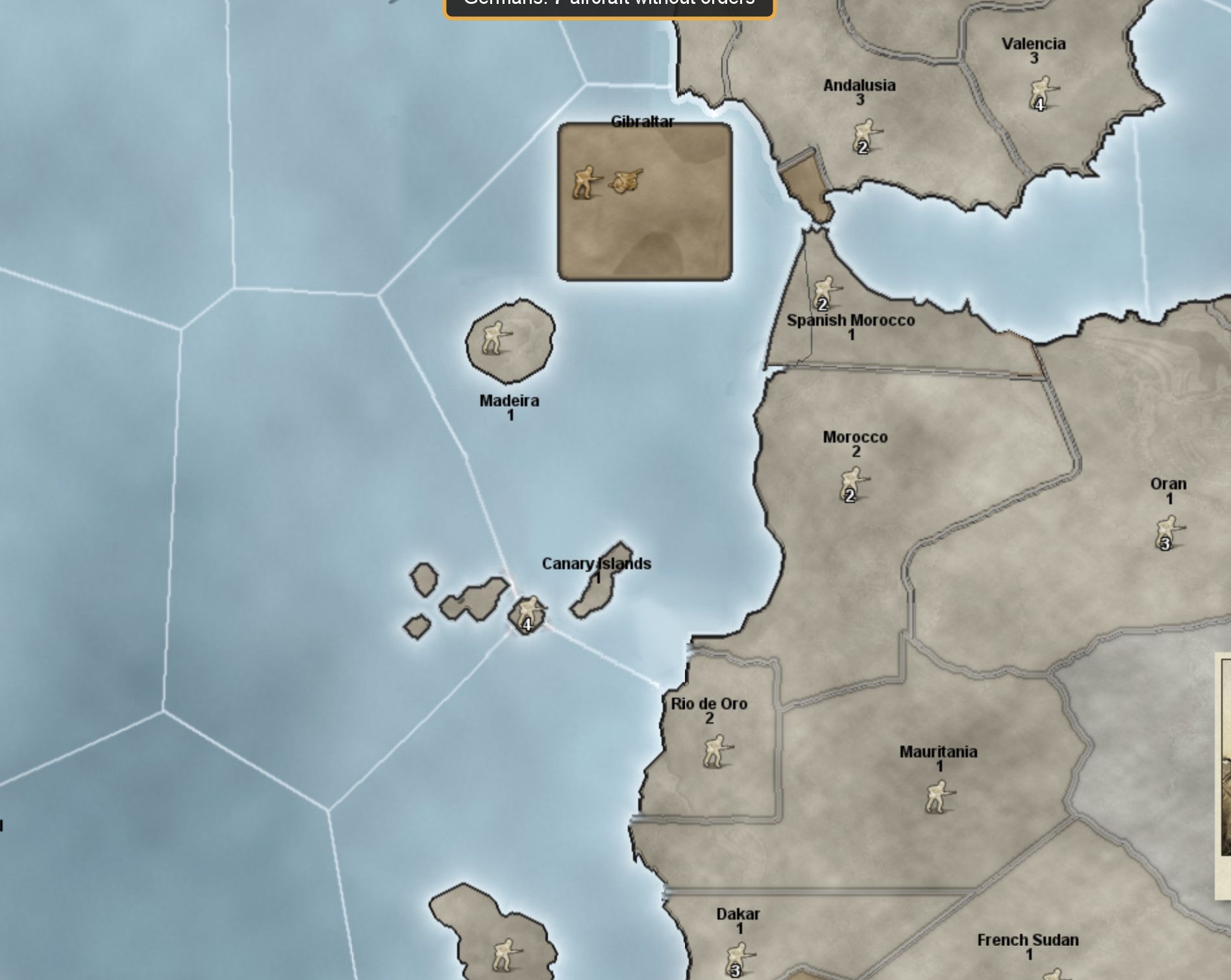
- Canary Islands being at the junction of three sea zones is good, but it could be shifted left a bit to put more space between itself and the African coast
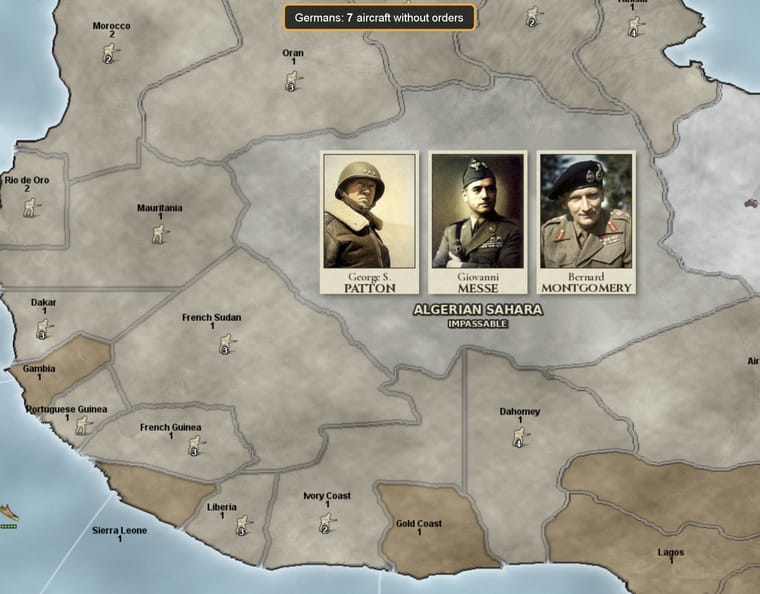
- Algeria is well divided but French West Africa is pretty off - Dakar extends across much of Mauritania, while Dahomey is covering what should be Upper Volta
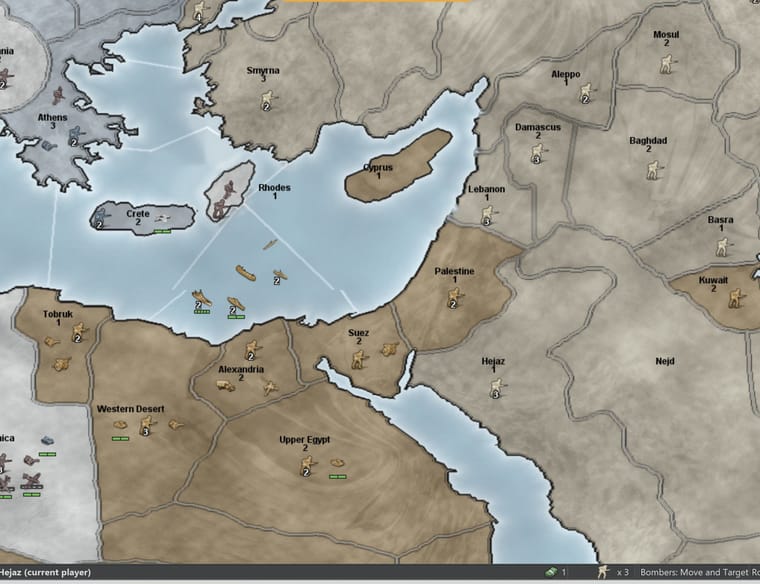
- Cairo is a poor label for southern Egypt since it lies in the northeast - Upper Egypt would probably be the best name for the southern region, or Aswan if you wanted another city name
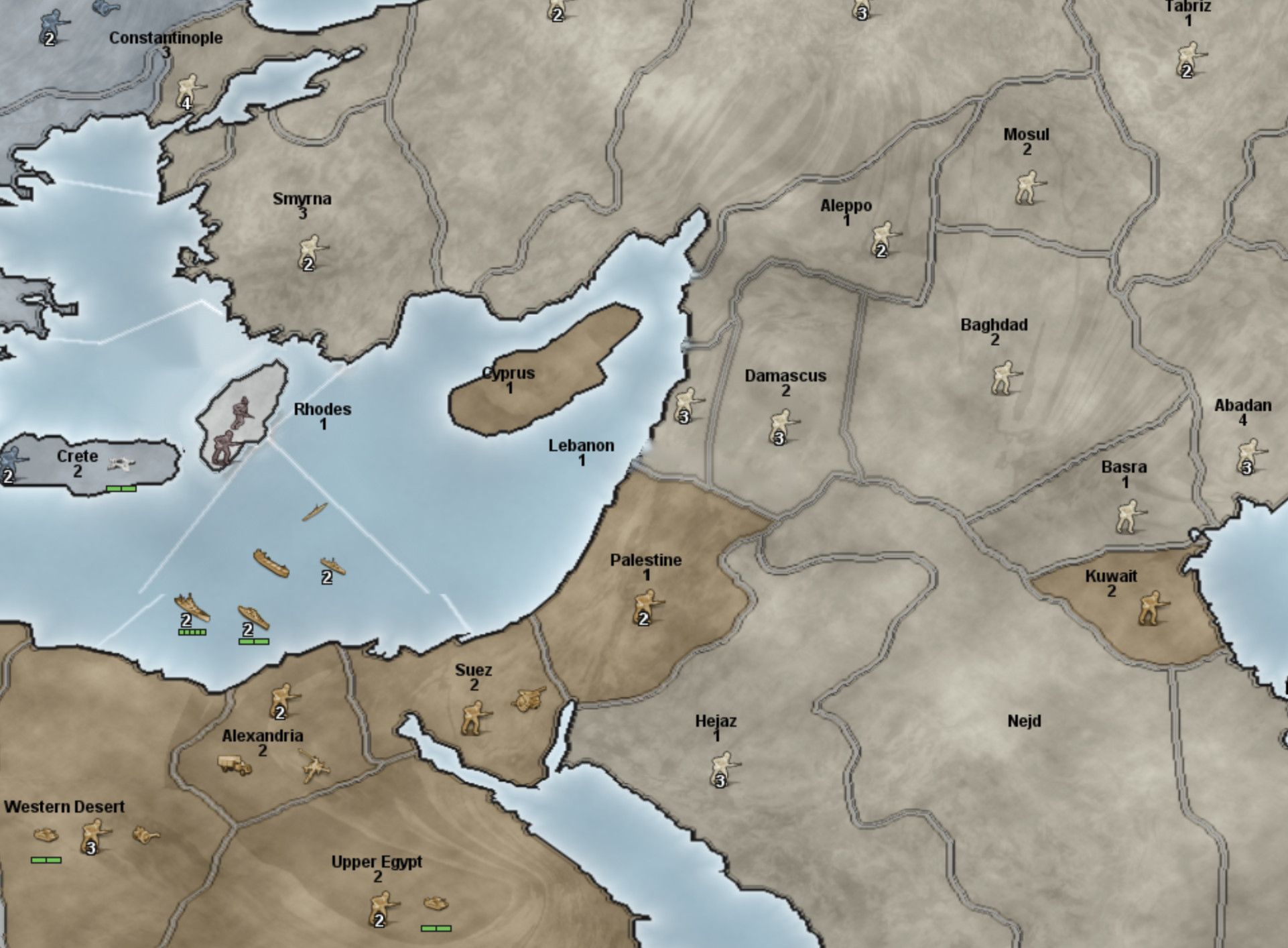
- Rhodes has a distorted shape, that whole lobe on the left shouldn’t be there - and what if Rhodes were shifted east to lie on that junction point between the sea zones instead of floating within the same one as Crete?
- The east half of Lebanon should be part of Damascus instead
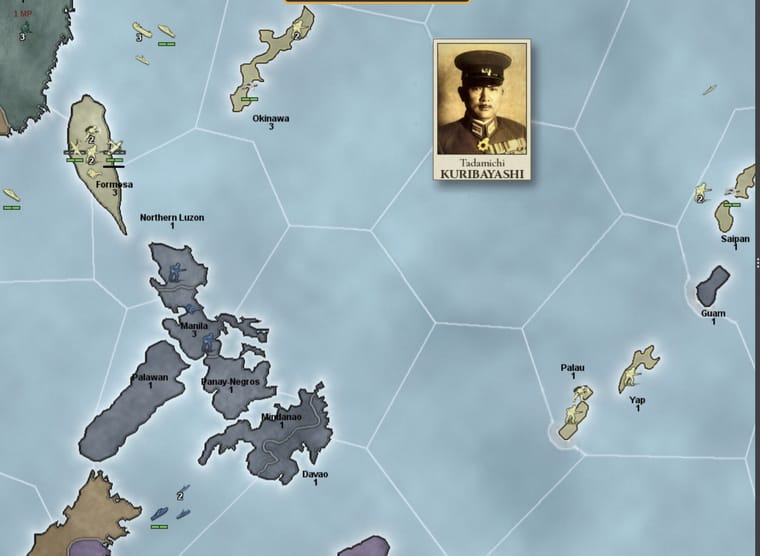
- Using the capital city Taihoku as a label for the whole island seems odd if you’re not subdividing it further - why not just Taiwan or Formosa?
- North Korea and Keijo are a mismatched pair - either North Korea and South Korea, or Keijo and Heijo
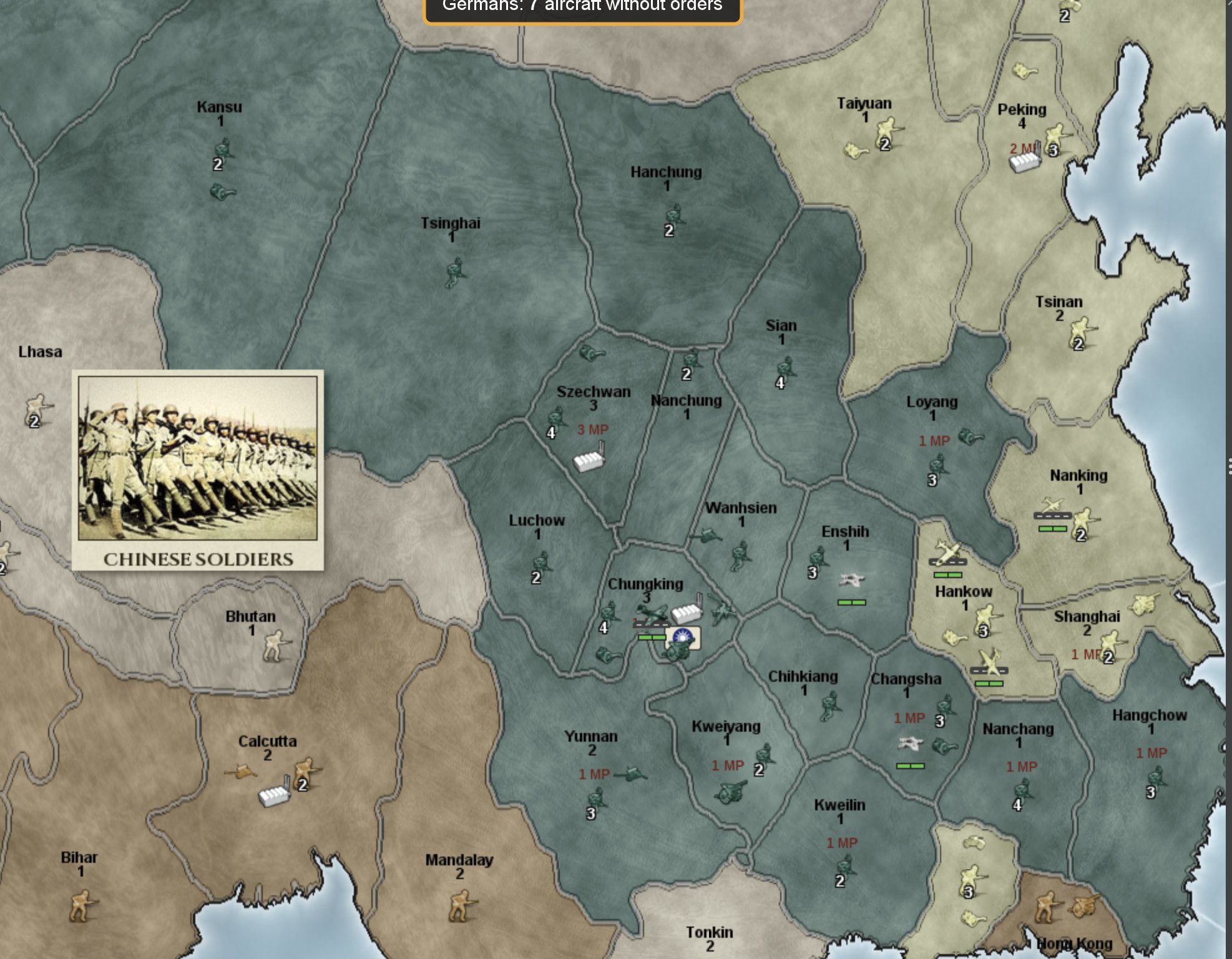
- China’s got a weird mix going on where half the country is labeled with provinces and the other half are cities
-
In a normal TripleA type map, it would be, "I have more air than he has ships. Therefore I will kill his navy on my next turn!"
And what makes you think your game will be any better, other than throwing in 'win more' stuff and endless superficial complexity, all while pretending to avoid it?
-
In a normal TripleA type map, it would be, "I have more air than he has ships. Therefore I will kill his navy on my next turn!"
And what makes you think your game will be any better, other than throwing in 'win more' stuff and endless superficial complexity, all while pretending to avoid it?
First off, I will acknowledge that Flames and Steel hasn't proven itself yet.
In my test games, a game round took less long than would have been the case for a round of Domination 1914 No Man's Land or World at War. I've spent the last few weeks redlining my Claude usage, in large part so that players wouldn't feel bogged down by complexity, the GUI, or anything else which might slow or confuse the game.
I've found that research strategy and military strategy are intertwined. A player researches now for the military strategy he intends to implement later.
Air units are specialized for different roles. It's no longer just, "build a fighter, use it against whatever." Now it's, "build fighters to shoot down enemy air. Build torpedo bombers to sink enemy navy. Build dive bombers to strafe enemy land units. Build strategic bombers to wage a strategic bombing campaign."
Will the game work as intended? I hope so, but I haven't gotten past round 7 in any of my test games. In my round 7 test game things seemed like they were off to a good start. But, a lot of what I'd envisioned for the game hadn't yet started happening, or else was only starting to happen. A better test of the map would be a round 15 game or so, with two humans playing against each other. (As opposed to me playing the map against myself.)
-
Giving the rest of the world map a quick lookover
- Morocco/Spanish Morocco is a little too pointy
- Canary Islands being at the junction of three sea zones is good, but it could be shifted left a bit to put more space between itself and the African coast
- Algeria is well divided but French West Africa is pretty off - Dakar extends across much of Mauritania, while Dahomey is covering what should be Upper Volta
- Cairo is a poor label for southern Egypt since it lies in the northeast - Upper Egypt would probably be the best name for the southern region, or Aswan if you wanted another city name
- Rhodes has a distorted shape, that whole lobe on the left shouldn’t be there - and what if Rhodes were shifted east to lie on that junction point between the sea zones instead of floating within the same one as Crete?
- The east half of Lebanon should be part of Damascus instead
- Using the capital city Taihoku as a label for the whole island seems odd if you’re not subdividing it further - why not just Taiwan or Formosa?
- North Korea and Keijo are a mismatched pair - either North Korea and South Korea, or Keijo and Heijo
- China’s got a weird mix going on where half the country is labeled with provinces and the other half are cities
Okay here are some map changes.
-
@KurtGodel7 Rhodes and the Canaries look a lot better now, and most of the naming issues got fixed.
The Philippines are kind of hideous, should see if Claude can try to focus on getting the shape of the islands down better.
The Gibraltar box is another problem spot where the name is floating outside of it. As a magnified blowup area, the square will probably look better if it has a lines or arrow at the corner that connects it with the land enclave.
Lebanon still cuts too far inland. Damascus should share a border with Palestine/Transjordan, and Lebanon should not touch Nejd at all.
One other issue I can see is that neutral and French territories are indistinguishable in color. Even if Vichy France is treated as a neutral power for gameplay purposes, it probably still ought to have its own distinct color to tell it apart from genuine nonbelligerents.
-
Gibraltar was only 6.8 square kilometres and certainly not plain.
This means that, depending on roughly how much your infantry is supposed to be in terms of infantrymen and stuff, and assuming that artillery, armour and so on are similarly limited, you can have a very low units limit.
This would be both realistic and helping with keeping low the needed area of Gibraltar for showing units in there.
I asked the "AI Mode" of Google "What is the maximum number of infantrymen which could have been defensively deployed in Gibraltar during 1941?"
This was the answer:
During 1941, the maximum number of infantrymen defensively deployed in Gibraltar was approximately 7,000 soldiers, organized into two brigades.
This infantry element formed the backbone of the overall 16,000-man total defensive garrison stationed on the Rock at the time, which also included large numbers of artillerymen, anti-aircraft crews, and Royal Engineers.If the question is framed around structural capacity rather than actual troop counts, the British military dramatically expanded the Rock's underlying infrastructure during this period. Royal Engineers and Canadian engineers excavated an extensive 25-mile network of underground tunnels, living spaces, and hidden fortresses.
Upon its completion, this massive subterranean complex was designed with a maximum theoretical capacity to fully house, protect, and sustain a force of 30,000 men for up to 16 months without external resupply. -
I would say that this means that every game for which 1 infantry is representing 20,000 men or more and in which every land unit takes no less capacity on transports than the infantry unit should have a maximum stacking limit of 1 land unit in Gibraltar. (This would mean practically every TripleA basic game.)
-
@Cernel Well, that gets into the whole issue of units in Axis & Allies not actually corresponding to a specific number of anything. They’re an artistic abstraction of capabilities.
Putting a stacking limit in Gibraltar alone would be arbitrary - why not in Malta too then, and Rhodes, and most of the Pacific Islands? And doesn’t that beg the question of the larger land territories getting their own limits? And how high should those be, how much would they vary, and how that would information be conveyed easily to the players?
I think it opens the door to a lot of extra complication and opportunities to run into balancing headaches without really adding much to the quality of the playing experience.
-
@Vendetta First of all, even though the AI mentioned that (and I just copy-pasted it for completess): this is not meant to be any kind of time-related limit: if you can put up to 1 land unit in a specific territory, those land units can stay there forever without any need to be resupplied. Anything which is able to stay in a territory for 1 day, can stay there forever. (Yes, obviously this is not realistic, but it is coherent with the fact that units loaded onto transports can stay loaded forever: you have the same loading limits for a 1 day vojage as well as for a 1 year vojage.) This is not about adding supply limit or starvation dynamics at all, nor adding attacking/defending limits based on frontlines wideness. (It is sort of like ships and loaded transports being able to stay forever in the open sea.)
It was meant to be only an area limit (not front-line, actually total area), meaning the fact that you cannot have more than a quantity of military men and stuff in Gibraltar because there is not enough space to deploy them in there literally anywhere.
You can think at Gibraltar like a transport and a carrier: the limit is akin to the limit by which the game does not allow you to load infinite units onto a transport or land infinite aircraft on a carrier. These are (space-only based) limits that the game has (I assume) for transports and carriers already.
Albeit the AI response added supply considerations (16 months limit for 30,000 men), my suggested limit has NOTHING to do with that, nor with any other kind of limits beside space limits only.
To answer your per se sensible objection (but touching something I did not meant to touch), Malta, Rhodes and most of the Pacific islands would have no limit because, as a matter of space, you could fit more than enough number of men and stuff in there. For example, the area of Malta (only the main island) is 36 times that of Gibraltar. Yes, if we set a limit at 2 for Gibraltar, we could set a limit at 72 (or whatever) for Malta and not have limits for whatever other territory having bigger limits: this would keep the number of territories needing this special rule fairly low (practically only islands as big as Malta or smaller).
Obviously, this does not mean that you can pack Malta of men and stuff so long as you have space for them: there are other limits (mainly resupply limits - living necessities over time), but I was totally not considering those also for Malta itself (for example, under my suggestion, those maximum units in Gibraltar would be able to stay there forever without needing to be resupplied, like I assume it works everywhere else).
I hope this clarifies that I was not opening for stacking limits per territory in general but just expanding the space limits (like in case of transports and carriers) to only a few very marginal situations on land of only extremely small territories like Gibraltar and such. Of course, this is meant to be an arbitrary approximation.
This said, once added such space-only-based stack limits to Gibraltar, only a few other similar realities would need similar limits, for example Midway (but not Hawaii or most other islands, even most small ones).
I hope this clarifies that this was meant to be a marginal case of adding space-only limits to one or at most a few cases of very small territories, not a systematic proposal for stacking limits in general. (Yes, it is limited and arbitrary, but the question would be if the game would be more realistic with or without, everything else being the same, and there is no more to it than that.)
If you then would still prefer no stacking limits at all over a very limited and arbitrary stacking limit system for a very few extremely small territories, that is fine. It's your preference.
-
@KurtGodel7 Rhodes and the Canaries look a lot better now, and most of the naming issues got fixed.
The Philippines are kind of hideous, should see if Claude can try to focus on getting the shape of the islands down better.
The Gibraltar box is another problem spot where the name is floating outside of it. As a magnified blowup area, the square will probably look better if it has a lines or arrow at the corner that connects it with the land enclave.
Lebanon still cuts too far inland. Damascus should share a border with Palestine/Transjordan, and Lebanon should not touch Nejd at all.
One other issue I can see is that neutral and French territories are indistinguishable in color. Even if Vichy France is treated as a neutral power for gameplay purposes, it probably still ought to have its own distinct color to tell it apart from genuine nonbelligerents.
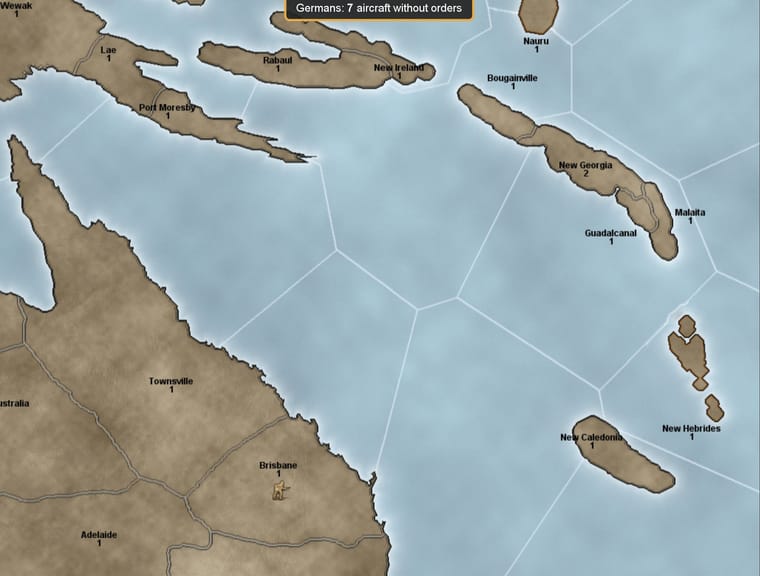
The new map:
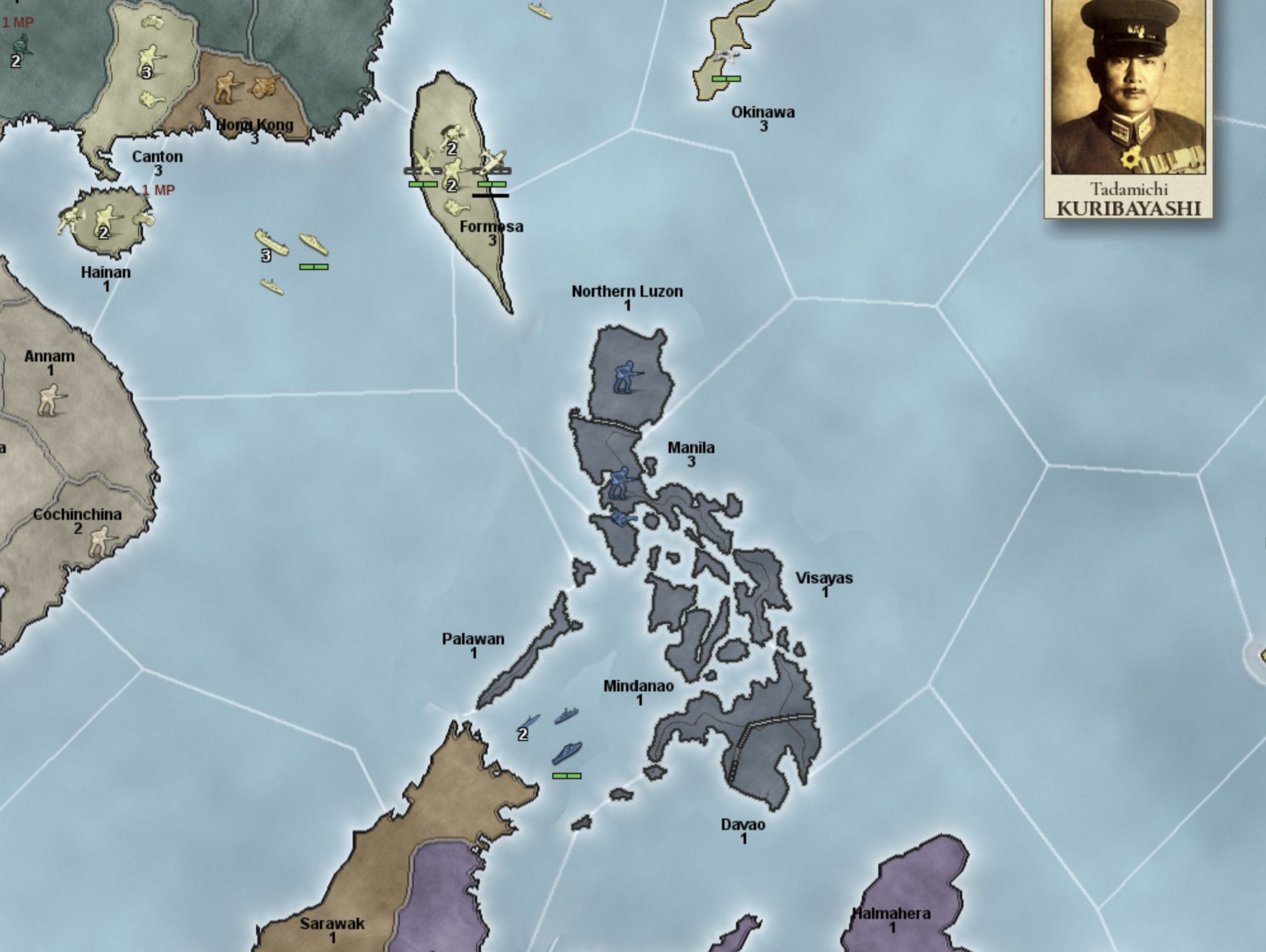
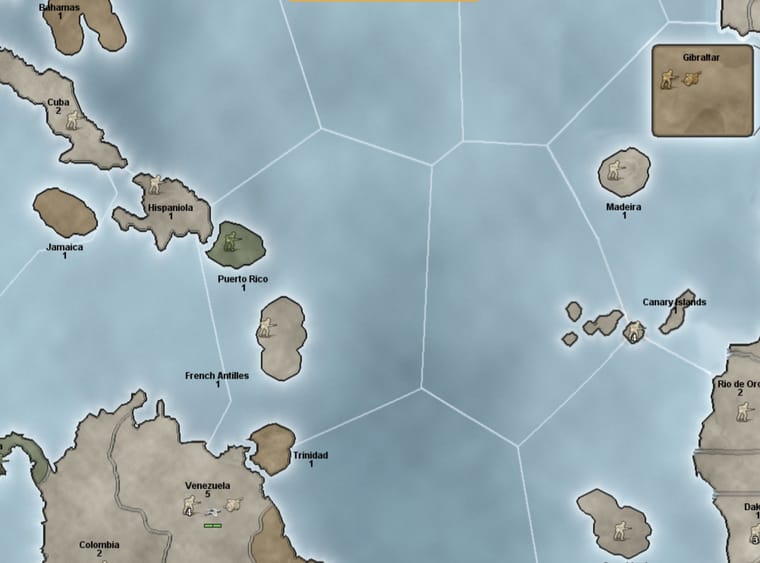
Vichy France. When I was first telling Claude to create this map, I had a decent discussion with it about Vichy France. I think Claude had wanted to simulate realism with respect to diplomacy as it pertained to Vichy France. I saw that as one added source of complexity. Added complexity is never justified just to make something more realistic. For complexity to justify itself, it must add to strategic depth. It must give players real choices. To avoid that here, I told Claude to make all Vichy French territory neutral, and to have it defended just like any other neutral territory. Problem solved.
Yes, I could make it a different color than other neutral territory. But that would indicate to the player that Vichy French neutral territory was being treated differently by the game engine than other neutral territory. It would be a false information signal, done for purely historical reasons, and disconnected from actual game play. If someone wants to propose ideas for how Vichy France can be handled I'm all ears. My one constraint is that I would want it handled in a nice, simple way, with no diplomacy-related decisions by the player whatever.
Flames and Steel has avoided diplomacy altogether, except that on rounds 1 and 2 Japan's only wars are against China and neutrals; and America is not at war at all.
-
Gibraltar was only 6.8 square kilometres and certainly not plain.
This means that, depending on roughly how much your infantry is supposed to be in terms of infantrymen and stuff, and assuming that artillery, armour and so on are similarly limited, you can have a very low units limit.
This would be both realistic and helping with keeping low the needed area of Gibraltar for showing units in there.
I asked the "AI Mode" of Google "What is the maximum number of infantrymen which could have been defensively deployed in Gibraltar during 1941?"
This was the answer:
During 1941, the maximum number of infantrymen defensively deployed in Gibraltar was approximately 7,000 soldiers, organized into two brigades.
This infantry element formed the backbone of the overall 16,000-man total defensive garrison stationed on the Rock at the time, which also included large numbers of artillerymen, anti-aircraft crews, and Royal Engineers.If the question is framed around structural capacity rather than actual troop counts, the British military dramatically expanded the Rock's underlying infrastructure during this period. Royal Engineers and Canadian engineers excavated an extensive 25-mile network of underground tunnels, living spaces, and hidden fortresses.
Upon its completion, this massive subterranean complex was designed with a maximum theoretical capacity to fully house, protect, and sustain a force of 30,000 men for up to 16 months without external resupply.You could say that the physical land area Britain actually owned for Gibraltar was small. Too small to station a large army there. Okay, you're probably right about this.
But suppose a nation wanted to station a large army in or near Gibraltar. Because of the lack of room for the army, it would need to take some nearby land from Spain. Germany invades Spain on its very first turn. The concept of taking land away from Spain is hardly far-fetched for this map.
A better example of a space constraint is Midway. Unlike Gibraltar, there is no nearby land for someone to seize if they need more space. The American government stationed planes on Midway--but only a limited number, because space was constrained. If I wanted to simulate this source of realism--which I don't--I would create a small island rule. If something is categorized as a "small island" its garrison must be limited in size.
It's easy to create a lot of rules, exceptions, and special cases, all in favor of realism. Individually each may seem relatively harmless. Their collective weight burdens the player. Before I say yes to anything like this, I ask, "How does this improve game play?" Suppose the answer is, "this was never intended to benefit game play. Its only purpose was to make the game more realistic." At that point, the idea can be dropped. Added complexity is never justified by realism for the sake of realism.
WWII saw enormous technological progress. Production capacity greatly increased. Nations' armies were limited by their available manpower. There was an air war. Losing the air war meant your enemy could strafe your armies and bomb your factories. Flames and Steel is intended to do a much better job of simulating all of this than a normal TripleA map would. I embraced realism in those specific areas because I thought it would improve game play. Adding those things would give the player a richer array of strategic choices.
If Gibraltar's garrison is limited, that means it can't be defended against Allied attack. Which means that America Atlantic's fleet could enter the Mediterranean. Allowing America Atlantic's fleet access to the Mediterranean is a decision about game play. Currently, I believe that the better decision for game play is to allow the Axis to harden Gibraltar, and thus keep the Allies out. If I'm persuaded otherwise--if it turns out that allowing the Allies into the west Mediterranean really would lead to a better game--then I will change rules to allow that to more easily happen.
-
If Gibraltar's garrison is limited, that means it can't be defended against Allied attack.
To be clear, if you can have at most X land units in Gibraltar (which would need to be decided based on a guess of how many infantrymen is an infantry units and the broad assumption that the other land units take about the same space when deployed or in reserve but ready for immediate deployment), you can also attack Gibraltar with at most X land units. (No other rules for land units here.) This would make Gibraltar actually more defensible, possibly much more defensible.
(Obviously, this is an approximation: you should realistically be able to attack with infinite land units but only Y at the same time, with Y lower than X, then, when you win, every land unit exceeding X goes back to the transports (because it never left them), but I'm not proposing front-line based limits or anything else other than a max X both stacking and attacking for a few very small territories like Gibraltar and Midway. Ideally, every territory for which X would be greater than 10 gets infinite - so no limit - for simplicity (yes, an arbitrary upper limit over which not to bother): this would likely include Malta and every island bigger than Malta depending on how many men an infantry unit is representing.)
Moving on to air limits, Gibraltar would also have a maximum air unit limit to land (like an aircraft carrier) (again, arbitrary and limited only to a few extremely small territories like Midway etc.). In this case, however, there is no limit for attacking air units over Gibraltar. (Again, I'm not claiming this is very realistic.)
Practically, the land limit would favour the defenders, and the air limit would favour the attackers.
In case of paratroopers, the limit would be total on land units. For example, if Gibraltar has a land unit limit of 2, you can offload 2 land units, or para-drop 2 land units or 1 of each, no more. (Again, a simplification.)
My point is not that this would be highly realistic, just that it would be more realistic than nothing, everything else being the same (and it is meant to be limited to Gibraltar, Midway and at most a few other similar cases if not just these two).
Whether or not something like Gibraltar could be attacked with paratroopers at all is of course a disputable matter. Personally, I would say that a simple rule that Gibraltar can never be attacked with paratroopers unless completely undefended would be a good special rule to add for Gibraltar and anything else about as small as Gibraltar (as an approximation of how insanely borderline suicidal would such a thing be). An arguably more realistic rule would be limiting it to the unused stacking limit. For example, if Gibraltar has a limit of 2, then you cannot para-drop if there are 2 defenders, can paradrop at most 1 if there is 1 defender and can paradrop at most 2 if it is undefended by land units. In any case, the total attacking land units would never be more than 2.
-
This all beside the fact that, of course, a sea borne assault of Gibraltar would be suicidal with land units only: the guns at Gibraltar would sink whatever thing which can transport land units before it reaches the shoreline. (I'm not an expert, so I do not know if there is any blind spot anywhere, but I doubt that there is any one or that would make a difference in this case.)
The question, in this case, would be whether or not the guns can be silenced with battleships and/or huge bombs, to make the landings possible at all.
Of course, this would be even more special rules for Gibraltar: I'm not proposing them, just saying.

Hello! It looks like you're interested in this conversation, but you don't have an account yet.
Getting fed up of having to scroll through the same posts each visit? When you register for an account, you'll always come back to exactly where you were before, and choose to be notified of new replies (either via email, or push notification). You'll also be able to save bookmarks and upvote posts to show your appreciation to other community members.
With your input, this post could be even better 💗
Register Login