TripleA Logo TripleA Forum
    • TripleA Website
    • Categories
    • Recent
    • Popular
    • Users
    • Groups
    • Tags
    • Register
    • Login

    Iron War - Official Thread
    Scheduled Pinned Locked Moved Maps & Mods
    662 Posts 26 Posters 1.3m Views 23 Watching
    Loading More Posts
    • Oldest to Newest
    • Newest to Oldest
    • Most Votes
    Reply
    • Reply as topic
    Log in to reply
    This topic has been deleted. Only users with topic management privileges can see it.
    • Black_ElkB Offline
      Black_Elk
      last edited by Black_Elk

      For anyone just coming to it, also just wanted to note again the things I really like about this map...

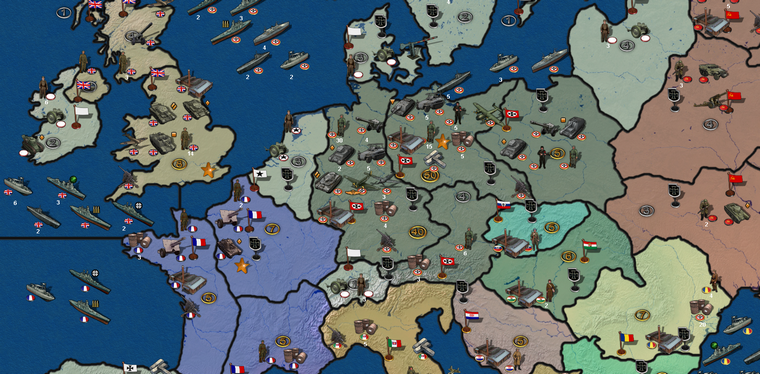
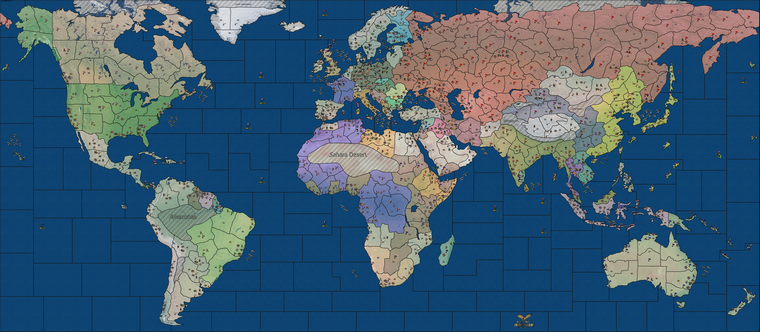
      Its visually clean and easy to read at a glance. The map details and notes are straight forward to parse, and the map divisions and overall play-scale fits a nice niche at the level above global. There's enough familiar stuff going on that you can step into pretty quickly, and its accessible coming at it from a basic A&A background. There are for example fewer complex rules to track than in global (total war start, no politics national objectives or nation specific rules), but a more complex map with a greater number of player nations, and more expansive unit roster. The production rules are also much simpler, with only one kind of factory and very clear factory build locations designated with the gold stars. The naval game is solid with convoy zones putting money in the water, but done in a way that is very intuitive to understand (control of the sz either awards cash or denies it the opponent). It's familiar going back to A&A Europe, tied directly to the sz tiles, and much easier to step into than the complex rules for coastal convoy raiding or interdiction that you see in say the 1940 A&A games. Technology advances based on the timeline with unit unlocks, so again pretty simple to understand. I think the lighter footprint in rules overhead makes it easier to focus on areas where there is more complexity like with the unit roster, resources and combat. The game-phase set up is streamlined for combat before purchase, which makes the playpace much faster in my view, and the production spread and cost structure for units allows for a nice mixed force build for most player nations, with cool variety in the base abilities. Not so many types that it becomes overwhelming but definitely enough to keep it engaging. D10 and base 10 infantry is a fun change from D6 base 3 infantry, and the naval roster balances well on the water at base 20 for the transport. The naval game kind of feels like a cool throwback to older A&A games in some respects, with transports still as a combat unit, fighters moved onto the carrier at placement, capture convoy zones etc, but with a better overall cost structure. Ships are relatively cheap compared to land/air units, and there is a good pairing of unit abilities on the water, again all pretty intuitive and quick to settle into. The build up and eventual smack down on land sea and in the air is all very enjoyable and I dig the soundwork and music. Game works well for a solo too, which is good to have in the back pocket. Anyhow, I think its high quality for sure and has kept me entertained for a while now.

      Solid work

      1 Reply Last reply Reply Quote 3
      • Black_ElkB Offline
        Black_Elk
        last edited by Black_Elk

        I've only played a few games in the past couple weeks, waiting on the next update before I go to town again trying to pick apart the difficulty settings vs AI opponents. But I do have some more thoughts on fuel.

        Right now the starting fuel reserves for both sides are nearly 3 times the recurring fuel income per turn. So for example, Russia starts with 80 fuel +32 per turn. Japan starts with 90 fuel +38 per turn, ANZAC starts with 20 fuel +6 per turn etc. Honestly I think the ratio is weighted way too heavily towards the starting reserve, and not enough on + per turn recurring fuel. The starting fuel reserve is dramatically larger than the fuel income that can be achieved from the barrels on the actual map, but the player (esp. a first time player) is unlikely to notice just how stark the disparity is until the reserve is exhausted which takes sometimes 3 or 4 rounds of play. Germany for instance starts with 80 fuel, but in order to ever see a total like that on + fuel per turn they'd basically have to conquer most of the globe, so once its spent the starting reserve is essentially unrecoverable. Since the game is based on movement at bedrock this makes that starting fuel reserve (how you spend/save it initially) the single most important thing going on in the whole game.

        The issue I see is that the new player just doesn't have enough time to settle in and get used to how fuel works before it totally dominates the gameplay and they have to learn the hard way. Basically its a situation where the first and second round can accommodate casually moving just about everything on the board, but then you see a really hard crash in the third and fourth round after which point the fuel per turn can't cover a substantial number of the units in play. From round 5 on most of the larger powers can only move like half their stuff in a given round and some of the smaller nations barely have enough to move even a couple steel units before running dry. I think the fuel movement works against the entertainment factor here mainly because from the player pov it occurs really suddenly, more as a crash than something gradual that you can figure into your planning, and so potentially more frustrating than fun, since its harder to see coming until you're all mired in the problem hehe. But again, I think its more because the starting fuel reserve is so large relative the recurring fuel per turn, and not the fuel mechanic per se that leads to the disconnect.

        I'd consider coming way down on the starting reserve, so that fuel is a factor right from the outset and a critical consideration in the opening round gameplay, then bringing up the +fuel per turn by a significant amount, like 25% at least, maybe 50% more to cover the disparity from having a smaller starting reserve. That way the learning curve isn't quite so steep, and the player has some time to get used to the fuel/movement restrictions before seeing a hard crash off the cliff. In other words, having the player immediately confronted with the fuel thing right from G1, instead of pushing it out into the midgame, so the player can see what's happening right from the outset and say to themselves 'oh wait what's going on here? I guess I need fuel to move? I better figure this out'. Then start adapting to the new mechanic right away.

        For that to work at its best, ideally each nation should have to make at least one important fuel/movement decision in their opener, so that each player is immediately introduced to the core concept that will be governing the gameplay for the rest of the match. So an example might be on G1, the player discovers that they don't have quite enough fuel to move every single starting unit and must choose between say moving the bomber, or moving a couple mech or moving a few ships. Same deal with J1, where maybe Japan can move 'almost' everything but not quite all of it, so the whole fuel=movement thing comes into play immediately.

        Right now the way its set up, all players depend on the much larger starting reserves to see them into the midgame. Even planning way ahead and only moving what is absolutely necessary from the get go, the ultimate limit usually comes from the size of the starting reserve and how quickly you do or don't burn through it. But if the +fuel per turn was increased it would feel a lot less do or die, and players would have an easier time recovering from a poor decision in early rounds (moving a large fleet too early, buying more armor than you can afford to move etc.) Basically putting in more of a buffer over time, rather than front loading it with larger starting reserves.

        The optimal target range would be enough +fuel per turn so that new units can still enter play and be functional, higher than the current, but with the movement spread per round being narrower. So rather than a choice between moving like just half the existing steel unit force, it'd be more like just a few units in a given turn that would fall out of range. Same deal on the purchasing side, where you'd be acquainted with the fuel dynamic sooner (right from the opener), so you'd have a better feel for how a new purchase plays into the fuel requirements.

        I think the current recurring + fuel per turn is just too low to really get a feel for things before it suddenly becomes the whole game, so basically trying to stage it in more gradually if that makes sense. I think the easiest way is to come down on the reserve based on the movement needs of the openers, and then put the +fuel per turn at right around that amount (little more or a little less) depending on which nation it is, whether they are meant to expand into oil territories right away, or giving them up to the other side after the openers.

        Any thoughts?

        In the save below you have Germany doing a max move, and ends up using just about...

        20 fuel on mobile ground (maybe about 25 if all the armor/mech move 2 tiles.)
        10 fuel on aircraft (closer to 20 committed to land.)
        25 fuel on ships (if you move all the naval units.)

        German fuel.tsvg

        So ballpark, something around 70 fuel to move all their starting units?

        In that case a range of maybe 55-65 starting fuel would probably force a fuel/movement decision in the opener. So either leaving some ships in position, some armor at move 1 instead of move 2 etc. Things like that.

        Assuming the attrition rate for steel units is pretty low in the opening rounds (most will survive the opener to keep moving each turn) then that probably also gives a decent ballpark from how much G should be seeing in +fuel per turn. Buying new steel units beyond that means that some existing units would either have to stay in position or die in combat to make room, or else the new unit stays in position until enough fuel is conquered or saved up to get them moving out together.

        I know having large starting fuel reserves might feel thematically cooler (since its easier to rationalize as pre-war stockpiling of fuel), but for the gameplay and ease of use I think it'd be much better to have the player learning to manage fuel as they go, incrementally, with more guideposts out of the very first turn. I think that would be an easier sell for the newb, instead of the current situation where they kind of have to be already familiar with the mechanic, and able to prognosticate about fuel consumption far in advance in order to play well (like an expert fuel barron), which is what the practical effect of having such a large starting reserve relative to the recurring totals per turn amounts to.

        Black_ElkB 1 Reply Last reply Reply Quote 1
        • Black_ElkB Offline
          Black_Elk @Black_Elk
          last edited by Black_Elk

          just trying to do the legwork here with a solitaire, for opening fuel/movement (trying to move everything I could think of the max distance) you get numbers around the following...

          Germany somewhere around 55-60 fuel expended (of 80 starting total). With max naval movement its 26 fuel just for the ships.

          Balkans 3 fuel used (of 5 total) if they move their fleet to attack Russia in the black sea.

          Finland 6 fuel (of 5 total). Finland starts with 5 fuel in reserve, so this is the first example of a movement/fuel choice in round 1, since they can't move all fuel units the max distance. But this one probably goes unnoticed just owing to Finland's position usually doing turtle up.

          Russia somewhere around 60-65 fuel used (of 80 total). Assuming that Germany takes Ukraine on G1 and if the soviet ships survive for max naval movement at 15 fuel.

          Britain about 20-22 fuel used (of 30 total). It's 19 for all the ships/air max movement, then depending on whether the tanks needed to go to Scotland.

          France 8 fuel used (of 10).
          British Colonies 12 fuel used (of 20) .
          South Africa 8 fuel used (of 10)

          Italy 32 (of 40). This is if they are moving all their fleets/armor the max distance. But Italy is probably the nation with the narrowest fuel gap going into the second round because they are only collecting +10 per round.

          That's as far as I got on lunch today, but the basic pattern is that the nations all have just enough fuel to cover a max move in the opening round, but not nearly enough on recurring fuel per turn to cover that in the second round. So basically the first time player would have very little warning about the consequences of their heavy fuel consumption until after its already too late, when things start crashing off after round 2.

          I think it would be better to have the starting reserve just under max movement from the outset, in round 1, that way the player can see what's going on before they commit to combat movement. Having it happen sooner rather than later would serve as a wake up, so the player can get familiar with the fuel mechanic right away. Then give them some cushion to purchase new units or recover from a movement error by not having the +fuel per turn be quite so scarce. Essentially having the first round movement consumption as the benchmark (from the player's pov) for what can be done with the total fuel coming in per turn. If that makes sense?

          Right now the are many more starting steel units on the board than can move once the initial fuel reserve is spent, and the +fuel per turn is so low relative to the starting fuel, that I don't think the player really has a chance to see what their movement benchmarks actually are for their starting units until after they have already run critically dry. Since fuel is ultimately a cap on movement per turn, I think its important that the player has a somewhat more forgiving way to see that in operation from the very first turn of the game, and a little time to learn the ropes since its an entirely new mechanic going on here for most people. If the fuel coming in per turn was boosted and the starting fuel lowered, then I think the game could be more about managing/conserving fuel income in line with your movement needs, rather than managing the starting fuel reserve. The later is much more challenging (though not necessarily more entertaining owing to that challenge), since it requires a more advanced understanding of how fuel works than I think most people would be able to see coming at it cold. And each nation has different needs, so its hard to ballpark until you actually play through it, which is why I think round 1 movement needs would make sense for the recurring amounts of fuel, rather than having a large reserve meant to be spread out over several rounds.

          My impression is that the learning curve for the fuel/movement mechanic goes up the higher the difference between the starting fuel reserves, what that nation can move initially, and what the nation will collect or be able to move on average. But if there is going to be a large difference between starting fuel reserves and +fuel per turn per nation, then I'd consider going way up on that by a substantial amount, enough to cover more than one round of max movement by the starting units (probably several rounds at that level before it starts to fall off, just to cover normal purchasing). Right now I think the overall fuel totals are too low to really accommodate the large number of units that enter play through regular purchasing, so I'd put it in the barrels +fuel per turn, because to me that is much easier to get a feel for. But either way I think you just need more fuel in this thing for the gameplay.

          For me the ideal on G1 would be that the German player first tries to move all their stuff, discovers that they don't have quite enough fuel to do everything, and so much choose which stuff to move for their strat in that game. Thinking about it from phase 1, starting to build a mental picture from the very first turn of how much fuel they need to acquire/conserve to move effectively each round. Then have something near that coming in next turn on G2 (with some flex aid or conquest), and do much the same for each nation on both sides in the first round. So their totals are just under their max movement for the starting units, and their fuel income also at about the same amount with a little give and take.

          @redrum you gotta couple games of Iron War under your belt, but might be able to speak to first impression better than I can here. What do you think?

          1 Reply Last reply Reply Quote 2
          • J Offline
            John Cena
            last edited by John Cena

            I think that it would be a good idea to have each turn represent 4 months, rather than 6. That's the standard used for several other TripleA games.

            C 1 Reply Last reply Reply Quote 0
            • C Offline
              Cernel Moderators @John Cena
              last edited by

              @John-Cena Which ones and how? I cannot think of a single TripleA game where there is a coherent or even referenced timeline, except only Civil War, that is supposed to be 2 months per round (and that is a far from standard game).

              J 1 Reply Last reply Reply Quote 1
              • Black_ElkB Offline
                Black_Elk
                last edited by Black_Elk

                I also favor a shorter per round timeline. I think 1945 just arrives a bit too soon, and 3 season year would extend the endgame before the nukes start flying hehe.

                In general I like a timeline that is open to interpretation based on what's happening in game, so the player is more free to create their own narrative. Like if D-Day happens in round 7 or round 10, either one might be seen to correspond to 1944, if nothing else is there to tell the player otherwise. But since its all fixed aligned up with the tech advances here, and the new round prompts, I think it would be cool at least to split the years into 3 rounds rather than 2.

                Some of the units like medium tanks and tech weapons like V1s would probably benefit from a longer period of use before they get replaced by the more advanced stuff.

                1 Reply Last reply Reply Quote 0
                • J Offline
                  John Cena @Cernel
                  last edited by

                  @Cernel I mean that it's the standard length for a couple of TripleA games that I've played and most of the Axis and Allies games that I've played.

                  1 Reply Last reply Reply Quote 1
                  • J Offline
                    John Cena
                    last edited by John Cena

                    I found that this map didn't work, and I just got an error message. This is the only time that something like this has happened to me, and I'm using the latest version of TripleA.

                    Edit: Nevermind. The issue was just that the the map name in the map file was different from the name in the game xml file.

                    FrostionF 1 Reply Last reply Reply Quote 0
                    • FrostionF Offline
                      Frostion Admin @John Cena
                      last edited by

                      @John-Cena Did you change any names in any files after downloading this map? Or is it a flaw in the map itself that should be fixed?

                      I must admit that I have not been paying this map much attention lately as I have had very little TripleA time and the time I have had has been spent on another map.

                      So I might not notice if there is a flaw in the map.

                      Map maker of: Star Wars: Galactic War + Star Wars: Tatooine War + Caribbean Trade War + Dragon War + Age of Tribes + Star Trek: Dilithium War + Iron War + Iron War: Europe + Warcraft: War Heroes

                      J 1 Reply Last reply Reply Quote 1
                      • Black_ElkB Offline
                        Black_Elk
                        last edited by Black_Elk

                        @Frostion

                        Sorry to hear of the RL time sink, I know how that goes. Currently up on a move, buried in boxes and packing tape haha.

                        Still looking forward to Iron War updates though. I love this map and can't wait to see where it goes next. Especially with the resources ideas for steel/fuel.

                        Catch you next round

                        1 Reply Last reply Reply Quote 0
                        • J Offline
                          John Cena @Frostion
                          last edited by

                          @Frostion It has nothing to do with the map itself. The name of the map in the XML file (Iron War)was different from that in the zip file (iron_war), so it only worked when I changed the map name (info name) to iron_war. The issue was that the map name differed from the name of the zip file. The actual map worked fine.

                          1 Reply Last reply Reply Quote 0
                          • J Offline
                            John Cena
                            last edited by John Cena

                            @Frostion Also, I think that it would be a cool idea if you could unlock increasingly better technology with multiple tiers (e.g. better aircraft, ships, nukes etc) so that having a technological advantage would have more effect on the gameplay. It could also be interesting if you added more esoteric special units for different countries, e.g. occult weapons, UFOs for Germany, sea monsters for Japan. It would also be neat if there were some units that you could unlock after a certain point in the game, e.g. intercontinental bombers, more powerful, tanks and artillery, and nuclear missiles.

                            1 Reply Last reply Reply Quote 0
                            • Black_ElkB Offline
                              Black_Elk
                              last edited by Black_Elk

                              I still think this map needs more fuel. Maybe a tech advance in like 1942/43?

                              For Axis it could represent an advance in synthetics, for Allies an advance in refining/shipping capacity.

                              In its current state the map just isn't really playable during the endgame. The fuel totals seem scaled fairly well for the starting units and early purchasing, but doesn't account for the huge number of units that enter play in subsequent rounds. So its ok at the outset, but really starts to fall apart as things go on, especially nations that require transports or aircraft to stay in the game. By about 1943 everyone is dry, and the fuel mechanic shifts from a somewhat grinding novelty to just a delay on game resolution. After a certain point there are so many fuel units on the board that it becomes increasingly difficult to track the per round fuel consumption, but I think even if it doubled via a tech advance in the midgame, players will still be running out of gas just from the sheer number of units involved. Players would still have to do fuel triage for movement, but if more fuel production was unlocked at the halfway point it wouldn't be so extreme as to undermine the gameplay. I think it would make sense thematically as a tech advance, and solve the main issue I see right now, without upending the initial balance. Otherwise this is one of our best WW2 maps available for tripleA, and still among my top favs overall.

                              redrumR 1 Reply Last reply Reply Quote 0
                              • redrumR Offline
                                redrum Admin @Black_Elk
                                last edited by redrum

                                @Black_Elk I actually think that nations need to be able to purchase/place additional fuel "refineries" or whatever you want to call them. That way they end up with a few different options in the mid/late game:

                                1. Avoid buying oil dependent units
                                2. Capture oil rich territories (middle east, russia, etc)
                                3. Build additional oil producing units (essentially converting PUs into oil per turn)

                                Otherwise I think balancing fuel on a map into mid/late game is close to impossible as some games will have more battles so less units on the map while others will have fewer battles and more units on the map.

                                TripleA Developer with a Passion for AI: https://forums.triplea-game.org/topic/105/ai-development-discussion-and-feedback

                                Black_ElkB 1 Reply Last reply Reply Quote 2
                                • Black_ElkB Offline
                                  Black_Elk @redrum
                                  last edited by Black_Elk

                                  @redrum I definitely agree, some system to exchange PUs for oil would be a great way to give it more nuance. But baseline I still think the overall totals are currently set way too low. I can understand the logic behind it, because you want the player to begin thinking about fuel sooner rather than later, since its such a major part of the game, but the margins are still too narrow right now. Unless the majority of starting fuel units are destroyed or sit idle in the first two rounds (both of which aren't really ideal for drumming up exitement) then the fuel is expending very quickly. I said 1942/3 but really its already on fumes by late 1941.

                                  If the player could buy oil directly or build more capacity, this would probably require more PUs in play. That sounds fine to me, since I'd like to see more +5 gold spots anyway, but even then it might be good to keep a tech advance in the back pocket, as another way to increase the totals over time.

                                  Just for some context, moving 10 ships or 10 mobile ground across 2 tiles on a given turn consumes 20 fuel. Moving 10 aircraft is going to consume 40+ fuel just to get them in the air, regardless of how far they actually end up travelling. When you look at the starting unit distribution compared to the recurring fuel totals, you can see just how quickly adding new units will outpace the available fuel. The only reason it works in the first couple rounds is because most nations have a starting reserve that's like 2 to 3 times larger than their recurring fuel production. I think tinkering at the margins there won't do the trick, unless the economy/starting unit set up is redesigned, it really needs a more dramatic increase in fuel to accomodate normal purchasing over the 8-12 rounds that most games will last.

                                  ps. another consideration is how much micromanaging fuel actually adds to the gameplay vs the tedium once the unit totals get into the higher numbers of the endgame. I think there can be a balance there but I feel like it needs to be more forgiving, at least on the back end, to allow for mistakes or for when plans fall apart or just the kind of major force redirects that will happen even when things are going well.

                                  I'd say keep everything the same for starting totals and distribution, but just allow each 'oil producing' territory to support like 2-3 more barrels over time. Have a 'barrel buy' where the player exchanges PUs for increased capacity, but still capped at some set amount so its not too extreme. Then the player can make strategic choices about how best to exploit the oil they can reach over the long haul.

                                  Even then though, I'd still have a late game tech advance that increases the totals on a percentage. Maybe 15-20% for both sides in late 1943 or early 44, because the endgame after that is when the largest force movements should occur. Major Axis nations could have a synthetics advance, and Major Allied nations a refining advance. Especially with the large fleet movements or drives overland that need to happen at the close, plus all the fuel unit spawns that add up over time (subs for Axis, air transports for Allies), and of course since all the interesting tech weapons also consume more fuel haha.

                                  Anyhow that's my thought on taking it next level. Players will still be running dry even after all that I think, but it won't be as punishingly short on oil, so that the player isn't losing all initiative due to fuel shortages during the critical time when the last VCs are in play.

                                  1 Reply Last reply Reply Quote 1
                                  • Black_ElkB Offline
                                    Black_Elk
                                    last edited by Black_Elk

                                    Been thinking also about dimensions of victory. In A&A style games its usually by total number of VCs controlled, and the economic balance usually has a more fantastical version of WW2 where Axis have a better shot at achieving rough parity through crazy world conquest. But I think for a game patterned more on historical realities like overwhelming Allied superiority in cash and resources like oil and such, it might make more sense for Axis victory to just be holding Berlin and Tokyo and their core territorial gains past 1945. More of a sudden death resolution, where Allies can still lose if Axis can prolong the fight into 46 or beyond?

                                    It would make sense thematically, since in reality, winning for the Axis would probably have meant just surviving long enough through some kind of stalemate at best. I think that would be a fun concept, since a managed defense like that can be just as interesting as a world steamroll to take 20 VCs on a mad dash. It also kind of inverts the usual scheme, where the clock is ticking against Axis and instead has it ticking against Allies, which might be cool for the gameplay and to keep both sides engaged till the final rounds.

                                    Then team Axis wouldn't need as much fuel in the endgame, since the dugout would be more baked in. Using tanks and fighters on defense, Kamikaze and such. Japan and Germany had what like 80% of their fuel disrupted or knocked off in the course of the war? I know it was mainly coal and synthetics anyway, but in that same time the Allied production of crude doubled like year after year, with more than 2/3rds of the world's supply. I think to model that in any way realistically it would make sense for the victory conditions to reflect something more achievable for Axis, like just not dying up to a certain point at the dawn of the nuclear era.

                                    Had a long convo with CWOMarc about it a while back, in a G40 context, but he raised some ideas more generally for WW2 victory conditions. Just going to quote a part I found interesting...

                                    "On the German side, the conceptual model of fighting a series of short, decisive campaigns initially went well. Germany achieved a quick and complete victory on the Eastern Front, conquering the eastern side of Poland, then got a long break (the Phony War) during which it was able to rest, reorganize, plan and train for the next campaign. It then achieved a quick and complete victory in Denmark and Norway, then another quick and complete victory against the Low Countries and France. Against Britain, however, the German campaign of May-June 1940 did not produce a victory, but rather a second-best result: what I call a “sustainable stalemate.” Germany knocked the BEF out of Continental Europe, forcing it to abandon all its equipment in order to evacuate its men, but it proved unable to invade and occupy Britain or to force it to capitulate. Britain survived and stayed in the war, but was in no immediate (or even medium-term) position to invade and liberate Western Europe or to force Germany to capitulate. Hence, the two sides were essentially deadlocked, and were reduced to fighting each other on the ground in fringe territories (like Africa), in the air (in reciprocal bomber offensives) and at sea (the Battle of the Atlantic), with the air and sea campaigns being the start of attritional warfare between the Britain and Germany. This went on for years, and did not change fundamentally until the mid-1944 D-Day landings in Normandy and Anvil-Dragoon landings in Southern France signaled the resumption of maneuver warfare in Western Europe, and the gradual driving back of the Germans out of France and into Germany.

                                    On the Eastern Front, in 1941, Germany initially tried to win a quick victory over the USSR through maneuver warfare. The Germans managed to push deeply into Soviet territory, but not deeply enough to achieve either a decisive victory. (“Deeply enough” would have meant the Urals, or possibly just the A-A line, but my feeling is that it was simply unrealistic for the Germans to get that far.) Instead, the Germans ran out of steam, then got pushed back part of the way by the Russians…who in turn ran out of steam. This scenario was repeated in 1942-1943, with the Germans pushing eastward towards Stalingrad and the Russians pushing them back. In other words, the two sides engaged in a combination of maneuver warfare and attrition warfare for about two years, with the maneuvering component mainly being a back-and-forth see-sawing of the front (similarly to what happened in North Africa) and the attrition component mainly being a huge consumption of manpower on both sides. The fundamental change on that front occurred in the period following Kursk, when the Russians were able to finally start pushing the Germans back without getting stopped.

                                    How could we define “winning conditions” for Germany in this context? Physically overrunning Britain proved impossible because of the Channel and physically overrunning Russia proved impossible because of its sheer size, so we can rule out physical conquest as an indicator of victory. The number two option then becomes getting Britain and Russia to quit. Germany did make some progress in that direction: Britain’s convoy situation got pretty grim on a couple of occasions, and the USSR supposedly put out some peace feelers to Germany at one point. All in all, however, Britain and the USSR weren't too strongly motivated to capitulate unless their resources were exhausted – and neither ever got to that point. The number three option then becomes achieving a sustainable stalemate on each front. To “win” in practical terms, Germany would have had to be able to defeat the 1944 Anglo-American landings in France (and any subsequent ones made in 1945 and thereafter) and would have had to be able to keep playing “push me, pull you” with the Soviets on the Eastern Front: falling back from Soviet advances in the winter, and driving forward into Soviet territory in the summer. So on that basis you could say: if the Germans can achieve this on the game board, and can sustain it for long enough, they can be considered to have won by default because they’re holding on to their gains no matter how hard the Allies try to defeat them. Conversely, if the Allies manage to regain and hold significant territorial space that the Germans have conquered, they can be considered to have won because the momentum is on their side. You could call this the “barometer” approach rather than the “thermometer” approach. With a thermometer, the single reading given at a single moment is meaningful; with a barometer, the meaningful information is the trend shown over time, i.e. whether the pressure is rising or falling.

                                    I’m not going to analyze Japan’s situation in much detail because, frankly, I don’t think Japan ever had much of a chance to win. It was already wearing itself down in China when it launched (with the bare-bones forces it could spare) its 1941 campaign of conquest in the Pacific and Southeast Asia, so right from the start it was biting off more than it could chew. In my opinion, Japan’s only realistic chance of achieving sustainable conquests in the Pacific and Southeast Asia would have been if it had done something that can’t be modeled into A&A (because it would distort the game too badly): attacking the British and Dutch colonial territories it wanted, but not going to war against the US. Japan’s vague strategic hope was that the Americans would get tired of fighting a losing war against Japan, and would eventually sit down to negotiate a treaty that would allow Japan to keep its gains. This hope would only have worked if Japan had left it up to the US to decide if it wanted to enter WWII, and thus if the US had gone to war without the powerful motivation and the sense of outrage that Pearl Harbor caused."

                                    1 Reply Last reply Reply Quote 1
                                    • FrostionF Offline
                                      Frostion Admin
                                      last edited by

                                      NewFuel.png

                                      @Black_Elk @redrum
                                      I agree that there is a problem in regards to the lack of fuel that starts some rounds into the game. Fuel thirst has always been the intention, but it is nevertheless potentially fun spoiling for the gameplay. After some consideration, I like the solution redrum gave as it gives options/further motivates the players to make some choices/follow strategies if they don’t want to run out of fuel: Avoid fuel units, focus on capturing fuel, conserve fuel … or now … purchase fuel.

                                      I have implemented a “Synthetic-Fuel” (unit). It is essentially a buildable version of the fuel producing barrel. It must be built and placed at a factory. Everyone can purchase it, but only Germany has a unit of this type on the map from round 1 (just for the looks and to make players aware of its existence).

                                      It costs 5 PUs (half price of an Infantry) and produces 1 Fuel per round, just like normal fuel production. Unlike the normal capturable fuel barrels, Synthetic-Fuel production is destroyed during capture, just like factories. So I guess players would want to build them at the safest territories.

                                      I see this solution to the fuel problem as not ruining, but just easing a bit, on the original idea about players always having to be thirsty for fuel. Even though players should probably buy/plan their fuel policy many rounds in advance, players can now choose to pay their way out of the fuel needs.

                                      I hope to upload this to GitHub soon, but what do you think about it at first glance?

                                      @John-Cena said in Iron War - Official Thread:

                                      ... it would be a cool idea if you could unlock increasingly better technology with multiple tiers (e.g. better aircraft, ships, nukes etc) so that having a technological advantage would have more effect on the gameplay. It could also be interesting if you added more esoteric special units for different countries, e.g. occult weapons, UFOs for Germany, sea monsters for Japan

                                      As much as I like the idea about increasing technologies and advancements, I can’t see this being implemented into Iron War this late into the game-development. There would just be too many things to consider, balance, adjust and so on. I would rather implement this into another map of mine that is still in early development. This is the sort of features that needs to be thought into a map from start, as I see it. I also like the idea about uberweapons, wonderweapons etc. But one of the concepts of Iron War is standardized unit types, so it would be kind of strange to start implementing nation specific special units. Sorry to disappoint 😮

                                      Map maker of: Star Wars: Galactic War + Star Wars: Tatooine War + Caribbean Trade War + Dragon War + Age of Tribes + Star Trek: Dilithium War + Iron War + Iron War: Europe + Warcraft: War Heroes

                                      redrumR 1 Reply Last reply Reply Quote 5
                                      • redrumR Offline
                                        redrum Admin @Frostion
                                        last edited by

                                        @Frostion Yep, pretty much exactly what I was thinking. Not sure on how much they should cost but 5 PUs seems like a decent start as I was thinking somewhere between 5-10 PUs.

                                        TripleA Developer with a Passion for AI: https://forums.triplea-game.org/topic/105/ai-development-discussion-and-feedback

                                        1 Reply Last reply Reply Quote 2
                                        • Black_ElkB Offline
                                          Black_Elk
                                          last edited by

                                          Sounds rad! I dig that its destroyable too. I think that should probably be enough to solve most issues, since a player who builds them early on should be able to get enough juice flowing to handle the needs of later rounds. It also creates some strategic tension between gunning early and trying to max place combat units for conquest to seize the initiative vs developing fuel infrastructure early so you can press in the late game. Nice work!

                                          Black_ElkB 1 Reply Last reply Reply Quote 1
                                          • Black_ElkB Offline
                                            Black_Elk @Black_Elk
                                            last edited by Black_Elk

                                            Also forgot to mention but I think the introduction of this unit may also solve the issue of playbalancing the solo challenge vs the HardAI. Since they're destroyed on capture, adding synthetic barrels to the enemy capitals via edit mode would allow the AI to overcome some its fuel management deficiencies without giving the human player an advantage when they eventually start taking those VCs for themselves. Since the hardAI is pretty competent otherwise, this will probably reduce the need for a recurring bonus to even the odds for the machine. I like it.

                                            1 Reply Last reply Reply Quote 1

                                            Hello! It looks like you're interested in this conversation, but you don't have an account yet.

                                            Getting fed up of having to scroll through the same posts each visit? When you register for an account, you'll always come back to exactly where you were before, and choose to be notified of new replies (either via email, or push notification). You'll also be able to save bookmarks and upvote posts to show your appreciation to other community members.

                                            With your input, this post could be even better 💗

                                            Register Login
                                            • 1
                                            • 2
                                            • 19
                                            • 20
                                            • 21
                                            • 22
                                            • 23
                                            • 33
                                            • 34
                                            • 21 / 34
                                            • First post
                                              Last post
                                            Copyright © 2016-2018 TripleA-Devs | Powered by NodeBB Forums