Lend-Lease (in singleplayer, not multiplayer games)
-
@Unternehmer said in Lend-Lease (in singleplayer, not multiplayer games):
Dear @Hepps,
I am the least qualified individual to answer ANY question about the AI.
You are one of the most experienced veterans of TripleA. No wonder that such rookies like me need your clever advice.While I may be a Triple A veteran... I have little to no knowledge of the AI. My experience with it might as well be what a new born could make of an abacus.
However, it does not initially address the L&L issue while Japan and Russia are neutral.
In my mod I have cancelled any opportunity for the Pacific lend-lease route by creating "neutral to all" Soviet Far East-faction and have tried to focus the AI on the 2 lend-lease routes:- long and less-risky lend-lease route through Persia;
- or short and risky lend-lease route through Arkhangelsk;
An obvious down side to this approach.
I thought the Hard AI will chose which route to go concerning current position of German subs on its way.
But unfortunately the Hard AI sends troops only directly. If I were the Hard AI, I personally would choose the Persia lend-lease route even if it takes more game rounds.The day the AI can see long term goals over immediate ones... is the day Skynet is born. I'll take a dumb AI any day!

The only flaw I see in your approach is that what incentive is there to expand? If you earn what you earn... why invade anything ever?
I place victoryCities on the map for the squares I think historically important for the game to go historical way.For example,
the Germans have spent so much time on Stalingrad.
Before the WW2 the Stalingrad was one of the biggest production centers of the USSR. But after the battle of Stalingrad the entire area, even hundreds kilometers from the city, laid in ruins and ashes.If I give some important number of PUs to the Stalingrad area, then in the game after Germany eats the Stalingrad area, it will add extra income to the Germany. But it should be no benefit to Germany as the only thing the Germans get are ruins and ashes - no additional manpower and no additional PUs' income.
The Germany is not an amoeba that can "eat => grow => eat => grow => eat ..." Production facilities of conquered areas are completely destroyed, basic infrastructure is destroyed, everywhere there is famine and devastation, population sabotages the invaders, etc.Good concept. I'd be interested in how you are executing such a goal. For it would need to be implemented on a grand scale to be viable.
Also if the Soviets reconquer their land (and the Allies reconquer the Western Europe) they can also not increase their PUs' income and manpower resources due to the same reasons.
This is a bigger question for me. A liberated state would inherently benefit a liberator more than it had the occupier.
So I mod it the following way:
I give Germany the fixed income 600 PUs every round and the manpower resources (the manpower resources are given only once at the start and cannot be supplied any more during the game. So if the faction runs out its initial manpower resources, the game is over like it is historically.)
And each territory receives only 0-5 PUs' value. This difference I need to have the minimum requirement to be able to place different production facilities. For example, the square with the 2 PUs' value allows me to place only small infantry barracks whereas the square with 5 PUs' value allows me to produce heavy tank-destroyers and battleships.Seems reasonable.
Therefore if the Germany conquers all Europe from London to Moscow, the Germany will be able to place the production facilities on all these squares according to the PUs' values of the correspondent territories. But the total production output will still not be more than fixed 600 PUs (the Germany gets every round) + small number of PUs from the conquered territories - PUs spent on upkeep - PUs spent on fuel (in my mod Japan and Germany are charged PUs every movement in order to represent their oil shortage of WW2).
Seems like a steep penatly if you are also trying to represent a more historical economic structure.
but being worth nothing?!? Seems counter intuitive to the philosophy of taking foreign territories in the first place.
Colonies are worth occupation and exploitation, major powers are not. Major industrial powers are worth stopped and defeated but not occupied.Im my current mod I add to the fixed German income the income of Germany, Austria, Czechoslovakia, Scandinavia and some eastern European minor countries (based on their GDP values). But not the income of France.
Why? Because French contribution to the Germany during WW2 was only nominal. Maybe 1% of what France could have given to Germany or even less. "De Gaulle saved French honor and Petain saved French purses."Also I do not boost the PUs' fixed income of any other factions if they conquer or reconquer any territories.
If any faction is losing territories I also do not change the fixed income the faction receives every turn. Because with the reduced number of territories the remaining production facilities get more limited. And the fixed income helps the losing faction to start production of small numbers of high-tier units. And therefore to boost the resistance of the losing faction.
For example, if Germany expands it focuses on huge numbers of cheap infantry and PzIV-tanks whereas if Germany has only Berlin left it focuses on Jagdtigers and 128mm-Pak44 guns with huge defensive stats.
Also I should say I don't like Axis and Allies to be equalized like in the most TripleA games. Historically Allies have been multiple times superior to Axis in all terms (GDP, manpower, oil).
I try to use historical GDP and manpower ratios and additionally charge Germany and Japan with fuel costs.
And it makes me so much fun to play for Axis and to be under steady growing pressure.All I can say is that if you are making a game where expansion is less rewarding... and the Axis are getting "taxed" for being under supplied... I fear the playability of this game might be so daunting that none but the most ardent facist would never want a match as the Axis.
-
You could use negative national objectives to prevent collecting income from captured areas, but still losing income when your home areas fall. This could also be done with subtlety as some captured areas (Ukraine, Dutch East Indies) could be of use to invaders because the locals were hostile to the original owner or because the value was mostly natural resources which could be used without the cooperation of the locals. In some cases the value was mostly logistical, as with the Pacific islands.
-
It would be more realistic to represent Western Allies manpower lower than it actually was since they couldn't tolerate very high casualties as other nation could. Some might argue "but they could tolerate and continued in WW1?" But they weren't demanding unconditional surrender of all Central Powers. In WWII Western Allies felt only comfortable to demand it after they won in Stalingrad, El Almein, Midway and Guadalcanal.
Its true Germany benefitted little from the occupied France compared to productive capacity of France. But Germany had already an inefficiency issue in its home as well until mid-late 1943, just I mean capping the benefits of occupied France would be unrealistic as well.
-
Dear @Hepps,
The day the AI can see long term goals over immediate ones... is the day Skynet is born. I'll take a dumb AI any day!
In some PC-games the AI scans the whole map and then takes decisions. In other PC-games the AI scans only squares close to him (not adjacent but several squares away) and then takes decisions.
That's why I am interested to know how far the AI scans the map before I create the map with "to much" squares for the AI brains.This is a bigger question for me. A liberated state would inherently benefit a liberator more than it had the occupier.
If something remains after 4-6 years of consecutive "occupations" and "liberations" multiple times a day, then it is true. But in most cases it seems that only ruins and starving not-young population are left.I don't know the situation well in other countries, but speaking about the USSR it took decades to increase the living standard of people to the pre-WW2 years. Meanwhile the demographic catastrophe of the WW2 has never been overcome.
I fear the playability of this game might be so daunting that none but the most ardent facist would never want a match as the Axis.
If I had been one of the Axis politicians, I would have never started the WW1/WW2 concerning GDP, manpower and oil ratios between the Axis and Allies.But if we speak about singleplayer maps of our TripleA-game, I think some more or less challenge is what the player needs.
Also it is always possible in the TripleA to cut away some mechanics from the mod (complicated for the AI) or play some "what if" scenarios like, e.g. USA+France against British Empire+Germany+USSR+Japan.
Now I am testing how the AI can or can not handle the mechanics of the repair facilities required for multi-hit units. I don't like e.g. battleships to be repaired in the middle of the ocean. So I try to force the AI to bring its multi-hit units to its homeland production facilities for repair.
-
@RogerCooper said in Lend-Lease (in singleplayer, not multiplayer games):
You could use negative national objectives to prevent collecting income from captured areas, but still losing income when your home areas fall. This could also be done with subtlety as some captured areas (Ukraine, Dutch East Indies) could be of use to invaders because the locals were hostile to the original owner or because the value was mostly natural resources which could be used without the cooperation of the locals. In some cases the value was mostly logistical, as with the Pacific islands.
Dear @RogerCooper,
thank you very much for this advice.In some cases the value was mostly logistical, as with the Pacific islands.
Fully agree with you. These mechanics with national objectives is not very well-known to me yet, but I hope I will do my best. -
Dear @Schulz,
It would be more realistic to represent Western Allies manpower lower than it actually was since they couldn't tolerate very high casualties as other nation could.
Could be possible. I also use manpower resources for new constructions and facilities' repair to represent population losses due to Allied bombing raids.But they weren't demanding unconditional surrender of all Central Powers.
I don't know yet whether my approach for WW2 is suitable for WW1 maps, but in my WW2-maps the game lasts until either the enemy is completely occupied or its' manpower resources are completely destroyed.Its true Germany benefitted little from the occupied France compared to productive capacity of France. But Germany had already an inefficiency issue in its home as well until mid-late 1943, just I mean capping the benefits of occupied France would be unrealistic as well.
If I go so far then I should also consider many other things like:
- whether USSR was really economically successful or whether it was a complete deception with socialistic statistics since 1917 till nowadays when children of socialistic bosses are now top-managers of state-owned entreprises;
- whether British Empire during WW1 and WW2 was really economically successful or whether it got very severe problems due to German subs and lost of British holdings in Asia;
- whether Japan during WW2 was really able to fight with almost no oil production all the WW2-years;
- whether US companies have put 1000% margin on the governmental military orders during or not;
-
Games mostly ends way before the victory conditions achieved even if you make expanding less rewarding. It is anti-climatic if one side surrenders way before they lost almost all lands. I believe there should be some good reasons for loser side to continue even if somethings went really badly. It could be giving a change to the loser side turning the tide of war or pursuind draw hence possibility of to achieve total victory gone.
For example German military production peaked in 1944 due to Speer's intervention of the military armament after losing in the Stalingrad and their main hope was achieving good bargaining chips to force either W.Allies or the Soviets separate peaces. I understand its very hard and probably not possible to represent but my point is they have rational reasons to continue the war and would be realistic even if it was represented in abstract way.
-
Dear @Schulz,
we are speaking about the singleplayer and not about the multiplier and don't have enough game experience to say how well the AI can try to achieve the victory conditions. So I try to make the AI to continue until all its lands are lost or until all its manpower resources are lost.
Games mostly ends way before the victory conditions achieved even if you make expanding less rewarding. It is anti-climatic if one side surrenders way before they lost almost all lands. I believe there should be some good reasons for loser side to continue even if somethings went really badly. It could be giving a change to the loser side turning the tide of war or pursuind draw hence possibility of to achieve total victory gone.
I beg your pardon but I don't understand well what kind of victory conditions are you speaking about in your case. What is your idea how the victory conditions you are speaking about could be implemented in any TripleA mod?
they have rational reasons to continue the war
Do you mean the Axis side? I think all factions had reasons to continue the war.
E.g. so many lifes from both sides were destroyed during the Battle of Berlin even though the war had already been almost ended.
-
Victory condition can be vary which already implemented in most map like economic victory, victory cities or capturing capital.
Of course both sides had reasons to continue because unlike TripleA there were another goals other than total victory.
-
I have extensively analyzed this issue database category in Axis & Allies Wiki, and the Allies had roughly 80% of the production capacity but started the war with about 50% of the military strength. With the US & USSR initially neutral, the Axis was strong enough to make major gains. The Germans came close to knocking the Soviets out of the war in 1941 and had another shot in early 1942.
Most WW2 games handle this by giving the Axis a shot at some sort of sudden death victory as well as a survival victory if they can avoid defeat for a sufficient period.
The A&A boardgames took a different route by exaggerating the economy of the Axis nations. This was so overdone that AAG40, AAP40, AA42 & AA42-2 strongly favor the Axis.
From a game point of view, it makes sense to strengthen the Axis, but the Americans are usually too badly nerfed in production. TripleA allows to try both approaches, an ahistorically strong Axis or an Axis that can win by surviving.
One thing which I don't think works is a separate manpower resource. Manpower is more of an economic resource rather than a military constraint, the Soviets actually demobilized soldiers in 1944 to send them to work in factories. Adding to the game increases complexity without increasing realism.
-
Dear @RogerCooper,
From a game point of view, it makes sense to strengthen the Axis, but the Americans are usually too badly nerfed in production. TripleA allows to try both approaches, an ahistorically strong Axis or an Axis that can win by surviving.
On the European war theatre:
If we assume that the TripleA game starts 1941-1942, we could approximately estimate Germany to be like UK+USSR.So if Germany is joined by Italy and European minors, the Axis has an advantage. And the Axis should realize maximum from its advantage before USA enters the European war theatre.
And USA (with Canada) seems to be 2 times bigger than both UK and USSR together. So even 1/2 of the USA PUs invested into USA operations on the European theatre drops a favor completely into the Allies hands. As it was historically, US lend-lease, bombing raids and to some less important part land troops were the key for victory.
On the Pacific war theatre:
Speaking about Pacific theatre, I do not rely much on any information about the "Chinese warfront". Paying full respect to the Chinese nation, I can't even imagine how Chinese people could have inflicted any serious damage to the Japanese forces as:-
90% of Chinese population and economics were (like nowadays) concentrated in the regions near the coast. And they were occupied by the Japan forces or are the part of the Manchukuo.
-
9-9.99% of Chinese population and economics were (like nowadays) concentrated in the regions in middle China and these regions have been the main battle regions according to the "Chinese history" and thus have been in ruins and ashes.
-
and the remaining less than 0-0.01% of Chinese population and economics were (like nowadays) concentrated in the Gobi, Taklamakan deserts and Himalayas and are definitely not enough neither to provide any supplies nor to provide any manpower resources.
So to my mind the "Chinese front" should not be so overvalued like in many A&A games. And of course there should be no land way from the Chinese coast to Western Europe through the whole Eurasian continent like in many A&A games.
But even with the less important "Chinese warfront" Japan should only be played defensively as even 1/2 of the US power (+ some help from the British Empire) is several times more than what Japan could afford.
To summarize my view I think the naval shipments and therefore naval engagements to prevent them should be the key for both Allies and Axis either to win or to lose WW2-games. And unfortunately the naval shipments (from North America to Europe/Pacific) seem to be the weakest point in the current AI behaviour on the map.
One thing which I don't think works is a separate manpower resource. Manpower is more of an economic resource rather than a military constraint, the Soviets actually demobilized soldiers in 1944 to send them to work in factories. Adding to the game increases complexity without increasing realism.
Currently I use only 2 resources in any game:
- PUs and
- manpower
Any other resources like fuel or supplies or steel etc. seem to be not handled properly by the AI and are more suitable for multiplayer.
The manpower I have implemented for several reasons:
-
to have accumulated statistical information about "kills/losses" of all factions from the start of the game;
-
to bring units some human nature. It is my personal problem that I can not easily measure peoples' lifes in gold (PUs);
Before I have implemented "manpower resources" I could easily send dozens of units for some unimportant square with enemy troops just for fun.
After I have implemented "manpower resources" I think twice whether I should send my troops or let my bombers destroy some facility even if my bombers have nothing else to do this particular turn;
-
I try to use more expensive units (like heavy tank-destroyers) than to keep crowds of cheapest infantry even though the cheapest infantry has the best "PUs to stats ratio";
-
Also the "exhaustion of the manpower resources" limits the total game rounds if due to the stalemate there is no way for the rapid advances;
In my games the AI doesn't need neither to produce manpower resources nor to convert PUs into manpower resources. The manpower resources are given only once from the very beginning and for the whole game. There is no way to replenish the manpower resources.
As the result there is no problem for the AI to concentrate only on the PUs.
I am now testing several ways of how to let the US unit to be converted into British/Soviet unit where the US unit is built in the USA for the US PUs, is then transported by the US ships to the British/Soviet territory and is then converted into British/Soviet unit by consuming British/Soviet manpower resources.
The idea is that the lend-lease version of the US unit should be able to move but with 0 att./0 def./1 hit stats ("Transport Casualties Restricted" true). And only after it becomes British/Soviet (with the British/Soviet crew) it should get normal stats for this type of the battle unit.
-
-
@Unternehmer said in Lend-Lease (in singleplayer, not multiplayer games):
Speaking about Pacific theatre, I do not rely much on any information about the "Chinese warfront". Paying full respect to the Chinese nation, I can't even imagine how Chinese people could have inflicted any serious damage to the Japanese forces as:
- 90% of Chinese population and economics were (like nowadays) concentrated in the regions near the coast. And they were occupied by the Japan forces or are the part of the Manchukuo.
The Japanese had a majority of the military manpower in the CBI theater. The Chinese inflicted 2,500,000 casualties on the Japanese (mostly wounded). China was not a speed bump.
Many major Chinese cities were not occupied (Many people in China live inland)
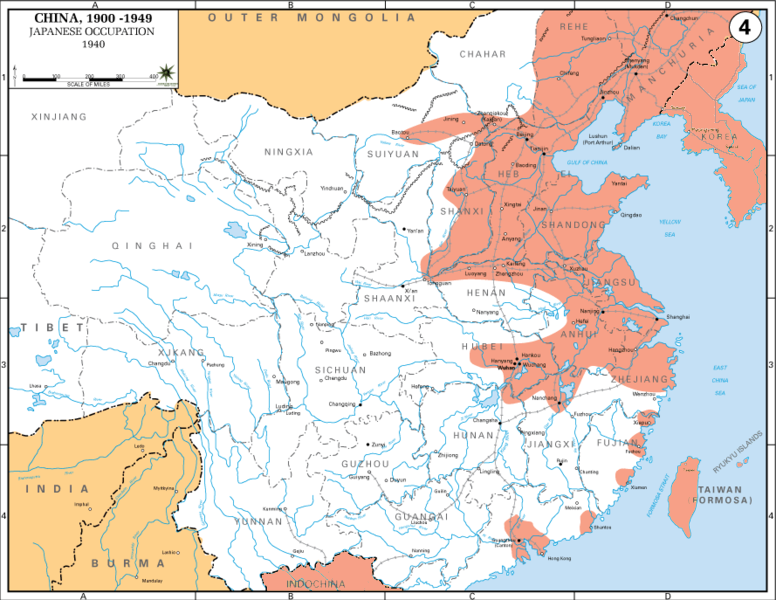
3 times the Japanese failed to capture Changsha (1939,1941,1942) before falling in 1944. In general from 1941 to 1944 the front changed in little in China. In 1944, the Japanese launched Operation Ichi-Go which took some cities but did not break Chinese resistance (the Chinese actually took the offensive in 1945)
Even the areas occupied by Japan had widespread partisan activity.
-
Dear @RogerCooper,
The Japanese had a majority of the military manpower in the CBI theater.
Here we come to the necessity to distinguish between the 2 kinds of TripleA units:
- units, who consume relatively more manpower and cost less PUs (like infantry). Their manpower to PUs ratio favours manpower.
- and units, who consume relatively less manpower and cost much more PUs (like naval units). Their manpower to PUs ratio favours PUs.
So for Japan CBI theater is more manpower consuming and Pacific theatre more PUs consuming.
The Chinese inflicted 2,500,000 casualties on the Japanese (mostly wounded). China was not a speed bump.
Dear @RogerCooper,
what is your opinion how many % of its total war power (PUs invested) should Japan spend in TripleA games on the China-India continental land theater?
(0-100%,- where 0% means Japan should concentrate only on Pacific operations (naval battles, southern islands, possible invasion to Australia);
- where 100% means Japan should concentrate on continental operations (China, India, possible land invasion deep into USSR);
-
Dear @beelee, @Hepps, @RogerCooper, @Schulz and all members of the TripleA community!
I wish you all Merry Christmas! Thank you very much for your support. -
@Unternehmer said in Lend-Lease (in singleplayer, not multiplayer games):
Here we come to the necessity to distinguish between the 2 kinds of TripleA units:
- units, who consume relatively more manpower and cost less PUs (like infantry). Their manpower to PUs ratio favours manpower.
- and units, who consume relatively less manpower and cost much more PUs (like naval units). Their manpower to PUs ratio favours PUs.
So for Japan CBI theater is more manpower consuming and Pacific theatre more PUs consuming.
I am not convinced that naval & air units require less manpower than infantry. The manpower in naval & air units is in the support units. For example the US ended the war with
- Army 5,851,000
- Air Force 2,282,000
- Navy 3,288,000
- Marine Corps 456,000
The US ended the war 31,335 combat aircraft. So there were 73 air force personnel per plane. An Essex class carrier had a crew of 3,500 to fly 100 planes. If you consider escort ships, supply ships and shore facilities, I suspect that the number personnel per plane was at least equal to the air force (and the planes were smaller).
As for how the Japanese divided their efforts, my guess is about 50/50. Battle casualties were about equal between the 2 (most casualties in China were non-combat). The Japanese stopped major offensive operations in China from Pearl Harbor to mid-1944 when they launched Ichi-go.
Historically, the Japanese had no reason to invade Russia. Conducting a military offensive against a major power on a single rail line was folly. Were the Japanese should have gone was India. They could supply by sea and benefit from local allies. British resources were strained in 1942.
In games, it usually pays to put most effort in Asia, as they way the Axis wins games is by taking out Russia so putting pressure on Russia is important. In many games, there is de facto Pacific cease-fire as both sides have greater profit with operations elsewhere.
-
@RogerCooper said in Lend-Lease (in singleplayer, not multiplayer games):
I am not convinced that naval & air units require less manpower than infantry. The manpower in naval & air units is in the support units. For example the US ended the war with
- Army 5,851,000
- Air Force 2,282,000
- Navy 3,288,000
- Marine Corps 456,000
The US ended the war 31,335 combat aircraft. So there were 73 air force personnel per plane. An Essex class carrier had a crew of 3,500 to fly 100 planes. If you consider escort ships, supply ships and shore facilities, I suspect that the number personnel per plane was at least equal to the air force (and the planes were smaller).
I use some info from Wiki (https://en.wikipedia.org/wiki/Military_production_during_World_War_II) :
WW2 US air forces have the total number of aircraft 295,959 and the personnel 2,403,806. So there were 8 air force personnel per plane. This number of personnel includes not only pilots themselves but also other personnel that belongs to the whole U.S. Air Force organization.Also from Wiki
(https://en.wikipedia.org/wiki/United_States_Army_Air_Forces#USAAF_statistical_summary) :
Total aircraft losses for the USAAF from December 1941 to August 1945 were 65,164.
88,119 airmen died in service (among them 52,173 men were battle casualty deaths).
To rough approximation 1 aircraft lost = 1 man lost.If the carrier is lost with all the carrier crew, pilots and 100 planes then there are only 3,500 men lost. But the carrier costs a fortune in comparison to the equipment of the infantry regiment with 3,500 men including transport, servicemen etc.
If we compare manpower losses to $ losses than for example
- 1 in-game infantryman lost is e.g. 10 manpower and only 1 PU lost;
- 1 in-game fighter lost is e.g. 1 manpower and 10 PU lost;
- 1 in-game carrier lost is e.g. 10 manpower and 100 PU lost + the PUs and manpower losses for the fighters lost if there were any on the carrier;
-
@Unternehmer I was counting only front-line combat aircraft (from Ellis: World War 2: A Statistical Survey, page 231). The discrepancy between total production and front-line combat aircraft is from the large number of non-combat aircraft (about 40% of the aircraft) and losses.
Aircraft losses in the war were huge and primarily not combat. The US actually had fewer aircraft in August 45 then December 44 (Ellis, page 242). An aircraft that is worn out and used for parts is out of operation just as much as one that was shot down. Under wartime conditions, the attrition rate in remarkably high, so you can't just add up aircraft production.
My basic point is that it keeps a lot of people to keep an aircraft flying, even though only few of those people are actually in the airplane. Also, the industrial technology of the 1940's were far less automated than that of today. There was an actual competition between the manpower needs of military production and the needs of military operations.
There was no such thing as a country with lots of industrial capacity but little manpower capacity. There were places which were the reverse. India's huge population fielded only 2,159,000 at the end of the war, less than half of Great Britain's.
No power was defeated in WW2 because they ran out of manpower to field viable armies. If heavy losses were taken in combat, men would be transferred from support to combat to restore the proper ratio. This was the reason the Russians could basically loses their entire starting military and still keep an army in the field. (This is also how my father ended up in the Battle of the Bulge).
This is why I don't see I need to track manpower separately from overall production. It creates a complication in the game system without enhancing realism.
I suggest you pickup World War II: A Statistical Survey by John Ellise (ISBN 978-0816029716). It has every imaginable statistic,
-
Dear @RogerCooper,
I was counting only front-line combat aircraft (from Ellis: World War 2: A Statistical Survey, page 231). The discrepancy between total production and front-line combat aircraft is from the large number of non-combat aircraft (about 40% of the aircraft) and losses.
Aircraft losses in the war were huge and primarily not combat. The US actually had fewer aircraft in August 45 then December 44 (Ellis, page 242). An aircraft that is worn out and used for parts is out of operation just as much as one that was shot down. Under wartime conditions, the attrition rate in remarkably high, so you can't just add up aircraft production.
My basic point is that it keeps a lot of people to keep an aircraft flying, even though only few of those people are actually in the airplane. Also, the industrial technology of the 1940's were far less automated than that of today. There was an actual competition between the manpower needs of military production and the needs of military operations.
Do you agree that losing an aircraft carrier is many times bigger economic damage, than losing an infantry regiment with the same number of men?
And losing 100 fighters with all their crews is many times bigger economic damage, than losing 100 infantrymen?There was no such thing as a country with lots of industrial capacity but little manpower capacity.
The idea is to represent the difference between e.g. Germany and USSR. For example, WW2 Germany had 3 times less manpower and 2 times more GDP then USSR.
Were these ratios important for the structure of German and Soviet forces?More important the manpower to GDP ratio is for naval engagements. Naval battles were small in comparison to the land battles in terms of manpower losses involved but bigger in terms of GDP invested in all these ships.
No power was defeated in WW2 because they ran out of manpower to field viable armies.
It's rather questionable point. Could the country keep fighting when whole generations of young men born e.g. 1910-1920 are killed and only women, elderly people and children are left? Or how long can the situation last when almost all people are taken from the economics and are sent to the front to patch the holes in the front line?
Could the Germany or the USSR keep fighting for 1 more year considering their every day casualties? Or were they just one step until their manpower resources are completely exhausted?
USA definitely could as the USA had no so much manpower losses during WW2 as well as UK.This was the reason the Russians could basically loses their entire starting military and still keep an army in the field.
How much does the russian human life costs for the bolsheviks everybody knows quite well. Red Terror has taken not less russian lifes than Nazis.
And even with all these extraordinary recruitment measures (impossible for humane Western culture), the manpower losses of the USSR in WW2 were almost at the limit of complete exhaustion. -
I think both of you are actually right at your arguments.
Hight tech military investments do not necessarily mean to conserve manpower in WWII timeline. The difference that they soak up overwhelmingly non-combatant manpower compare to like an infantry regiment as Roger rightfully said. The confusion is here that the game do not reflect non-combatant manpowers which would be imposible to run and replace these high tech military vehicles without them.
On the other hand, high tech miliary units could preserve manpower as well because majority of the manpower would be in home area rather than dangerious frontline plus there would be higher change to melt enemy manpower on the filed by right tactics.
-
Schulz's point is well-taken. The saying was "Iron is Cheaper than Blood". Air power consumed far fewer lives compared to the resources expended compared to ground power. This was definitely good for morale.
The disproportions between Russia and Germany was not as great as Unternehmer suggests. USSR forces peaked at 13,200,000 compared to 9,500,000 for Germany. Angus Maddison gives the Soviet Union a larger GDP in 1940 than Germany by 15% (if you count Germany's minor allies it comes out to about equal). The Soviet Union had 3 x as many people as Germany, but its backwardness resulted in fielding only 1.5 x as many soldiers. The hordes of Red soldiers was a myth promulgated by German generals after WW2.
Russia was able to build much the same type of army Germany had. For example in 1944, both Russia and Germany build about 40,000 military aircraft.



Hello! It looks like you're interested in this conversation, but you don't have an account yet.
Getting fed up of having to scroll through the same posts each visit? When you register for an account, you'll always come back to exactly where you were before, and choose to be notified of new replies (either via email, or push notification). You'll also be able to save bookmarks and upvote posts to show your appreciation to other community members.
With your input, this post could be even better 💗
Register Login