Flames and Steel (official thread)
-
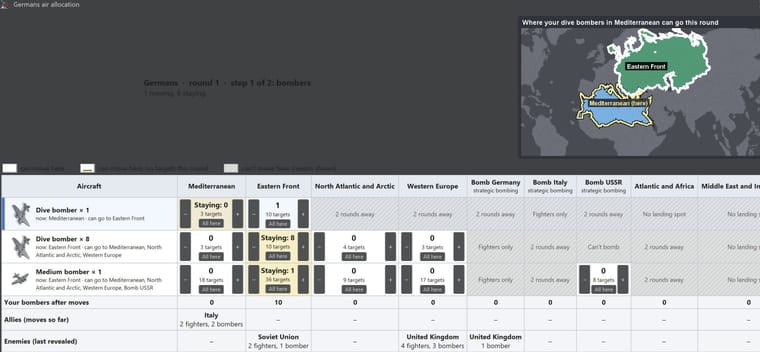
German air allocation: bombers. Note that it is sending a medium bomber and a ridiculous number of dive bombers to the eastern front. This is the start of round 1, and the start of Operation Barbarossa. Those German air will have much work to do.
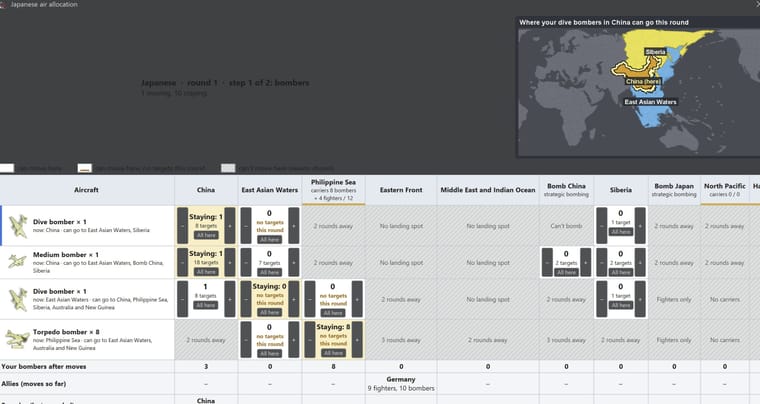
Japan's air allocation: bombers. Japan is sending two dive bombers and a medium bomber to strafe the Chinese Army. It is keeping its 8 torpedo bombers with its carriers.
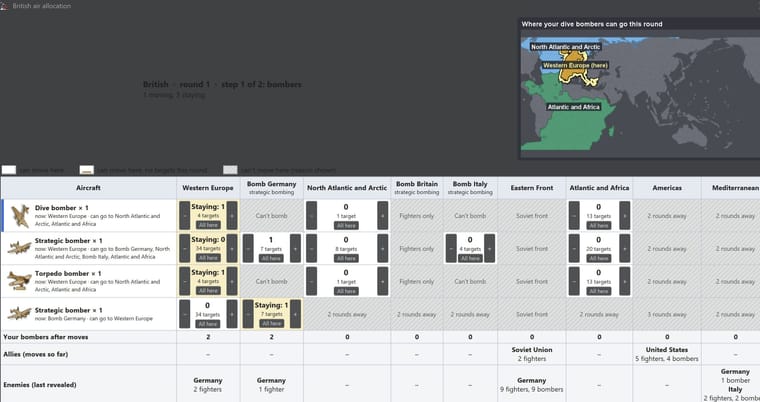
British bomber allocation. It is assigning both its strategic bombers to the task of bombing Germany. Its dive bomber and torpedo bomber don't yet have the range to reach across the Channel. That will come later, with Extended Range tech. In the meantime, it can use those air for neutral farming.
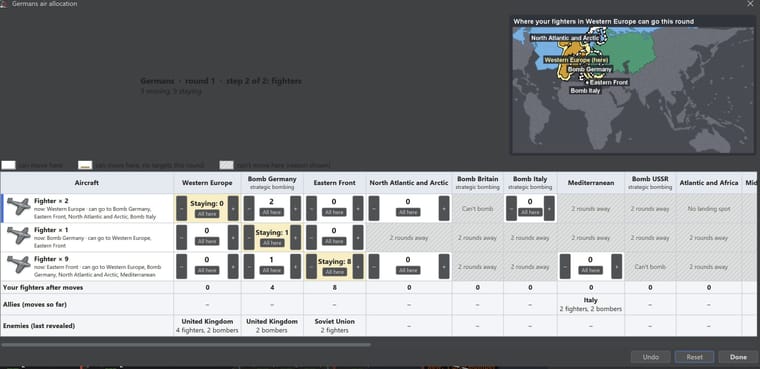
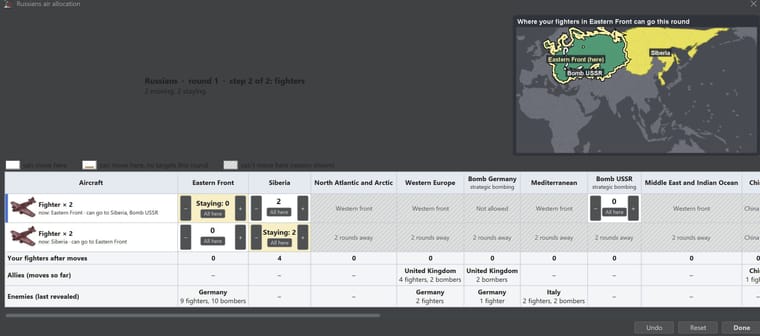
Fighter allocation: Germany. It is sending four fighters to defend the "bomb Germany" theater. The rest are allocated to the eastern front to ensure air supremacy there.
The Soviet player allocates his air to Siberia, to avoid air war with Germany.
Air war in "bomb Germany." Note that fighters take 2 hits to kill, and strategic bombers take 3 hits to kill. The German fighters have fired.
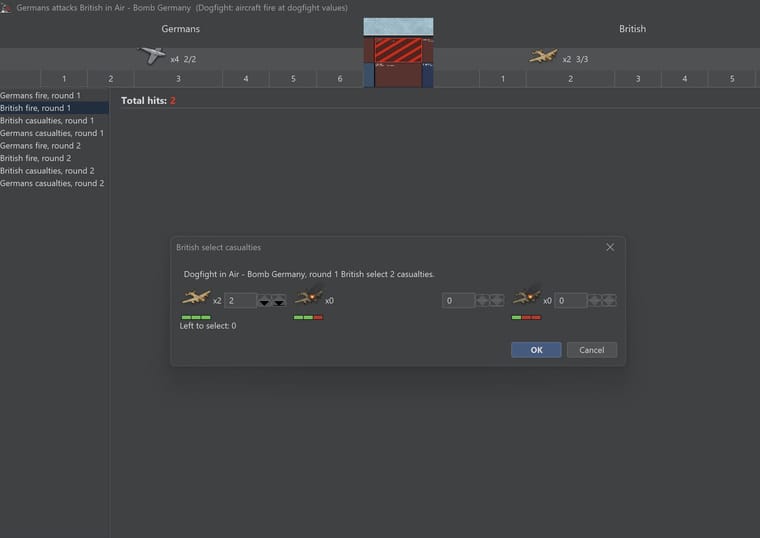
The British bombers have fired back. Strategic bombers have a dogfight value of 2, compared to 3 for fighters.
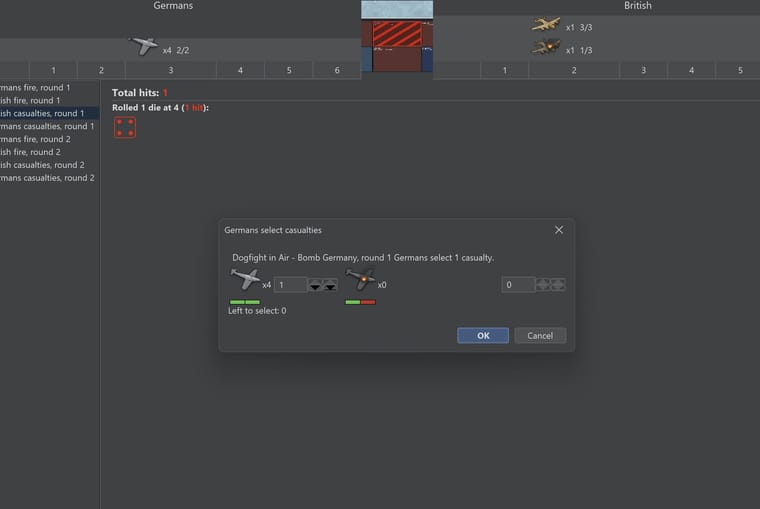
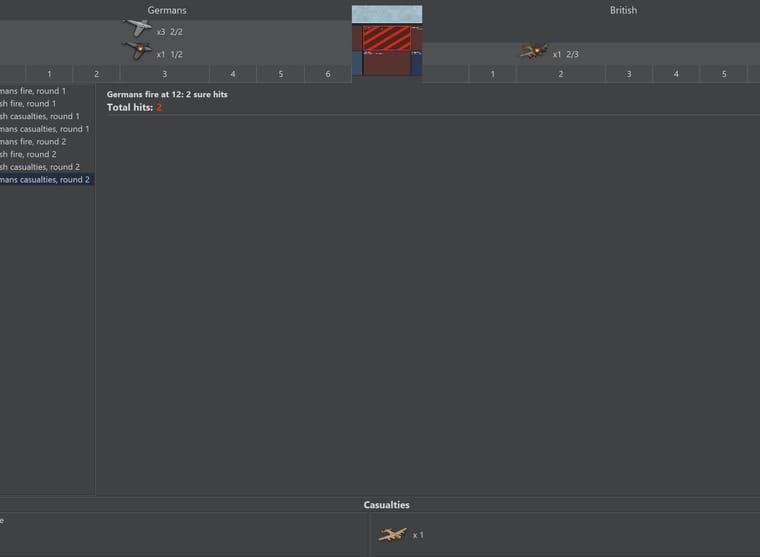
Dogfights last two combat rounds. The second round is now concluded. Britain has lost a bomber, and the other took damage. A German fighter took damage.
Now it is time for Germany to assign targets for its bombers. The bright green territories represent potential targets.
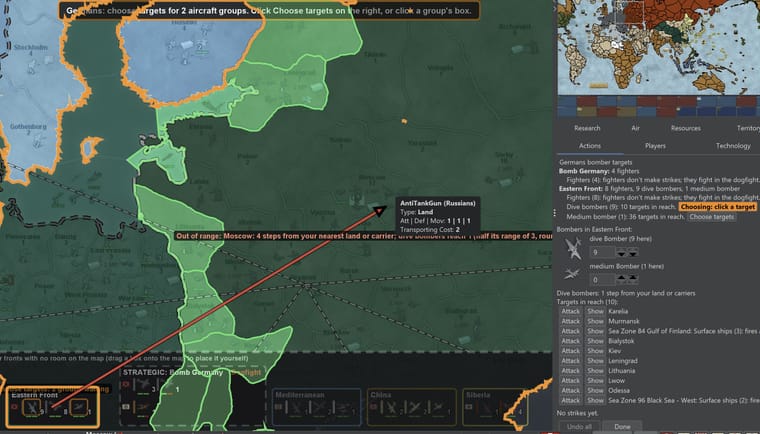
There is only one potential target the Luftwaffe actually cares about. Leningrad! All German bombers are assigned to that one target.
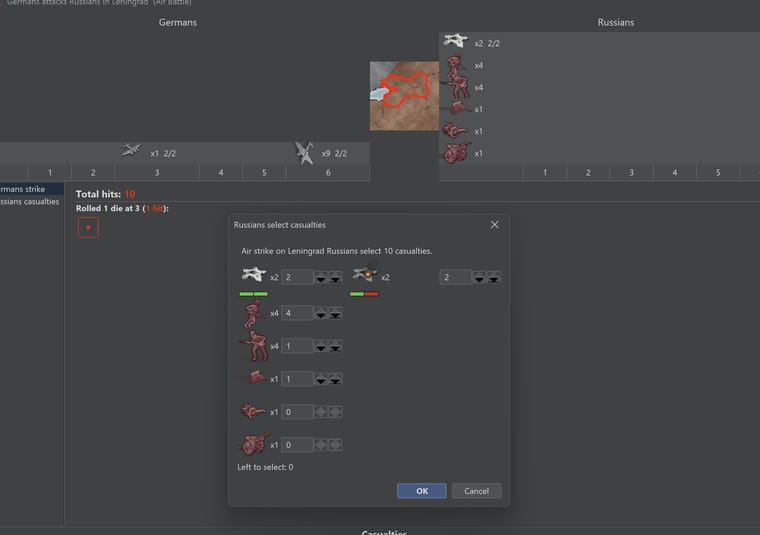
The strafing of Leningrad. The Soviets have taken 10 hits. Land units don't get to fire back, unless they are aa guns.
The British bomber chose Hamburg as its target, and did 5 PUs of damage with its bombing raid.
-
The German research phase.
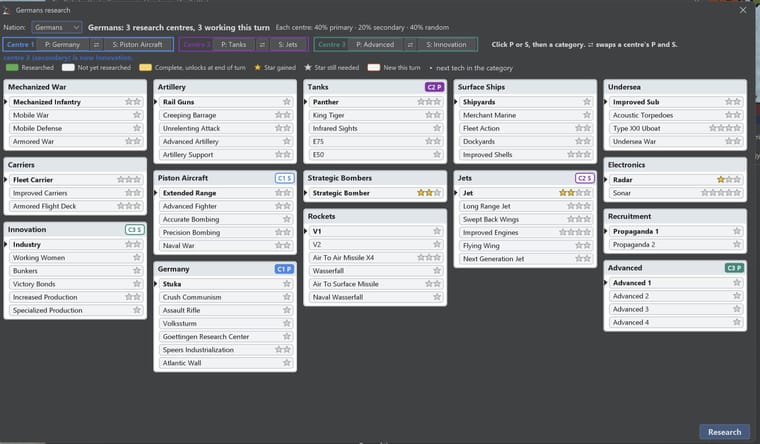
Germany has three research centers. It's assigned one of them the primary focus of Germany. There are some good techs in that category. But the one which really has Germany's mouth watering is Speer's industrialization. This gives Germany a free Panther each turn on each of its SPCs. But for this to actually work, Germany must have researched Panther tech. Also, it must be able to build SPCs. That is why Germany has chosen tanks tech as the primary focus for its second research center, and "advanced" as the primary focus for its third research center. The more advanced tech you have, the more SPCs you can build. But each nation has a hard cap on the number of SPCs it can have. Germany is capped at four SPCs.
For secondary research Germany has chosen Piston Aircraft, Jets, and Innovation. The first tech in Piston Aircraft is Extended Range. That tech allows fighters, dive bombers, and torpedo bombers to have a range of 4 instead of 3. Jet technology allows Germany's SPCs to produce jets as their special unit. Jets can only attack other aircraft, never surface targets. The first Innovation tech is Industry, which grants +2 to factory placement capacity. A tech like this could help Germany invade the Soviet Union.
Germany has now researched.
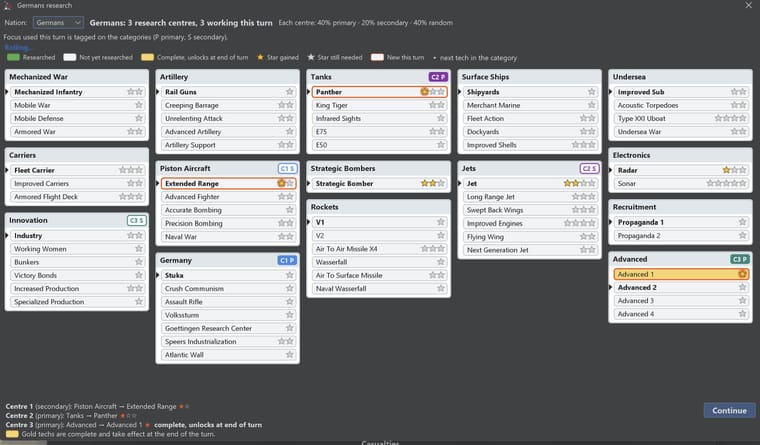
One star towards extended range. One more star there, and Germany's dive bombers will be able to go deeper into Soviet territory to strafe.
One star towards Panther tech. Excellent. Germany also gained Advanced 1 tech. This means it can build one SPC. But, that one SPC would be useless if built now, because Germany does not yet have the technology to build any advanced units. To solve that problem it needs to finish researching Panthers or jets.
-
The beginning of Germany's combat move. Note that Leningrad has been considerably weakened during the air phase. It is now possible to take Leningrad on G1.
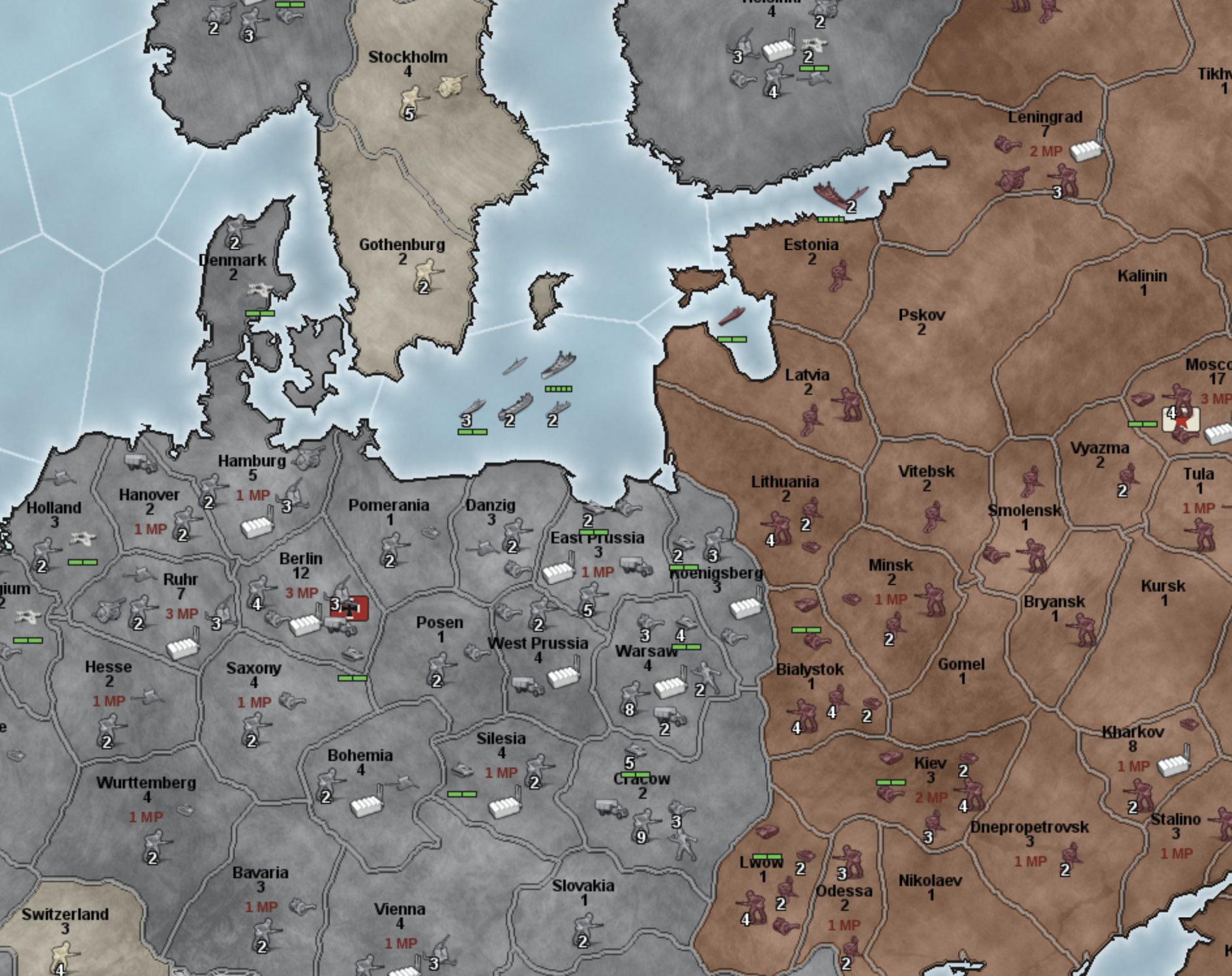
The German combat move is now complete. Having used dive bombers to weaken the Leningrad defense, Germany is now finishing off the Leningrad army with units from Helsinki and units shipped in via transports. It is also attacking most territories on the German/Soviet front.
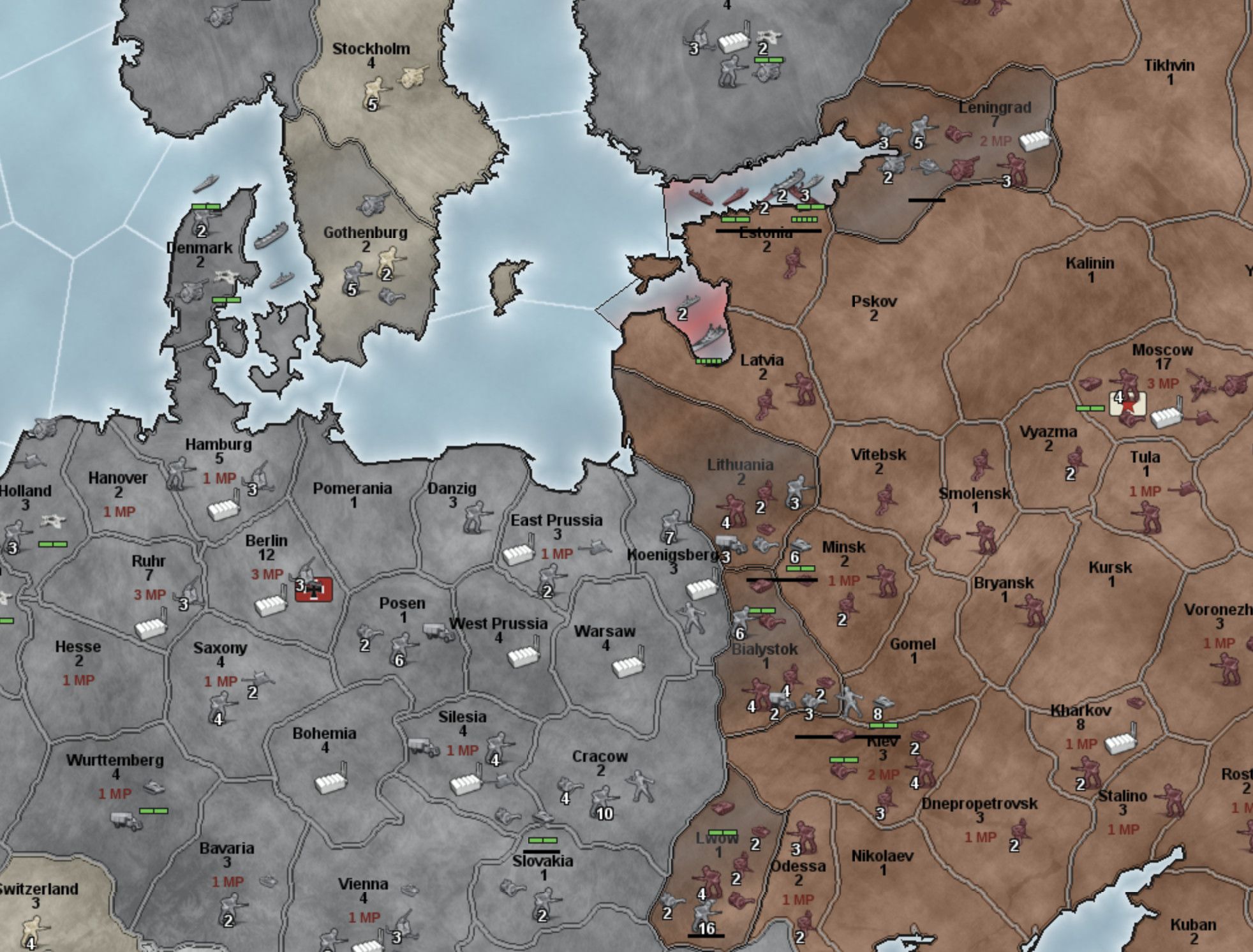
The purchase units phase for Germany. Note that it has 120 PUs and 15 Manpower Points (MPs) to spend.
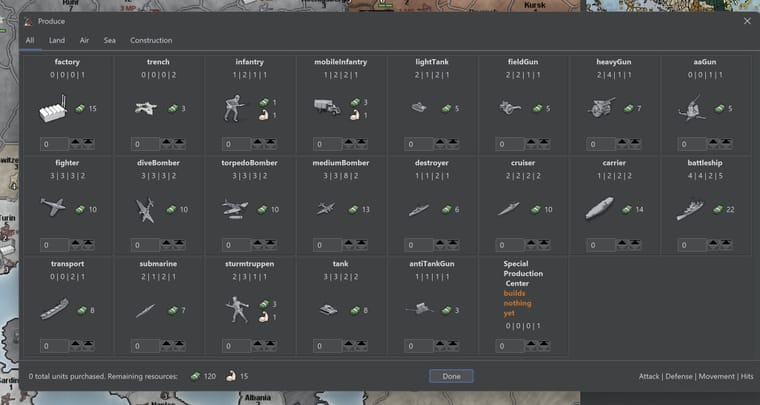
Germany's purchase. Most of its MPs are going to infantry. Some are going to mobile infantry or Sturmtruppen. If you need a cannon fodder unit and you're out of MPs, the anti-tank gun is a good cannon fodder unit. Germany is buying a number of those. Tanks have two hitpoints and move 2, so they are a good choice for an invasion of the USSR. Light tanks only have 1 hitpoint, but they give you more offensive firepower for your money than tanks. However, Germany isn't buying any light tanks this turn. It's buying a few field guns to spice up its offense.
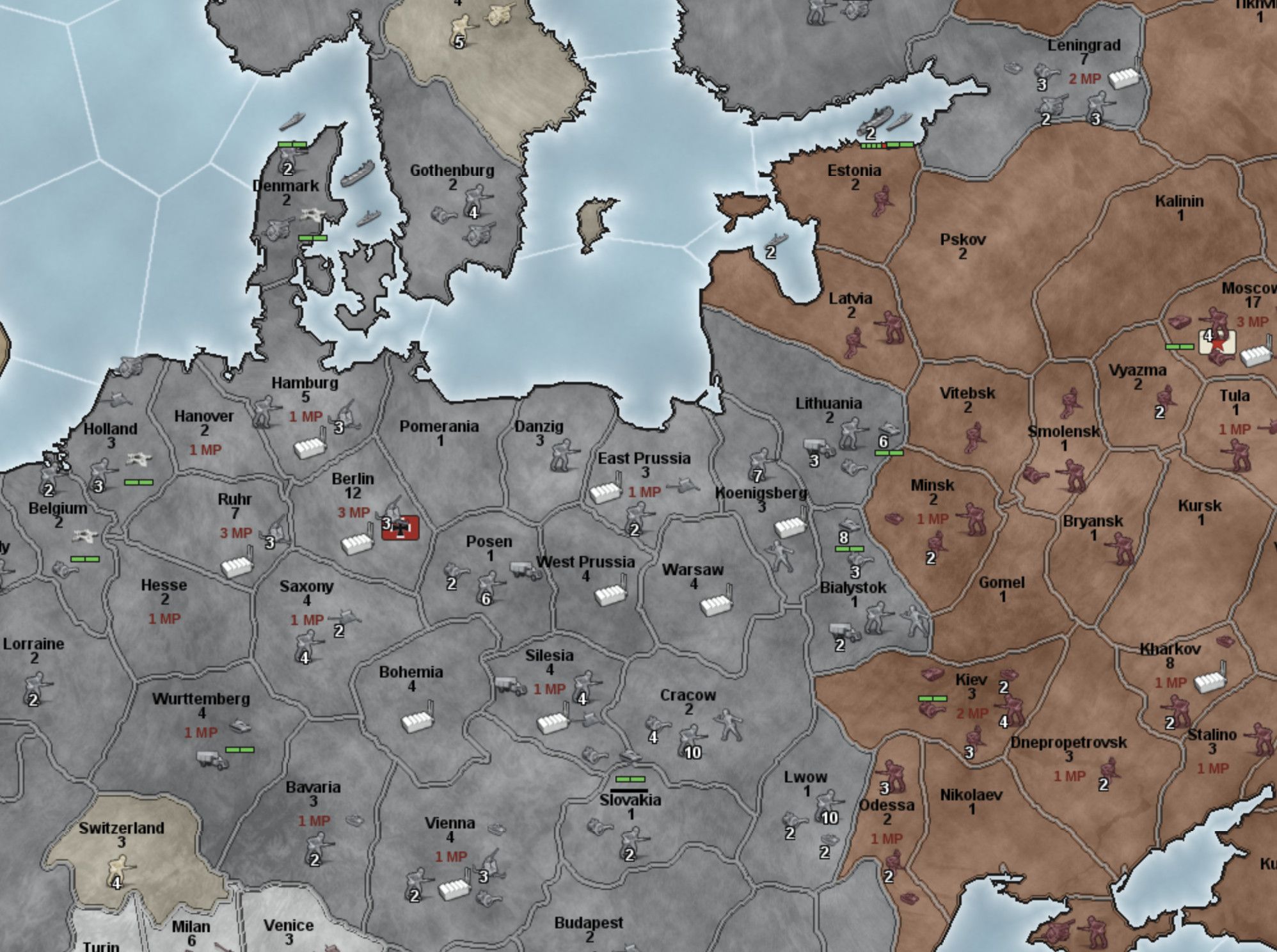
Germany has won its battles.
-
The Soviet player's turn. Research phase.
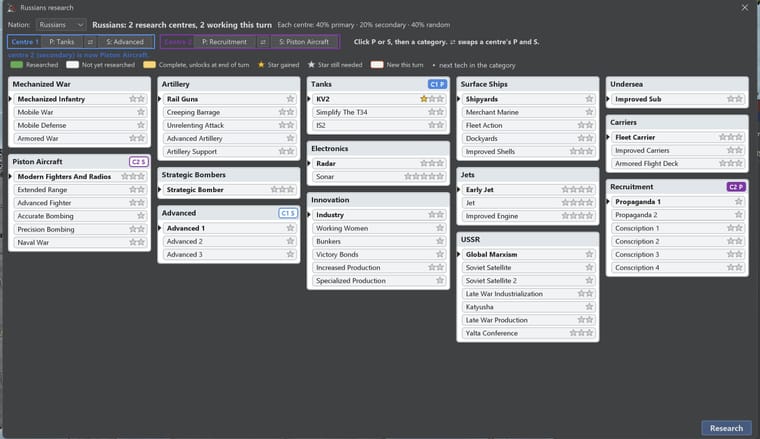
The Soviet player envisions having SPCs producing heavy tanks. With that happy thought in mind, he has selected tanks tech as the primary focus for one of his research centers. The other research center's primary focus is on recruitment. Recruitment tech is way more powerful for the Soviet Union than for any other nation. Conscription 1 tech causes Soviet factories to spawn 1 free conscript per turn, so long as the underlying territory is worth at least 9 PUs. Conscription 2 tech increases that bonus to 2 free conscripts per turn. Tech like this is a very tempting thought in the eyes of the Soviet player.
For secondary research focus, the Soviet player has chosen Piston Aircraft and Advanced. Currently Soviet fighters have a dogfight value of 2. Modern Fighters and Radios gets rid of this nerf, and brings their dogfight value up to the normal level of 3. That would be a step towards being able to challenge the Luftwaffe over the Eastern Front. (The Soviet Air Force has been hiding in Siberia, to avoid getting wiped out by the Luftwaffe.) The other secondary research focus is Advanced. This will allow the Soviet player to actually produce the KV-2 heavy tanks he hopes to have.
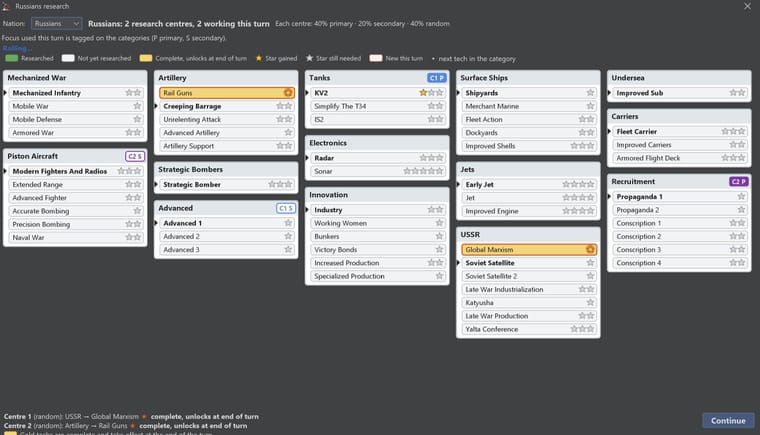
Both these techs were selected at random. But they are still good techs for the Soviet player. Rail guns tech causes your heavy guns to defend on a 5 instead of on a 4. A very solid defensive tech. Global Marxism allows the Soviet Union to receive MPs from captured territories, so long as those territories have an MP value. (A cap of 4 MPs received.) This doesn't help now, because the Soviet Union isn't about to capture territories with MP value. But there are techs further along in that tech category, such as Late War Industrialization and Late War Production, which improve Soviet income.
The Soviet Union does not go to war against Japan until the start of Japan's third turn. For right now it is mostly focused on Germany.
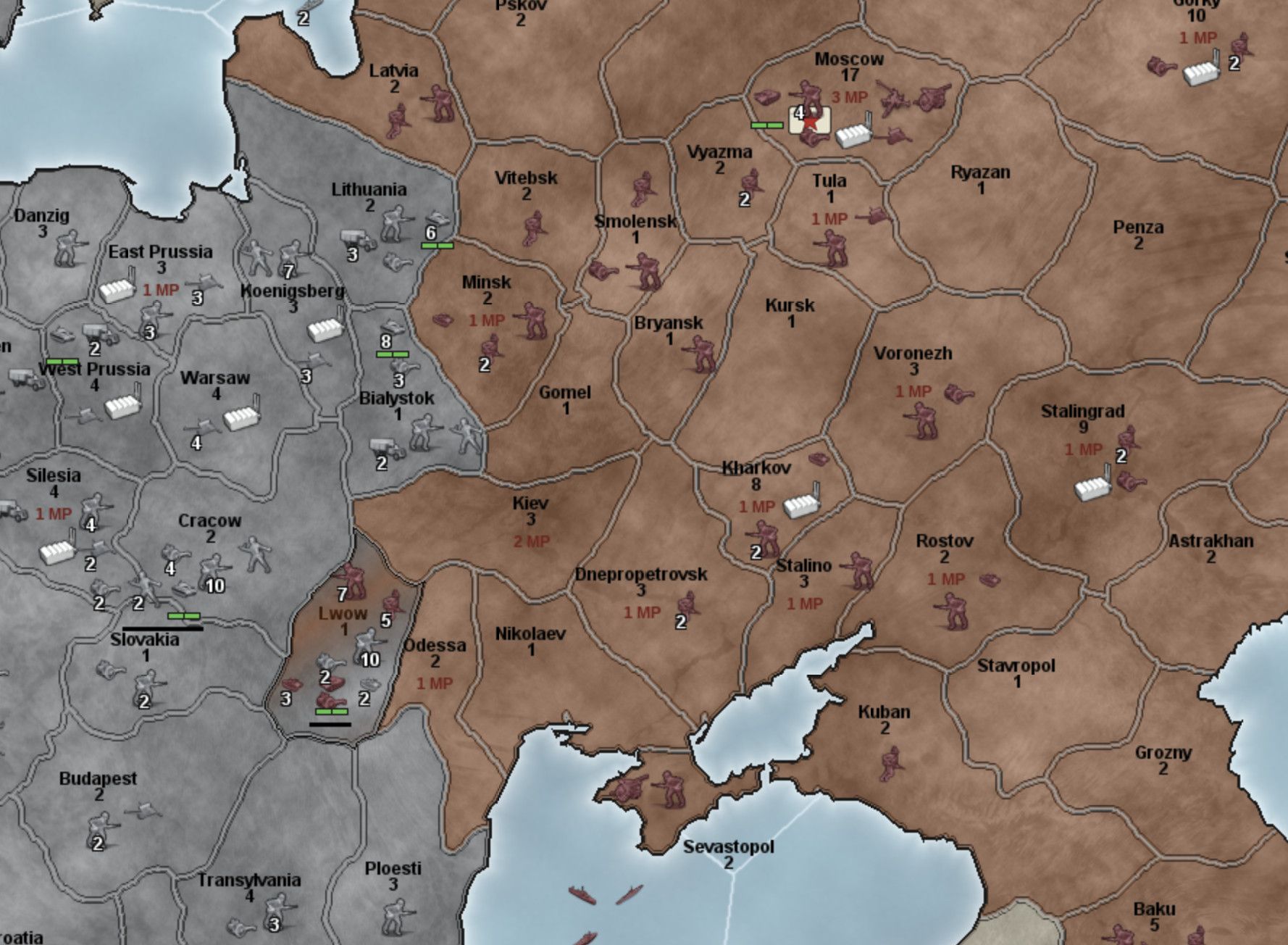
Germany will continue to push east despite this counteroffensive at Lwow.
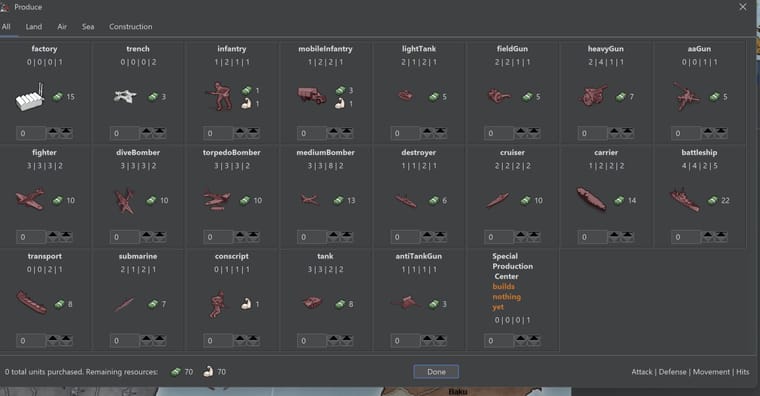
The Soviet build screen. The Soviet Union starts off with only partial income (70 PUs.) But, it also starts with several turns' worth of MPs, to reflect the one-time conscription which happened in the summer of 1941. If it wanted, it could build 70 conscripts at a cost of 70 MPs and 0 PUs. The problem with that would be unit placement.
The Soviet build.
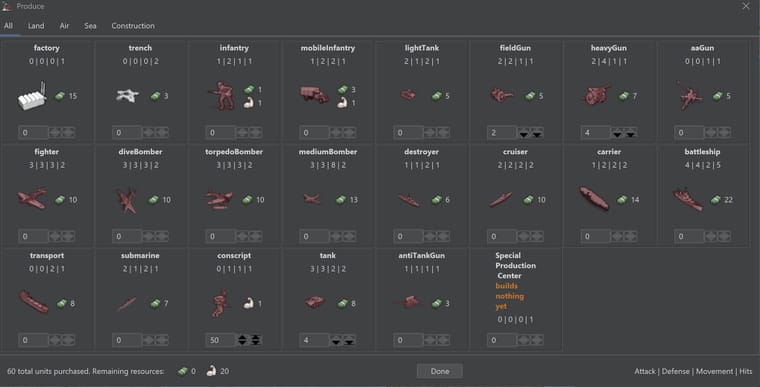
It's using 50 of its MPs, saving the rest for next turn. It's building some heavy guns, suitable for defense. A couple field guns, which are good for offense. Four tanks, which are versatile, move 2 units with 2 hitpoints.
The end of the Soviet non-combat move. At this point, it looks like the German Army is much stronger than its Soviet counterpart. The Soviets won their counterattack in Lwow, with 1 unit remaining.
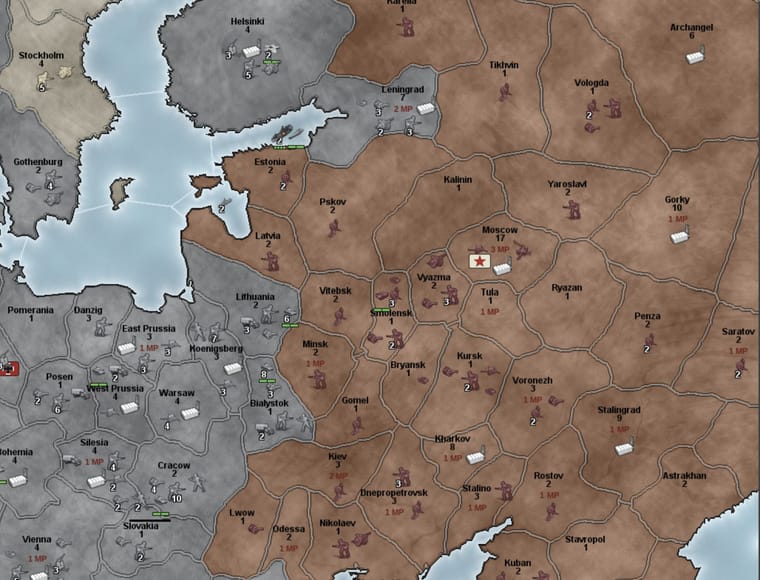
Place new units. 60 new units for the Soviets to place. Other than 7 conscripts for Vladivostok, all of them are being sent against Germany. Note that this unit placement was largely a result of the USSR starting out with 70 MPs. Currently it collects 26 MPs per turn, so it will not continue to place units in such massive numbers.
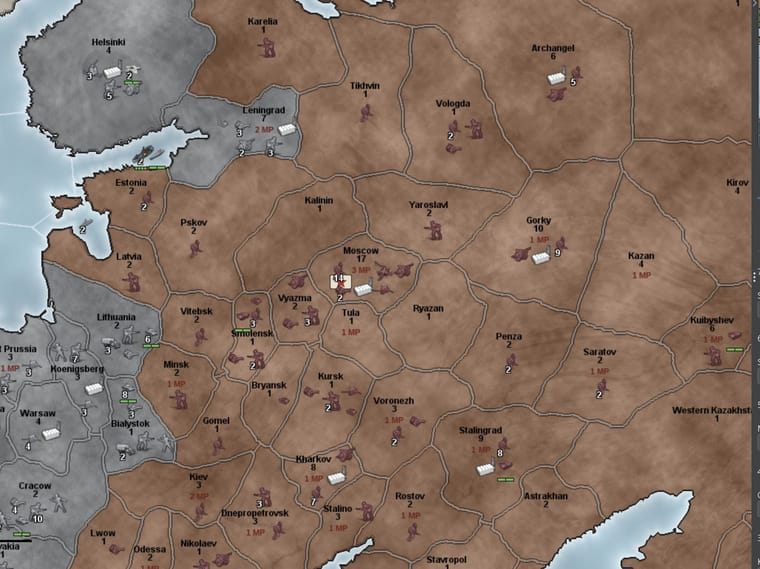
The Soviet player built at Archangel and Gorky to counter the German army at Leningrad. The units placed in Moscow, Stalingrad, and Kharkov are intended to fight the Germans south of Scandinavia.
-
Japan's turn. Research phase.
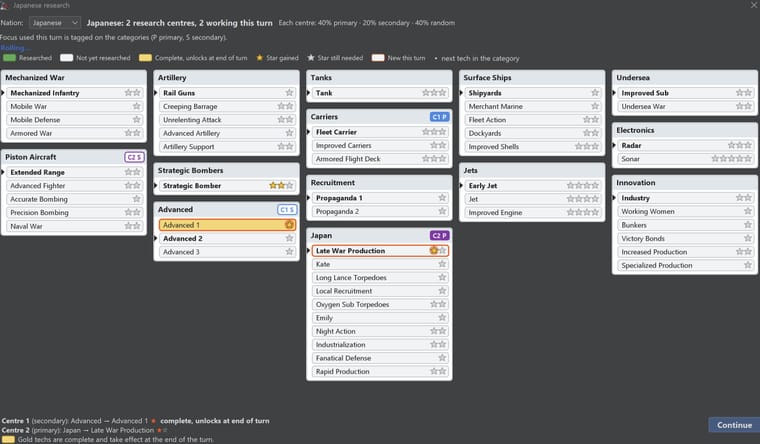
Japan gained Advanced 1, allowing it to build one SPC next turn. But, that SPC would be useless initially. Japan needs to research the ability to build at least one advanced unit type before that SPC would do any good. It had selected carriers tech as a primary focus, hoping to work its way toward fleet carrier tech. But it did not receive any advancements in carrier tech. Instead, its other advance was in Japan tech. There are some good techs in that category. Late war production, Industrialization, and Rapid Production will all give Japan an income boost later in the game. Kate tech improves Japan's torpedo bombers. Night Action improves its cruisers and Yamato battleships.
Japan doesn't go to war against the U.S., Britain, Dutch, or U.S.S.R. until round 3. In the meantime it is at war against China and neutrals.
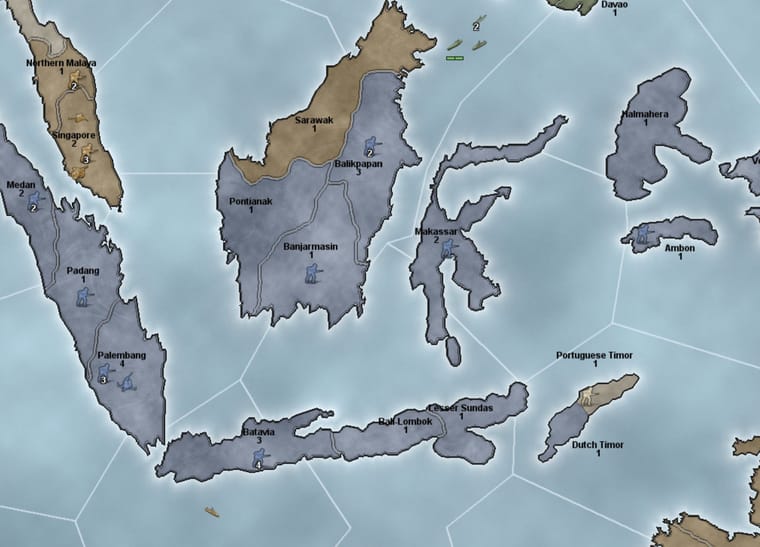
The Dutch East Indies. The Dutch don't actually get a turn. Unless Britain ships in reinforcements, the East Indies will be like this later when Japan attacks.
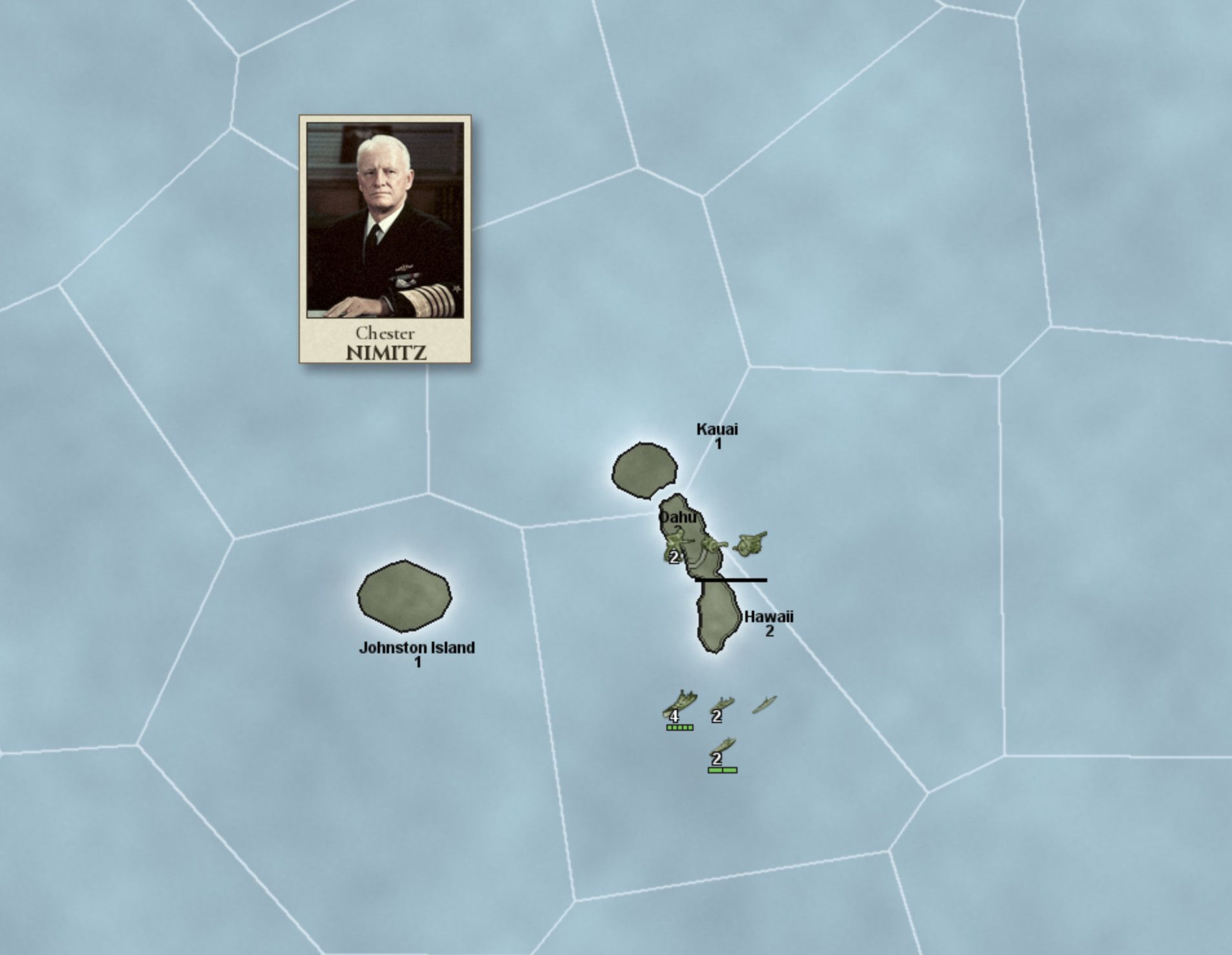
The American fleet at Pearl Harbor. The U.S. is not allowed to move units while at peace.
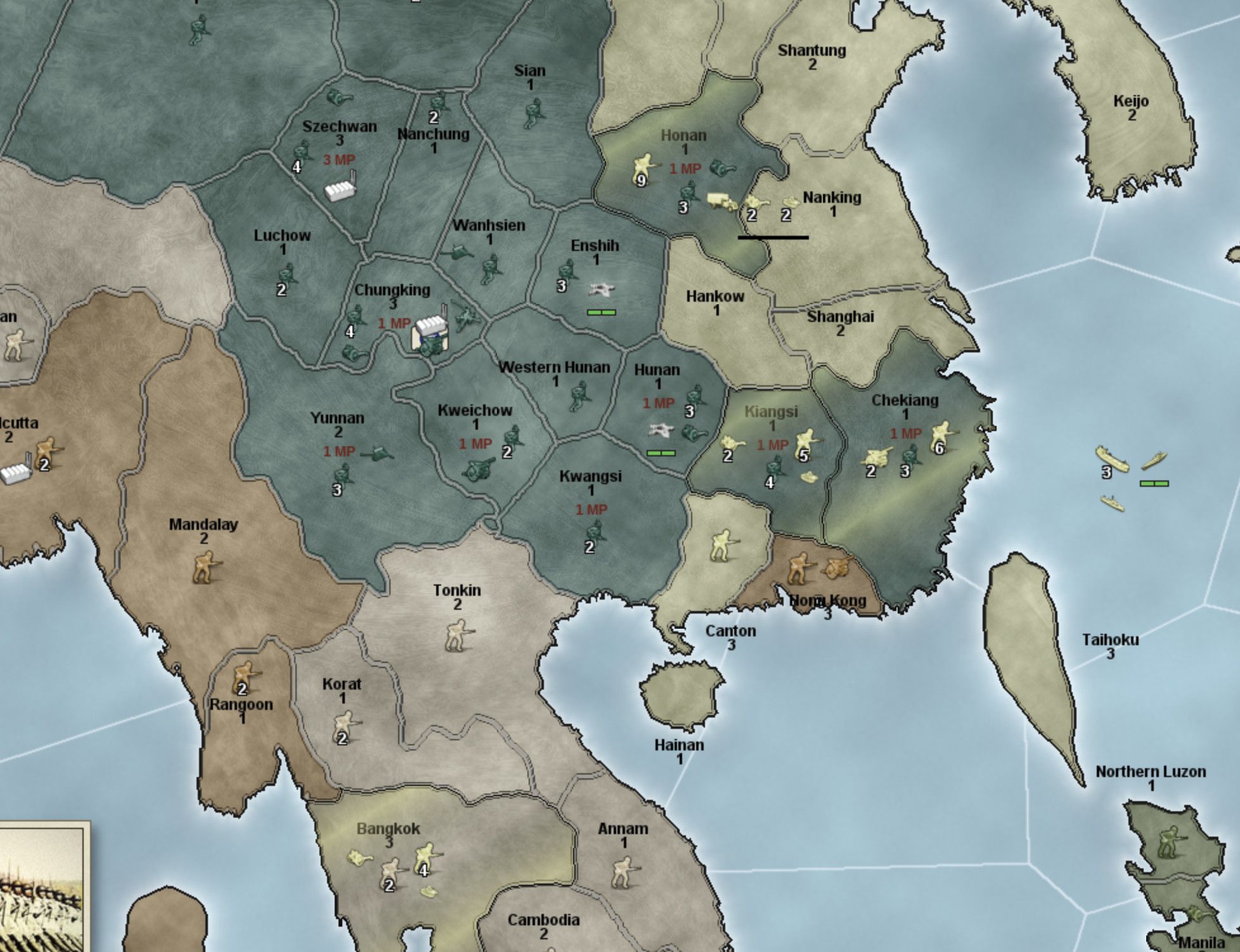
Japan's combat move. Some Japanese air had strafed China during the air phase. Japan is now following that up with ground attacks. But, it's also invading neutral Bangkok. That isn't just greed. Japan greatly lacks unit placement capacity in the south. Its plan is to invade Bangkok on round 1 and build a factory there on round 2. This will give it some of the unit placement it needs to pressure the South Pacific and Southeast Asia.
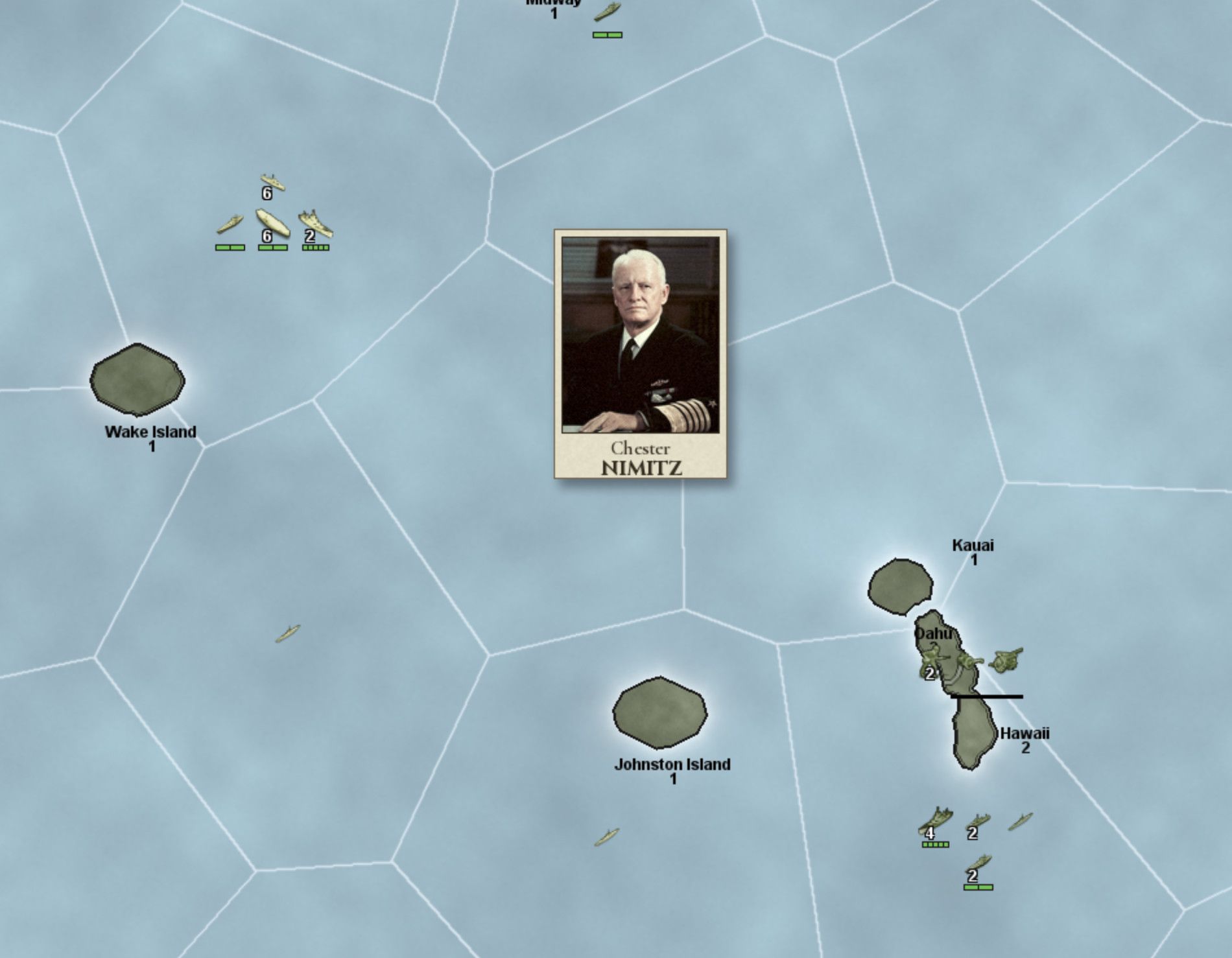
Japan is moving its main fleet closer to Pearl Harbor. At the start of round 3 it will attack the Pearl Harbor fleet with 8 torpedo bombers. Those will do considerable damage. Then it will use its navy to finish off the Pearl Harbor ships. The Japanese carriers appear to be empty because of the way air are handled on this map. In reality, those carriers are filled to the brim.
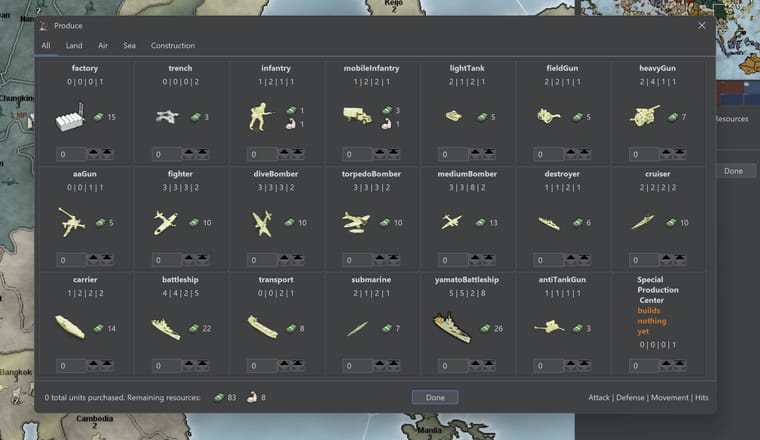
Japan's purchase phase. It has 8 MPs. Mostly those will go to infantry, but it might build a mobile infantry or two. 83 PUs.
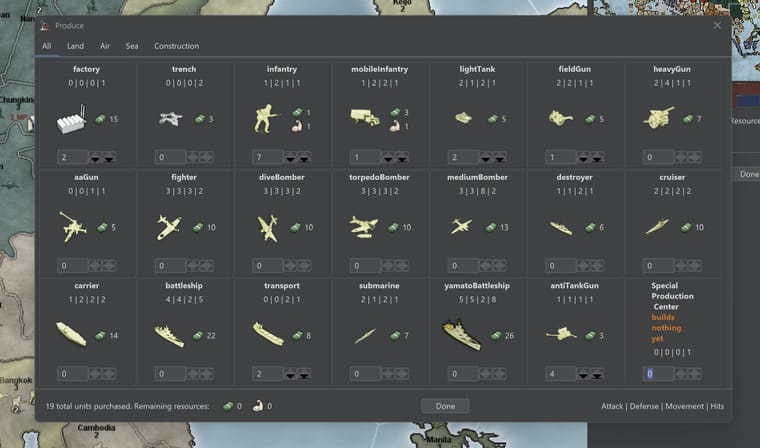
Japan's purchase. Two factories to help unit placement in the south. A couple transports to help ship units off Japan. Land units, mostly for its factories in northern China.
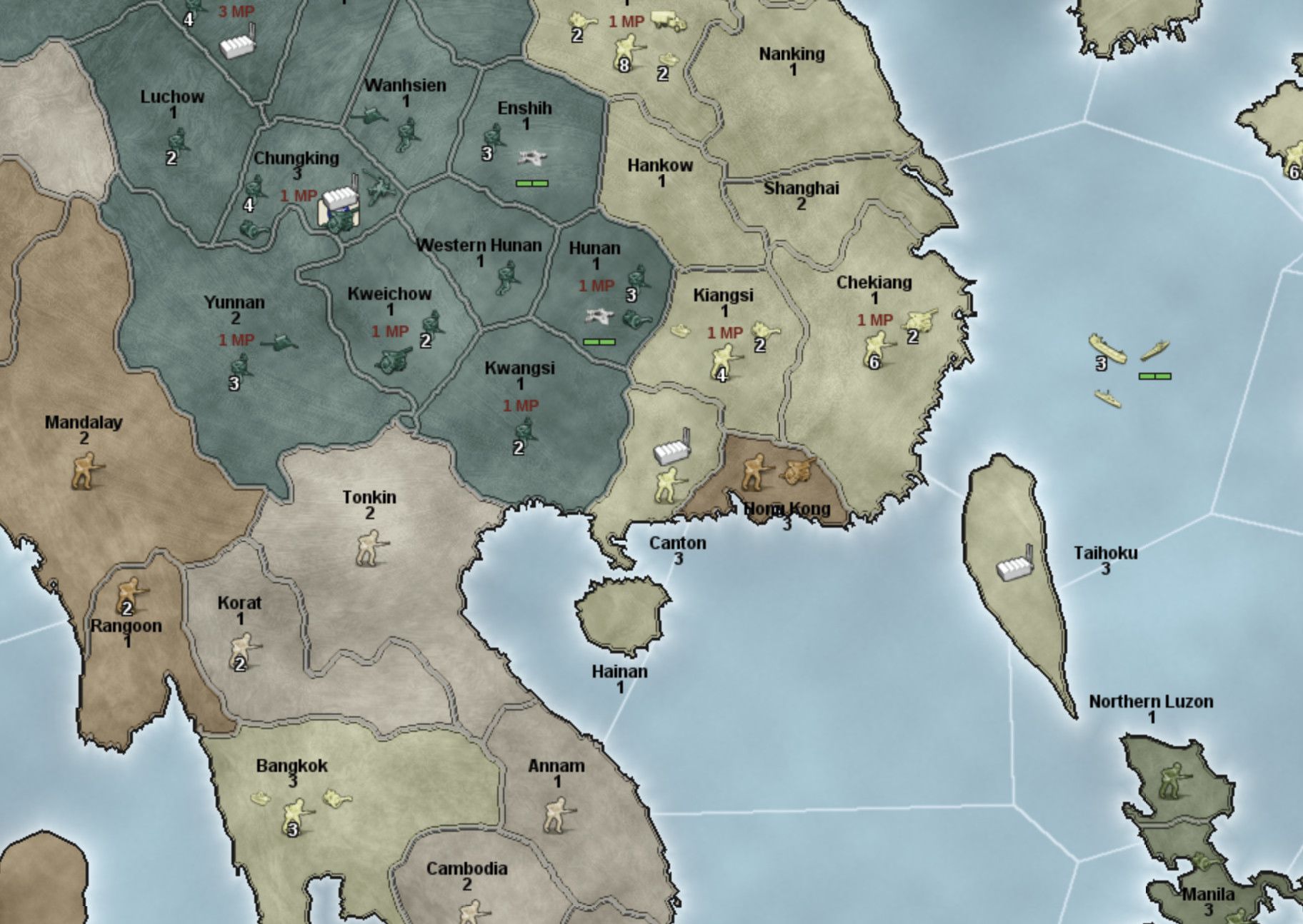
Japan's unit placement. Note that the new factory in Canton appears to be in more danger than it really is. Britain cannot attack it because Britain is not yet at war with Japan. China could attack it with two conscripts. A conscript attacks on a 0 (or 1 if supported).
-
Britain's research phase
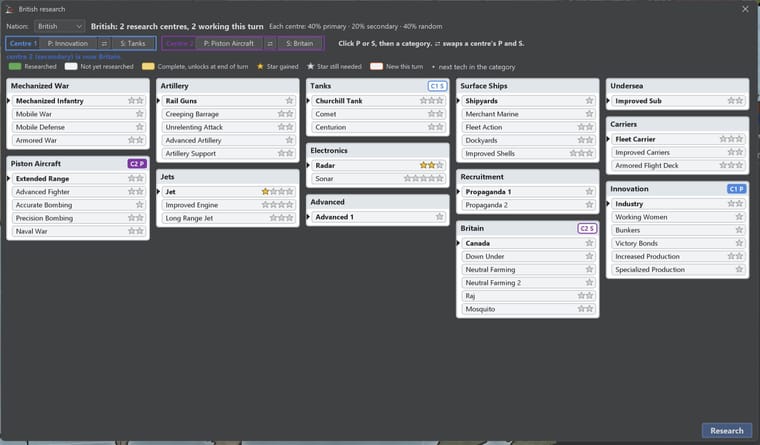
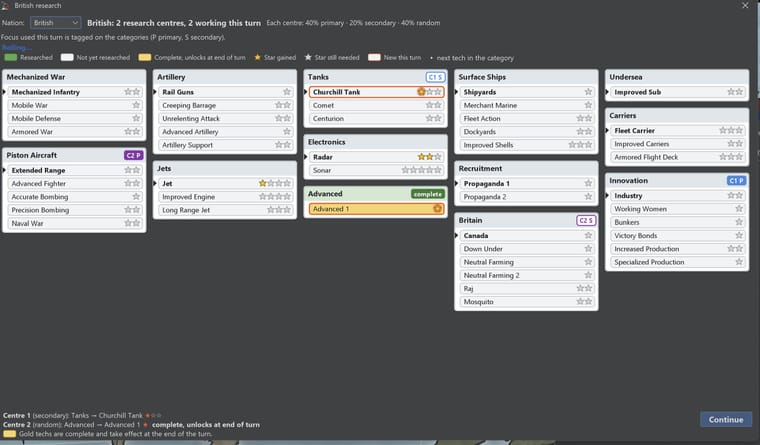
The result: one star towards the Churchill heavy tank, and Advanced 1 tech. Britain can now build an SPC, and has completed the advanced tech category. But that SPC would sit idle until it researches at least one advanced unit type. The Churchill heavy tank would be one example of an advanced unit. As an aside, the Churchill heavy tank is a little inferior to a normal heavy tank. But Britain can solve this problem by researching Centurion tech, which makes its heavy tanks superior to normal heavy tanks.
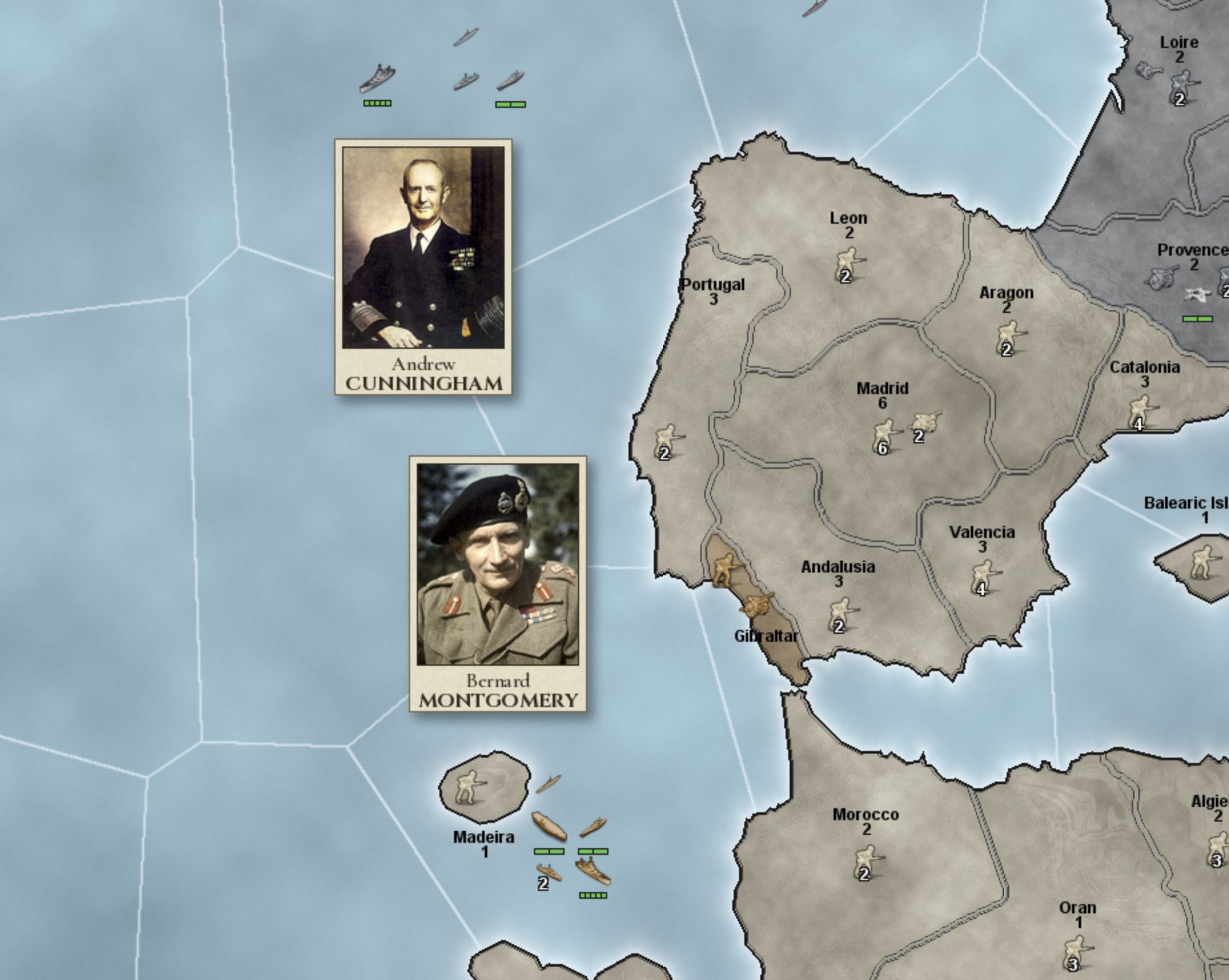
The British fleet in the west Mediterranean was not strong enough to challenge the Italian Navy. Therefore it has exited the Mediterranean and journeyed into the Atlantic. Note the German fleet to the north.
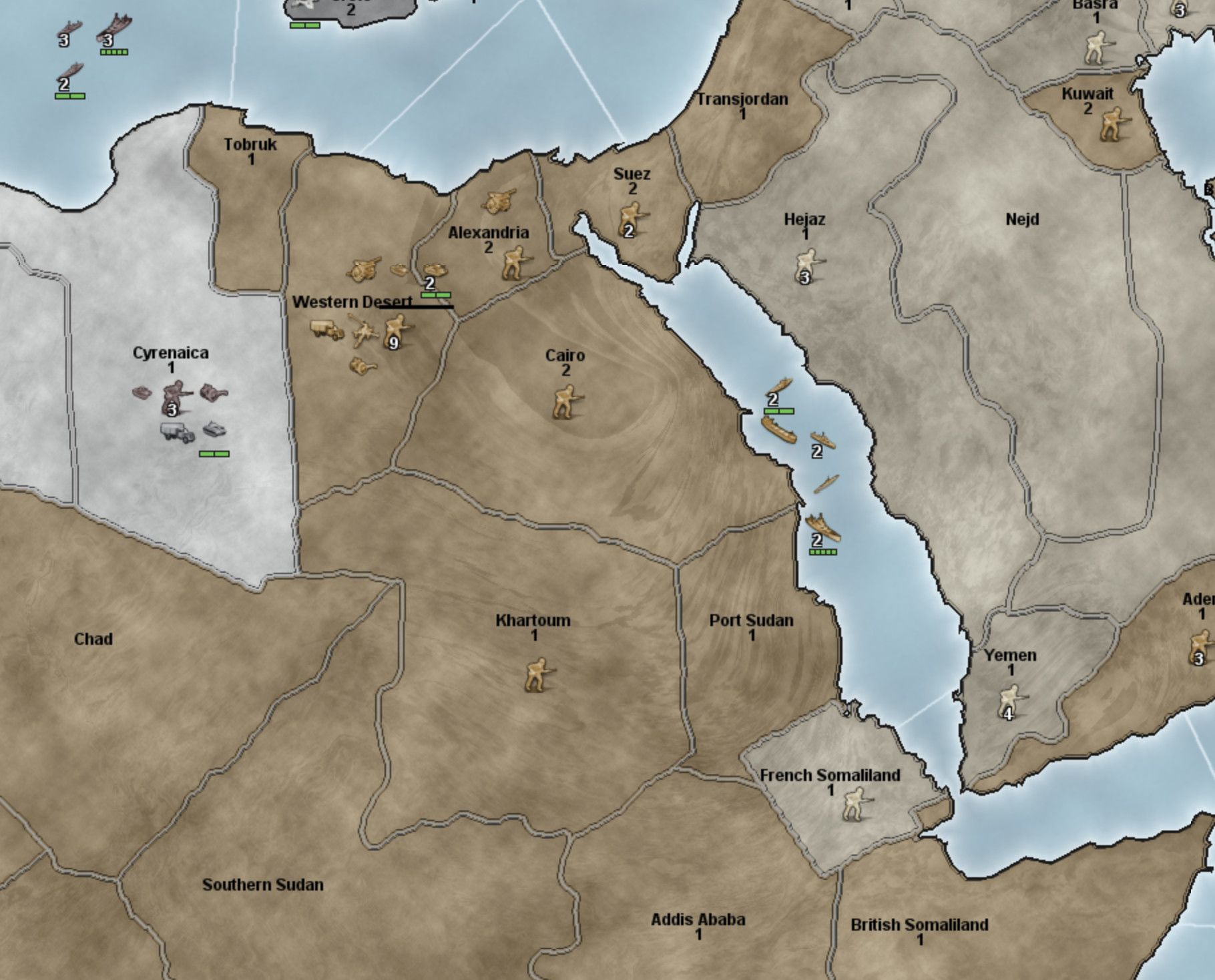
Here, the British and Italians are competing for North Africa. Britain has a bit of a tricky situation. It is only allowed to place new factories in the British Isles, Canada, India, Australia, or South Africa. This means its supply lines will often be longer than it might prefer.
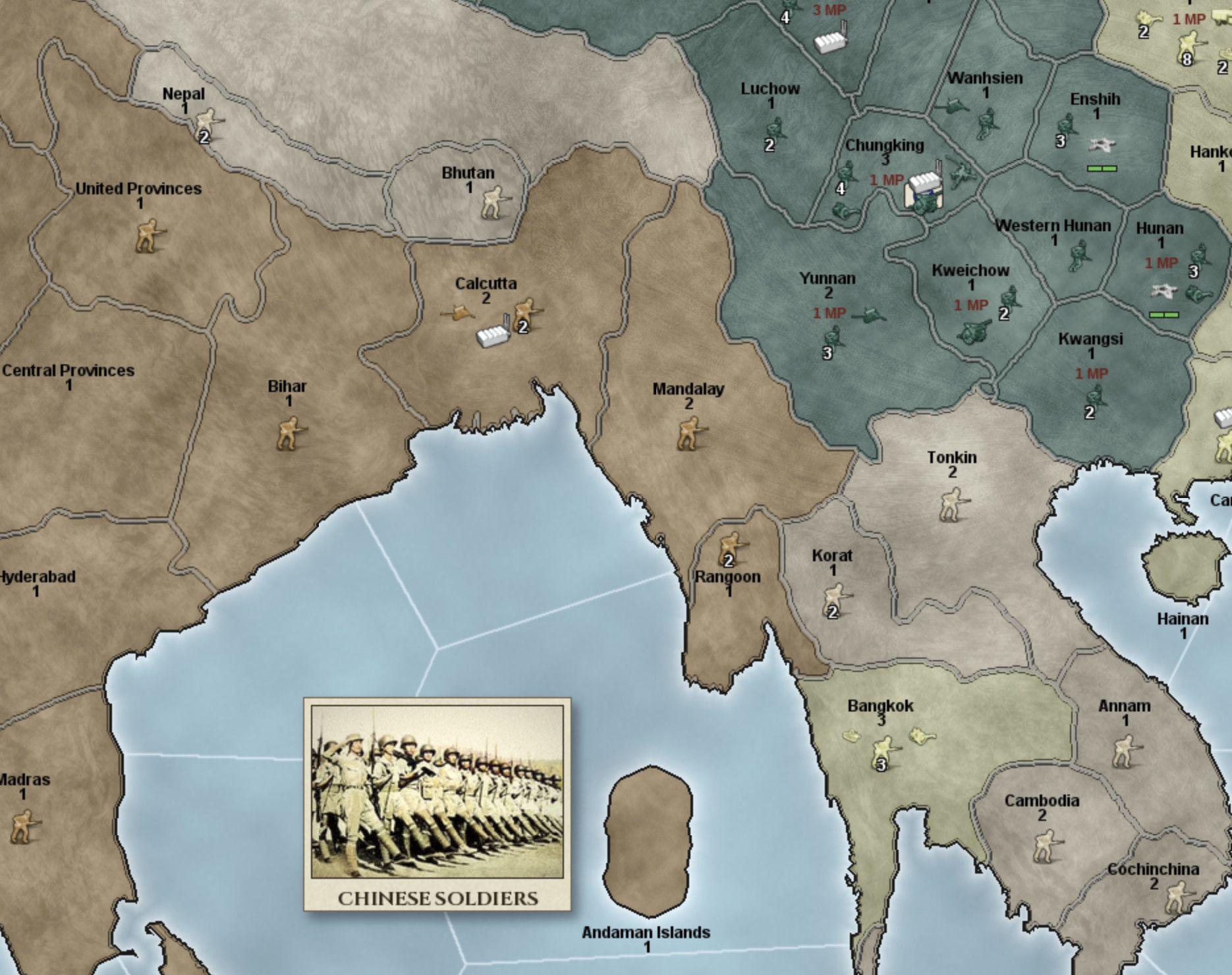
Note that Britain is unable to reinforce China, because non-Chinese soldiers are not allowed onto China-owned soil. Britain will have to fight its own, separate war with Japan, starting in round 3. Also, Lend-Lease munitions can only be placed in the continental United States, Canada, or the British Isles. This means Britain cannot use its India factories to send Lend Lease munitions to China or the Soviet Union.
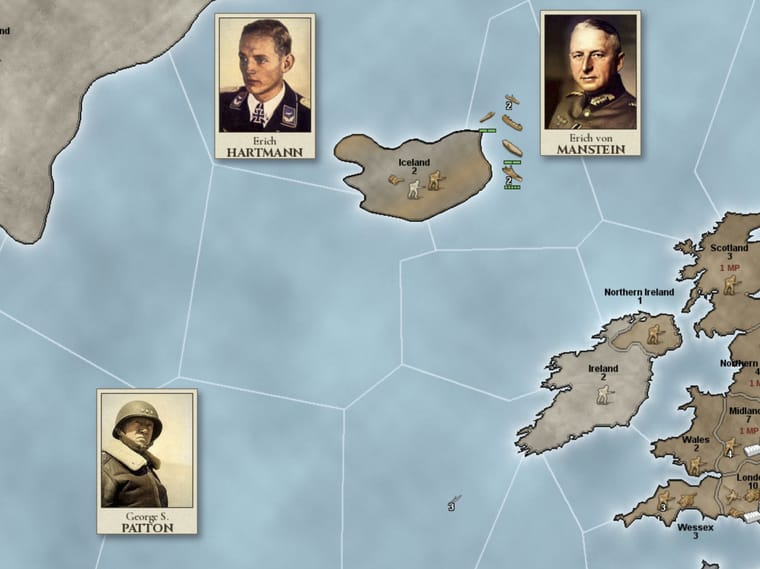
The British Navy couldn't reach the German subs in the North Atlantic, so Britain chose to neutral farm Iceland instead. During the air phase it had strafed Ireland, killing one of the two infantry defending it. If it kills the other infantry during the next air phase, it will be able to waltz into Ireland unopposed. The British dive bomber and torpedo bomber would prefer to strafe the Germans in France instead, but they cannot do so until Britain gets the Extended Range tech.
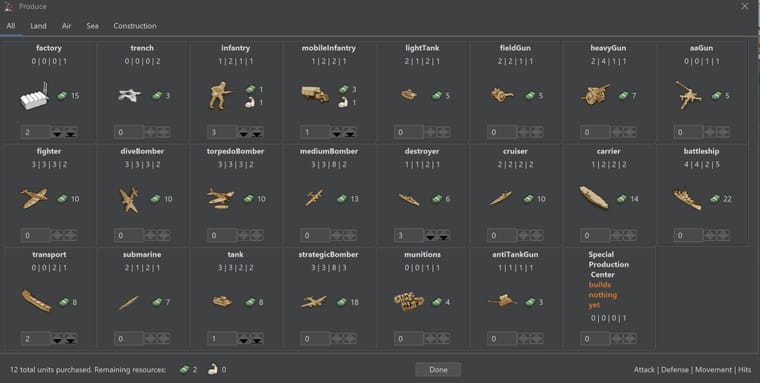
The British build. One factory for India, the other for South Africa. Destroyers for the North Atlantic. Land units for the factories in India and Africa Britain already has.
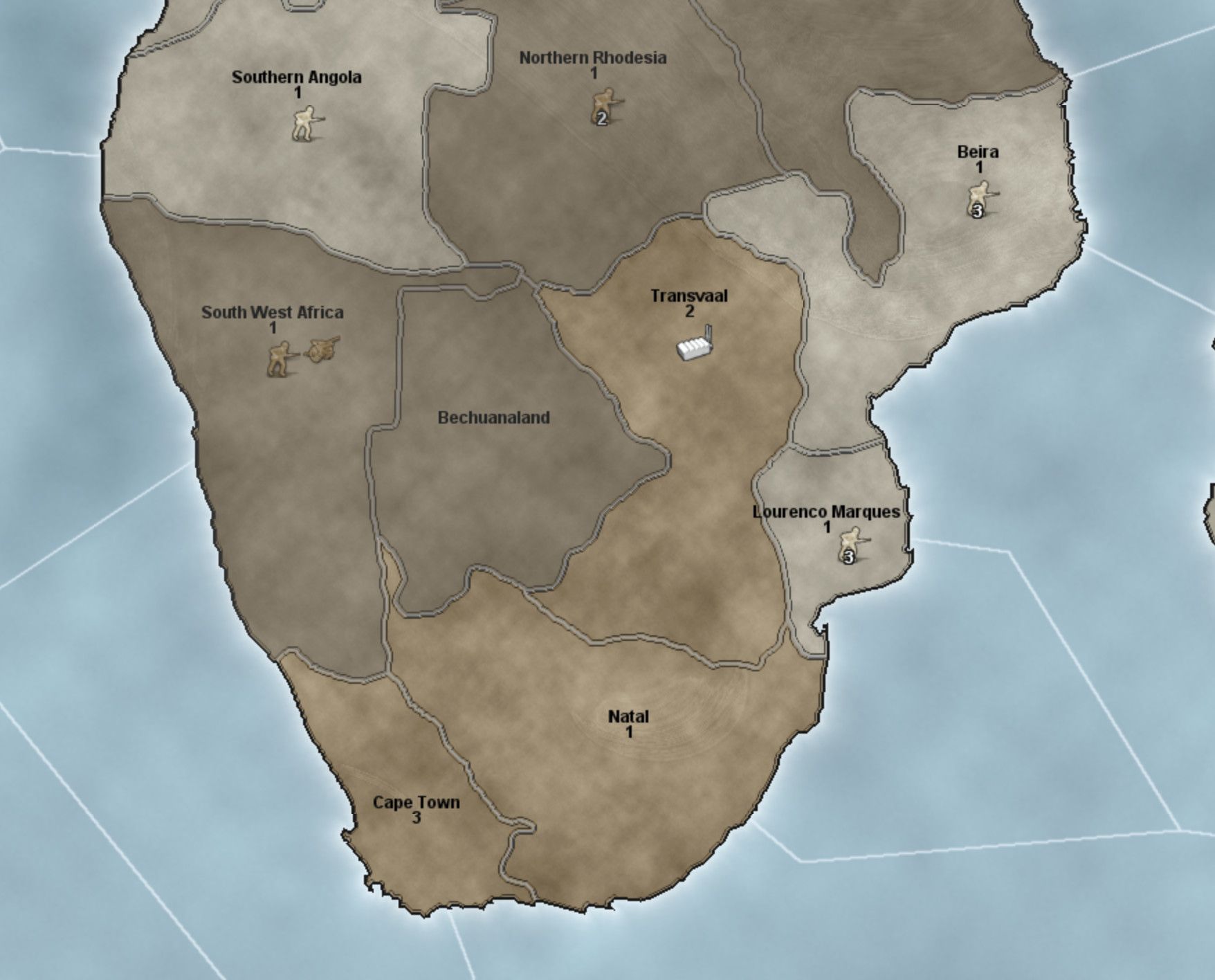
Place new units. Note that allowed locations for factories are colored somewhat differently than disallowed locations.
-
Italian research phase. Italy has one research center. As a small nation, its main research objective is to get anything it can to produce free resources. That means innovation tech as its primary focus, and recruitment as its secondary focus.
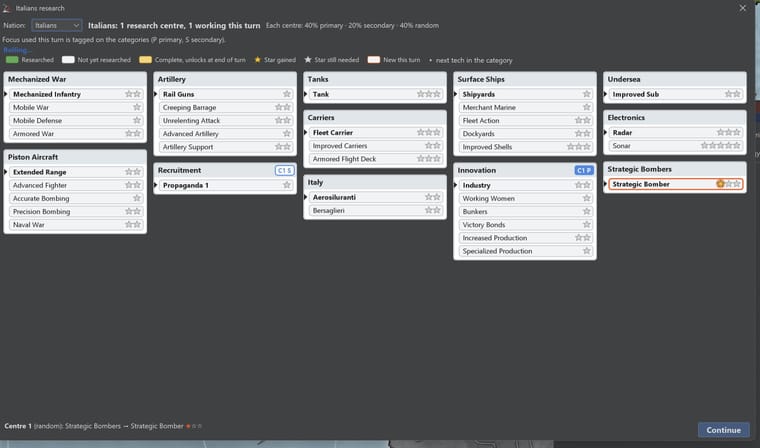
A randomly chosen tech, towards being able to build strategic bombers. Not what Italy had wanted.
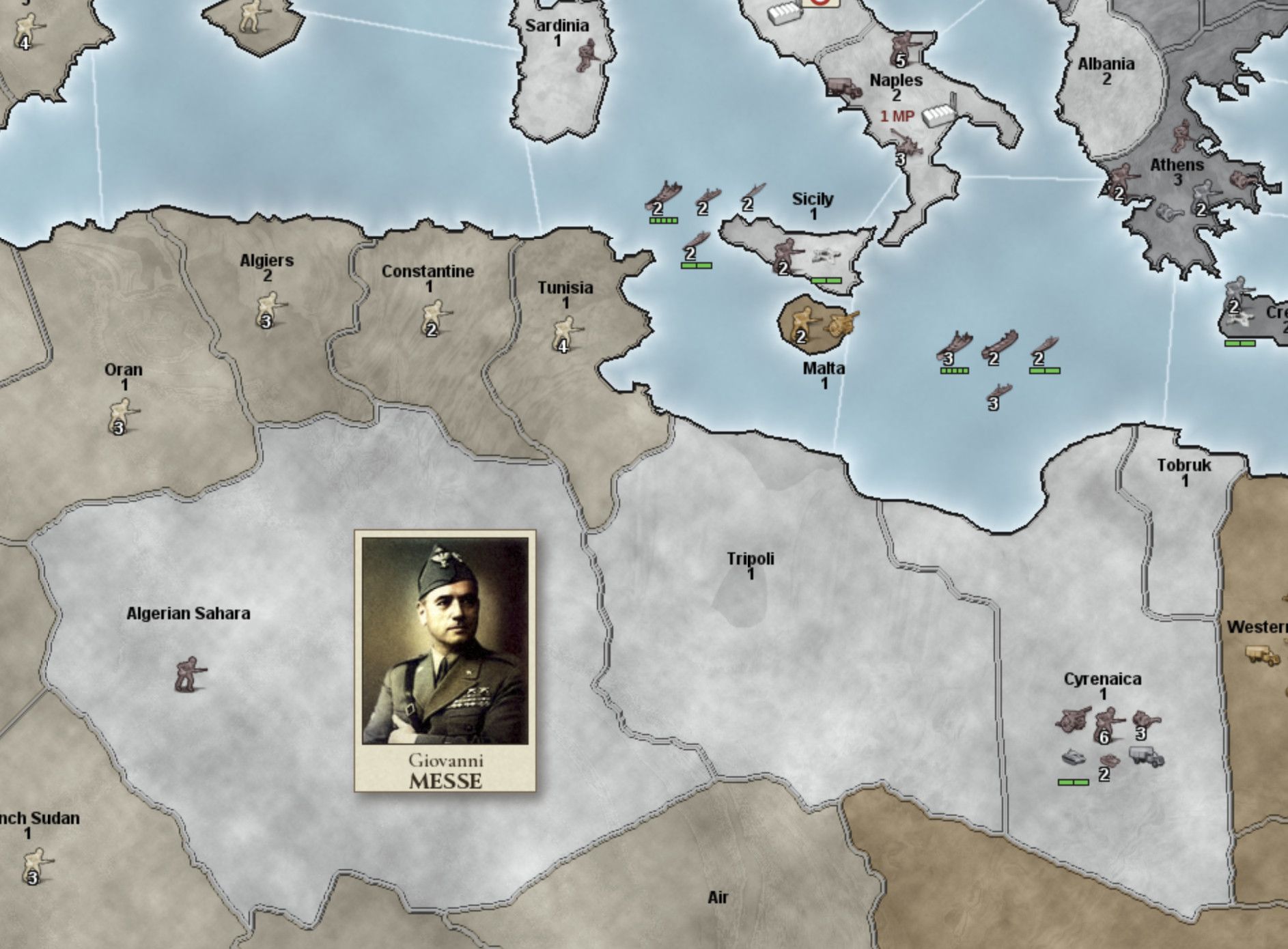
Italy's combat move. No actual attacks, but a buildup in North Africa.
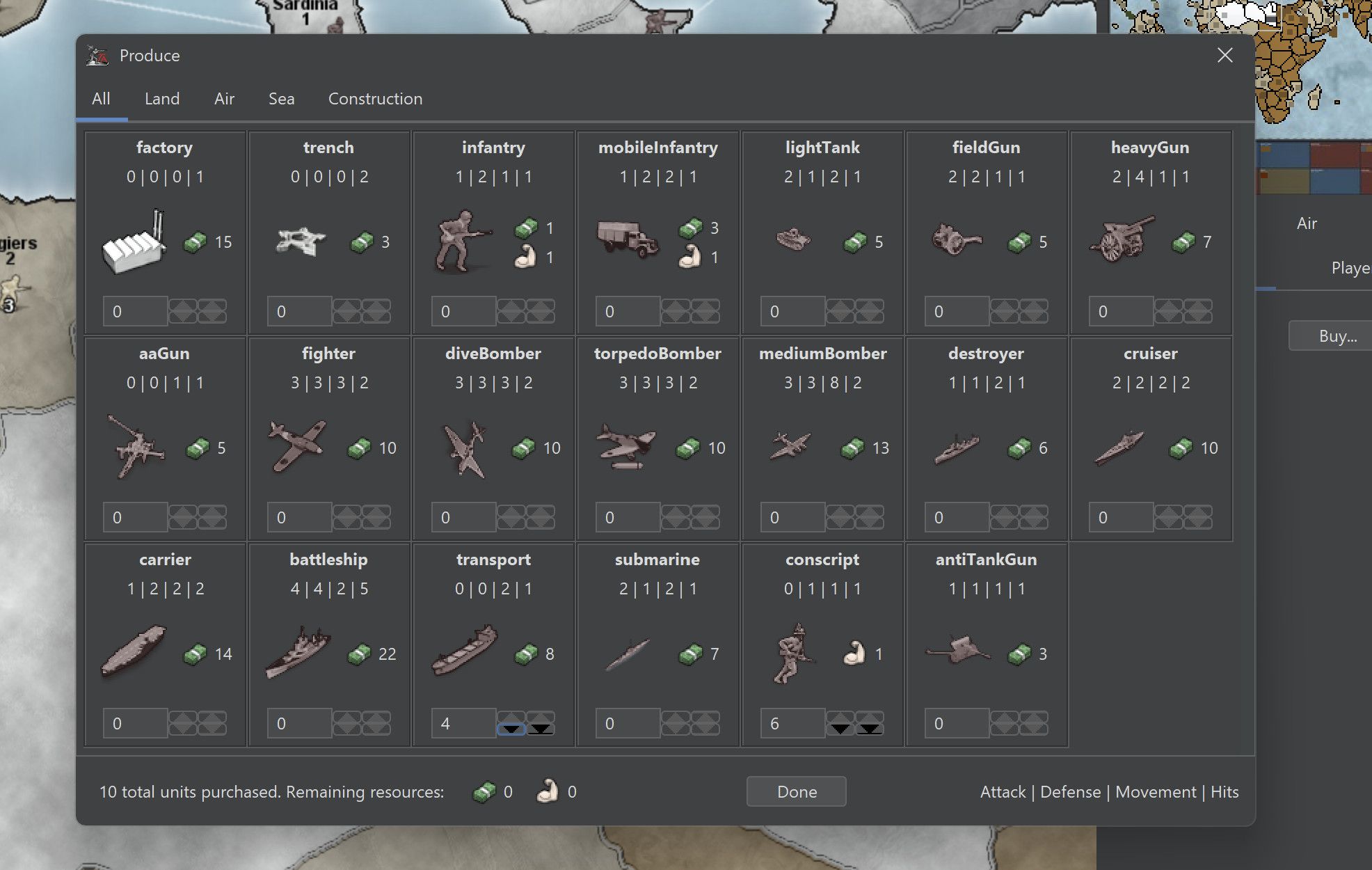
Italy's build. It is one of three nations able to build conscripts. (The other two being the Soviet Union and China.) A conscript attacks on a 0, or a 1 if supported. Defends on a 1. Costs 0 PUs and 1 MP. Six conscripts for Italy, as well as four transports.
-
China's build phase
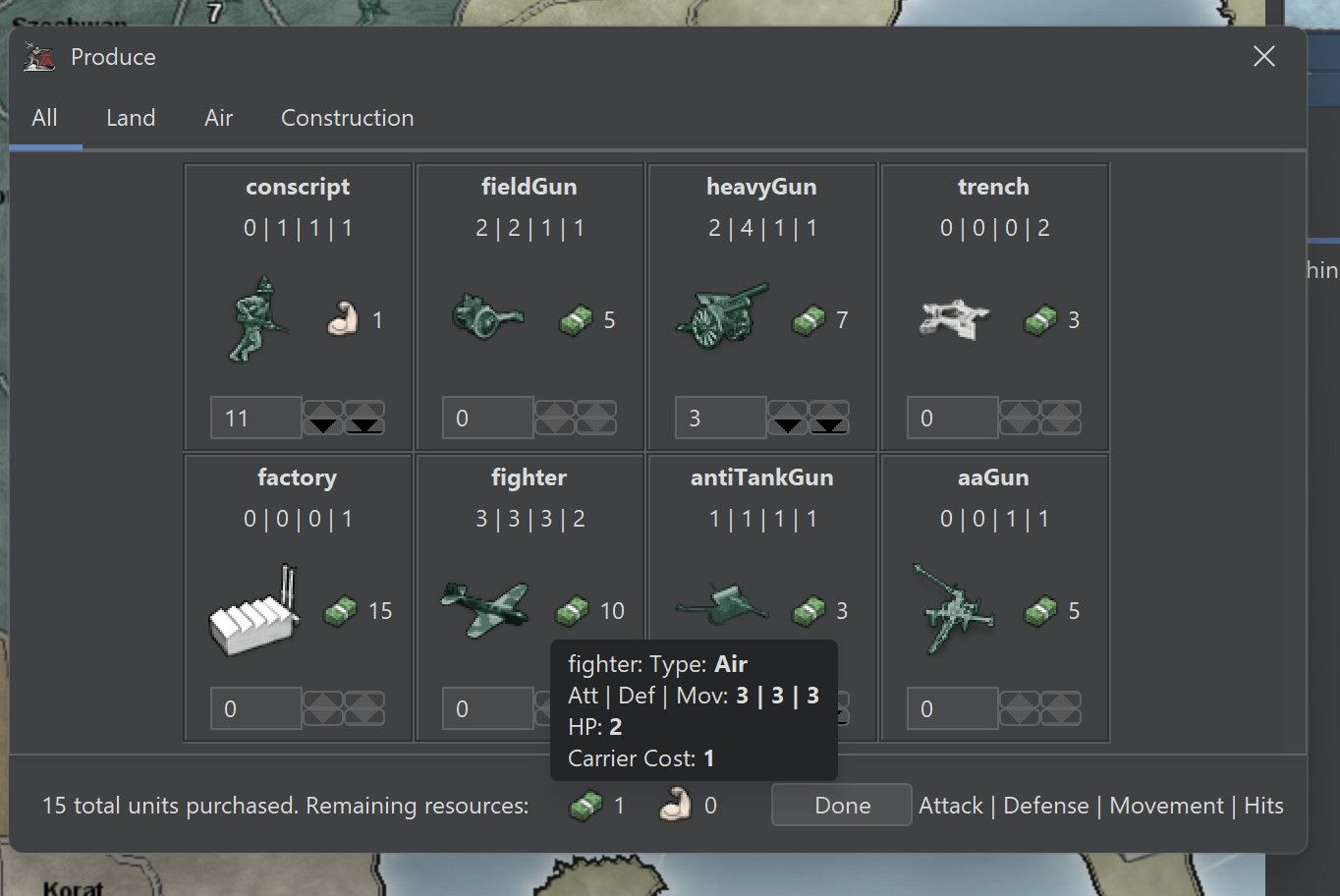
11 conscripts, made possible by having 11 manpower points on hand. But China doesn't have many PUs, so its PU units consist of three heavy guns and an anti-tank gun.
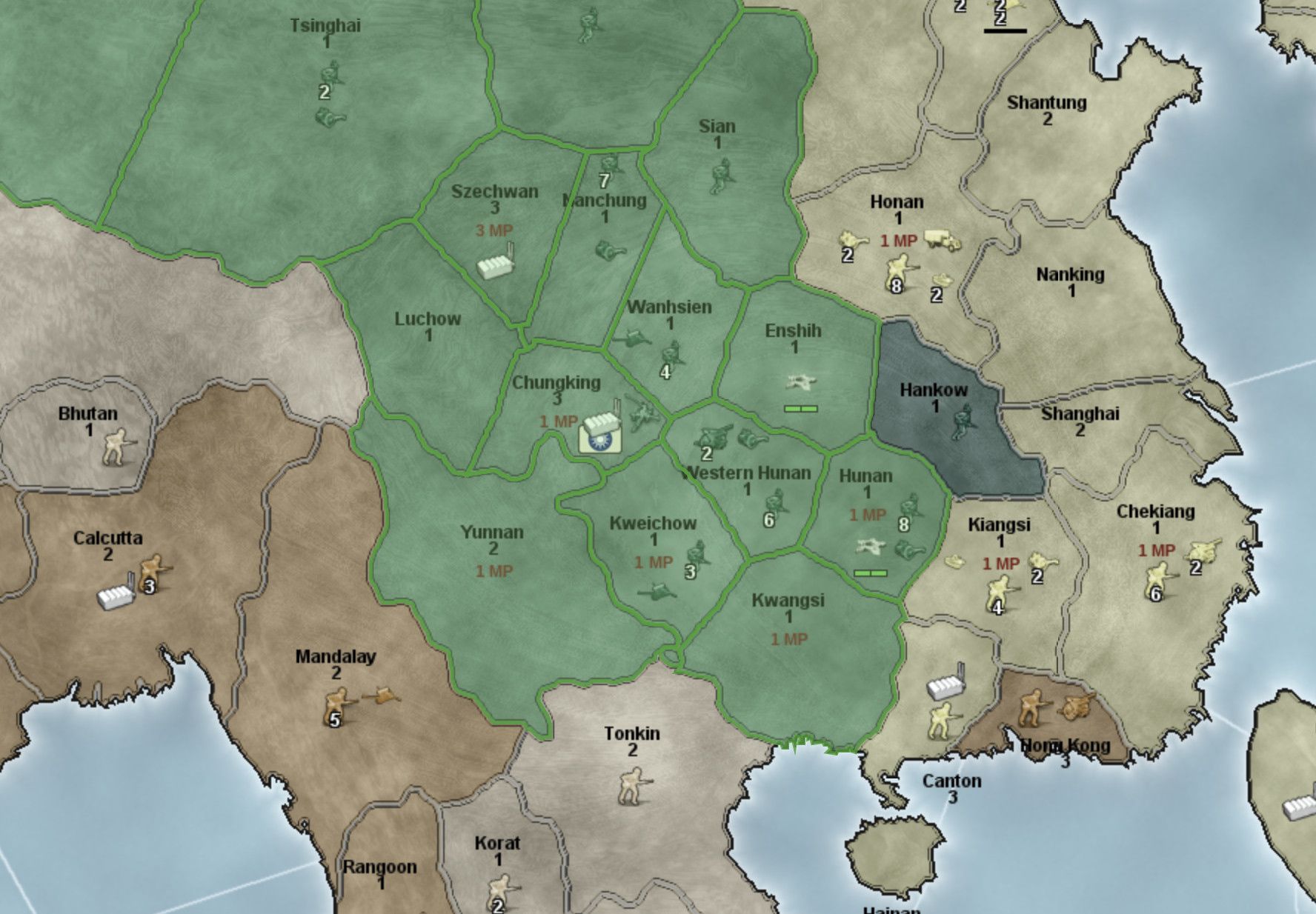
Unit placement for China. China is allowed to place up to two conscripts in any Chinese territory, so long as it owned that territory at the beginning of its turn. Hankow was conquered this turn, which is why it's a different color than the rest of China's territories. Units which cost PUs can only be placed in China's factories. China is allowed to place up to two conscripts in a factory territory without having them count against the factory's unit placement.
-
America's first turn. Research.
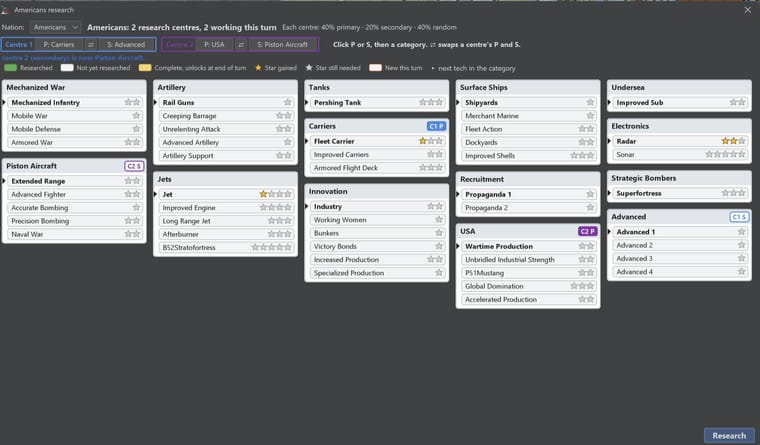
America gets good income bonuses from its USA tech. That's why USA is a primary focus of one of its research centers. The other research center's primary focus is on fleet carrier. The U.S. starts off with one star towards fleet carrier tech, so this would be a good opportunity to unlock an advanced unit for the U.S. to produce. The U.S. chose Advanced as a secondary focus, in hopes of being able to build Special Production Centers (SPCs) to produce advanced units. The U.S. is allowed to have up to four SPCs, tied with Germany for most in the game. The other secondary focus for the U.S. is Piston Aircraft. You need extended range to start with, but after that there are some good piston aircraft techs available.
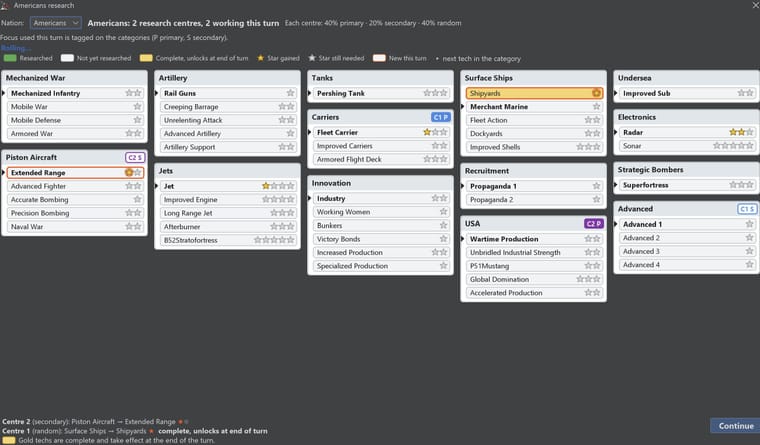
One star towards Extended Range. The other research advance was shipyards. That's a 1 PU reduction in the cost of your transports and cruisers. Also that builds towards other good surface ship techs. This is very good news for a nation which will soon be in a naval war against Japan.
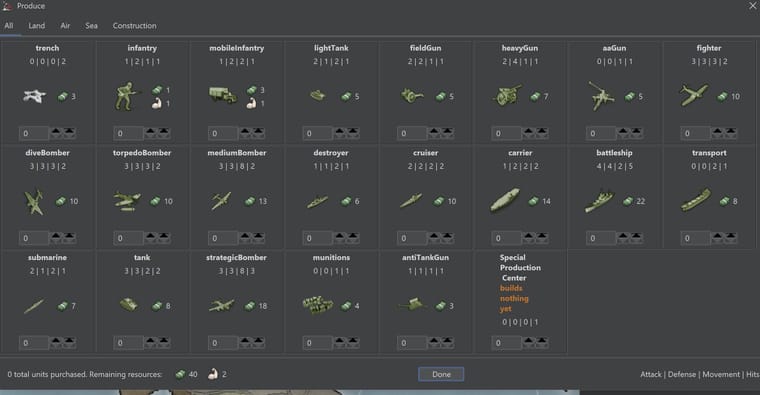
The U.S. build screen. The U.S. has limited building ability while at peace.
U.S. unit placement: 2 trenches for Manila. Trenches can be placed without a factory. But only 2 trenches max per territory per turn. The trenches won't stop Japan's invasion of the South Pacific, but they might slow it down. The rest of the U.S. units were placed in the Pacific or in San Francisco. The U.S. is unable to move units while at peace, so it went straight from unit purchase to unit placement.
The U.S. collected income of 36 PUs and 4 MPs. Okay, that's not much. Granted. This is the U.S.'s peacetime income. At the end of its third turn it will collect 50% of its true income. At the end of its fourth turn it will collect 60%, then 70%, and so on, until it has fully ramped up. How much will America's income be once it's fully ramped up? 227 PUs, 13 MPs. Plus whatever income it is able to add to that through neutral farming or technological research.
Currently Germany's income is 142 PUs and 15 MPs. Japan's is 94 PUs and 8 MPs. Germany hopes to expand its income at the expense of the Soviet Union. Japan hopes to grow its income through conquest in the South Pacific, China, and southeast Asia. Japan isn't looking to invade the Soviet Union any time soon. Japan would be content with a stalemate between the Soviet army in Vladivostok and its own army in Manchuria.
-
Germany's second turn:
Air phase: strafed Soviet land units adjacent to the Germans. Damaged the Red Army. The Soviet Air Force is not strong enough to challenge the Luftwaffe at this time.
Research phase: gained Extended Range. In future turns German dive bombers will be able to reach further in to Soviet territory. Gained Advanced tech 2. Now Germany can build up to two SPCs. That wouldn't do it any good right this instant however, because Germany hasn't yet unlocked the tech for any advanced units. Germany's third tech advance was chosen at random, and is the V1 rocket. The V1 has no game effect. But there are other techs further down that tree which do.
Germany's build was all land. It was going for quantity, so lots of anti-tank guns. Its income has risen to 163.
Soviet second turn. Research phase. A tech chosen at random, going towards strategic bomber tech. Ouch. But, an advance towards unlocking KV-2 tech (heavy tanks). Only one star left to go on that one. However, the Soviet Union has not unlocked any Advanced tech, which means that it cannot yet build any Special Production Centers (SPCs). The KV-2 heavy tank is useless until the Soviet player has at least one SPC with which to build KV-2s. Not that the Soviets have fully unlocked KV-2 tech just yet.
Soviet build phase. It had a lot of leftover MPs at the end of round 1, giving it 46 MPs to spend for round 2. 46 conscripts. Also it collected full income at the end of round 1, giving it 192 PUs to spend for round 2. It has plenty of cannon fodder (conscripts), so it needs firepower to go along with that. Field guns, heavy guns, and tanks are good options for firepower.
Place new units. One unplaced conscript. The Soviet Union could have placed it well to the rear. Instead it will save the conscript for next turn, when it can be placed a lot closer to the front. The Soviet Union has large unit placement capacity, even after the loss of Leningrad.
-
Japan's second turn. One star towards late war production (Japan tech category). That was the final star needed, unlocking that tech. Bonus income for Japan! The other tech advance was shipyards. Less costly transports and cruisers. Japan is very pleased with this research phase.
Japan is invading Cochinchina, a territory in southeast Asia which would make a decent spot for a factory. It is building a factory for Bangkok. It also invaded Tonkin, another decent spot in southeast Asia for a factory.
Its build was largely land units, plus a transport and three destroyers. Also a medium bomber to send to China.
Britain's second turn. It researched "Canada" tech, which provides a free infantry each turn in Canada. Also one star towards industry tech. One more star, and it will add +2 to the unit placement capacity of its factories. Very useful for a nation with a far-flung empire.
British build: Italy's constant strafing of Britain's North Africa force is getting annoying. To solve the problem Britain is building four fighters. Also more land units and transports for Africa, India, and the Indian Ocean. Some destroyers for the North Atlantic.
Italy's second turn. Tech chosen randomly. One star towards Mechanized Infantry. Not what Italy had wanted.
Italy is growing its force in North Africa. But it is not yet time to attack the British. One problem: Italy's unit placement capacity is mostly in northern Italy. But it would wish to exert offensive pressure to the south, in north Africa. This is creating a situation where units are being placed in North Italy, then plodding their way south for a bit before they can be shipped.
U.S. turn. One star towards fleet carrier, with only 1 star left to go! One star towards Wartime Production, with only one star needed. A good American research phase, even though there is no instant gratification.
Still limited peacetime income. Its spending all went to the Pacific.
Hello! It looks like you're interested in this conversation, but you don't have an account yet.
Getting fed up of having to scroll through the same posts each visit? When you register for an account, you'll always come back to exactly where you were before, and choose to be notified of new replies (either via email, or push notification). You'll also be able to save bookmarks and upvote posts to show your appreciation to other community members.
With your input, this post could be even better 💗
Register Login