Flames and Steel (official thread)
-
@KurtGodel7 I think there are two options here, not necessarily mutually exclusive. I assume that your conscript is 0/1 while the infantry is 1/2. The question is if something like the "standing infantry" should be unable to Combat Move too (thus being -/1 unless your game has stalemate or other conditions allowing to attack without combat moving). Then, one could also expand the matter further if there should even be something like the Volkssturm, which may be worse than the "standing infantry".
So the main question would be, are your conscripts going to be
- just 0/1, rest same as infantry.
- 0/1 and unable to receive artillery support.
- 0/1 and unable to attack. (Is it possible to attack without combat moving in this game?)
Then, there are the Chinese. I think we all know the famous scene of "one man gets a rifle, the second man follows" of "Enemy at the Gates". Now, that may (or may not) have happened sometime in the Soviet army in some small-scale localized situations, but it was either something which happened very rarely or just a mith. However, if you ask Google AI "What percentage of the Chinese infantry in 1941 was not equipped with fire-arms?", the answer is
Historical estimates indicate that as many as one-third (approximately 33%) of the soldiers in a typical Chinese Nationalist division in 1941 were not equipped with any firearm.
The primary factors driving this staggering shortage include:
• Logistical Roles: Due to an acute lack of motor transport and draft animals, a substantial portion of un-armed infantrymen were used strictly as human pack animals to carry ammunition, food, and supplies for the rest of the unit.
• Severe Supply Shortages: While the Nationalist Army had roughly 3.8 million men on paper across hundreds of divisions in 1941, only about 40 divisions were fully equipped with modern European or foreign-manufactured weapons.
• Industrial Deficiencies: Domestic Chinese factories lacked the industrial base to produce small arms at a rate that could keep pace with massive wartime conscription.The conscript is just like an infantry, except with less firepower. Conscripts are allowed to attack. If attacking on a 0, at least they serve as cannon fodder to protect other attacking units. If supported they attack on a 1.
Your research found 40 Chinese divisions apparently equipped with modern European or foreign-manufactured weapons.
Currently China is able to buy conscripts, but not infantry. Those 40 divisions make me wonder if China should be allowed to purchase either conscripts or infantry. I will have to do more research on this. Being handed a modern rifle does not automatically make a soldier as combat-effective as a normal infantryman would be. If I think of a normal WWII infantry division, I'm expecting them to have machine guns, hand grenades, maybe some handheld anti-tank weapons. Also combat training. If China's better divisions lacked these other weapons, if they were poorly trained, I would consider them having more in common with conscripts than infantry.
-
@KurtGodel7 Asking Google AI "How many men of the Soviet-equipped divisions did China field in 1941?", the answer is
Between 1937 and 1941, Soviet military aid provided under the Sino-Soviet Non-Aggression Pact and transported via the Gansu-Xinjiang Highway enabled China to form 15 Soviet-equipped divisions. Based on the typical paper strength of the Chinese Nationalist Central Army infantry divisions at the time (ranging from 8,000 to 11,000 men per division), this represented a force of approximately 120,000 to 165,000 men.
Key Facts About China's Soviet-Equipped Force
• Strategic Role: Rather than being sent straight to the front lines, these 15 divisions were largely held in reserve by the Nationalist government for future strategic counteroffensives.
• Equipment Scope: The Soviet Union supplied roughly 110,000 rifles, 14,000 machine guns, 1,600 artillery pieces, 82 T-26 tanks, and thousands of ZIS-5 military transport trucks to outfit these formations.
• The Mechanized Elite: This aid famously established China's first fully mechanized unit, the 200th Division, which incorporated Soviet armor and saw action in major engagements like the Battle of Kunlun Pass.
• The 1941 Cutoff: This military pipeline officially halted in April 1941 following the signing of the Soviet–Japanese Neutrality Pact, after which China increasingly relied on American Lend-Lease aid.I guess this could be somewhat represented by China starting with a few infantry units but unable to build any more of them.
More complex would be accounting for lend-lease or whatever other kind of supply or even fully internally created infantry (as opposed to conscripts, which would be infantry units armed with very little more than just their rifles), possibly to represent their existant albeit very scarce (a few tens of thousands) heavy and light machine-guns production, but a proper infantry unit is supposed also to have a good quantity of infantry mortars (unless there are infantry mortars in the game as units), and I've no idea about domestic Chinese mortars production.
-
Properly representing China isn't possible without either additional rules or China-specific units.
I don't even think adding China is worth it. It's just not interesting to play with or against. Its front is nothing more than a much more boring version of the Eastern Front in terms of gameplay.
-
In Domination 1914 No Man's Land, there is a unit called a conscript. It can be built only by the Russian czarists and by the Bolsheviks at war against the czarists. It costs 2 PUs, attacks on a 0, defends on a 1. It can receive artillery support for attack. I took this exact unit verbatim and added it to Flames and Steel, except now its cost is 0 PUs and 1 MP. Only the Soviet Union, Italy, and China can build this unit.
This is not the only inspiration I've drawn from NML. Techs like industry, working women, and propaganda were inspired from that map.
In any case, and to return to your point: I will grant that the majority of men who served in WWII infantry forces were conscripted. According to Merriam Webster, anyone conscripted into a military fits the definition of a conscript. Therefore, I will grant that "conscript" is not the best word for this unit, because it could also be accurately applied to normal infantry. If anyone has a better idea for a label, I'm open to suggestions.
Also, I'm not sure if the German bodenständige Divisionen would fit into your idea of "conscripts" (guess not but just checking)
Historically this would be justified. These "static divisions" were less well-armed and less combat-effective than normal German infantry. Also, they often consisted of old men, or of conscripts from occupied territories. Germany has a tech called "crush communism," which allows it to collect MPs from occupied Soviet territories. (I think there's a ceiling of 5 MPs per turn.)
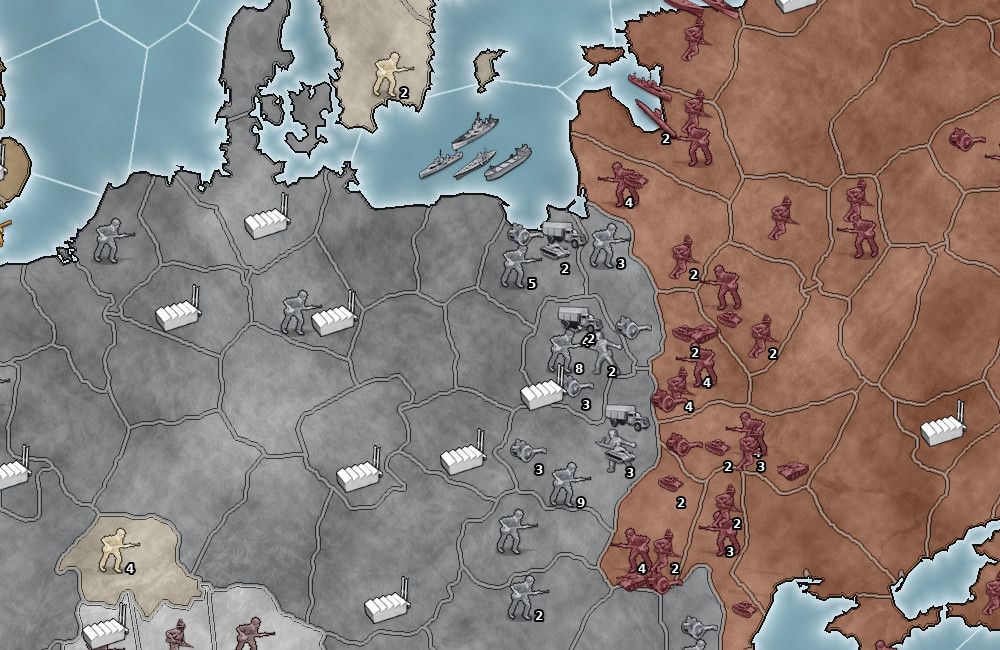
You could argue that instead of the MPs, Germany could get free conscripts. This would be more accurate and would give the game a better flavor. The main obstacle I see is that this game has a lot of unit types already, with Germany being Exhibit A of that. As it is, Germany can buy two types of infantry, two additional types of mobile infantry, three types of artillery, four types of tanks, three types of fighters, and five types of bombers. Also trenches, aa guns, factories, and SPCs.
Allright. This makes me understand a bit more what a conscript is, so how it can be called.
Since this is an "English" game, the natural way to call such unit would be "home_guard".
Granted, the home guard never actually fought against other land units (beside Irish insurgents) because it was never shipped to fight Germany or Italy, nor Germany or Italy ever invaded the United Kingdom with land units. Granted, if the Germans did, the home guard would have fought.
However, calling this unit "home_guard" would be very strange if the primary case of that name would not actually exist: Britain being actually unable to buy conscripts. This could be fixed by making Britain able to buy conscripts but having the conscripts unable to be shipped: this should be somewhat realistic in representing the home_guard.
(Conscript as a name would be a particularly poor term to define something like the Home Guard as they were almost all volunteers!)
However, the Home Guard may actually be too low of a thing even to be the "conscript" unit: it was an unpaid (not sure) armed citizen militia, whereas I guess the conscripts are actual full time soldiers albeit poorly trained/equipped. The Home Guard is more like on par with the German Volkssturm, which I assume is something even below what the conscript unit is supposed to be and is not going to be represented as a unit.
Assuming that the conscripts are something better than the British Home Guard, and that you are not going to give Britain the conscript unit anyway, I guess the most relevant players of those you have mentioned is the Soviet Union.
However, I'm not sure what a conscript is meant to be in the Soviet Union. Is it meant to be the
https://en.wikipedia.org/wiki/Narodnoe_Opolcheniye
?If so, it can be called just "militia". However, in this case, only a very small part of the Soviet army should consist of "conscripts".
Asking Google AI "In 1941, what percentage of the Soviet infantry was given by the Narodnoe Opolcheniye?", the answer is
- The Proportions by Divisional Breakdown
In the desperate months following the German invasion on June 22, 1941, the Soviet military underwent massive expansion to replace staggering casualties:
• By the end of 1941, the Red Army had deployed or was forming over 400–450 total rifle (infantry) divisions.
• Between July and October 1941, approximately 60 to 70 divisions of the Narodnoe Opolcheniye (or units built directly from volunteer militia frameworks) were formed across the USSR.
• Mathematically, this means the volunteer Opolcheniye frameworks provided roughly 13% to 15% of the total infantry divisions generated by the Soviet Union during the critical defense phases of 1941.- Regional Breakdown (Where they mattered most)
The Opolcheniye was not evenly distributed; it was concentrated heavily in major industrial hubs where the regular military lines were breaking down:
Region / Battle Contribution & Impact
Moscow 12 to 16 divisions were quickly raised in July and autumn of 1941. During the darkest days of the Battle of Moscow, these militia units made up a massive chunk of the immediate front-line infantry defense, plugging gaps until Siberian regular reserves arrived.
Leningrad 10 to 18 divisions (alongside several independent machine-gun battalions) were mobilized. At the onset of the Siege of Leningrad, the Opolcheniye accounted for nearly one-third (approx. 30%) of the infantry forces actively holding the city's immediate defensive lines.
Other Hubs Major volunteer contingents were also raised to fight as localized infantry in Stalingrad, Kiev, Rostov, and Odessa.- Transition to Regular Infantry
The reason an exact "militia percentage" remains fluid is that the Narodnoe Opolcheniye was quickly absorbed into standard metrics. Because they suffered horrific casualties—frequently losing upwards of 80–90% of their strength within weeks due to lack of heavy weapons and formal training—the surviving divisions were formally re-numbered and converted into regular Red Army Rifle Divisions by the late autumn of 1941.
The Soviet union did not generally have scarcity of infantry equipment, but rather a tendency not to train their men for very long before sending them to the frontline (Any resemblance to actual Russian soldiers in Ukraine, living or dead, is purely coincidental.
 ). Especially with you mentioning a WW1 game, I wonder if here we are making some confusion with the WW1 Russian army (which was much poorer than the 1941 Soviet army and for which something like a sub-infantry unit would fit a lot more).
Practically, if the Opolcheniye units are the conscripts, then the Soviet Union should have no conscripts at all from the spring of 1942 onwards if things go historically (as they would all be lost or absorbed into the regular infantry by then).
Alternatively, as said, conscripts could represent the Soviet tendency to train their men a lot less than others (say, the Americans) before sending them to fight. In this case, the unit could be called "replacement_infantry" or "untrained_infantry". (Of course, it is not totally untrained.)
-
Properly representing China isn't possible without either additional rules or China-specific units.
I don't even think adding China is worth it. It's just not interesting to play with or against. Its front is nothing more than a much more boring version of the Eastern Front in terms of gameplay.
I think just having a cheap infantry unit which is unable to combat move would go a long way in making China more realistic without adding cumbersome special rules.

Hello! It looks like you're interested in this conversation, but you don't have an account yet.
Getting fed up of having to scroll through the same posts each visit? When you register for an account, you'll always come back to exactly where you were before, and choose to be notified of new replies (either via email, or push notification). You'll also be able to save bookmarks and upvote posts to show your appreciation to other community members.
With your input, this post could be even better 💗
Register Login