Unit-strength function
-
Ah, I see there is a miscommunication here. When I wrote unit-strength function at the top, I did not mean "strength of a unit", but "strength of an army as a function of its number of units and combat strength", shortened to unit-strength function. I considered using the header unit/strength function instead, and for this very reason, but decided it wasn't that important, and that the specific meaning would come out in the discussion. In any case, I was myself only starting to think about the concepts and develop the required language.
So let's call it the "stack power function" instead.
There is a practical purpose to this. Supposing you have some collection of units, and some territory to defend, and the bad guys could attack you with some other collection of units. How much do you need to put there to secure the territory? Or a similar question. Now, you could eyeball it and hope you are right. Or you could move a tentative stack there and then run the Battle Calculator with hypothetical enemy attack stacks, that would be all possible hypothetical attack stacks, unless you want to trust to luck. OK, that may be doable, but it could take a long time. But what if the hypothetical attack is going to happen 3 turns in the future, and it's your capitol, and the outcome of that future hypothetical battle will be used to decide your strategy for the next few turns? Pretty hard to use the Battle Calculator in such a situation, and remember, if you get it wrong, you're out of the game.
So what we seek is some sort of a "stack power function" that will give an approximate but very good estimate of whether your stack will beat the enemy stack. That's what I'm trying to do here. And I think I have something useful - stay tuned.
Now, before I get into more detailed calculations, I will show a graphical solution to the paradox A > B > C > A. In the context of the AAA combat system, we know that both number of hit points and combat power are essential in evaluating an army. Thus we are looking at 2-D vectors, and perhaps higher dimensionalities. Add 3 vectors together: you can easily form a triangle, and in fact, in the context of this problem, the evaluation A->B, B->C, C->A must form a triangle. However, it can be seen that if you add only the lengths of these vectors (i.e. attempting to express the values as scalars, you get no useful result.
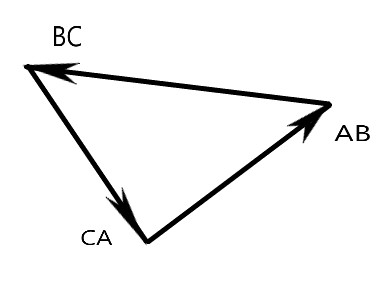
Next, let me show a "stack power" function that can properly solve the paradox Alkexr posed in post 3 of this thread.
Stack A is 10x6. Stack B is 2x6 plus 27 padding. Stack C is 1x6 plus 55 padding. A beats B, B beats C, and C beats A.
Now, it may be obvious, but this is a clear example of the competition between combat power and hit points. Thus I propose a "stack power" function P = U + C, where U = Unit differential, C = combat strength differential. But wait, you say! You promised that you would consider Skewness as well. I won't do that yet, but I will introduce a new term R to express the relative Reduction in the combat strengths as the rounds progress. Let P = U + C - R. It is important, as you know, because if you bring a whole bunch of padding to your gunfight, the other guy can shoot and shoot, and have no effect on your combat strength. On the other hand, the unpadded stack suffers near-linear reduction in its combat power over time. For a linear decrease, the effective combat strength is just 1/2 of the maximum. But wait, you say! The combat strength acts over a number of combat rounds. Of course; my test function is actually P = U + N*(C - R)/6. N is the number of combat rounds; division by 6 is necessary because it takes 6 combat points to get a hit.
The calculations: Stack A has zero padding, and thus suffers a linear strength decrease. Stacks B and C suffer no decrease over time. In the BC combat, the relative strength reduction is zero. In the CA combat, stack C shoots at padding only, so the Reduction factor is applied to every combat round. The effective value of C is 5.5x6 (R = 27). In the AB combat, stack C shoots at padding for 4 rounds. The effective value of C is 7x6 (R = -18).
In the AB combat, there are 5 rounds. In the BC combat, it takes 27 rounds to hack through the padding, and there are 28 rounds. In the CA combat, there are 10 rounds. In each case, the winner has exactly one unit left.
P(A->B) = -19 + 5*(48 - 18)/6 = + 6
P(B->C) = -27 + 28*(6 - 0)/6 = + 1
P(C->A) = 46 + 10*(-54 + 27)/6 = + 1You will note that all the U's sum to zero, all the C's sum to zero, and all the S's sum to zero, but the weighting of the factors differs in each case.
But mostly, you will note that all the relative stack power functions evaluate positive, which means that A > B > B > C.
Still, although I have showed that it is possible to construct a function that models several situations correctly, this is not the real stack power function that I will be proposing. More later.
-
In actual game play, the Army A defeats Army B, and B defeats C, but A loses to C is virtually unheard of, so I wouldn't focus on this. It basically only happens if there are huge mismatches of power and fodder. A good player would be actively building to avoid this situation.
There isn't a great mystery on how to predict battle outcomes, especially if you are doing low luck only. Probability trees do it, most battles don't see more than 4 or 5 rounds of combat so they aren't difficult to use.
A few extremely common battles have been done out with a probability tree on the axis and allies forums (dice and low luck).
-
@VictorIn_Pacific The solution to the linear equations when all units have the same power gives the remarkably simple and elegant solution of sqrt(A^2 - B^2) for the expected number of units surviving, where A is the total initial strength of the stronger side, B is that of the weaker one. Despite being a continuous approximation, it seems to have an error margin of only around 5% for larger stacks (relative to A), and is invariably an upper estimate. This result is absolutely anticlimactic, by the way.
-
@prastle Not sure about the downvotes. I can see them No Problem. (On a phone btw)
About the topic: Not an expert on maths, but I don't think there's a way to calculate some sort of strength of an army without knowing the opponents, there are just too many factors involved.
Because of this the hard AI at least simply uses the BattleCalculator to determine whether or not it's a good idea to attack a certain territory.
Also the reason the AI is relatively CPU-Heavy. -
I'm still trying to figure out whether he's opened up a can of worms or not yet (I'm guessing no because CrazyG said this doesn't involve the game engine)
this thread is typically why I still read this forum though ... math, ai , strategy etc. etc! so interesting!
-
So to add to this, even if you came up with some function that could handle strength and HP to say 99% of the time. Most of the newer maps actually have things like targeted rolls, multi-HP units, positive/negative support, suicide units, etc. These make things much more complex to the point that its very difficult to even find the optimal casualties to select each round let alone have some function of the armies strength that predicts the winner. They also make it so A > B > C > A will always exist because I can have an AT gun army, a tank army, and an infantry army which form counters to each other with targeted attacks (AA like rolls).
Given all that, this is why the battle calc is very important and that we generally just use a strength estimate of 2*HP+power to give a very high level estimate of army strength as that is a fairly good yet simple formula.
The biggest issue with the A&A combat system tends to be that 1 or 2 additional units changes a battle from 50/50 to 95% win chance (especially true for LL). The ways to address this drawback is:
- Have more of a ranged suicide unit type map where armies are mostly firing units at each other rather than entire stack vs stack
- Have limited combat rounds so that you can only inflict so many casualties per turn to avoid the first round of battle deciding the fate of the entire stack of units. This allows more tactics around retreating, counterattacking, reinforcing, etc.
-
2*HP + power was something I used before (when playing on a board game, when you have to do all the math on your own!)
Even then, you really need to factor what units die, if one side is losing more power than the other (a, its a big deal. Occasionally on World War 2 Revised, Germany attacking Russia looks like an even fight, but its heavily German favored (Germany loses low value 1 attack units, while Russia is losing 2 defense units).If you want another interesting case, look at TWW. Its not uncommon for a heavily fortified Russian city to have fewer hitpoints and lower defense than an attacking German army, but still win the battle 90 to 100% of the time., due to a combination of targeted attacks and 'Skewness'. Even without targeted attacks, less complex abilities such as units supporting each other or having two hitpoints make a big difference.
-
A lot of good points above. I have incorporated as much of that as possible in my next post. Riders: this applies to the basic combat system, LL. The following may be old hat, or not.
How many knives should you bring to a gunfight? Obviously, if your army has exactly the same characteristics as the enemy army, then they have the same combat power. But in general, having more weaker units can compensate for a deficit of stronger units, and vice-versa.
The old hands know that there is an Army Power Function 2*U+C that works quite well, where U is the number of hit points and C is the total combat strength. Of course, this must be an approximation, because the combat strength is applied in each combat round, while the hit points count only once, so there must be at least one more factor in the function. However, if the combat lasts 3 rounds or less, then you should be able to calculate the result exactly, while hardly any combat lasts longer than, say, 6 rounds. The function may be analytical (based on analysis) or empirical (based on observations), but it turns out that it is exactly equal to a good, simple analytical function, up to a scaling factor, provided that there are 6 rounds of combat.
Initial considerations indicate that we should look for an Army Power Function that has the form
P = P(U,C,N) ,
where U is the number of hit points, C is the total combat strength, and N is the number of rounds of combat. We try
P = U + N*(f*C/6) ,
noting that it takes a combat strength of 6 to inflict each hit point.N = U'/(f*C/6), where U' is the number of units in the enemy army, and f is a factor to be determined.
It quickly becomes apparent that there are unexpected and undesirable features to this trial function. According to this function, the power of your army increases when attacking stronger armies, because the number of rounds of combat increases! Indeed, the power is equal to the total number of units in both armies! In general, the Army Power Function depends on the exact nature of the enemy army. Therefore, we abandon the attempt to find a general function that calculates the power of an army, and instead seek only a function that calculates the power of an army at balance, that is, when your army is as good as the enemy army. Having that, then we can add a couple of units or make a couple of units stronger, because it is known from experience that that increases the probability of winning a battle from 50% to about 95%. (That applies to Low Luck conditions.)
It should be clear that the factor f cannot be unity, because the total combat strength of an army drops each round, unless it is padded with 0-strength units. The rate at which the combat strength drops is nonlinear, because the rate at which the enemy army inflicts casualties decreases each round, unless it is padded.
In order to keep the solution simple but general, we linearize the problem by assuming that the combat strength of each army at balance drops linearly from its maximum value to zero. The expression f*C is equal to the average combat strength of the army, and for this linear decrease, it is equal to half the maximum strength. Thus f = 1/2.
The practical problem at hand is what we need to have in order to equal a specific army, i.e. how many knives do we need to bring to this gunfight. Thus in general, U' and C' will be known, and the average combat strength of your units C/U will be roughly known, so the problem reduces to determining U.
N = U'/(C/12) = U/(C'/12) , so
U/U' = C'/C = (U'C'/U')/(UC/U) , so
(U/U')^2 = (C'/U')/(C/U) , so
U/U' = SQRT(c'/c) ,
where c and c' are the average unit strengths of the respective armies.Let's look at one example to see how this works. The enemy has 10x4. How many 1s do you need to equal this? U/U' = SQRT(4/1) = 2 . Bring 20 units for balance, and 2 more for the win. The power of these armies is P = U + U' = 30.
The number of combat rounds is N = 12x10/20 = 12x20/40 = 6. This is an approximation. Direct calculation shows that each army kills exactly 1/3 of the opposing army in the first combat round and 2/3 of that in the second combat round, for a total of 5/9 in the first 2 rounds. Thus 10 units are reduced to 4.4 in 2 rounds and 2 in 4 rounds and .9 in 6 rounds, so the true number of rounds is about 8.
The army power can also be expressed as P = U + 6xC/12 = (2*U + C)/2 , which is the same as the legacy function, except for the constant scaling factor. Although the legacy function is less accurate, it is easier to use, and does not involve fractions.
Let's see how well the legacy function predicts the number of units you need for balance. The legacy function has 2U+C = 2U'+C' , so U*(2+c) = U'*(2+c') , so U/U' = (2+c')/(2+c) . The reader can verify that, for the smallest quality mismatch c=c', U=U' for both functions. Also, for the largest likely mismatch c=1 and c'=4, U/U' = 2 for both functions. For some other cases such as c=1.5 and c'=3, the results are almost identical. Otherwise, the legacy function gives a slightly inaccurate result.
-
@VictorIn_Pacific alright good stuff but I will wait for more replies to see if anyone thinks your newer equation is a better function for predicting battle outcomes!
Funny also, this reminds me of when I was in highschool I drew a chart showing a man 6 feet tall who could jump 3 feet high and next to him was a man 12 feet tall who could jump 6 feet high and I drew a line straight from the 6 foot tall guys head directly to the 12 foot guys head and I said "a guy twice the height of another person will have twice that person's ability to jump" ... and my smarter friends told me my chart was impossible BECAUSE OF GRAVITY ...
so my point is math and physics can be peculiar and so I'm expecting some "unknown factor" to not allow Victorin_Pacific to achieve his objective but again I will wait for more responses!
-
@VictorIn_Pacific said in Unit-strength function:
seek only a function that calculates the power of an army at balance, that is, when your army is as good as the enemy army
I don't quite understand what you are saying. My goal is to calculate army power, but I can only calculate if my opponents army is about equal to my army. Don't I need to be able to calculate army power in order to do affirm if the two armies balanced?
Also, the number of combat rounds would be a function of my power, enemy power, my HP, and enemy HP. So you should be able to build a function that just calls those four instead of adding a new variable.
As a teacher, I'm interested in seeing if something can be done, but I'm not optimistic to be honest.
-
this topic is just another example where I find it interesting the difference between "mathematics" and its counterpart "applied mathematics"





Hello! It looks like you're interested in this conversation, but you don't have an account yet.
Getting fed up of having to scroll through the same posts each visit? When you register for an account, you'll always come back to exactly where you were before, and choose to be notified of new replies (either via email, or push notification). You'll also be able to save bookmarks and upvote posts to show your appreciation to other community members.
With your input, this post could be even better 💗
Register Login