Flames and Steel (official thread)
-
Of course, the United States being needed to avoid the fall of India would also require that India starts with very few factories (or anyway placement ability), that factories are very expensive and that the British player (if unified with India) already has enough factories in Atlantic efficiently to place all or almost all its production there without any need to purchase new factories (or anyway not being able to defend India efficiently without help from the United States). If it would become better for the United States fully to focus Atlantic while British focus on defending India successfully, that would obtain exactly the opposite effect than inducing the United States to split play between Atlantic and Pacific.
-
Hi Guys
Just to chime in, I'd say it depends on what you want the IPC value to represent. A purely historical production value would differ from a strategic and tactical one.
This is from the Captains Global 40 Mod page 25
https://drive.google.com/file/d/1SRDOsOwlO4Aa13cULwkWrorrXEmCmiN-/view?pli=1
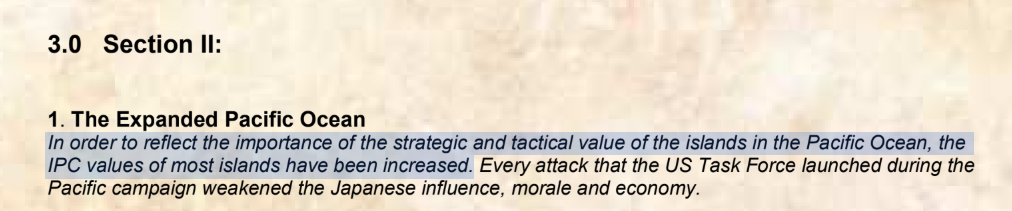
just a thought

-
It's simple to make the Pacific War work.
"Give the USA a Pacific fleet and marines worth 2–3 rounds of the entire country's income, and make sure they are far enough away to take at least 5–6 rounds to reach Europe."
Hence, the US would be unable to take advantage of these units for a very long time if they try to move the entire navy to execute KGF.
To prevent KJF, as I said an unstoppable Germany without US commitment is enough.
-
@Cernel said:
For example, the restriction can be that the US cannot invade any enemy territory so long as any part of the US plus Hawaii (so not comprising Alaska) is in enemy hands. This way, while going for KGF, the United States is forced to do the minimum necessary to keep Hawaii (need splitting it in more than one island to avoid this being done just by piling up land defence, or you can add that also warship presence near the West Coast counts as a no-no as well). Not a big fan of political restrictions though.Sounds like an obnoxious rule to play with, and it still wouldn't compel the US to do anything beyond stacking defense in Hawaii - they can still hang China, India, and Australia out to dry while dogpiling Germany.
I would continue to look at the bonus objectives as the right way to incentivize a mixed strategy. Besides messing around with Germany and Japan's bonuses to make them more dangerous if left unchecked, there's an alternative option, which is to tie the US objectives to sets of goals located in both the European and the Pacific theaters. And not just little ones. If the US is still getting something like that big 30 IPC bonus from Global 1940 just for being at war, break that bonus up into chunks, say, three bonuses worth 10 IPC each.
Match each of those 10 to a target in the west and a target in the east.
For example:
10 if the Allies hold both India and London
10 if the Allies hold both Canberra and Egypt
10 if the Allies hold both Hawaii and MoscowThe bar should be set pretty high for the Axis, so the targets should be objectives the Axis never actually managed to take in real life.
But you see what happens if the US ignores one theater now? Germany or Japan have the opportunity to slice a huge chunk of income away from the US player. The Axis dominating either theater reduces US power across the entire globe, so the US player must commit to fighting both.
Your economies have much different base values from the vanilla G40 game, of course, so you'd have to adjust accordingly to account for the relative difference.
I understand what you are getting at, and I agree with it from a game-play stand-point, but that is just completely or largely ahistorical, just to force the game into some direction.
Generally speaking, I'm not a big fan of national objectives unless they are actually representing something like "Monopoly": two or more territories which are worth more than the sum of their productions if the same player or alliance owns them all.
Let's take as an example "10 if the Allies hold both Hawaii and Moscow". I assume that this is a +10 PUs per turn for the United States. What would that be based on? My answer is absolutely nothing.
If Hawaii already has a production value, that is all that it is needed to represent the ability of Hawaii to increase the productive capacity of the United States. Back then, Hawaii (even only as a matter of relative population) was nearly insignificant: losing Hawaii would not have reduced in any significant measure the ability of the United States to produce stuff and raise armies. (And, no, the political shock of losing Hawaii to the Japanese would not have caused the United States to produce less. At most, you might argue the opposite.)
Obviously, Moscow does not matter for the ability of the United States to produce more of anything.
Is it representing trade advantages? No, it is not: there was no significant trade to the United States at that point (after the loss of Philippines and Dutch East Indies) needing Hawaii as a hub (as far as I know). Besides, that would be better represented giving production values to those (indeed valuable) territories.
Is it representing some sort of beneficial link between the Soviet Union and the United States which is granted or facilitated by the United States controlling Hawaii? No, it is not: the only link would be the Lend-Lease from the United States to Vladivostok (and that would be need Vladivostok in the objective amongst others), and Hawaii does not matter for that because transports flying Soviet flag were completely free to move through the Pacific without being attacked by the Japanese anyway. On top of that, the Lend-Lease would be a loss of income for the United States in exchange for a bonus of income for the Soviet Union, certainly not a bonus income for the United States.
As I said: I agree with it from a game-play stand point, but you don't actually need National Objectives: you can just give high production values to Midway, Hawaii, the Solomons and so on to incentive just the right amount of Pacific play without forcing the United States to go full Pacific to get Japan itself or something hard to conquer which would impose an all-or-nothing approach. The problem with that is just on the level of realism: none of the territories which I've mentioned actually had any significant production vale, meaning that none of them would have changed the ability of the United States to produce anything (beside the Dutch East Indies, which were very valuable to the United States especially for the rubber and are a good candidate to add some not too hard to get income in the Pacific) to any significant level. (Hawaii and Alaska back then were way more backward and underpopulated than they are now and amounted to almost nothing compared to the population and economy of the United States and did not produce anything important. Yes, sugar and other stuff is nice to have, so Hawaii should have a little bit of production value because it did have some relatively very small productive value.)
This said, a realistic way by which it is possible to force a moderate amount of Pacific play exists: as per your first objective, it is called India. Using National Objectives is not necessary. Making India very valuable (to a limit) as a matter of normal territory production is quite realistic (India was economically important back then: it was economically about as important as all of China, actually, contrary by far to what every TripleA game is depicting.).
The way this can be done is by making India very valuable and balancing everything so that a modest amount of United States effort in the Pacific is all that is required to avoid Japan taking India (which would be critical if India is valuable enough and Japan is powerful enough to take it if the United States do nothing in Pacific), so that the United States have advantage in just spending on Pacific the minimum necessary to avoid the fall of India (or assuring the British or the Soviets to be able to take it back) while investing the rest in the Atlantic against Germany and Italy.
Can I point to a map which does this. Sorry, no. India's production being (ahistorically) much lower than China's production is pretty much a given in every map I know.
For example, using Maddison, China for 1937 is given as 528 something GDP (GDPpC multiplied by Population) and India as 400 something GDP, so there is all the margin to have the production of India anywhere between 50 and 100% of the production of China (and by China I'm saying summing up all the production of Chinese as well as all Chinese territories occupied by Japanese comprising Manchuria. I guess not Formosa/Taiwan, but I'm not sure if Maddison's China comprises it).
I've been researching some of the things you're saying, and I think you've done a good job of adding increased realism to this discussion.
At least according to AI, India may have actually had more military production than China during WWII. China's military production was reduced due to Japanese occupation, and because of its civil war. Whereas, the Raj served to increase India's military production due to the organizational efforts of the British empire.
Likewise, you've correctly stated that Japan's military production should be significantly less than Germany's. Here is a link to military aircraft production during WWII.
Military aircraft production can be used as a decent proxy for overall military production. This metric will understate British and American military production, because both nations produced a significant portion of heavy bombers. A heavy bomber, with its four engines, is more difficult to produce than a one - two engine fighter.
Interestingly enough, the Japanese Zero (obsolete later in the war) required 10,000 hours to manufacture. Whereas, Japan's late war Ki-84 Hayate plane (modern by the standards of 1944) required only 4,000 man hours to manufacture. The Zero had not been designed with large scale mass production in mind. It had a lot of custom work needed for it. Whereas, the Ki-84 Hayate--the "Frank"--was designed to be more easily manufactured in large numbers. A total of 3,500 Ki-84s were built, compared to nearly 11,000 Zero carrier aircraft.

Hello! It looks like you're interested in this conversation, but you don't have an account yet.
Getting fed up of having to scroll through the same posts each visit? When you register for an account, you'll always come back to exactly where you were before, and choose to be notified of new replies (either via email, or push notification). You'll also be able to save bookmarks and upvote posts to show your appreciation to other community members.
With your input, this post could be even better 💗
Register Login