Flames and Steel (official thread)
-
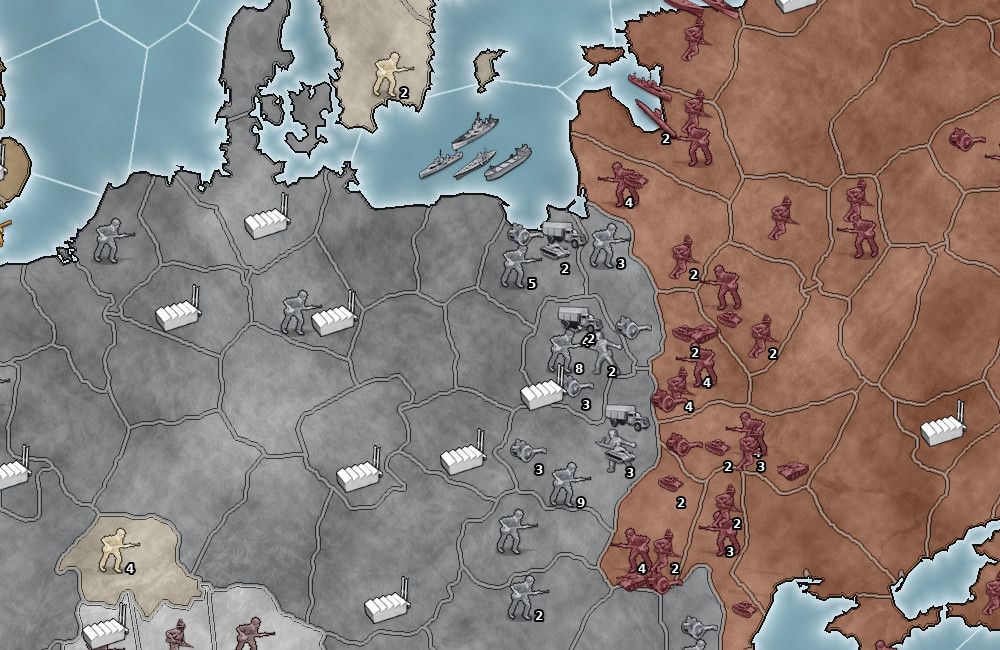
In-game, a conscript unit represents an infantry division with lower firepower and fewer personnel.
Soviet infantry divisions were more numerous but weaker as a result. Furthermore, Italy used a binary system (two battalions per division instead of the standard three). Still, "conscript" remains an incorrect term.
Yet, in the game, conscripts are simply superior to regular infantry, which is obviously unhistorical.
I don't think so. I think that, in that case, the same 1 infantry unit would simply represent more infantry divisions for one player and less for an other one.
I was more like thinking that the "conscript" was an infantry unit with a lower firepower/personnel ratio (like the chinese having 2 fire-arms per every 3 infantrymen).
However, this is @kurtgodel7's game, so it is up to him to clarify what a conscript is supposed to be, exactly.
(Yes, I know that Soviet armies were smaller than other armies, but I assumed that had nothing to do with the "conscript" unit at all.)
-
Late in the war, the performance of the German army sometimes declined. Their military age men had been killed, replaced by boys or old men. Whereas the performance of the Red Army improved as the war went on. Their generals and officer corps gained in proficiency, and they overcame the problems which had plagued them during Barbarossa.
At some point after WWII, the U.S. military did a study about combat effectiveness. The Battle of Kursk was chosen for the study. The reasoning was that this battle was early enough in the war that the German army still consisted of military age men. Late enough in the war that the Soviets had overcome their early war problems.
According to the study, Soviet soldiers were 25 - 33% as combat-effective as their German counterparts. Similar studies found that British soldiers were about 50% as combat-effective as the Germans. American soldiers were 80 - 100% as combat-effective. A follow-on study concluded that American soldiers may have been overestimated, and that their combat-effectiveness was equal to that of the British.
At least according to a quick search, 13.6 million Germans served in the German Army during WWII. Whereas, 34 million Soviets served in the Red Army during WWII.
In the key year of 1942, the Soviet Union produced almost twice as many military aircraft as the Germans, and 3 - 4 times as many land weapons. Because of all this Soviet production, as well as Lend-Lease aid, Soviet soldiers were provided with weapons. The "one rifle for every two soldiers" stuff may have been true in 1941, but had ceased to be true as the war progressed. The difference in combat-effectiveness at Kursk, which the U.S. military study found in 1943, was not due to the Soviet soldiers lacking weapons. They had plenty of weapons in 1943. I don't know what caused the difference in combat-effectiveness.
Regardless, I wanted to translate all this into the language of TripleA. A truly vast Red Army, but with soldiers individually less combat-effective than the Germans, British, or Americans. That is why I gave the Soviet Union the conscript.
Then I guess, if you still want to have the Soviets having the regular "infantry" unit which the Germans have too (same cost and values) but sided by this other cheaper and weaker alternative, you can call it "replacement_infantry" or "replenishment_infantry".
This would represent mainly less well trained infantry and would somewhat account for your general concept of depicting the Soviets as less effective man-per-man and pound-for-pound than the Germans.
However, I've some difficulties seeing what you are seeing because (according to what you said) I would guess that it should be the Soviet infantry being worse than the German infantry (and I guess not only the infantry) rather than the Soviets having an infantry equal to the German infantry and also this other unit if they want to buy it.
-
I think just having a cheap infantry unit which is unable to combat move would go a long way in making China more realistic without adding cumbersome special rules.
A combatant unit (especially infantry) being unable to participate in attacks is counter-intuitive and makes no sense.
Also, I would rather make Kwangtung a separate nation over Vichy or the Eastern US. This would make both the Chinese front and the Japanese playthrough more interesting.
-
Late in the war, the performance of the German army sometimes declined. Their military age men had been killed, replaced by boys or old men. Whereas the performance of the Red Army improved as the war went on. Their generals and officer corps gained in proficiency, and they overcame the problems which had plagued them during Barbarossa.
At some point after WWII, the U.S. military did a study about combat effectiveness. The Battle of Kursk was chosen for the study. The reasoning was that this battle was early enough in the war that the German army still consisted of military age men. Late enough in the war that the Soviets had overcome their early war problems.
According to the study, Soviet soldiers were 25 - 33% as combat-effective as their German counterparts. Similar studies found that British soldiers were about 50% as combat-effective as the Germans. American soldiers were 80 - 100% as combat-effective. A follow-on study concluded that American soldiers may have been overestimated, and that their combat-effectiveness was equal to that of the British.
At least according to a quick search, 13.6 million Germans served in the German Army during WWII. Whereas, 34 million Soviets served in the Red Army during WWII.
In the key year of 1942, the Soviet Union produced almost twice as many military aircraft as the Germans, and 3 - 4 times as many land weapons. Because of all this Soviet production, as well as Lend-Lease aid, Soviet soldiers were provided with weapons. The "one rifle for every two soldiers" stuff may have been true in 1941, but had ceased to be true as the war progressed. The difference in combat-effectiveness at Kursk, which the U.S. military study found in 1943, was not due to the Soviet soldiers lacking weapons. They had plenty of weapons in 1943. I don't know what caused the difference in combat-effectiveness.
Regardless, I wanted to translate all this into the language of TripleA. A truly vast Red Army, but with soldiers individually less combat-effective than the Germans, British, or Americans. That is why I gave the Soviet Union the conscript.
Then I guess, if you still want to have the Soviets having the regular "infantry" unit which the Germans have too (same cost and values) but sided by this other cheaper and weaker alternative, you can call it "replacement_infantry" or "replenishment_infantry".
This would represent mainly less well trained infantry and would somewhat account for your general concept of depicting the Soviets as less effective man-per-man and pound-for-pound than the Germans.
However, I've some difficulties seeing what you are seeing because (according to what you said) I would guess that it should be the Soviet infantry being worse than the German infantry (and I guess not only the infantry) rather than the Soviets having an infantry equal to the German infantry and also this other unit if they want to buy it.
Your point is valid. If Soviet infantry had good weapons, but were less combat-effective than some other nations' infantry, one way to handle that in game terms would be to make them cost the same as other infantry, but at conscript-type combat values. An infantry costs 1 manpower point (to reflect the need to conscript men) and 1 PU (which reflects the need to provide the men with weapons). Soviet infantry were equipped with good weapons, so letting them get out of that 1 PU does seem a bit ahistorical.
However, if I constrain the Soviets to conscripts only, then people will tell me they had some good infantry, and I'll hear about Revolutionary Guards or some such. One idea which I can toss into this discussion would be as follows:
Soviet infantry: cost 1 PU, 1 MP. Attack 0, defend 1. Receives support.
Revolutionary guard: cost 2 PUs, 1 MP. Attack 1, defend 2. Receives support.Interestingly enough, Revolutionary Guards received higher pay than normal Soviet soldiers, even though the whole point of the revolution they were guarding was to make everyone economically equal.
I'm not committing to this idea yet--a change like this requires mulling over first--but it's certainly worth adding this to the discussion.
-
@KurtGodel7 Well, "Guard" would be the most typical pick for elite Soviet infantry but would not be a very good one for something which you purchase directly: Guard status is usually earned on the field, so that would really only make sense as an upgrade. What you are searching for is more like the Shock status (ударная армия), which is actually top-down elite from day one. However, that is primarily correlated to having more organic artillery and such: I don't know how much that would (or would not) relate to the infantry itself being elite, though I do remember to have read somewhere that they were paid more than regular infantrymen rank-per-rank (cannot give a reference and may be wrong), and I guess they are also better trained and equipped as a matter of infantry weapons, but I don't actually know (guess you can make a search or ask Claude).
-
By the way, this could be alternatively (or also) represented by making the Germans unable to buy regular infantry as well as anything lesser, so making them able to buy only "elite" or "grenadiers". This was actually formalized late in 1942. I will let the AI explain better.
If I tell Google AI "Tell me how Hitler gave the elite status of grenadier to every infantryman during World War 2.", the answer is
Adolf Hitler did not actually grant elite status or specialized training to every standard infantryman; rather, he executed a massive, cost-effective propaganda and morale-boosting rebranding campaign.
On October 15, 1942, Hitler ordered all standard German army (Heer) infantry regiments to be renamed Grenadier Regiments (Grenadierregimenter). This sweeping change relied entirely on psychological warfare and historical prestige rather than changing structural reality:- The Power of "Branding" & Historical Illusion
Historically, "grenadiers" were the physically imposing, elite assault troops of the 18th and 19th centuries, famously associated with Frederick the Great’s Prussian Army. By decreeing that every basic foot soldier was now a "grenadier," Hitler sought to link the struggling, heavily fatigued Wehrmacht landsers to a legendary lineage of unstoppable military heroes.
- Boosting Crashing Morale
By late 1942, the German army was facing severe strain, immense casualties, and an agonizing winter stalemate on the Eastern Front. The rebranding was designed to give the average, exhausted "straight-leg" foot soldier a psychological lift, making them feel like chosen shock troops without the state having to invest in new equipment or extra rations.
- Masking Material Shortages
Simultaneously, Germany's mechanized and motorized infantry regiments were renamed Panzergrenadiers. This created a linguistic illusion of overwhelming armored might. While a Panzergrenadier sounds like a high-tech, heavily armored soldier, the stark reality was that Germany faced severe fuel and vehicle shortages. In fact, only about 11% of these "elite" Panzergrenadier battalions were actually equipped with armored half-tracks; the vast majority relied on standard cargo trucks or simply marched on foot alongside horse-drawn artillery.
- Late-War Desperation: The Volksgrenadiers
As the war turned entirely against Germany in 1944, the regime took the naming scheme a step further by creating Volksgrenadier ("People's Grenadier") divisions. Though the name implied a fierce, elite vanguard of the German people, these units were actually understrength, desperate defensive formations. They were rapidly cobbled together from raw teenagers, older conscripts, and transferred personnel from the Navy and Air Force who often received as little as three to six weeks of basic training.
Ultimately, Hitler's sweeping upgrade of the infantry to "grenadiers" was a semantic trick—the battlefield duties, lack of transport, and standard gear of the average infantryman remained exactly the same, but they now carried a title designed to sound formidable to both themselves and their enemies. -
I love how the AI starts by saying
Adolf Hitler did not actually grant elite status or specialized training to every standard infantryman
and then proceeds to explain how he did formally grant elite (grenadier) status to every standard infantryman.
-
Actually, you can have both. You could have that Soviet infantry can be upgraded to "guard_infantry" but that you can also buy "shock_infantry". They may be actually the same except that the former is an upgrade and the latter is purchased directly. Can you ask Claude what was the most elite between Guard and Shock armies in the Red Army during World War 2?
This is what Google AI says when asked that question:
In the Red Army during World War II, the Guards Armies were considered more inherently elite than the Shock Armies.
While both were highly formidable and significantly outperformed regular All-Arms field armies, they represented entirely different organizational philosophies.The Distinction Between the Formations
Guards Armies earned their status through battle merit.
The "Guards" designation was an honorary title awarded by the Soviet high command (Stavka) to existing units that had demonstrated exceptional courage, skill, and heroism on the battlefield. Over time, these highly decorated divisions and corps were clustered together to create whole Guards Armies. Because their status was a direct reflection of combat proficiency, they were universally viewed as the elite institutional backbone of the Red Army.
Shock Armies were defined by their structural role, not their prestige.
A Shock Army (Udrarnaya Armiya) was designated as such from its creation based purely on its specific tactical purpose. Built to execute the first phase of the Soviet "Deep Battle" doctrine, their purpose was to act as heavy battering rams to breach fortified German defensive lines. They were packed with massive amounts of field artillery, heavy mortar regiments, combat engineers, and assault infantry to create a breakthrough so that more mobile forces could flood through the gaps.Operational and Structural Realities
• Resource Priority: Both types of armies received equipment priority over standard armies. Shock Armies often received heavy emphasis on firepower (like heavy self-propelled guns and siege artillery) needed for breakthrough operations. However, by the later stages of the war, Guards Armies typically matched or surpassed Shock Armies in terms of qualitative artillery and armored support.
• Personnel Quality: Guards units attracted the best replacements and maintained an institutional culture of high morale and rigorous training. Shock Armies, while heavily reinforced with personnel, suffered devastatingly high casualty rates due to the brutal nature of frontal breakthrough operations, meaning their ranks were frequently replenished with regular conscripts.
• Perks and Incentives: Soldiers serving in Guards units enjoyed distinct institutional privileges, including a unique badge, specific uniform tailoring, and higher pay scales (double pay for enlisted men and 1.5 times pay for officers). Shock Armies did not automatically receive these systemic personal benefits unless individual sub-units within the army had also independently earned Guards status.
Ultimately, a Shock Army was a temporary or specialized tool designed for an incredibly violent tactical job, whereas a Guards Army was a permanently recognized elite force comprised of the Red Army's most proven veterans. -
AT guns may be common, but they still have to be distributed in every territory across the front line. So this would turn the Light Tank into a unit that can be used opportunistically to punish an enemy player who leaves gaps in his defenses.
The 1:1 rule also means there’s opportunities to get the bonus even when the opponent does have AT defenses through concentration. Perhaps the Soviet player has 16 Anti-Tank Guns and I as Germany have only 8 light tanks. At first glance, sounds like he has me completely countered.
But the Soviet player’s front line is so large that he has to spread those guns out so that there’s only 2 or 3 AT guns in each zone. I pick one that has has only 2 of them, and rush all 8 of my light tanks there - now 6 of them are attacking at 50% greater strength and can tear up all the infantry and field guns there.
And because the Light Tank is speed 2 and the AT gun is speed 1, I can always move my tanks around to concentrate for an attack faster than my opponent can shuffle his guns together to mass a defense.
This sounds like it will make for some really fun dynamics since it turns the Light Tank into a unit that rewards smart tactics, and the AT Gun into something that actually plays a role befitting its name instead of just being a generic filler unit to use as cannon fodder.
You could even consider extending that dynamic to the Medium Tank - it gets +1 over its current stats, but reverts to its current ones if it gets fought by heavier tanks or by AT guns at a 1:1 ratio.
@cernel
I would recommend Jason Clower’s Type 56 - Story of the SKS YouTube channel as a very informative and entertaining source on how the Chinese army fought - he principally covers the PLA, but there’s a lot of overlap with the NRA in terms of the logistical struggles they had during WW2.I implemented Guards Infantry and Shock Armies as Soviet unlockable bonuses in my TRO outline. Guards was a promotion mechanic where you replace up to two regular Infantry per turn with Elite Infantry for free if you win a battle. Shock Armies was one where Elite Infantry would pair with the Assault Gun and allow the AG to get one pre-battle bombardment shot at the enemy.
My policy was to avoid bloating the roster with adding a bunch of new unique units and instead use nation-specific techs to add new bonuses or synergies to the baseline units (or ways to get them cheaper).

Hello! It looks like you're interested in this conversation, but you don't have an account yet.
Getting fed up of having to scroll through the same posts each visit? When you register for an account, you'll always come back to exactly where you were before, and choose to be notified of new replies (either via email, or push notification). You'll also be able to save bookmarks and upvote posts to show your appreciation to other community members.
With your input, this post could be even better 💗
Register Login