Flames and Steel (official thread)
-
Even WaW's 14 nations are too much, let alone 22.
Turns take forever to complete, and that's not even the only issue with this map:
- Units too small.
- Insufficient unit spaces and unit skins.
- Mega stacks.
- Anticlimactic endings.
- Immortal air units.
The only good thing about it is Japan being split in two, which prevents them from railroading into China and/or putting heavy pressure on Russia.
This isn't specific to WaW, though—it's more my general distaste for maps with too many nations or units. I feel like the standard rules stop working when a map gets too big.
-
@KurtGodel7 How are you going to enforce "Sticky Hits"?
I've used AI to make a few tweaks to the engine. The modified version of the engine lives only on my computer. The modified engine allows me to do the following:
Sorry if this was already asked, but I guess you are planning to make a pull request to have all new features you developed to support this map added to the official TripleA release once you have the map ready. Right? Are you confident that the main developers will accept them? Maybe you should open feature requests (assigned to you) in advance (one for each new feature which your map needs) so to try to understand if there is the willingness to accept the feature additions? I mean, what happens if you finish the map and then the feature requests needed to have it playable are refused?
You ask very good questions.
I've come up with what I believe are some good ideas. But do these good ideas gel into a good game? I'd like to think the answer to that is yes, but until I get closer to a finalized version of my game I won't know that for sure.
My thought process here is as follows.
- I need to develop this into a fun map to play.
- Then, I need to go to the main developers and show them the finished product. Or at least the somewhat finished product.
- Hopefully by that point there will be some users willing to speak up in favor of this map. "I've played this, it's really fun, and it's worth adding these new features to standard TripleA."
- Is it possible for the AI to create a developer-friendly version of the engine changes? If so, that's what I'd like the AI to do before I would ask for anything. But I don't know the specifics of what the developers would want to make the AI's engine changes developer-friendly.
-
- My planned solution to this (once my weekly usage limit resets).
Just for curiosity, once your weekly limit resets, how do you interact with AI ?
You just write what you posted here on the forum in teh propmpt and AI understand everything at your 1st attempt ?There are two different AIs I've been using for this. Cloud Claude and desktop Claude. Normally the interaction is as follows. I will have a conversation with cloud Claude. I will tell it objectives I have, or things I believe aren't working as intended. It will give me ideas on how to solve the problem. I will take the best of Claude's ideas, the best of my own ideas, and the best of ideas I've seen elsewhere. I will tell cloud Claude to do that. Cloud Claude can change the XML file directly. There have been nearly 100 versions of the XML file.
If I want changes to the engine itself, cloud Claude creates a change document. It's written in plain English and is several pages long. I will read this document over. Then I pass it along to desktop Claude so it can change the engine. Engine changes don't always go as planned. There can be GUI problems (most common), there can be bugs. Solving that requires a follow-on engine change. Desktop Claude has implemented roughly 25 engine change requests so far.
The things pushing me towards my weekly limit are engine change requests (which can take a long time) and creating the map itself. Tweaking the map a little here and there isn't bad; building the initial map was. For three straight weeks I've gotten very close to my weekly limit.
-
Even WaW's 14 nations are too much, let alone 22.
Turns take forever to complete, and that's not even the only issue with this map:
- Units too small.
- Insufficient unit spaces and unit skins.
- Mega stacks.
- Anticlimactic endings.
- Immortal air units.
The only good thing about it is Japan being split in two, which prevents them from railroading into China and/or putting heavy pressure on Russia.
This isn't specific to WaW, though—it's more my general distaste for maps with too many nations or units. I feel like the standard rules stop working when a map gets too big.
You're making me feel happy about some of the good things of my map.
In my map, neither Japan nor the Soviet Union want to wage a huge early game war against each other. Partly this is due to the map shape, and partly due to priorities. Early game Japan wants to focus on China and the south Pacific. The Soviet Union wants to focus on Germany. But, the USSR wants to be strong enough in the east to prevent Japan from feeling too much temptation. It achieves this by building conscripts for Vladivostok.
Japan conquers China slowly. China resists by buying large numbers of conscripts. As China loses territory its ability to buy conscripts slowly diminishes. While I haven't taken this to the late game yet, I'm guessing China can hold out at least ten rounds. Maybe more.
I've achieved all this without dividing Japan. Japan is one nation, not three or four little Japans. The Soviet Union and China are able to defend using manpower points and conscripts.
In this map, I would want the United States to divide its efforts between the Pacific and Europe. What I don't want to happen is a WaW-like situation in which the U.S. always goes kill Japan first. I am willing to contemplate extreme measures to avoid that outcome. I might even divide the United States into two nations. One of which would be anti-Germany, the other anti-Japan. But I'd prefer to avoid taking things to that point.
-
The Soviets and China having cheaper cannon fodder than Japan is a nice thing that prevents the Soviets and China from being too appealing targets. It's probably enough to diversify Japanese strategies.
I would suggest keeping the United States as one nation. Make Germany at least two times stronger than Japan, and make the Soviets doomed to fall if the US doesn't put significant pressure on Germany.
Personally, I can't stand seeing Japan outproduce Germany (this must be an extremely rare case, not a regular thing). I would make sure Japan is still weaker than Germany even if they take China and the Far Eastern Soviets.
-
@KurtGodel7 said:
4) Is it possible for the AI to create a developer-friendly version of the engine changes? If so, that's what I'd like the AI to do before I would ask for anything. But I don't know the specifics of what the developers would want to make the AI's engine changes developer-friendly.You need to know what every line of AI generated code is doing before it can be committed to a final product. Usually, AI comments code fairly well, but the programmer needs to understand it.
-
I've played New World Order. It's a very good map. I've also played The Rising Sun a few times. It seems like a very good map as well, based on my limited experience with it.
But when you combine the two together, it becomes possible for both the eastern and western half of the United States to go after the same target. Usually that target is Japan. This cannot happen if you were playing a game of New World Order and, separately, a game of The Rising Sun.
I see three options here.
- Undivided U.S. This means the U.S. player will have to choose between Kill Germany First, Kill Japan First, or a mixed strategy. In Revised it's usually KGF, in WAW it's KJF. I've almost never seen a good player pursuing a mixed strategy.
- Undivided U.S. but with victory conditions. Larry Harris did this for Global. While the U.S. can still emphasize one front over the other, you don't want to let things go too far, or the Axis power you ignored might meet its victory conditions.
- Divided U.S.
I hate to choose option 3, but I think it's the least bad of the three evils. Let's say it's a game of WAW, and the U.S. is pursuing its usual strategy of KJF. Japan can have some fun initially, but as the game progresses it gets less and less fun for Japan. The Japan player is focused on delaying the American advance as long as possible, extracting maximum casualties as he loses his armies and his fleets, moving stacks to safety, and holding his capitals as long as possible. Late game Japan in a game of WAW is not nearly as fun to play as late game Japan in a game of The Rising Sun. More generally, late game WAW is a largely a dance between the Axis stack and the Allied stack, both of which will generally exist in mainland Asia. I'm desperate enough to avoid it that I'm even willing to take extreme measures, such as dividing the U.S. in half.
But as partial compensation for the divided U.S., each half can send munitions to the other. These munitions are converted into cash. At first, each half can absorb up to 8 PUs of munitions per turn. That cap can be increased to 16 PUs per turn through research. If one half of the U.S. wants to help the other half, it can--but only up to a limit.
As for German late game economic strength, some of that comes through research. The research does three things. 1) Increases Germany's PU income. 2) Allows Germany to have SPCs, which spawn one special unit per turn. 3) Germany has a unique tech called "Speer's Industrialization." This causes each German SPC to generate one Panther tech per turn, in addition to whatever special unit it provides. If Germany has, say, four SPCs and Speer's Industrialization, this means it's getting four Panthers per turn, plus, say, three jets per turn and one King Tiger.
Like Germany, the Soviet Union can research techs that generate free PUs. Also the Soviet Union can build SPCs, and these can be used to create heavy tanks, early jets, or jets. The Soviet Union does not have an equivalent of Speer's Industrialization. Instead, its late game conscription techs cause its factories to auto-generate free conscripts. (The underlying territory must be worth 9 PUs, and the factory must be on originally Soviet soil.)
-
@KurtGodel7 Yeah, players are relentless optimizers, so min-maxing is always a tough problem to try and get rid of. The one thing you really want to prevent is players feeling too railroaded, where it feels like there is only one possible strategy you can use if you want to win. If the Soviets can only survive by playing a very specific build order, people are not going to have as much fun playing them as they do with another nation that gets more choices.
One more idea... have you tried testing what happens if you reverse the order on your air turns? What if everyone does a blind allocation on their fighters first, you reveal those, and then you commit your bombers once you've seen where the fighters are? That would allow players of a weak air force to do some misdirection (send your fighters one way but your bombers another) , or take advantage of vulnerabilities where your opponent didn't send enough fighters.
Or, since you've included heavy fighters alongside normal fighters, you could further differentiate their roles by having one type get allocated in the first round, and the other type in the second round - the fighter is an aggressive unit you commit blindly, the heavy fighter is a reactive unit you send after you've seen where some of the enemy air force is going.
You could also split the different bomber types between the two rounds - medium bombers and strategic bombers go in the first round so that strategic bombing raids are telegraphed and easier to respond to, but dive bombers and torpedo bombers get to sneak in on the second round and become harder to defend against.
Not sure which particular combination would be best, but shaking up which types go in which order seems like a good approach to investigate.
I've come up with an idea which might solve the problem you're trying to solve. The idea, which I borrowed from Axis and Allies naval miniatures, is that you can have a maximum of four air over any one territory. Well, four fighter type air, plus four bomber type air. This will allow the Soviets to strafe German land units.
To give an example, the Germans send four fighters and four dive bombers to a Soviet territory they want to strafe. Likewise, the Soviets send four dive bombers and four fighters to a German territory they want to strafe. The Germans and the Soviets each also send four fighters to defend their own territories.
Things happen as follows. There is a dogfight, in which only fighters participate. The fighters fire at their dogfight value. Then, there is an interception phase. The fighters fire at their interception value, the dive bombers fire at their air defense value. Let's say one dive bomber is destroyed and another is aborted. The remaining dive bombers get through, and are able to strafe their land targets.
For strategic bombing raids the following is true. Up to four strategic bombers can be assigned to any one factory. However, the defender is allowed to have an unlimited number of aircraft defending any given factory. Normally the attacker cannot send escorts into strategic bombing raids. Therefore, it behooves the defender to use plenty of heavy fighters to defend against raids. A normal fighter has a higher dogfight value than a heavy fighter. But the heavy fighter has a higher interception value. For this air combat there is no dogfight, due to the lack of any fighter escort. Only an interception.
Later in the game, the U.S. will be able to unlock the P-51 Mustang tech. This will allow the U.S. to send up to four advanced fighters as an escort to each factory it wants to bomb.
I haven't play tested any of this yet, so we'll see how the GUI will be.
-
My thought process here is as follows.
- I need to develop this into a fun map to play.
- Then, I need to go to the main developers and show them the finished product. Or at least the somewhat finished product.
- Hopefully by that point there will be some users willing to speak up in favor of this map. "I've played this, it's really fun, and it's worth adding these new features to standard TripleA."
Once you are at point 3, you will need to release your own version of TripleA, and users will have manual to install both your version of TripleA and the map. This is going to exclude the vast majority of TripleA user, but I do wish you to find enough players to get some play-testing as you describe. I've never seen anything like this happening in all my years around TripleA, but I do wish it does.
-
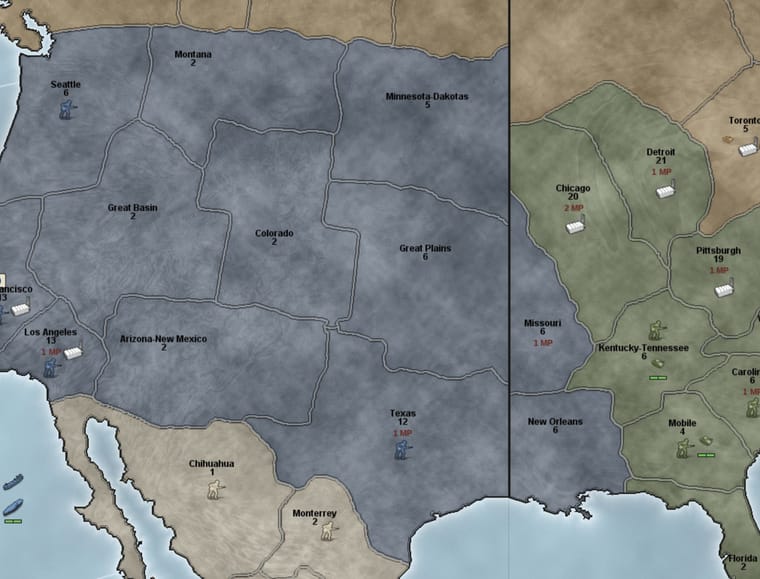
The split between America Pacific and America Atlantic.
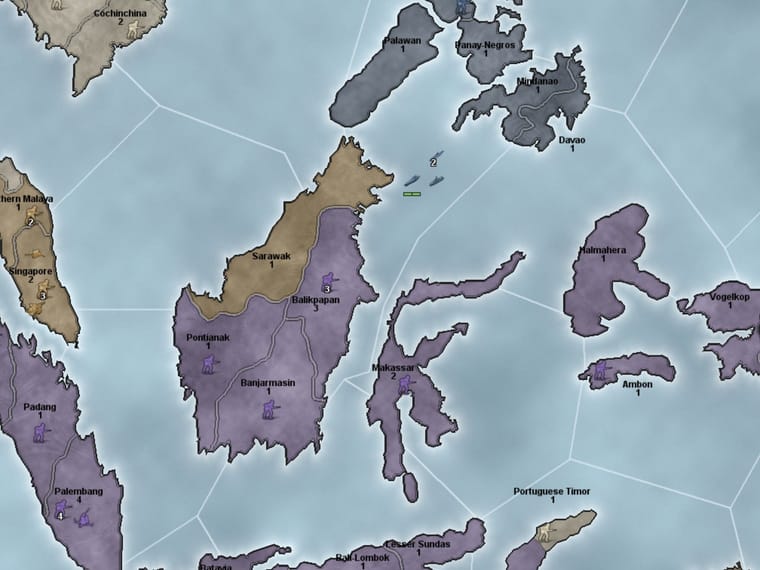
The East Indies
America Pacific is capped at two SPCs, and America Atlantic at three. They each get two research centers.
The Dutch don't get a turn. Those purple infantry can never be moved or replaced. If Japan owns the East Indies the income goes to Japan. If the Allies control the East Indies the income goes mostly to the Dutch, which means it goes to no one.
On turns 1 and 2 the U.S. is at peace, which means it gets very limited income. On turn 3, America Pacific gets, I think, 70% of its full income, while America Atlantic gets 30%. Each turn, both Americas go up by 10 percentage points until they reach 100%. I may need to adjust this income nerf, depending on the need for game balance.
-
Just because Revised and WaW failed to provide the US with a balanced strategy between two fronts doesn't mean it can't be done on other maps.
You can still have an undivided USA and make pursuing both oceans simultaneously as viable as KGF or KJP. It's simply better to give the US player the option of how to divide their resources between the fronts.
WaW failed to achieve this due to:
- The Hawaii factory.
- The USA being closer to Japan than Germany/Italy.
- Japan being divided while Germany is not strong enough.
All you need is to not make the same mistakes that WaW did. A much stronger Germany will already naturally force the US player to commit at least part of their resources to Europe.
-
America Pacific research screen, round 2.
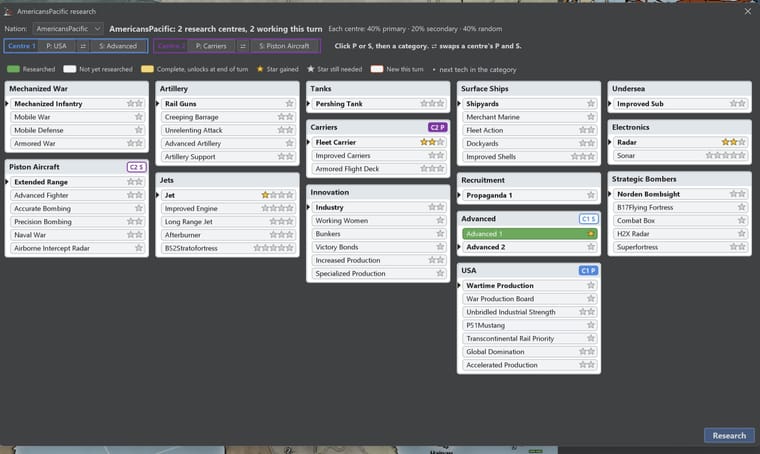
The primary target for center 2 is fleet carrier. It hopes to build fleet carriers as its special unit. The primary target for center 1 is USA. There are good income increasing techs in that category. For secondary research, one of its centers is focusing on Advanced. It already has Advanced 1. Getting Advanced 2 will let it build both of its special production centers. The other secondary priority is piston aircraft. A lot of solid techs in that category.
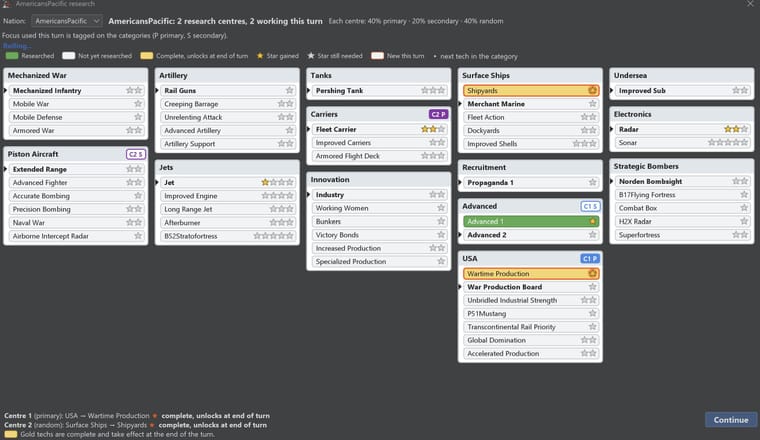
Research phase complete. Shipyards tech was chosen at random. It reduces the cost of transports and cruisers. This will be helpful for its upcoming war against Japan. The other tech chosen was wartime production: a good boost to America Pacific's income.
Here is the research screen for America Atlantic
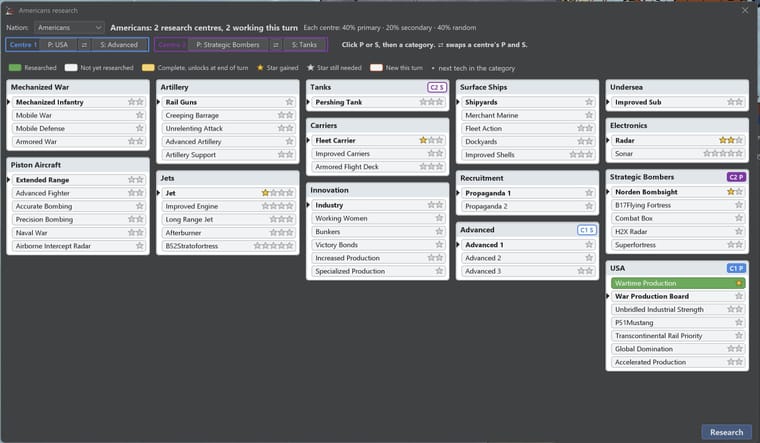
One of its research centers has a primary focus of USA tech, for basically the exact same reasons as America Pacific. The other research center is focusing primarily on strategic bombing tech. It is contemplating a strategic bombing campaign against Germany. Due to a nerf, an entry level strategic bomber has 2 hitpoints and does 2 PUs of damage when strategic bombing. An air defense value of 1. The U.S. and Britain have the best available options for strategic bomber tech.
Long-term, America Atlantic is thinking its special unit should maybe be the Superfortress. Short-term, however, the heavy tank seems like a good idea. That is why it has chosen tanks tech as a secondary focus. Its other secondary focus is advanced, so that it will be able to build the three SPCs it hopes to have.
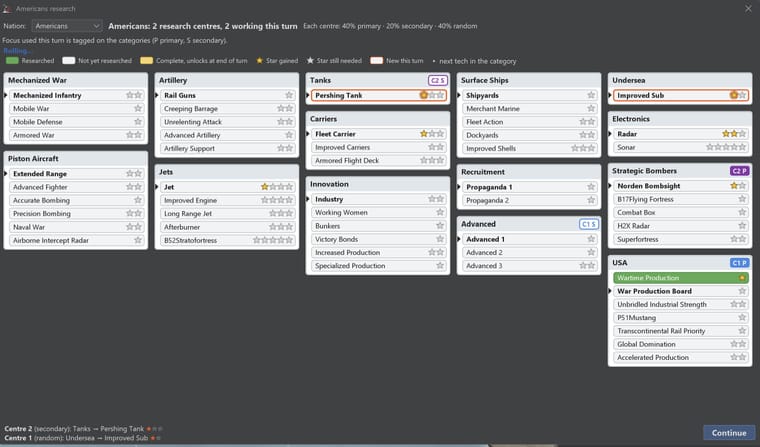
One star towards Pershing tank. That part went according to plan. One star towards improved subs, as a randomly chosen advance. This is not nearly as helpful to America Atlantic as it would have been to America Pacific.
-
Some comments on strategic bomber tech:
In a test game, Britain used most of its round 2 purchase to buy strategic bombers. These were devastating to Germany on round 3. I felt like it was too early in the game for Germany to have to deal with stuff like this. 40 PUs of damage was going too far. That's why I decided to nerf the strategic bomber.
An entry level strategic bomber does 2 PUs of damage (down from the 5 PUs for the pre-nerf version). The entry level has 2 hitpoints instead of 3, and an air defense value of 1 instead of 2.
Britain and the U.S. are the nations with the two best tech trees for strategic bombers tech. Britain's bombers can be upgraded to a strategic bombing value of 5, as opposed to 4 for the U.S. Also Britain can research Window, which reduces enemy interception value by 1. (Can never go below 1.) British and American bombers can each be upgraded to 3 hitpoints. American bombers can be upgraded to have better air defense than British bombers. Germany, Japan, and the Soviet Union can use one star to research an entry-level strategic bomber. Then one star to upgrade it to the final version. The final version won't be as good as British or American strategic bombers. Japan's final version is a little better than the other two.
-
On another matter, the new air system seems to be working out well. Four bombers per land territory max, along with four fighters max. I was afraid this would create a GUI problem, but that has not been the case.
The Soviets sent their dive bomber against a German army. Granted, that dive bomber got aborted, so no attack. But I think the real time for the Soviets to push back in the sky will come later in the game. The four plane limit is doing its job of giving both sides a reason to fight for control over the sky. Thanks to @vendetta for pushing me on this.


Hello! It looks like you're interested in this conversation, but you don't have an account yet.
Getting fed up of having to scroll through the same posts each visit? When you register for an account, you'll always come back to exactly where you were before, and choose to be notified of new replies (either via email, or push notification). You'll also be able to save bookmarks and upvote posts to show your appreciation to other community members.
With your input, this post could be even better 💗
Register Login