Flames and Steel (official thread)
-
@KurtGodel7 Yeah, players are relentless optimizers, so min-maxing is always a tough problem to try and get rid of. The one thing you really want to prevent is players feeling too railroaded, where it feels like there is only one possible strategy you can use if you want to win. If the Soviets can only survive by playing a very specific build order, people are not going to have as much fun playing them as they do with another nation that gets more choices.
One more idea... have you tried testing what happens if you reverse the order on your air turns? What if everyone does a blind allocation on their fighters first, you reveal those, and then you commit your bombers once you've seen where the fighters are? That would allow players of a weak air force to do some misdirection (send your fighters one way but your bombers another) , or take advantage of vulnerabilities where your opponent didn't send enough fighters.
Or, since you've included heavy fighters alongside normal fighters, you could further differentiate their roles by having one type get allocated in the first round, and the other type in the second round - the fighter is an aggressive unit you commit blindly, the heavy fighter is a reactive unit you send after you've seen where some of the enemy air force is going.
You could also split the different bomber types between the two rounds - medium bombers and strategic bombers go in the first round so that strategic bombing raids are telegraphed and easier to respond to, but dive bombers and torpedo bombers get to sneak in on the second round and become harder to defend against.
Not sure which particular combination would be best, but shaking up which types go in which order seems like a good approach to investigate.
I've come up with an idea which might solve the problem you're trying to solve. The idea, which I borrowed from Axis and Allies naval miniatures, is that you can have a maximum of four air over any one territory. Well, four fighter type air, plus four bomber type air. This will allow the Soviets to strafe German land units.
To give an example, the Germans send four fighters and four dive bombers to a Soviet territory they want to strafe. Likewise, the Soviets send four dive bombers and four fighters to a German territory they want to strafe. The Germans and the Soviets each also send four fighters to defend their own territories.
Things happen as follows. There is a dogfight, in which only fighters participate. The fighters fire at their dogfight value. Then, there is an interception phase. The fighters fire at their interception value, the dive bombers fire at their air defense value. Let's say one dive bomber is destroyed and another is aborted. The remaining dive bombers get through, and are able to strafe their land targets.
For strategic bombing raids the following is true. Up to four strategic bombers can be assigned to any one factory. However, the defender is allowed to have an unlimited number of aircraft defending any given factory. Normally the attacker cannot send escorts into strategic bombing raids. Therefore, it behooves the defender to use plenty of heavy fighters to defend against raids. A normal fighter has a higher dogfight value than a heavy fighter. But the heavy fighter has a higher interception value. For this air combat there is no dogfight, due to the lack of any fighter escort. Only an interception.
Later in the game, the U.S. will be able to unlock the P-51 Mustang tech. This will allow the U.S. to send up to four advanced fighters as an escort to each factory it wants to bomb.
I haven't play tested any of this yet, so we'll see how the GUI will be.
-
My thought process here is as follows.
- I need to develop this into a fun map to play.
- Then, I need to go to the main developers and show them the finished product. Or at least the somewhat finished product.
- Hopefully by that point there will be some users willing to speak up in favor of this map. "I've played this, it's really fun, and it's worth adding these new features to standard TripleA."
Once you are at point 3, you will need to release your own version of TripleA, and users will have manual to install both your version of TripleA and the map. This is going to exclude the vast majority of TripleA user, but I do wish you to find enough players to get some play-testing as you describe. I've never seen anything like this happening in all my years around TripleA, but I do wish it does.
-
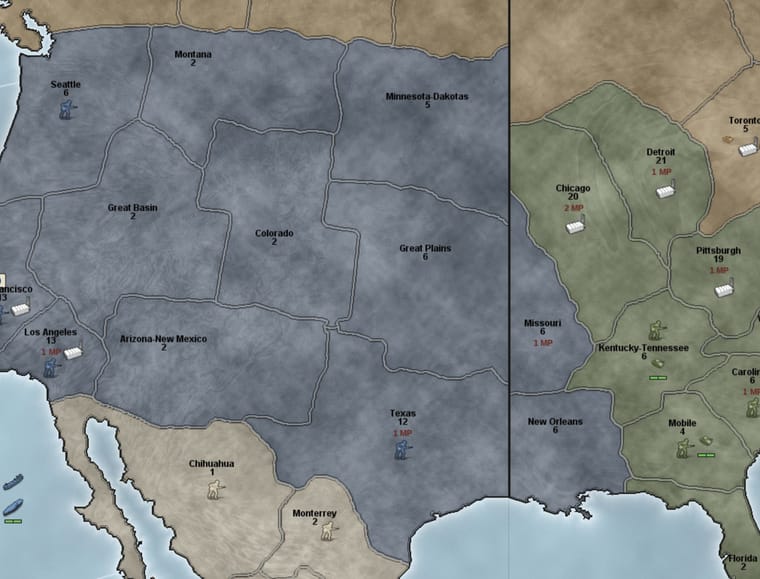
The split between America Pacific and America Atlantic.
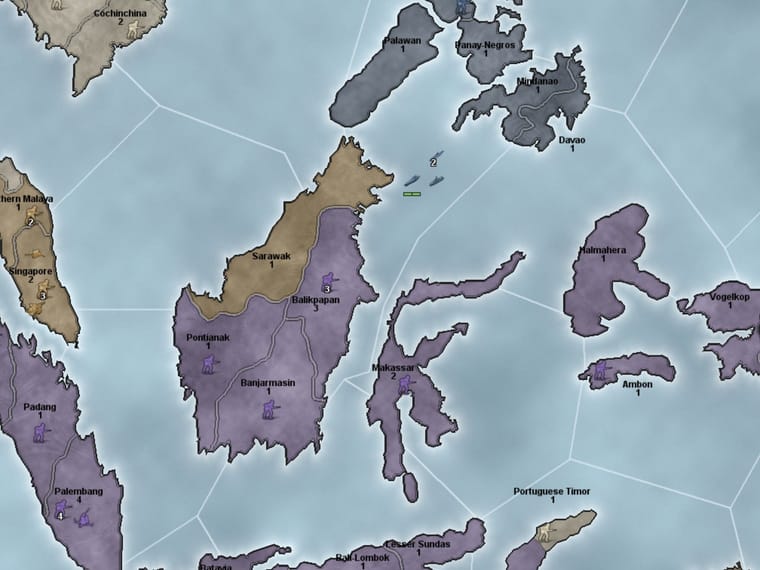
The East Indies
America Pacific is capped at two SPCs, and America Atlantic at three. They each get two research centers.
The Dutch don't get a turn. Those purple infantry can never be moved or replaced. If Japan owns the East Indies the income goes to Japan. If the Allies control the East Indies the income goes mostly to the Dutch, which means it goes to no one.
On turns 1 and 2 the U.S. is at peace, which means it gets very limited income. On turn 3, America Pacific gets, I think, 70% of its full income, while America Atlantic gets 30%. Each turn, both Americas go up by 10 percentage points until they reach 100%. I may need to adjust this income nerf, depending on the need for game balance.
-
Just because Revised and WaW failed to provide the US with a balanced strategy between two fronts doesn't mean it can't be done on other maps.
You can still have an undivided USA and make pursuing both oceans simultaneously as viable as KGF or KJP. It's simply better to give the US player the option of how to divide their resources between the fronts.
WaW failed to achieve this due to:
- The Hawaii factory.
- The USA being closer to Japan than Germany/Italy.
- Japan being divided while Germany is not strong enough.
All you need is to not make the same mistakes that WaW did. A much stronger Germany will already naturally force the US player to commit at least part of their resources to Europe.
-
America Pacific research screen, round 2.
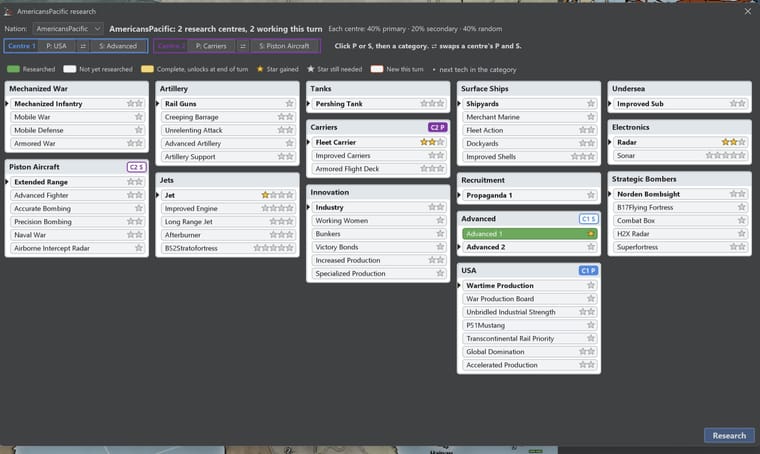
The primary target for center 2 is fleet carrier. It hopes to build fleet carriers as its special unit. The primary target for center 1 is USA. There are good income increasing techs in that category. For secondary research, one of its centers is focusing on Advanced. It already has Advanced 1. Getting Advanced 2 will let it build both of its special production centers. The other secondary priority is piston aircraft. A lot of solid techs in that category.
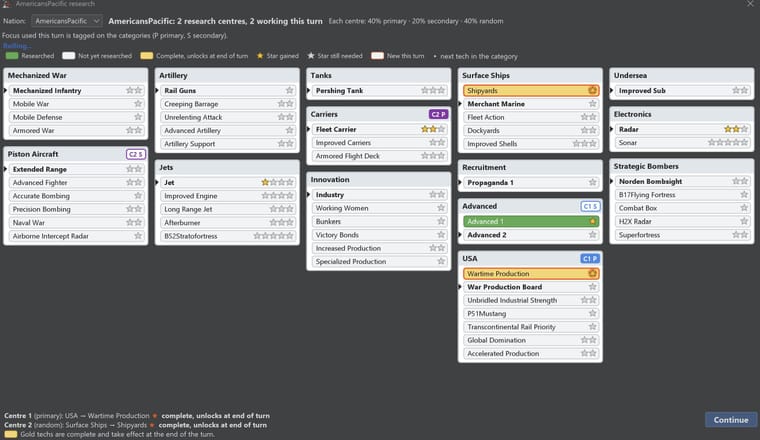
Research phase complete. Shipyards tech was chosen at random. It reduces the cost of transports and cruisers. This will be helpful for its upcoming war against Japan. The other tech chosen was wartime production: a good boost to America Pacific's income.
Here is the research screen for America Atlantic
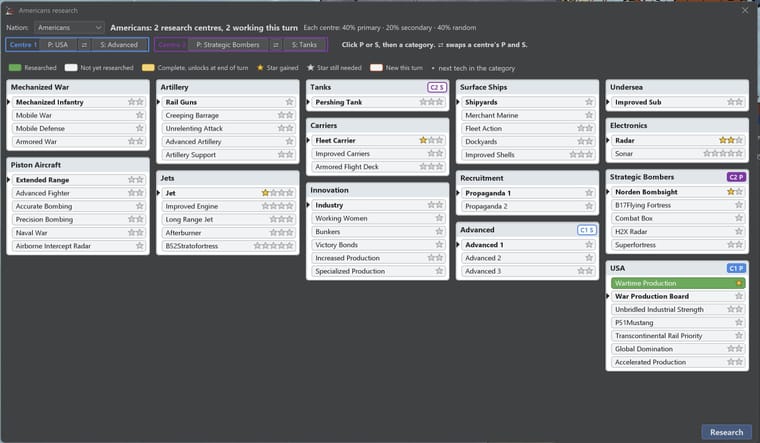
One of its research centers has a primary focus of USA tech, for basically the exact same reasons as America Pacific. The other research center is focusing primarily on strategic bombing tech. It is contemplating a strategic bombing campaign against Germany. Due to a nerf, an entry level strategic bomber has 2 hitpoints and does 2 PUs of damage when strategic bombing. An air defense value of 1. The U.S. and Britain have the best available options for strategic bomber tech.
Long-term, America Atlantic is thinking its special unit should maybe be the Superfortress. Short-term, however, the heavy tank seems like a good idea. That is why it has chosen tanks tech as a secondary focus. Its other secondary focus is advanced, so that it will be able to build the three SPCs it hopes to have.
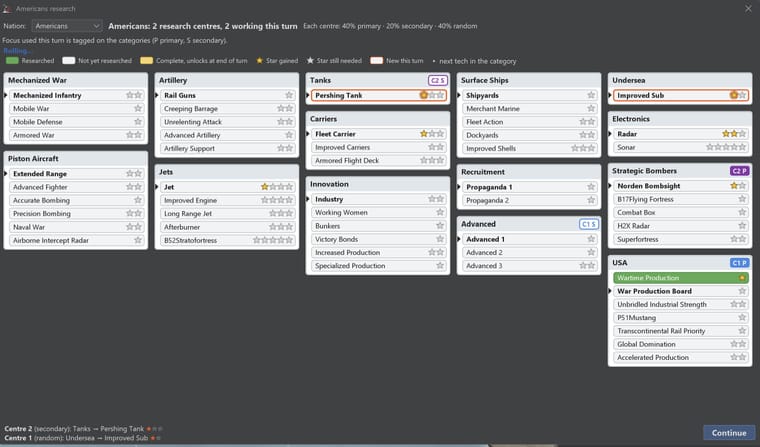
One star towards Pershing tank. That part went according to plan. One star towards improved subs, as a randomly chosen advance. This is not nearly as helpful to America Atlantic as it would have been to America Pacific.
-
Some comments on strategic bomber tech:
In a test game, Britain used most of its round 2 purchase to buy strategic bombers. These were devastating to Germany on round 3. I felt like it was too early in the game for Germany to have to deal with stuff like this. 40 PUs of damage was going too far. That's why I decided to nerf the strategic bomber.
An entry level strategic bomber does 2 PUs of damage (down from the 5 PUs for the pre-nerf version). The entry level has 2 hitpoints instead of 3, and an air defense value of 1 instead of 2.
Britain and the U.S. are the nations with the two best tech trees for strategic bombers tech. Britain's bombers can be upgraded to a strategic bombing value of 5, as opposed to 4 for the U.S. Also Britain can research Window, which reduces enemy interception value by 1. (Can never go below 1.) British and American bombers can each be upgraded to 3 hitpoints. American bombers can be upgraded to have better air defense than British bombers. Germany, Japan, and the Soviet Union can use one star to research an entry-level strategic bomber. Then one star to upgrade it to the final version. The final version won't be as good as British or American strategic bombers. Japan's final version is a little better than the other two.
-
On another matter, the new air system seems to be working out well. Four bombers per land territory max, along with four fighters max. I was afraid this would create a GUI problem, but that has not been the case.
The Soviets sent their dive bomber against a German army. Granted, that dive bomber got aborted, so no attack. But I think the real time for the Soviets to push back in the sky will come later in the game. The four plane limit is doing its job of giving both sides a reason to fight for control over the sky. Thanks to @vendetta for pushing me on this.
-
Just because Revised and WaW failed to provide the US with a balanced strategy between two fronts doesn't mean it can't be done on other maps.
You can still have an undivided USA and make pursuing both oceans simultaneously as viable as KGF or KJP. It's simply better to give the US player the option of how to divide their resources between the fronts.
WaW failed to achieve this due to:
- The Hawaii factory.
- The USA being closer to Japan than Germany/Italy.
- Japan being divided while Germany is not strong enough.
All you need is to not make the same mistakes that WaW did. A much stronger Germany will already naturally force the US player to commit at least part of their resources to Europe.
I did not say anything because did not want to be too assertive but completely agree with @schulz here. I think that splitting the United States into Atlantic and Pacific is a very crude and historically wrong way to have this country going both oceans. It is true that in many games you see the United States unhistorically focusing almost exclusively on Atlantic or Pacific, with at most the choice to go in one direction or the other, but it would be much better to find other less forceful ways to allow that to happen. One way, for example, may be making Pacific into the better choice (by giving value to the Dutch East Indies and having the Japanese Empire being much weaker than the United States, so that the United States can handily win in Pacific using less than half of its total production) but making possible to place only very little in there through severe placement limits especially for ships. Having very low placement capabilities and even production in the West Coast is actually not necessarily unhistorical as back then the western part of the United States was a lot less populated than today both absolutely and relatively to the East Coast, so much so that most ships used in Pacific were actually launched from the East Coast. For sure, Hawaii should not be able to place anything at least at start game.
I definitely hear what both you and @schulz are saying. You guys are not wrong. Also, I'm not going to object to anyone providing honest feedback about this. I've never done anything like this before, I'm going to make mistakes, and it's valuable feedback when people point out what they believe those mistakes to be.
However, in literally every map I've ever played, the U.S. goes KGF or KJF. No mixed strategy, pretty much ever. Okay, maybe Global, with its victory conditions for the Axis, is a partial exception. But number 1, I didn't want my map to have Global-like victory conditions. Number 2, even with Global it's normal for the U.S. to send enough to one theater to dominate it, while sending just enough to the other theater to prevent the Axis victory conditions from triggering.
I will grant that maybe the WAW map could be tweaked to induce the U.S. to produce a mixed strategy instead of its usual KJF. Maybe. What you've described in your post is a method of achieving that which might or might not work. Even with your modifications, I believe that the U.S. could still pursue a version of KJF. It would build more expensive units to optimize unit placement capacity. Air for the U.S. Pacific Fleet's carriers could be flown in from the Eastern U.S. Land units could be built in the Eastern U.S. and plod their way west. This would mess with the U.S. Pacific unit mix big time, it would make KJF more cumbersome, but (especially if you're weakening Japan's income) this would not necessarily solve the problem of KJF.
As individual maps, NWO and The Rising Sun have a divided USA. Germany deals with the eastern half of the U.S. in NWO, and Japan deals with the western U.S. in The Rising Sun.
So now imagine this. You're combining NWO and The Rising Sun together, with a few simplifications, to create a WAW map. Imagine having to choose between two options. Option 1: you combine the two halves of the U.S. together. This means the U.S. will always choose KJF or KGF. Option 2: you keep the U.S. divided into two halves. The eastern half is anti-Germany, the western half anti-Japan. This results in a European theater playing out kind of like NWO, and a Pacific theater playing out kind of like The Rising Sun.
I know you'd want an Option 3, which you described in your post. But if Options 1 and 2 were your only two options, which would you prefer? Option 1, with American conquest of Japan, German conquest of the Soviet Union, and a late game Axis stack and Allied stack competing against each other in Asia? Or option 2, where you're legitimately getting a late game Pacific theater and, separately, a late game European theater?
Even if your Option 3 was implemented perfectly, I'd say it has a less than 50% chance of doing what you'd want it to do. And that would be assuming you're using Revised rules, as WAW does. The rules I'm actually using have nothing to do with Revised. If I'm using your Option 3, then with every technology, I'm asking, how does this affect the U.S.'s ability to go KJF? Industry adds +2 to factory unit placement capacity. Strategic bombers techs make strategic bombing raids more effective. P-51 Mustang tech adds +2 to the range of American advanced fighters, and allows those advanced fighters to escort bombers for strategic bombing raids. (With a max of four escorts per factory being hit.) The Superfortress tech gives the U.S. access to a very powerful strategic bomber type as a special unit. Compared to a normal strategic bomber, a Superfortress has more hitpoints, longer range, and does far more PU damage when bombing.
Your Option 3 is a delicate balancing act. That balancing act is far more difficult to achieve when you have technologies like these increasing the U.S.'s ability to go KJF.
Yes Option 2 is heavy-handed. No question there. Ahistorical? That's more debatable. Historically, the U.S. dedicated about 33 - 40% of its war effort to the Pacific, and the remaining 60 - 67% to the war in Europe. Option 1 gives you one United States (historical) which always goes KGF or KJF (ahistorical). Option 2 gives you two United States (ahistorical) which forces the U.S. to fight on both fronts at once (historical).
-
There is nothing wrong with the US being able to pursue KJF.
The issue is KJF (or KGF) being a no-brainer option every single time, while the balanced approach is arguably the worst one among them. They should all be equally viable.
I tried to tackle this issue in my map as well by implementing these features. The goal is to introduce natural disadvantages for both KJF and KGF.
-
If the US tries KJF: Japan is farther away than France and North Africa. The US can land in these places in 2 rounds, but Japan's mainland is 3 rounds away. (ships move at 3) There is no Hawaii factory and no ability to purchase new factories either, so everything has to come from California. Japan also starts with a bigger army and navy, so they will have plenty of time before a potential collapse. The US will be taking a huge gamble, (almost) sacrificing the survival of the Soviets (and even Britain) if they try KJF.
-
If the US tries KGF: The US Pacific Navy is rendered useless, as they can neither fight the Japanese nor reach Europe in a reasonable amount of time. Losing the Pacific—including Australia—is guaranteed. On top of that, taking Germany is even harder.
I also gave fighters the scramble ability without needing an airfield. This means you can still protect a smaller navy with fighters without investing in naval units. This feature is intended to prevent the UK from being immune to a German naval invasion, while also ensuring the German navy is not doomed to fall.
-
-
@kurtgodel7
A lot of what @schulz & @cernel said has been solved in 1941 Global Command DiscissionBlack Elk and I went through the same issues when starting out, he is a veteran of A&A and I brought a clean slate.
1941GCD has
- Hawaii factory with a Truk factory to offset it.
- USA is closer to France/Germany
- Japan is whole, so is USA, there are only 8 playable factions
I will bore you with some details.
- Factories/Industries have builtin invisible railways that +2 move to 1:Move units & +1 move to 2:Move units this enables reinforcements to cross continents in a reasonable time. There is a trans Siberian rail link.
- Factories have low output, forcing placements to spread out.
- VCs are capitals as well as Oil production TTs and other choke points, they are also spread-out so the USA should go east and west, if they dont the allies will lose.
- Bunkers litter the map and are hard to take, so USA must invade with a large force or suffer losses.
- USA has a massive production compared to a lot A&A maps.
- Axis must win before the USA gets into full production or lose
-
@KurtGodel7 There is also option 4. Make KGF the better option per se so that the US would want to go full KGF but add some political restrictions by which it is forced to do at least something in Pacific. For example, the restriction can be that the US cannot invade any enemy territory so long as any part of the US plus Hawaii (so not comprising Alaska) is in enemy hands. This way, while going for KGF, the United States is forced to do the minimum necessary to keep Hawaii (need splitting it in more than one island to avoid this being done just by piling up land defence, or you can add that also warship presence near the West Coast counts as a no-no as well). Not a big fan of political restrictions though.
Also, historically, ships and especially transports kept doing back and forth between Pacific and Atlantic service. Many of the transports ships which were used on D-Day were taking part in the liberation of the Philippines a few months later.
-
@TheDog Interesting, but I'm a big hater of Hawaii having a factory (especially one spamming carriers and/or battleships). It's by far my number 1 issue which makes Big World unplayable for me.
-
@Cernel
In 1941 GCD, there are 4 types of factory.- Industry-Hvy: Carriers, Battleships, Cruisers, in home TT
- Industry-Med: Convoy/Transport, Destroyer, in Hawaii & Truk
- Industry-Lgt: Infantry, Artillery, no ships
- Base-Camp: Infantry, no ships
-
@Cernel
In 1941 GCD, there are 4 types of factory.- Industry-Hvy: Carriers, Battleships, Cruisers, in home TT
- Industry-Med: Convoy/Transport, Destroyer, in Hawaii & Truk
- Industry-Lgt: Infantry, Artillery, no ships
- Base-Camp: Infantry, no ships
Eh, I'm not an expert, but I doubt that a single transport or destroyer was ever built in Hawaii during the war. I would be surprised if there was any artillery production either. Without knowing the facts, I feel almost sure Hawaii should be either a Base-Camp or nothing at all just based on my superficial knowledge of what was Hawaii at the time.
-
@Cernel
You are correct, no ships were produced, but a lot were repaired and resupplied, same for Truk.Not my choice but there for game play.
Even so, the map can be edited to your taste.


Hello! It looks like you're interested in this conversation, but you don't have an account yet.
Getting fed up of having to scroll through the same posts each visit? When you register for an account, you'll always come back to exactly where you were before, and choose to be notified of new replies (either via email, or push notification). You'll also be able to save bookmarks and upvote posts to show your appreciation to other community members.
With your input, this post could be even better 💗
Register Login