TripleA Server Costs
-
Just wanted to share and do a cost breakdown of where we stand with server costs. TL;DR, the launch of 2026-06 allows us to go from $114/month to $51/month!
Linode is our cloud provider and is essentially our monthly operating cost. Our last bill from them was $114.07
With the launch of 2026-06, we're able to start turning off servers. The 2.5 bots have now been shut down.
So, we have 5 bot servers for 2026-06 @ $5/month/server
Forum server is $12/month + $2/month for backups
Lobby is $24/month
The new marti is $5/month
Old marti is $25/monthWe'll be able to turn off Old marti very soon. Bringing our expected monthly cost to: 5*$5 + $14 + $24 + $5 = $68/month
As soon as we turn off the old lobby:
- we can reduce the lobby server SKU from $24/month to $12/month
- we can move the new MARTI to be cohosted on the lobby server, removing the need for the MART server.
So, with $17/month more in potential reduction, we'll be at $51/month
-
@LaFayette dave ramsey approves of this message.

-
Okay, following some server work today, our new grand total for servers per month is: $54
Lobby server costs were reduced by $19 and a new server added for $5, net down of $14/month.
Our current monthly server cost tally is:
- $25 - 5 bots
- $14 - forums
- $5 - dice server
- $5 - lobby (was $24)
- $5 - support server (AKA maps-server, a new server)
Turns out co-hosting MARTI is likely to not be a good idea. The biggest cost savings we could get right now are perhaps to turn off forum backups for $2/month, or maybe remove one of the bots, which are $5/month/bot. Both of which seem like bad moves.
In the future, the "node relay" feature could remove the need for 3 bots or so. Until then we'll be sitting at that $54/month price tag.
Just about the only other cost TripleA has is the domain address for 'triplea-game.org'. That hits it 10 years pretty soon and would need renewal. I'll cover that cost when the time comes, I think it's around $70 or something,
cc: @prastle
-
@LaFayette 70 for 10 years is pretty decent
-
@ubernaut namecheap FTW.. except was a bit off. $170 for 9 years
-
@LaFayette ouch thats actually abt fair these days. kinda sad google sold off their domains business it was very convent and a great deal
-
The biggest cost savings we could get right now are perhaps to [...] remove one of the bots, which are $5/month/bot. Both of which seem like bad moves.
Is it? Maybe I'm overlooking or missing from the lobby when it's really busy, but I'm under the impression that it would be very much safe to remove 1 bot (going down from 15 to 12 automated hosts). Since I've been back, I've never seen the bots anywhere near being all taken.
-
I would suggest waiting a month or two before removing one. There may be some people still transitioning to the new lobby and/or it might start gaining popularity.
Better to have a couple empty than not enough imo
-
Good points, we need to also keep in mind that the bots need to be available for peak lobby activity.
-
@LaFayette And I guess also the possibility of them breaking down. About that, if currently there are 5 servers of 3 bots each (for a total of 15), it seems like that only 10 out of 15 bots are currently working. This appears to be the situation:
California: 1 out of 3 working.
Jersey: 2 out of 3 working.
Toronto: 2 out of 3 working.
London: all working.
Frankfurt: 2 out of 3 working.
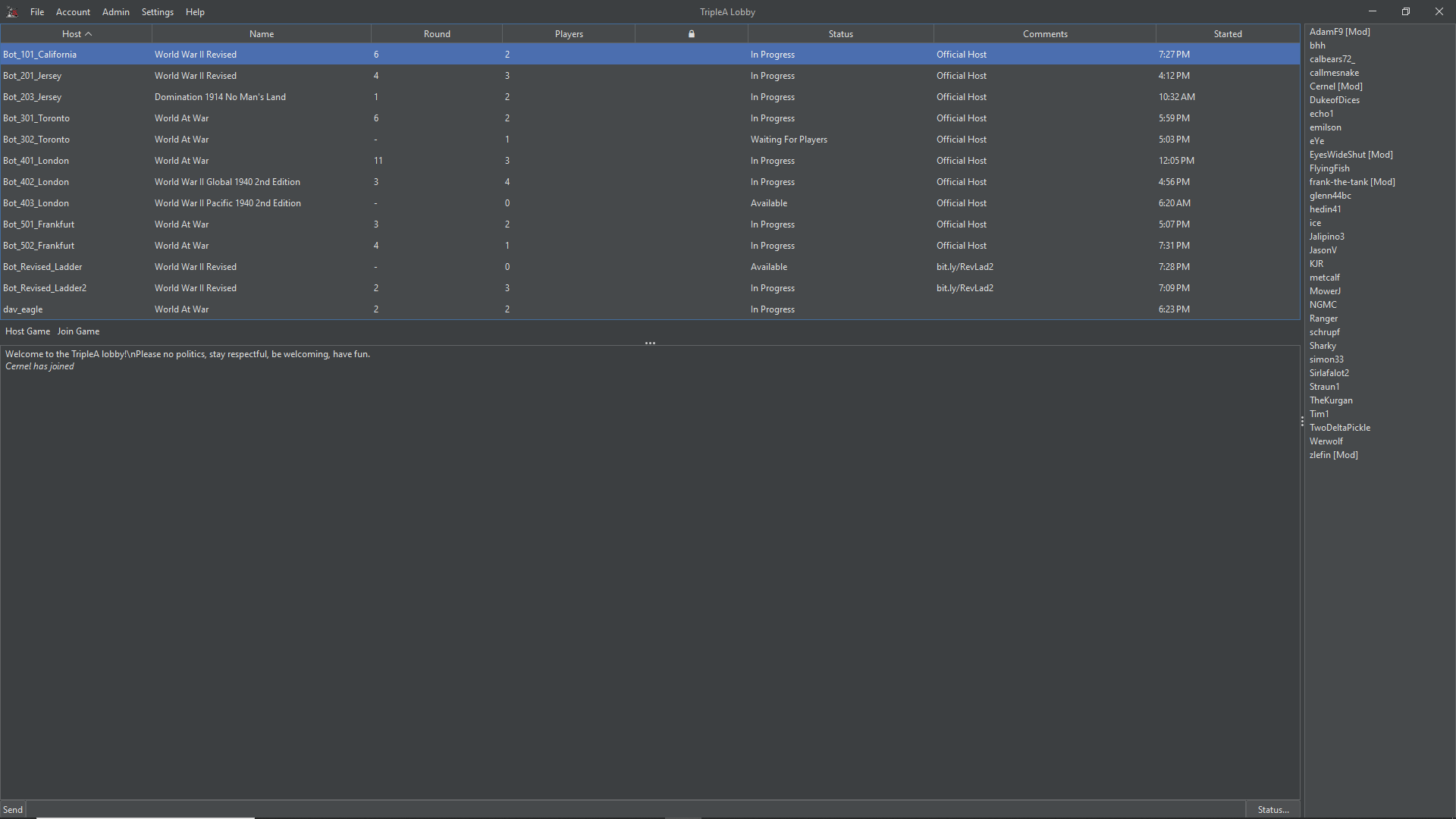
(Also, I understand that, thanks to @eyeswideshut, there are now 2 additional private-but-open bots dedicated to its Revised ladder.)
-
Monday, 7:20 pm UTC, bot shortage again. It doesn't seem like enough bots atm, it seems common for there to be shortages at peak times.
-
All 15 TripleA automated hosts are now working (so that's a total of 17 with @eyeswideshut's ones). Did anyone do anything or was it just something automated? Just curious.
-
@Cernel Thanks for flagging this. For the Revised Ladder bots, I set them up to run inside persistent tmux sessions on the AWS server, so they remain active even after I disconnect from SSH or close my computer. I also created separate run scripts for the bots and a startup script that launches them together, which makes them easier to restart and keep online. So far, that setup seems to be working and the Revised Ladder bots are still running, although I’m continuing to monitor them in case one freezes or disconnects. I am paying about $10 a month for both headless servers which I understand is consistent with what triplea in general is paying for the bots.
-
I am paying about $10 a month for both headless servers which I understand is consistent with what triplea in general is paying for the bots.
I guess this means that you are paying $5 per bot? What I understand @lafayette said is that TripleA is paying $5 per server of 3 bots, which would be $1.66 per bot.
-
@Cernel ah my bad. so I'm paying more. My Bots are cloud-based for better or for worse. They seem to be working fine but I haven't had crashes that I'm aware of.
-
@Cernel When the Revised Ladder bots were crashing frequently, I moved them onto Amazon Web Services and reworked how they were launched and maintained.
AWS is a cloud hosted Linux server, so the bots run remotely rather than depending on my own computer, home internet connection, or an open SSH window. I connect to the server through SSH, but the bots themselves run inside persistent tmux sessions.
tmux is useful here because it separates the bot process from the temporary SSH connection. I can disconnect from the server, close my laptop, or lose my local connection without terminating the bot. Each bot has its own named session, which also makes it easier to inspect or restart one without affecting the other.
The main upkeep commands are:
tmux ls
This shows whether the bot sessions are still present.
tmux attach -t revised_ladder
tmux attach -t revised_ladder2These reconnect me to the live console output for either bot so I can inspect errors, freezes, or lobby disconnects.
To leave a session while keeping the bot running:
Ctrl+B, then D
If the bot is frozen rather than fully gone, I can attach to the session, stop the process with Ctrl+C, and relaunch it using the relevant startup script.
I also set up the launch process so that if a bot process actually disappears or exits, it is automatically started again. In other words, the server does not simply leave the bot offline after a crash. The surrounding startup or monitoring process detects that the bot is no longer running and relaunches it. That does not necessarily fix every possible freeze, since a frozen process may still technically exist, but it does handle ordinary crashes and unexpected exits without requiring me to log in immediately.
So the overall setup has three layers:
AWS provides the continuously available cloud server.
tmux keeps the bot sessions alive independently of SSH.
The restart logic relaunches a bot when its process exits or disappears.This is what I implemented when the bots were crashing a lot. Since then, the AWS and tmux setup has generally been stable, and the automatic restart behavior has reduced the amount of manual intervention needed.
-
Good points, we need to also keep in mind that the bots need to be available for peak lobby activity.
@lafayette Yes, it looks like that at peak 15 bots are easily all taken. I've seen it happening despite the 2 additional bots courtesy of @eyeswideshut.
Unfortunately, the lobby is back having only 10 out of 15 TripleA bots working. Every server seems missing 1 of its 3 bots. The missing bots are "101", "202", "303", "403" and "501".
Maybe @eyeswideshut can help you making the bots more stable? It made a post with information about that right before this one.
CC: @frigoref
-
-
@Cernel OK! So I think I solved the bot crashing problem on my end. It was the script function, and the fix was actually very simple.
The problem was that I had this command in the Docker startup script -- and it's probably in all the bots:
--env EXIT_ON_GAME_END=true \
That tells the bot to exit when the game ends. Since the container was configured with --restart always, I was expecting Docker to bring it back, but this was creating problems with the bot disappearing from the lobby.
I removed that command from the startup scripts.
For example, the relevant part went from:
sudo docker run
--network host
--pull always
--restart always
--env BOT_PORT_NUMBER=3301
--env BOT_NAME=Bot_Revised_Ladder
--env BOT_COMMENT=bit.ly/RevLad2
--env LOBBY_URI=https://prod.triplea-game.org
--env EXIT_ON_GAME_END=true
--env BOT_MAX_MEMORY=256m \to:
sudo docker run
--network host
--pull always
--restart always
--env BOT_PORT_NUMBER=3301
--env BOT_NAME=Bot_Revised_Ladder
--env BOT_COMMENT=bit.ly/RevLad2
--env LOBBY_URI=https://prod.triplea-game.org
--env BOT_MAX_MEMORY=256m \And I did the same for the second bot on port 3302.
The two bots are now running normally, so I'm going to see whether they remain in the lobby after their next games. Hopefully that's all it was! check to see if the other bots have this function..
-
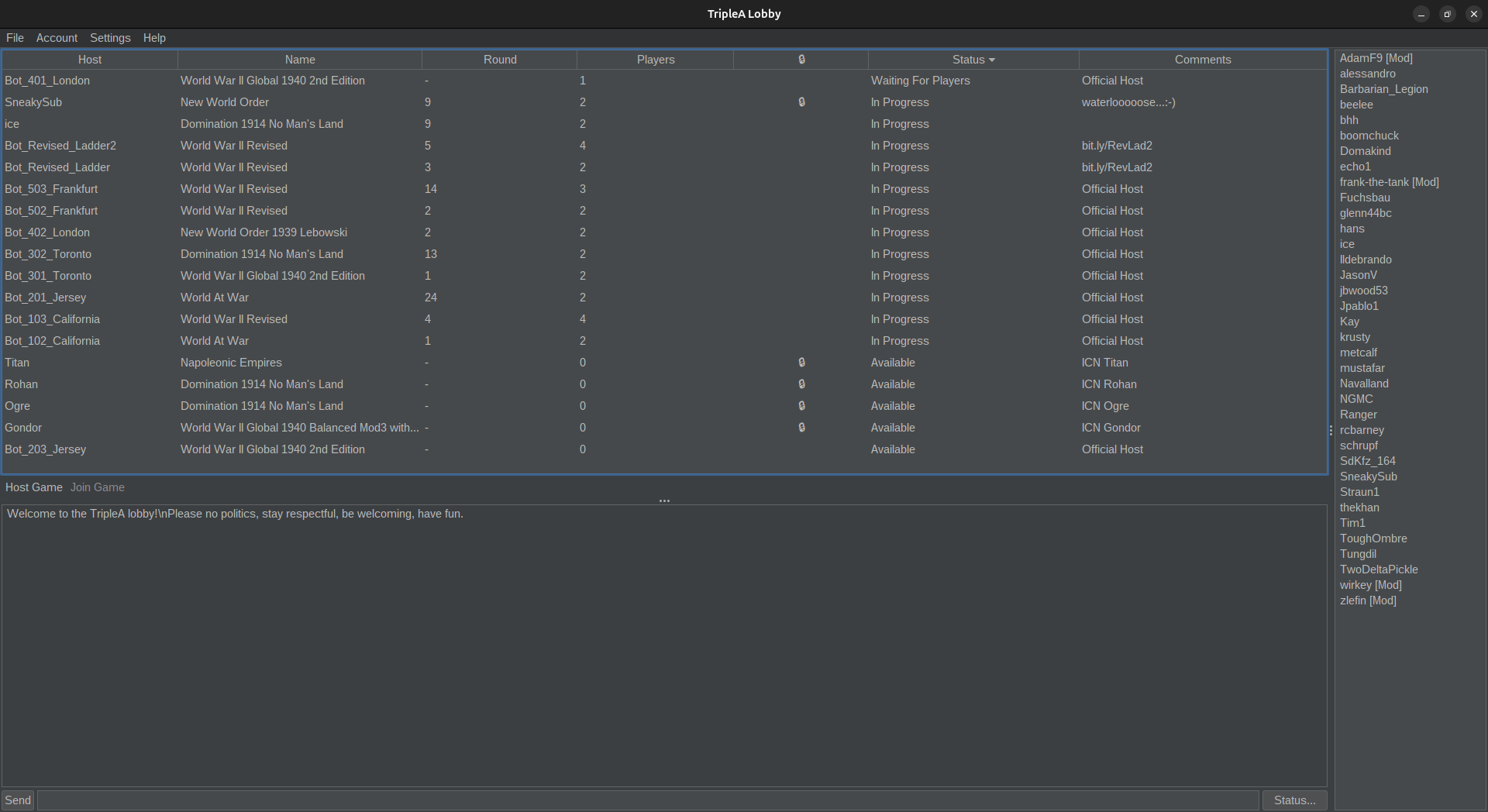
I'm consistently seeing only 10 triplea bots in the lobby. If triplea is paying for 15, then this is something that should be addressed sooner than later imo

Hello! It looks like you're interested in this conversation, but you don't have an account yet.
Getting fed up of having to scroll through the same posts each visit? When you register for an account, you'll always come back to exactly where you were before, and choose to be notified of new replies (either via email, or push notification). You'll also be able to save bookmarks and upvote posts to show your appreciation to other community members.
With your input, this post could be even better 💗
Register Login