Lend-Lease (in singleplayer, not multiplayer games)
-
@Unternehmer said in Lend-Lease (in singleplayer, not multiplayer games):
Speaking about Pacific theatre, I do not rely much on any information about the "Chinese warfront". Paying full respect to the Chinese nation, I can't even imagine how Chinese people could have inflicted any serious damage to the Japanese forces as:
- 90% of Chinese population and economics were (like nowadays) concentrated in the regions near the coast. And they were occupied by the Japan forces or are the part of the Manchukuo.
The Japanese had a majority of the military manpower in the CBI theater. The Chinese inflicted 2,500,000 casualties on the Japanese (mostly wounded). China was not a speed bump.
Many major Chinese cities were not occupied (Many people in China live inland)
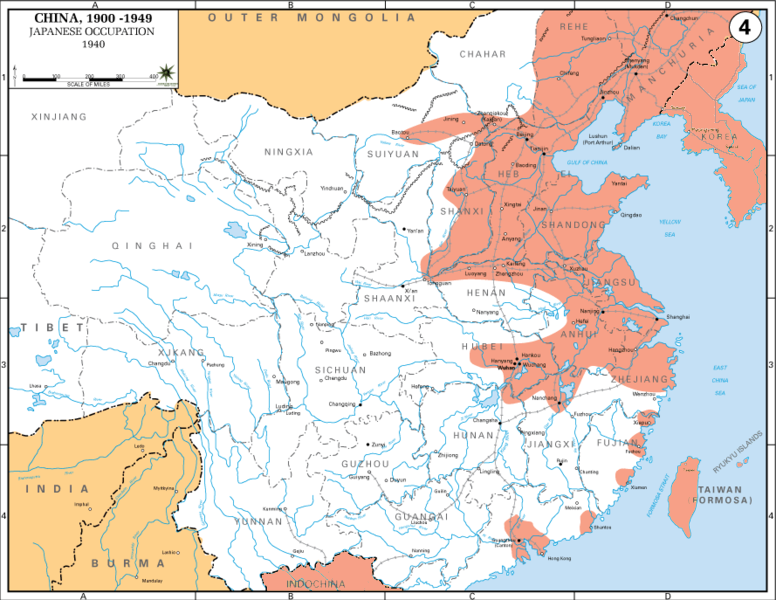
3 times the Japanese failed to capture Changsha (1939,1941,1942) before falling in 1944. In general from 1941 to 1944 the front changed in little in China. In 1944, the Japanese launched Operation Ichi-Go which took some cities but did not break Chinese resistance (the Chinese actually took the offensive in 1945)
Even the areas occupied by Japan had widespread partisan activity.
-
Dear @RogerCooper,
The Japanese had a majority of the military manpower in the CBI theater.
Here we come to the necessity to distinguish between the 2 kinds of TripleA units:
- units, who consume relatively more manpower and cost less PUs (like infantry). Their manpower to PUs ratio favours manpower.
- and units, who consume relatively less manpower and cost much more PUs (like naval units). Their manpower to PUs ratio favours PUs.
So for Japan CBI theater is more manpower consuming and Pacific theatre more PUs consuming.
The Chinese inflicted 2,500,000 casualties on the Japanese (mostly wounded). China was not a speed bump.
Dear @RogerCooper,
what is your opinion how many % of its total war power (PUs invested) should Japan spend in TripleA games on the China-India continental land theater?
(0-100%,- where 0% means Japan should concentrate only on Pacific operations (naval battles, southern islands, possible invasion to Australia);
- where 100% means Japan should concentrate on continental operations (China, India, possible land invasion deep into USSR);
-
Dear @beelee, @Hepps, @RogerCooper, @Schulz and all members of the TripleA community!
I wish you all Merry Christmas! Thank you very much for your support. -
@Unternehmer said in Lend-Lease (in singleplayer, not multiplayer games):
Here we come to the necessity to distinguish between the 2 kinds of TripleA units:
- units, who consume relatively more manpower and cost less PUs (like infantry). Their manpower to PUs ratio favours manpower.
- and units, who consume relatively less manpower and cost much more PUs (like naval units). Their manpower to PUs ratio favours PUs.
So for Japan CBI theater is more manpower consuming and Pacific theatre more PUs consuming.
I am not convinced that naval & air units require less manpower than infantry. The manpower in naval & air units is in the support units. For example the US ended the war with
- Army 5,851,000
- Air Force 2,282,000
- Navy 3,288,000
- Marine Corps 456,000
The US ended the war 31,335 combat aircraft. So there were 73 air force personnel per plane. An Essex class carrier had a crew of 3,500 to fly 100 planes. If you consider escort ships, supply ships and shore facilities, I suspect that the number personnel per plane was at least equal to the air force (and the planes were smaller).
As for how the Japanese divided their efforts, my guess is about 50/50. Battle casualties were about equal between the 2 (most casualties in China were non-combat). The Japanese stopped major offensive operations in China from Pearl Harbor to mid-1944 when they launched Ichi-go.
Historically, the Japanese had no reason to invade Russia. Conducting a military offensive against a major power on a single rail line was folly. Were the Japanese should have gone was India. They could supply by sea and benefit from local allies. British resources were strained in 1942.
In games, it usually pays to put most effort in Asia, as they way the Axis wins games is by taking out Russia so putting pressure on Russia is important. In many games, there is de facto Pacific cease-fire as both sides have greater profit with operations elsewhere.
-
@RogerCooper said in Lend-Lease (in singleplayer, not multiplayer games):
I am not convinced that naval & air units require less manpower than infantry. The manpower in naval & air units is in the support units. For example the US ended the war with
- Army 5,851,000
- Air Force 2,282,000
- Navy 3,288,000
- Marine Corps 456,000
The US ended the war 31,335 combat aircraft. So there were 73 air force personnel per plane. An Essex class carrier had a crew of 3,500 to fly 100 planes. If you consider escort ships, supply ships and shore facilities, I suspect that the number personnel per plane was at least equal to the air force (and the planes were smaller).
I use some info from Wiki (https://en.wikipedia.org/wiki/Military_production_during_World_War_II) :
WW2 US air forces have the total number of aircraft 295,959 and the personnel 2,403,806. So there were 8 air force personnel per plane. This number of personnel includes not only pilots themselves but also other personnel that belongs to the whole U.S. Air Force organization.Also from Wiki
(https://en.wikipedia.org/wiki/United_States_Army_Air_Forces#USAAF_statistical_summary) :
Total aircraft losses for the USAAF from December 1941 to August 1945 were 65,164.
88,119 airmen died in service (among them 52,173 men were battle casualty deaths).
To rough approximation 1 aircraft lost = 1 man lost.If the carrier is lost with all the carrier crew, pilots and 100 planes then there are only 3,500 men lost. But the carrier costs a fortune in comparison to the equipment of the infantry regiment with 3,500 men including transport, servicemen etc.
If we compare manpower losses to $ losses than for example
- 1 in-game infantryman lost is e.g. 10 manpower and only 1 PU lost;
- 1 in-game fighter lost is e.g. 1 manpower and 10 PU lost;
- 1 in-game carrier lost is e.g. 10 manpower and 100 PU lost + the PUs and manpower losses for the fighters lost if there were any on the carrier;
-
@Unternehmer I was counting only front-line combat aircraft (from Ellis: World War 2: A Statistical Survey, page 231). The discrepancy between total production and front-line combat aircraft is from the large number of non-combat aircraft (about 40% of the aircraft) and losses.
Aircraft losses in the war were huge and primarily not combat. The US actually had fewer aircraft in August 45 then December 44 (Ellis, page 242). An aircraft that is worn out and used for parts is out of operation just as much as one that was shot down. Under wartime conditions, the attrition rate in remarkably high, so you can't just add up aircraft production.
My basic point is that it keeps a lot of people to keep an aircraft flying, even though only few of those people are actually in the airplane. Also, the industrial technology of the 1940's were far less automated than that of today. There was an actual competition between the manpower needs of military production and the needs of military operations.
There was no such thing as a country with lots of industrial capacity but little manpower capacity. There were places which were the reverse. India's huge population fielded only 2,159,000 at the end of the war, less than half of Great Britain's.
No power was defeated in WW2 because they ran out of manpower to field viable armies. If heavy losses were taken in combat, men would be transferred from support to combat to restore the proper ratio. This was the reason the Russians could basically loses their entire starting military and still keep an army in the field. (This is also how my father ended up in the Battle of the Bulge).
This is why I don't see I need to track manpower separately from overall production. It creates a complication in the game system without enhancing realism.
I suggest you pickup World War II: A Statistical Survey by John Ellise (ISBN 978-0816029716). It has every imaginable statistic,
-
Dear @RogerCooper,
I was counting only front-line combat aircraft (from Ellis: World War 2: A Statistical Survey, page 231). The discrepancy between total production and front-line combat aircraft is from the large number of non-combat aircraft (about 40% of the aircraft) and losses.
Aircraft losses in the war were huge and primarily not combat. The US actually had fewer aircraft in August 45 then December 44 (Ellis, page 242). An aircraft that is worn out and used for parts is out of operation just as much as one that was shot down. Under wartime conditions, the attrition rate in remarkably high, so you can't just add up aircraft production.
My basic point is that it keeps a lot of people to keep an aircraft flying, even though only few of those people are actually in the airplane. Also, the industrial technology of the 1940's were far less automated than that of today. There was an actual competition between the manpower needs of military production and the needs of military operations.
Do you agree that losing an aircraft carrier is many times bigger economic damage, than losing an infantry regiment with the same number of men?
And losing 100 fighters with all their crews is many times bigger economic damage, than losing 100 infantrymen?There was no such thing as a country with lots of industrial capacity but little manpower capacity.
The idea is to represent the difference between e.g. Germany and USSR. For example, WW2 Germany had 3 times less manpower and 2 times more GDP then USSR.
Were these ratios important for the structure of German and Soviet forces?More important the manpower to GDP ratio is for naval engagements. Naval battles were small in comparison to the land battles in terms of manpower losses involved but bigger in terms of GDP invested in all these ships.
No power was defeated in WW2 because they ran out of manpower to field viable armies.
It's rather questionable point. Could the country keep fighting when whole generations of young men born e.g. 1910-1920 are killed and only women, elderly people and children are left? Or how long can the situation last when almost all people are taken from the economics and are sent to the front to patch the holes in the front line?
Could the Germany or the USSR keep fighting for 1 more year considering their every day casualties? Or were they just one step until their manpower resources are completely exhausted?
USA definitely could as the USA had no so much manpower losses during WW2 as well as UK.This was the reason the Russians could basically loses their entire starting military and still keep an army in the field.
How much does the russian human life costs for the bolsheviks everybody knows quite well. Red Terror has taken not less russian lifes than Nazis.
And even with all these extraordinary recruitment measures (impossible for humane Western culture), the manpower losses of the USSR in WW2 were almost at the limit of complete exhaustion. -
I think both of you are actually right at your arguments.
Hight tech military investments do not necessarily mean to conserve manpower in WWII timeline. The difference that they soak up overwhelmingly non-combatant manpower compare to like an infantry regiment as Roger rightfully said. The confusion is here that the game do not reflect non-combatant manpowers which would be imposible to run and replace these high tech military vehicles without them.
On the other hand, high tech miliary units could preserve manpower as well because majority of the manpower would be in home area rather than dangerious frontline plus there would be higher change to melt enemy manpower on the filed by right tactics.
-
Schulz's point is well-taken. The saying was "Iron is Cheaper than Blood". Air power consumed far fewer lives compared to the resources expended compared to ground power. This was definitely good for morale.
The disproportions between Russia and Germany was not as great as Unternehmer suggests. USSR forces peaked at 13,200,000 compared to 9,500,000 for Germany. Angus Maddison gives the Soviet Union a larger GDP in 1940 than Germany by 15% (if you count Germany's minor allies it comes out to about equal). The Soviet Union had 3 x as many people as Germany, but its backwardness resulted in fielding only 1.5 x as many soldiers. The hordes of Red soldiers was a myth promulgated by German generals after WW2.
Russia was able to build much the same type of army Germany had. For example in 1944, both Russia and Germany build about 40,000 military aircraft.
-
The Americans actually went a little too heavy with their air forces. They had to take a bunch of higher quality ? smart type guys that were supposed to have safe jobs into the infantry in 44. It actually worked out well for them.Ambrose talks about it in "Citizen Soldier".
I think the USA topped out around 9 million if I remember right. Soviets had like 47 million in their national guard. Forget what it was called.
-
@beelee said in Lend-Lease (in singleplayer, not multiplayer games):
The Americans actually went a little too heavy with their air forces. They had to take a bunch of higher quality ? smart type guys that were supposed to have safe jobs into the infantry in 44. It actually worked out well for them.Ambrose talks about it in "Citizen Soldier".
I think the USA topped out around 9 million if I remember right. Soviets had like 47 million in their national guard. Forget what it was called.
According to Ellis, the US ended the war with 11,877,000 military personnel and the USSR with 12,400,000, pretty close in numbers.
Did the US overinvest in airpower? The ratio of Air Force to Army was only a little lower for the Germans. Airpower was and is extremely effective but is subject to diminishing returns. A&A underrates airpower.


Hello! It looks like you're interested in this conversation, but you don't have an account yet.
Getting fed up of having to scroll through the same posts each visit? When you register for an account, you'll always come back to exactly where you were before, and choose to be notified of new replies (either via email, or push notification). You'll also be able to save bookmarks and upvote posts to show your appreciation to other community members.
With your input, this post could be even better 💗
Register Login