Determining Unit Cost
-
Is there any reliable way to figure it out?
Like, how would you readjust the cost of all your units if every unit had anti-air ability? Or how about giving +1 attack or defense to any unit? I know it's pretty map-specific, but just wondering if there's a way to determine cost differences between units as correctly as possible.
I like unit costs being as close to each other as possible. Like decreasing air units' cost as much as possible while not making them overpowered. Or something.
-
@Schulz
No, is the simple answer.But Atk+Def+Mov (-1 for A&A style) then +1 or +2 for any Targeted or Support Atk/Def or +1 other added bonuses like isDestroyer
Then playtest to see if the AI buys them.You can have the above then a multiplier and the AI still works out relative values.
-
Unit pricing is a bit of an art, there’s not really a universal formula for how many PU each stat or ability is worth. Generally it’s a good idea to start with your cheapest general purpose combat unit which players will be purchasing in the largest numbers (in A&A, the Infantry) and use it as an anchor to balance the rest of your roster against. Because for every more expensive type of unit, the question players will ask themselves is “why should I buy this instead of an equivalently priced stack of infantry?”
Fighting effectiveness is something that can be calculated. If you tell an AI that you need to calculate how often 6 Infantry beat 3 Tanks in battle on offense and defense, it can give you the exact probabilities once you’ve provided all the unit parameters. Whichever unit wins more often for the same IPC investment is the more efficient in combat.
I could go through a long list of examples to prove it, but I’ll just summarize and say that of the four basic combat stats (HP, attack, defense, movement), HP is king when it comes to combat efficiency, specifically HP per IPC. And when all the land units have 1 HP, a stack of cheap units is almost always favored to win against higher priced ones with more attack/defense. The only things that can really shift the balance in favor of the elite units over the swarm is if they have multiple attack rolls, multiple HP, or special abilities that disable or debuff some of the enemy units - which none of the land units in A&A have.
But combat efficiency isn’t the only thing you’re paying for. Movement is obviously another. Fast units should not be as cost efficient as slow units (otherwise no one would buy slow units) - you pay a premium for the greater responsiveness you get for extra movement points.
How much that extra movement is worth depends heavily on both the map size and the overall unit density. Extra movement becomes more valuable on larger maps, and blitzing capability is most useful on maps with lower unit density (leaner starting forces and relatively lower incomes).
Then you have all the other abilities like support, AA, etc. these are valuable for creating different role archetypes - jobs one unit can do better than any other unit. In A&A, Infantry’s role is to be the basic line holding and HP filler unit. It is the most efficient unit to buy for defense and to sacrifice as a casualty. Artillery’s role is an enabling one that turns the Infantry into an efficient attacking unit as well. The AA Gun is crap for most purposes but the only unit that has a chance to bypass screening and snipe powerful air units before they can fight.
The Tank delivers poor combat value for its price in A&A, but still has a role it can fill because it is fast, capable of blitzing, and individually superior to a lone Artillery or Infantry - exploitation. The Tank is good for seizing poorly defended territories. It’s bad for fighting in large scale battles on its own, but it can be used to tip the balance between two fairly evenly matched stacks of infantry. In wide fronts like Russia, tanks have multiple avenues they can attack from, which forces an opponent to spread their defenses or leave some areas uncovered. One Tank costs the same as two Infantry, and usually loses if it attacks them, but if your opponent has to put them in two different places to cover the Tank’s possible attack avenues, then the Tank has favorable odds to beat either of them on their own. So in the right environment (areas with a lot of provinces), the Tank makes up for its inefficiency in combat by threatening many areas at once.
The land and naval combat systems are self contained and relatively easier to balance. Air units are the hardest ones to get right because they interact with both systems - you might fine tune it to be in great balance with the land units but then find it plays horribly with ships, or vice versa.
And the base game does far from a perfect job at balancing unit capabilities against prices. I could go on a really long tangent about all the things it did poorly. So use basic A&A as a benchmark you don’t want to do worse than, but not as a shining example of balance done right.
Basically, at the end of the day, you want to look through each unit on your roster and ask if there’s a good reason players would pay the price you’ve set for it instead of buying something else. Does every unit have some niche it can perform better or more efficiently than all the others? If any of the units have overlapping roles, what traits set them apart - do they both have at least one distinct strength over the other, or interaction bonus with different unit types?
-
I've always liked Anniversary's unit costs more than others'. I think armor and bombers are on the expensive side, costing 6 and 14 respectively. Cruisers also feel expensive at 12 IPCs, and carriers + fighters are way too good.
I also like that air units always provide more value per IPC than naval units.
My current unit costs:
Fighters have a +1 attack bonus against surface ships (not currently working due to a bug), and they can scramble to nearby sea zones too if a fight occurs there.
Bombers can inflict 5–10 damage (no more than the territory's total value) and have +1 air attack as well. Meanwhile, fighters have +1 air attack and +1 air defense.
I'm struggling to balance the cost of air units vs. transports. I want strategic bombing to be neither too inefficient nor overpowered, while still keeping it nowhere near as efficient as a land invasion.
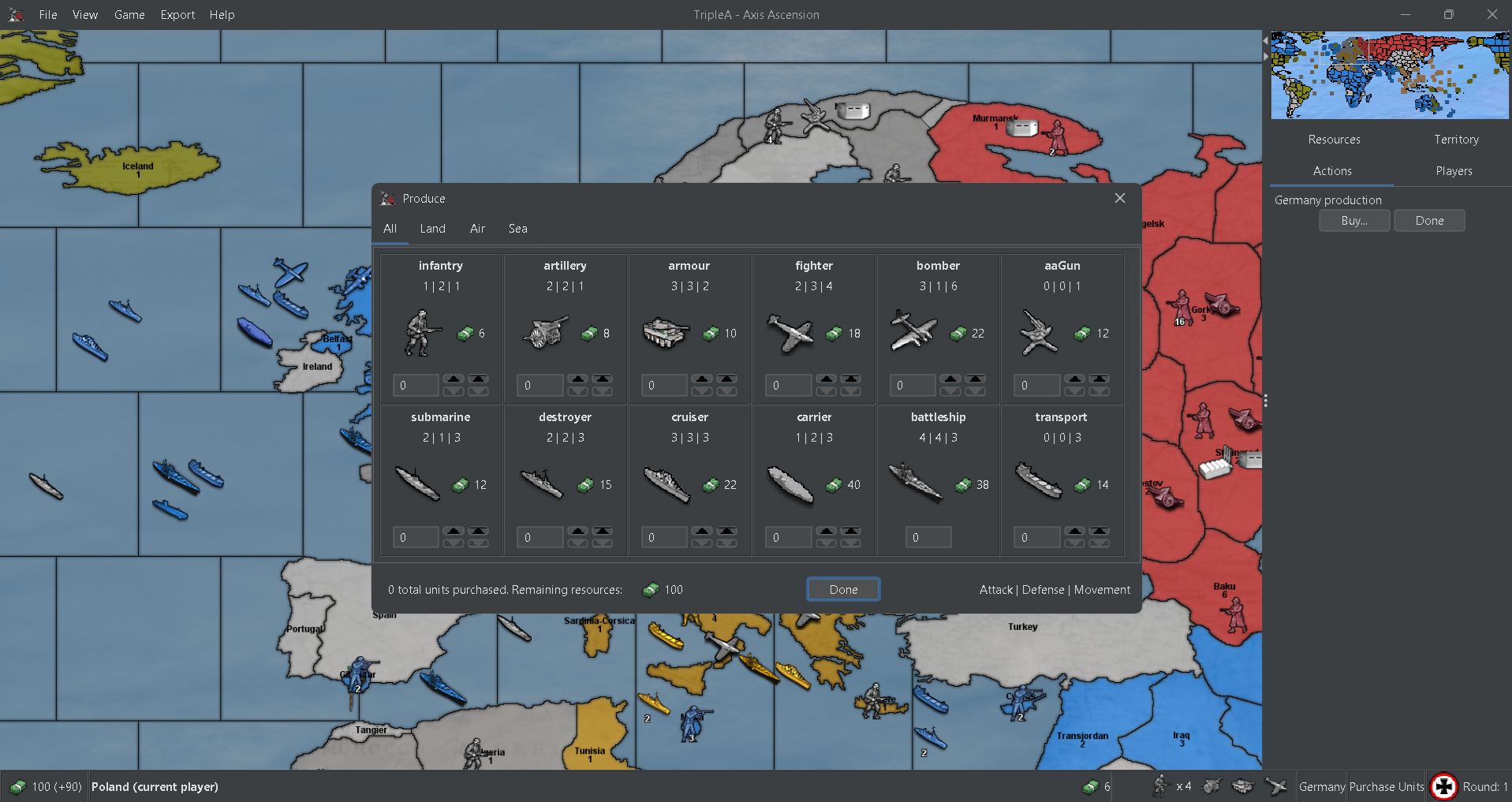
-
@Schulz Post the income rates for the nations in your mod too so we can get a sense of the scaling
-
Starting productions;
Germany: 90
Japan: 45
Italy: 25USA: 85
UK: 65
USSR: 45No Chinese front and no Soviet-Japanese War. The Western Allies and the Soviets can't land on each other's territory.
The Soviets and the Japanese get conscripts with 0/1/1 stats with a 4 IPC cost instead of infantry.
I'm still working on distributing incomes better, though. Like, the British mainland itself is currently only worth 10 IPCs, which is too low to be worth bombing compared to Germany's 30 mainland IPCs. So, Germany is prevented from using more than one bomber, which is a bit lame. Maybe the UK could be raised to 75, Germany to 95, and Italy to 30.
-
@Schulz
All right, so unit costs are around double the base game's, though some are a bit cheaper or more expensive relative to the standard game.I'm going to compare your starting incomes to the ones from the Larry Harris AAG 1942 setup, which I've doubled to account for the relative cost differences.
Germans: 90 vs 108
Japanese: 45 vs 96
Italians: 25 vs 20Americans: 85 vs 100 (130 with bonus income)
British: 65 vs 82 (62 Europe / 20 Pacific) or 102 with ANZAC included
Soviets: 45 vs 58Most of the world is poorer now; Italy is the only country that actually increased in purchasing power (with a 25% gain).
The rest lost purchasing power by the following amounts:
Germans (-16.7%)
Soviets (-22.4%)
Americans (-34.6%)
British (-36.3%)
Japanese (-53.1%)China had a 12 IPC income in AAG 42 (so 24 adjusted), which offsets only about half of Japan's 51 IPC loss in relative purchasing power.
The Axis is much stronger in Europe in your variant (Italy gained while Germany lost less than the Soviets and only half as much as the Americans and British) but far weaker in the Pacific.
Britain could use that income buff you're thinking of, but the US and Japan probably deserve that extra 5 more than Germany and Italy, unless Germany is already struggling for some reason in your test games.
Onto your unit lineup. Infantry and Artillery stayed constant from the base game, but there will be fewer of them since overall purchasing power has declined. The Tank is the unit that gained the biggest buff by becoming 17% cheaper. It lost its support functions since you axed the Mechanized and the Tactical Bomber, but it's a better buy for combat on its own now.
The Fighter lost 33% of its attack value and 25% of its defense value, while becoming only 10% cheaper, so it suffered a major nerf.
The Bomber also lost 25% of its attack value for an 8% discount, but it's probably increased in desirability as a combat purchase versus the Fighter because it's the only unit besides a Tank that attacks at a 3 in land combat.
AA Guns gained nothing and went up 20% in price while planes got cheaper. The planes having weaker stats also reduces the value of having a specialist unit to kill them, so the AA Gun, which was already a bad purchase in the original game, has become an even worse one in every way. It should have gotten cheaper, not more expensive.
At sea, Carriers cost more, Fighters are weaker, and Tactical Bombers are absent, while Destroyers, Cruisers, and Battleships all got relatively cheaper. Keep an eye out in test games on whether carrier air groups have become a losing buy versus surface fleets.
A loaded Carrier with two Fighters in your setup costs 76 IPC, the same value as two Battleships. In both your game and the original, the Carrier group gets demolished if attacks the two Battleships. However, in the base game, a Carrier + 2 Fighters actually wins 50% of the time when defending against two battleships (and achieves mutual wipeout 8% of the time) while costing 4 IPC less than them; in your mod, the carrier only wins 34% of the time on defense (and gets a mutual wipe out 7% of the time), and it's no cheaper at all. Carriers also become weaker on the offense without the option to load a Tactical Bomber, and ships have all gotten faster while the range of planes stayed the same, so it's harder for a carrier to launch air strikes from beyond an enemy fleet's retaliation range. Battleships are therefore a winning buy both for offense and for defense at sea.
The only thing the Carrier is efficient for now is providing Fighter support to land battles, and that air support is a lot weaker than it was in the base game.


Hello! It looks like you're interested in this conversation, but you don't have an account yet.
Getting fed up of having to scroll through the same posts each visit? When you register for an account, you'll always come back to exactly where you were before, and choose to be notified of new replies (either via email, or push notification). You'll also be able to save bookmarks and upvote posts to show your appreciation to other community members.
With your input, this post could be even better 💗
Register Login