Crazy Europe: House of Habsburg

-
@cernel Tho having a fleet in 56 is a serious annoyance for Habsburg, since you can drop in a bunch of territories in the Netherlands, that need to be defended, and, while waiting, you can use it to farm some. Still, doubt it's worth it, but not sure.
-
Pushed a small update
A few connections added
Some neutral units added
Venice controls the CycladesI want feedback on where to place the Italian city in the Eastern Mediteranean.
The issue with Crete is its very hard to defend because its two spaces from the Ottoman city in Athens, which is two spaces from the Ottoman capital. Just to hold it on turn 2, Venice needs to build a castle there. I can add some units, but all that does is allow to survive till round 4 or 5 instead of round 2.
You cannot defend it using navy for a very long time.
Rhodes is a lot less flexible for Venice, but much harder to take for the Ottomans.
Cyprus is too far away for Venice's home fleet to actually help.
-
-
@crazyg So, historically Crete (better named as "Candy" at this timeline and if you are going to use English names) was the main dependency of Venice, tho the hulls and the high tech stuff would be produced in Venice, and, then, armed in Crete (it would make more sense if ships are produced in 2 turns, but the hulls should stay in land; maybe using that thing of the air unit with carrier cost 0).
So, historically, I would say 1 city able to produce 1 unit in Crete.
Don't really know about Cyprus, tho I think Crete and Cyprus would have about the same population.
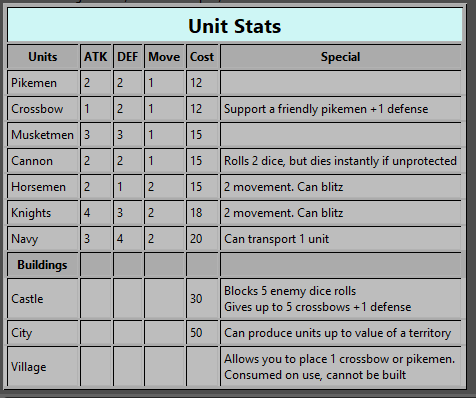
For gameplay, the best may be having both a city in Candy and a city in Cyprus, both at production 1, and 1 or 2 villages in Rhodes, plus a castle in each of Rhodes, Crete and Cyprus.For castles, I don't know. At this time there were fortifications pretty much everywhere, and, in your format, in which castles can only be 1 or 0 per territory, I've not really a clue what were the x% territories more castle intensive. Side note, with the current values, I think castles will be almost never bought, and, at most, only in very major chockepoints. The only cases I see are castles in France 46 and France 36, and even that I'm not sure it would be smart.
-
Test from last night...
Missing connections
Russia 02 <-> Russia 17
SZ 127<-> SZ 134
Turkey 36 <->Turkey 40
SZ 150 <-> Albania 01
Turkey 58 <-> ALL surrounding Terr.
Turkey 57 <-> All surrounding Terr.
Turkey 35 <-> Turkey 32Connections needing to be removed
SZ 98 <-> Spain 35
SZ 186 <-> Greece 02
Turkey 35 <-> Turkey 39
SZ 82 <-> SZ 83 -
Also, I think in this map might be good having 1 (and only 1) territory effect: Mountains, given to about 10% of territories in the map (only those with major mountains). But this would need to be played and, eventually, reverted, if it wouldn't feel fun to deal with (I'm always very cautious suggesting adding territory effects, as I'm not a big fan of such things, but this map might use some mountains).
-
@cernel
Castles are really powerful. A castle with 2 pikemen inside is very difficult to take. The cheapest force I found to reliably take it would be 3 pikemen and 2 cannons, which would need 5 navies to transport. Would you really spend all those resources taking Crete, Rhodes, and Cyprus?I see France building a castle in its southern city quite often (I think the Habsburgs can force France to build one there turn two if France does the opening you did in our game). They are weak in the Habsburg-Ottoman region because both sides have so many cannons, but I think that is fine. Its fine if they aren't built often, the starting castles affect the game a lot.
-
@crazyg I don't think any of Crete, Rhodes of Cyprus have to be taken. I guessed you wanted some gameplay there, even all game long. Cyprus city would be a pretty big annoyance for the Ottomans, I think, but only if having a castle.
edit: Cyprus city I think might be something problematic for the Ottomans even withot a castle, but I'm not sure. Anyway, surely much more with.
edit: The maintainment costs, even if modest, are a bit of a gamechanger in garrisoning islands, as now, for example, if Italians have 4 units in Rhodes the Ottomans will be: LOL you can stay there it will just be -1 PUs for you. Otto just needs to stay at reach to punish shipbuilding, which you probably are already doing to keep in check the Italians from the west.
Really, I would rename the Italian States as Venice, since I see now they are mostly Venice (Genova is neutral). Also it's strange that Italy 08 and Italy 10 have different owner, since they would be both Genova territories (loosely). Also I'm not sure if at this time the Italians still rather identified themselves as "Lombards" ("Lombard States" instead of "Italian States", but not sure).
-
@cernel said in Crazy Europe: House of Habsburg:
edit: Cyprus city I think might be something problematic for the Ottomans even withot a castle, but I'm not sure. Anyway, surely much more with.
Ottomans have 6 fleets that can reach Crete on turn 2. So Venice either has to sack a navy to block the cyclades (which only buys you 1 turn) or build a castle. I'm open to moving units around, but you need a lot of changes. Seems to me that the city falls to the Ottomans and helps them if they want to continue a naval strategy, Venice never gets to use it. Rhodes tends to stay Venetian controlled for a long time, even without a castle. I like the position more.
All future "why does X territory begin controlled by Y" questions can be answered by looking at the source maps I posted.
@cernel said in Crazy Europe: House of Habsburg:
edit: The maintainment costs, even if modest, are a bit of a gamechanger in garrisoning islands, as now, for example, if Italians have 4 units in Rhodes the Ottomans will be: LOL you can stay there it will just be -1 PUs for you. Otto just needs to stay at reach to punish shipbuilding, which you probably are already doing to keep in check the Italians from the west.
Maintenance is just an experiment (one that you have advocated for as long as I can remember).
-
@crazyg As I said, I tend to think that Cyprus city would need a castle too, but, in the first rounds, the Ottomans really want to focus as much as possible against the Habsburg; so whatever distraction is probably good for Franco.
I do believe that if Rhodes have a castle, then Ottoman would never try to invest for taking it, but I don't see this as a problem. Not sure about Crete, instead.
I suggest adding your referring map to the first post.
-
Update pushed- just missing connections (Hepps list and others)
-
@crazyg One little thing you may want to consider...
Add a default sound property setting

Sound.Default.Folder=classical
or
Sound.Default.Folder=preindustrial
Not that I don't love the sound of tanks blitzing during a cavalry charge... but these sounds might feel slightly more.... authentic.

"A joyous heart sours with the burden of expectation"
Hepster -
@hepps Definitely preindustrial, my suggestion.
-
@hepps
Updating now -
-
@CrazyG
One last connection problem: France 08 to France 18 should be changed to France 08 to France 15Cheers...
-
@wc_sumpton said in Crazy Europe: House of Habsburg:
One last connection problem
Somehow I doubt its the last

Big update just put out there. Changelog:
Connections added and removed.Balance changes: Anti-Alliance was found too weak, especially France.
France's starting unit positions dramatically changed. More units in the center and more knights. The goal is to give flexibility on where to attack
Spain slightly weaker
Denmark slightly weaker
Sweden slightly stronger
Some units moved on the Hasburg-Ottoman front. -
@crazyg
Maybe this can make you day:
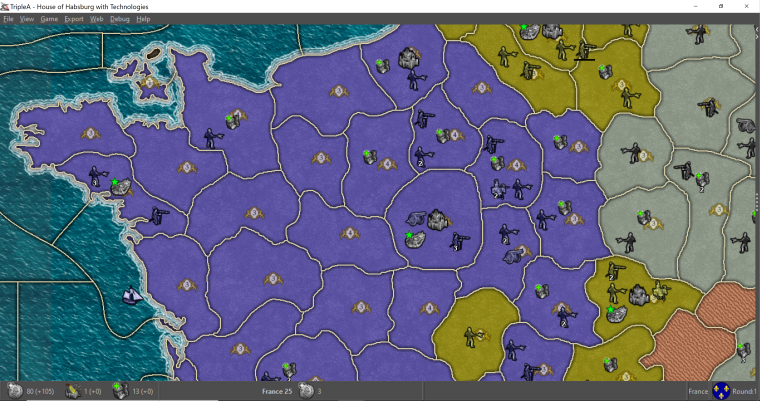
Beginning France turn. Please look at the resources...
The count (1 halfcastle and 13 villages) tell the France player how many of these items that can be bought this turn. The 13 villages is the number of territories that have villages not the number of villages.Looks interesting...
Cheers...
-
@wc_sumpton
Very interesting.I see you are modding your own XML locally. If you can, download the newer version and take a glance at the unit set up. Everyone found a France weak, so I've changed up the starting units a lot.
-




 I keep trying to keep up with those changes, but they are coming very fast!
Hello! It looks like you're interested in this conversation, but you don't have an account yet.
Getting fed up of having to scroll through the same posts each visit? When you register for an account, you'll always come back to exactly where you were before, and choose to be notified of new replies (either via email, or push notification). You'll also be able to save bookmarks and upvote posts to show your appreciation to other community members.
With your input, this post could be even better 💗
Register Login