Proposed Map: Domination 1941
-
@black_elk said in Proposed Map: Domination 1941:
ps. I guess now would also be a good time to ask if there's anything in the scaling or basic contours that feels like way too off?
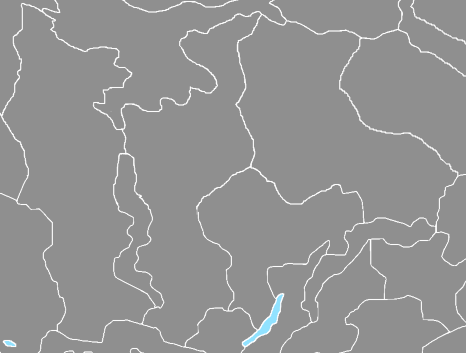
Well, in Russia there are 2-3 TT close to each other, that are big. Two should be halved, so there is a north and south, The third Im really not sure about, the big-ish one on the right, see below.
Other than that

-
@thedog Yeah I figured to bust those up a bit. I just roughed it in pretty quickly in that zone.
I'm currently closing in the gaps and giving it a pass on the pixel by pixel view. Basically I was able to use Inkscape to upscale everything, then trace bitmap on centerline down to 1 pixel. So all the boundaries will be at 1 pixel even at 16000, but doing that created little breaks (sorta where the stained glass effect is going on in those earlier drafts I posted, where the lines intersect after removing all the anti-aliasing and exporting it back out.) So basically still have to go in, fine tune it, and clean some things up. There might have been an extension to blow past that step, but I couldn't find it, and anyway I kinda enjoy this part, cause it allows me to noodle some stuff around and get back into the process with the fine toothed comb.
I'm about a third of the way through it now. It's much faster though, certainly compared to what I used to have to do, because you can see pretty quickly where there are openings and just close em out. Usually my method for this stage is to sorta go to town in GIMP or Paint, as an indexed color mode image, drawing with the pencil tool. Then what I like to do is create a decorative fill with color blocks using the paint bucket just to make sure everything is closed, it's the fastest way for me evaluate the fills, and to make sure there aren't and hanging pixels or weird isolated spots. It should be done by the end of the week I'd say. Moving at a pretty steady clip here. When it's fully dialed I will bring that back into inkscape and save out as the svg with the base layer full dialed like that at 16000. I want to get that saved, before charging too far ahead. Should be fairly easy to do any morphs or boundary corrections at that point. I'll shoot for the weekend!
All the best
Elk -
@Black_Elk
Last night I started building the xml skeleton for your map.My intention is to get Germany and Russia as unit playable sides, so people can comment on stats. Then do Japan and USA.
No timescale

Question to all, which WW2 1941 map should I use for the territory PU values that best equate to GDP values?
-
@thedog said in Proposed Map: Domination 1941:
Question to all, which WW2 1941 map should I use for the territory PU values that best equate to GDP values?
I'm not sure which one would be best but @RogerCooper might have one. i think I remember him posting a buncha of information on that at one time. Not certain though
-
@beelee said in Proposed Map: Domination 1941:
@thedog said in Proposed Map: Domination 1941:
Question to all, which WW2 1941 map should I use for the territory PU values that best equate to GDP values?
I'm not sure which one would be best but @RogerCooper might have one. i think I remember him posting a buncha of information on that at one time. Not certain though
You can use any map and just assign the production values you want. For economic statistics, see https://axisandallies.fandom.com/wiki/Correlates_of_War and https://axisandallies.fandom.com/wiki/Maddison_Database.
-
I'm skimming not reading so maybe this comment is useless.
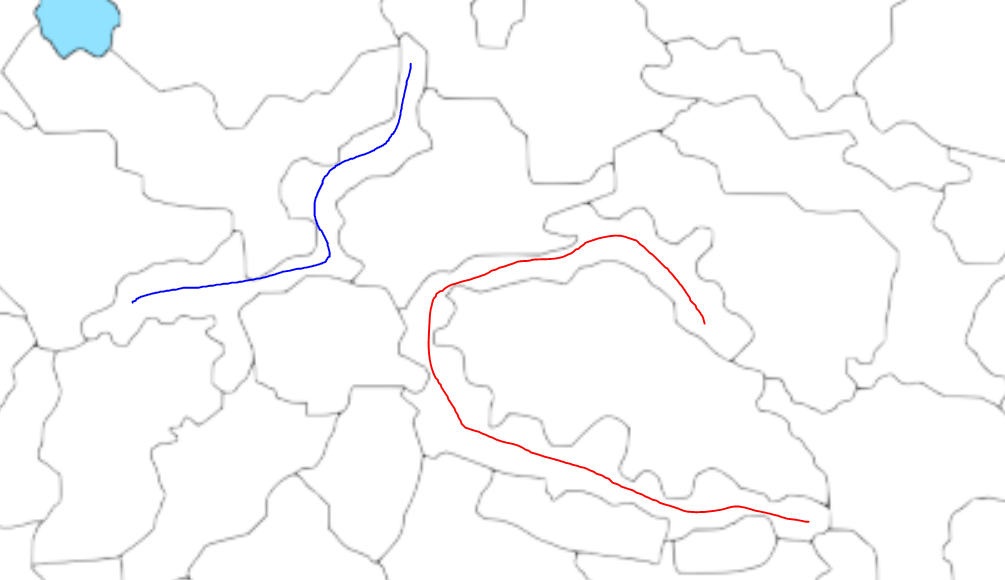
These types of territories would be interesting to fight for but from a UI perspective I don't know where you would put the unit stacks, and visually be able to tell where the units are. See red and blue for example
-
@luhhlz So those are actually mountain ranges corresponding the Himalayas basically, or extensions of that range in Kush/Tajikistan. There are a number of squiggly zones meant to suggest impassible terrain or to create some geometric choke points in that central Asian landmass that would otherwise probably just make the eyes glaze over with an endless series of similar jigsaw divisions hehe. So you have the Urals and the Altai etc, but with a few breaks and passes to mix it up I guess. Essentially spots with no units though. Some deserts look that way as well. I think they were meant to be slimmed down like that, to preserve more space for the adjacent tiles that might actually house units. On the whole, comparing it to my earlier draft, Hepp's was leaning a bit more topographical I'd say, whereas my first pass focused more on the political boundaries. So you end up with a bit of a compromise in the cartoon here. Rather than removing that work, I just tried to add some in that sliver to the far north, and in North America, so it would be a little more consistent throughout. Basically if it's long and thin and a bit wonky looking for units, it's probably meant as impassible, like a mountain range or frozen tundra or whatnot.
For the production spread (PU values of individual tiles) I'd say maybe start by assigning everything with a value of 1, see what the totals would be doing that, then adjust certain zones to create a rough parity between sides/player nations. I think trying to maintain a strict GDP analog or Industrial Production as the rule was one of the things kinda holding back the official A&A gameboards. I think PUs are better as genuine abstractions focused on gameplay, rather than as 1 million man hours of production or whatever. The Classic Mid range boards are fairly inconsistent on this stuff anyway, in terms of relative values. Also, every time Larry divided something or added a new tile in successive iterations, he tried to preserve the same regional totals, so you end up with more tiles at 1 ipc or zero ipcs, and a lower economy board that's more complex but with a lot of spaces that have no value beyond movement or connection.
In my view it's better to have the floor at 1, rather than zero, if the goal is to encourage the trading of TTs. Obviously this map is kinda ridiculous in terms of the number of tiles, whereas my old rule of thumb for the smaller scale maps, would be if "it's not worth 1, it's not really worth displaying on the map as a discrete tile." I prefer to think of PUs as generic "Strategy Points" as opposed to Industrial production, though some of that comes down to playstyle preference.
Reframing the standard acronym, I liked Industrial Production 'Commitment' (over 'Capacity') because then you can rationalize it somewhat better. Like Midway might have had an Industrial Production Capacity of fucking zilch, but that doesn't mean the US didn't still spend millions on a commitment to it's defense hehe. So I think it's a bit more flexible conceived that way.
PUs are a funny sort of gameplay conceit. I mean in wartime the reality is that it costs money to occupy new territory, so not exactly adding to the loot pile there. Like you're probably not seeing a return on that investment in conquered land for years and years, if ever, but it's a game, so it's gamey that way hehe.
If what you like is long lines of logistics and very low unit replacement to starting unit ratios, then I guess the standard paradigm works, but the result is generally a huge amount of dead space across the entire board. You'll also probably then have starting armies worth way more than the value of the entire globe, by orders of magnitude, which, while perhaps more accurate somehow in the narrow sense, also creates a more static gameplay situation -one where the strategy is based on more the starting unit totals and starting unit predisposition, rather than on purchasing new stuff (unit replacement). I like a more dynamic style of production myself, with more mobilization points or production 'bases', as opposed to say 'Factories.' The Manpower idea mentioned earlier might play into that, like where heavy equipment is built/mobilized in one way, but infantry another. But yeah, lowballing everything seemed kinda ill advised to me, like just to make sure the British Empire isn't worth more than 30 or 31 IPCs or whatever hehe.
I think Larry was too invested in the idea of Industrial Production as the metric, even though it's super vague and you can't really create a functional parity if going off the historical numbers. The Axis would always lose out, and are already punching way above their weight, even in Classic lol. In NML you have something similar going on with the CP. I don't know, I definitely have thoughts here, but don't want to derail anything. There are what, like 3-4 times as many tiles for everyone here, in some cases many more? So if the British are pulling down 30 starting income in Classic, you can ballbark it to say they'd probably need more like 90-120 here. Though I guess it depends how you want to handle the rest of the Commonwealth. Like if you're peeling off ANZAC or India to be a separate player, which was the approach in Global/IronWar. For my part, I like the older versions more, where the British had to globe trot on the brink, and make tough strategic choices about where to spend their loot or which fronts to reinforce/abandon. Starting cash is the easiest thing to modify, so you can always rebalance based on that when all is said and done. Adjusting TT PU values up or down is also relatively simple, but it's easier to put everything at 1 and build upwards from there, rather than putting the floor at zero I would think.
-
@black_elk the waitress asked my bartender buddy how much for a small glass of milk for a little kid.
He said everything cost at least a buck lol
-
These days no doubt! lol
Here so real quick, just in case I get hit by a bus or my hard drive bricks it lol, here is a draft raster at 16000...
https://www.dropbox.com/s/hejb20ttqkb91ih/TripleA_4k.png?dl=0
I closed in almost all the gaps at 1 pixel lines and killed most of the floating pixels, so work is proceeding apace.
There's really no great workaround when upscaling like this, even with inkscape's utilities, like at some point you have to dive in and draw the pixels and decide on some contours there. Some give and take obviously in deciding what to omit or abstract. Sometimes an island becomes a peninsula or whatever, or you just need to get a contour that reads without being too blocky. The idea being that when you pan out, unless it's your own back yard, that it looks close enough, or even if in your own backyard, still close enough that it's like 'yeah OK I get ya' lol.
The advantage is that when you downscale, you can expand the borders and make it actually look nice. Going from black to white or whatever blends in the relief, but for the utilities 1 pixel is the money spot. So anyway, that's the jam. Basically surveying the whole thing way zoomed in to clean it up 1 by 1, since it usually comes down to a one pixel gap. At this point I like to open 2 images in GIMP, the baseline and then an indexed color with like 14 colors with the paint bucket. If as I go along painting the map in indexed color to give myself ideas, if I see that a tile bleeds over into another when I fill, I know there's a hole somewhere. So that's sorta what I'm doing now.
Areas I added at the extreme north need another pass to settle on a sensible morph for the coastlines/islands there, but gives a sense.
At 1 pixel it's so light the image will appear white until you zoom in to like 10-15%, so the idea in the final relief would be to enlarge those borders all to 3 or more pixels, for the quick read at a glance. So like you'd open that indexed bitmap into Inkscape, no anti-aliasing, then trace bitmap. Then you use the vector to manipulate it how you like cause you can just expand the lines and such there, or doll it up on new layers.
It's too large (in pixels) to attach, but here's the one I'm working up just added to dropbox. I guess the idea would be to save the svg and the pull, and make a few bitmaps then add that to the package somewhere as just like a misc map tool or ref. You can see it's still being drafted, but pushing along alright. Gives you the scale though, so Europe a fair bit larger than Global in terms of space available.
-
Had a few hours to kill so I cleaned it up a bit and added the oceans. It's almost dialed
https://www.dropbox.com/s/jx9ajg5znjkry3s/TripleA_4k_oceans.png?dl=0
-
@black_elk I have experimented with using purely economic values for production, and it does not work. You can certainly justify giving a value to Midway to reflect the benefits of having an airfield in the Central Pacific. For the US, distance was a major hindrance, as well as the time it took mobilize. For the Germans, the failure to mobilize totally and flawed production strategies were a problem.
-
@rogercooper & @Black_Elk
Thanks for both confirming not to use GDP that has saved me time coming to the same conclusion. -
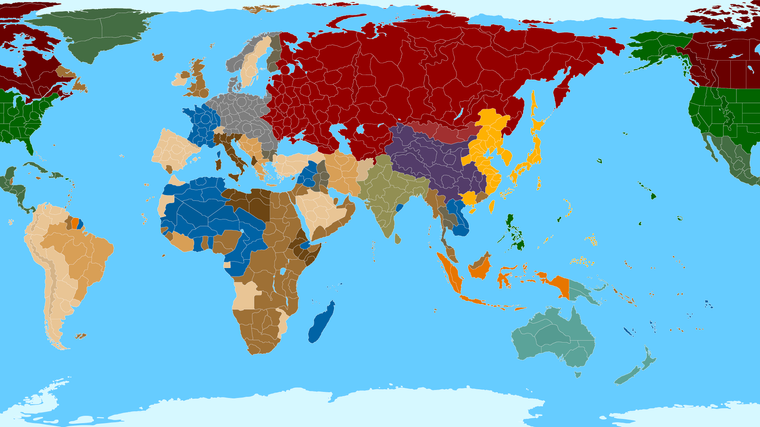
Right on! Ok so here it is with a little paintjob...
https://www.dropbox.com/s/wnwraqi1q57rnhc/TripleA_4k_painted.png?dl=0
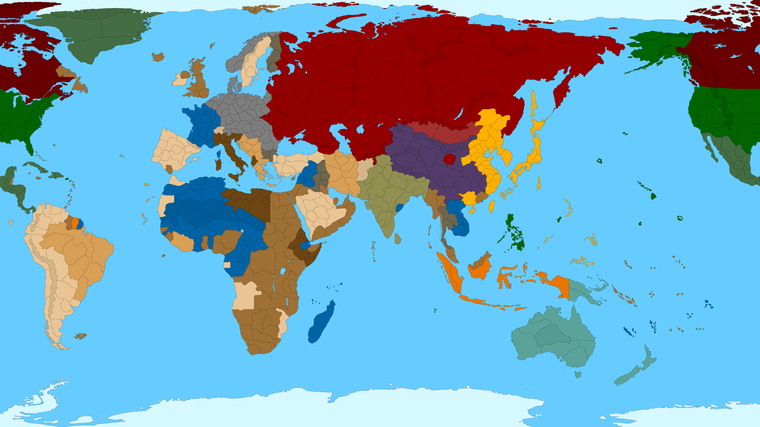
I like to do this to double check and make sure all the tiles are closed at the borders, but it also makes for a slightly better presentation. I followed a Global 1940 into 1941-ish display, with a similar color spread to the basics just for easy viewing. I made some slight adjustments in shade to indicate some features. Like a more drab Khaki for British India, teal for ANZAC, or a more Maple hue for Canada. For the mountains and impassible or pro-side neutrals etc I just knocked the shade up a tiny bit. Or like for Mongolia gave it a slight pro-soviet hue. Obviously you could do different things in the relief like with subtle patterns and such, but just for a the simple paint to get the quick read I did it with block colors. For 41 you can just imagine most of that french blue switching to Axis/Allied, or the line on the Eastern front shifting or whatever. But least it gives an impression.
You can see that the general idea was to enlarge the TTs and particularly SZ that usually need to house more stuff. So I thought perhaps to shift the Arctic ice sheet further north. Say Svalbard and sort locking further in that way, around those soviet islands north of Siberia. This gives more room for ships that just tend to stack up there the way the gameplay usually works hehe. Or anyway, it seemed like a little more room up there would be advisable, so I left it as is for now. But you could block of the arctic with an ice sheet and some frostiness, or just crop no mercy hehe. Whatever works.
Here's a quick preview at 25%, with the borders enlarged to 3 pixels before scaling RGB for a quick read.
-
@black_elk heh heh just kickin ass wherever he goes :grinning_face_with_smiling_eyes:
that big red blob in china the commies ?
-
@beelee thanks dude!
hehe yeah I mean that one's not strictly necessary, the whole thing was more impressionistic just so I could block in the tiles. But I figured it was on the HBG board, so might as well see if it worked. That's about where you'd have a stronghold, if one wanted to do a united front thing with soviet support lol. I got half way round the globe with France then remembered the thread title was more 41. But it's easy enough, most of the French Empire declared for Vichy after Paris fell, and the Japanese took over Indochina, so except for Equatorial Africa basically, you could just turn all that blue into German Gray or British Khaki, depending on the preferred start date. And of course any of those divisions could be reworked for the individual TTs. I just wanted to give us a place to start.
Provided you keep the anti-aliasing off, you can load up the big bitmap in any program like Inkscape, PS or GIMP or even MSPaint and just go to town with the paint bucket to try different ideas/timelines.
https://www.dropbox.com/s/wnwraqi1q57rnhc/TripleA_4k_painted.png?dl=0
If reworking the baseline you just want to make sure that's done at scale. 16000 with 1 pixel black lines, and keep it more indexed that way (no antialiasing or feathering) to make sure all the blacks stay black.
After you got the baseline you want you can make it pretty in relief however. Here it is with that tile in China handled more normally.
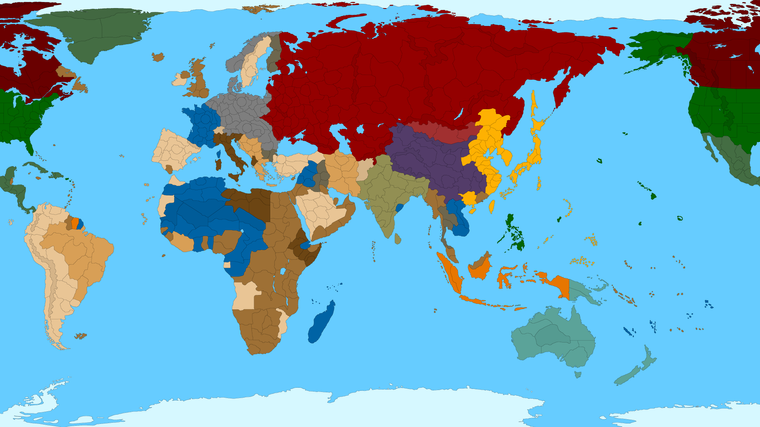
Or like above shows black border lines, but if one prefers white, you could make it like more this instead hehe. Or do a darker blue for the ocean, different color choices for the various factions. Whatever works. Just as long as that stuff is done after the baseline is created, after the grunt work with the utilities, you can go to town pretty much however you like.
-
@black_elk that is way cool ! Wasn't sure the white would look that good but from a zoom out looks pretty cool

-
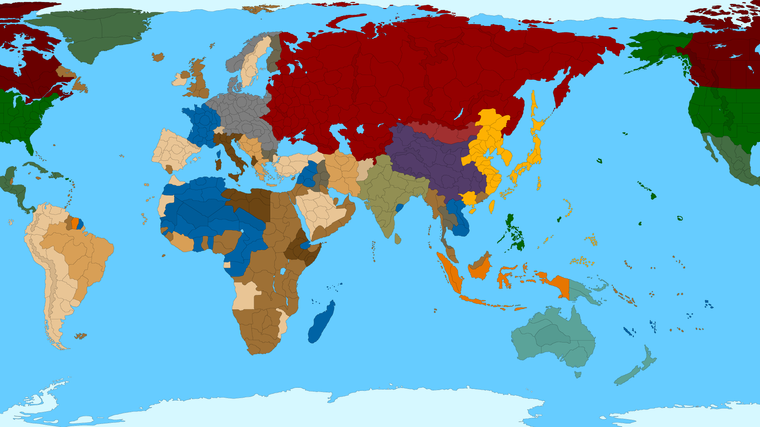
@beelee Yeah it's one of those things you almost wish was a mapview feature that could be switched on the fly. Cause it basically makes it easier to tell where the boundaries are when panned out.
I kinda prefer the black myself, but I'm also a bit of a minimalist when it comes to maps hehe. Some of my aesthetic preferences are showing here in terms of color choices, and a stripped down look, but I also think it should at least look decent with the details/reliefs turned off.
So here was my quick solution to the circles. Basically I just blobbed 'em, but tried to leave enough room so that those tiles could still fit a circle at like 200 px in diameter, like about the same amount of space. You know just so it can function for 1914-18 style games too if one wanted like with a roundel paintover or whatever, but more consistent here with the rest of the board, which doesn't have any circles. So Berlin, London etc they're still kinda circular in shape of course, but not like perfect circles, more like potatoes, which I think works a bit better for this one. Obviously we can clean that stuff up a bit, but again just to give an impression.
-
@black_elk looks awesome brother thank you
-
I'm recovering from a migraine from earlier today, so I'm not 100%. But I'll do my best to create a good post.
First, I'm glad to see the progress BlackElk has been making. Excellent work!
I'm also happy to see TheDog has started work on the XML file. @TheDog : You asked about what production values should be. For the 1941 NML map, I'd start with the 1914 NML map as a rough guide. But, Japan and the Pacific will obviously need some beefing up with respect to their production values. The U.S. also needs some beefing up, as it was more of an industrial powerhouse in WWII than it had been in WWI. Come up with something, and then we can always modify it later in play testing. I agree with the thoughts Black Elk shared about territory production values.
Separately, there is the question of production values for the second WWII game I envision. That raises some larger questions.
In an earlier post, I wrote about the difference between tactical complexity and strategic complexity. My goal is to minimize the former while adding some element of the latter. Complexity in any flavor is synonymous with price or cost. It is, if you will, a price the players pay. My goal in designing any map is to minimize price (complexity) while maximizing benefit (strategic depth).
My preferred source for added strategic depth is historical realism. Many sources of historical realism add tactical, rather than strategic, depth to a map. Supply lines, terrain effects, combat engineers, etc. can all make a game more realistic. But they are not what I'm looking for with this game.
During WWII, military aircraft production was a reasonably good proxy for overall military production. With that in mind, below is a chart which shows participants' military aircraft production in 1942 and in 1944.
U.S.: 48,000 || 96,000
U.S.S.R.: 25,000 || 40,000
U.K.: 24,000 || 26,000
Germany: 16,000 || 40,000
Japan: 9,000 || 28,000
Italy: 3,000 || 0Germany and Japan each had less territory in '44 than in '42; yet each was able to triple its military aircraft production. The U.S. doubled its production, and the U.S.S.R. experienced more than a 50% increase in its production.
Now consider military technology. During the 1930s, Spain was in a state of civil war between the fascists and the communists. The National Socialists (Germans) sent weapons to the fascists; the Soviet Union sent weapons to the communists. In 1936, Soviet-made planes ruled Spain's skies, giving the communists the edge. But then in 1937 the Germans began supplying the fascists with planes that were 100 MPH (160 KM/H) faster than last year's models. The fascists took control of the sky from the communists, paving the way to Franco's victory in the Spanish civil war.
Military aircraft technology continued advancing rapidly during WWII. A good example of that is the Pacific theater. In 1941, Japan's Zero planes were significantly faster and longer ranged than their American counterparts. However, American fighters had armor and self-sealing fuel tanks. Zeros omitted those features in order to increase speed and range. If it was 100 Zeros against 100 American fighters, the Zeros would win. As the war progressed, America developed increasingly powerful piston engines. 1944 saw the Marianas Turkey Shoot. By that point, American planes were faster than their Japanese counterparts, while retaining the beneficial characteristics of their early war predecessors. (Armor and self-sealing fuel tanks.) Contrary to popular belief, Japan did make major advancements in aircraft design during the war, and deployed some of these newer aircraft before the war ended. But Japan lacked industrial capacity, making it difficult for it to switch to solely producing these newer, more advanced, more difficult to manufacture piston aircraft.
The Germans and the British had, independently of each other, developed jet technology. The British had shared their jet technology with their American counterparts. Japan got a small jet technology boost from Germany, but for the most part had to, and did, develop jets on their own. The Soviet Union did not have jet technology during WWII. A pro-Soviet British government transferred jet technology to the Soviet Union after the war, despite Stalin's skepticism. "What fool would give us his secrets?" In the Korean War, Soviet MiG jets proved significantly superior to America's piston aircraft, and to its WWII-era jets. However, America's F-86 Sabre proved superior to the MiG. With its swept-back wings, the F-86 Sabre's shape had far more in common with Germany's WWII jets, than it did with American WWII jets. The Me 262 was a first generation German jet. Late in WWII, German engineers were busy designing Germany's second generation of jets. The war ended before Germany's second generation of jets could be produced.
If I wanted, I could write at similar length about advances in tank technology. At the beginning of the war, the Soviet Union had by far the world's best tank designs. Everything a WWII-era tank should have been, Soviet tanks were. In 1941, the Germans realized how outclassed their tank designs were. Over the next few years they eliminated the gap between their own tank designs and those of the Soviets. In 1944, a German general said to the Americans, "One of our tanks is worth ten of yours. Unfortunately, you always have eleven."
Toward the end of the war, the Germans were busy designing their next generation of tanks: the Entwicklung Series. The Entwicklung Series represented some level of improvement over their existing designs, while being much easier to manufacture. However, the war ended before Entwicklung tanks could be put into production.
Consider the torpedo. A standard-issue WWII torpedo had the following: diesel engine, diesel fuel, air tank, warhead, etc. Diesel engines are of course noisy. As ships' electronics, radar, and sonar became increasingly advanced over the course of the war, that noise made torpedoes increasingly easy to detect. Diesel fuel was combined with air from the air tank, and used to power the engine. That left a telltale trail of bubbles in the water. If you were up in the air, you might notice these bubble trails. In the South Pacific at night, these bubble trails could cause the water to glow. That looked cool, but it also gave away the position of the ship or sub launching the torpedoes.
The Japanese had figured out a way to separate oxygen from the rest of air. Thus, Japan's torpedoes had oxygen tanks, not air tanks. These "Long Lance" torpedoes could travel three times the distance of anyone else's, because apparently the limiting factor for a torpedo's range was the amount of oxygen it could carry, not the amount of diesel fuel. The bubble trails for Long Lance torpedoes were much weaker than for their standard-issue counterparts.
Fairly early in WWII, Germany made at least some use of electric torpedoes. These had the advantage of being very quiet, unlike diesel engines. They create no bubble trails. However, they had much shorter range than standard-issue diesel torpedoes. However, Germany increased the range of its electric torpedoes. Late in the war they had about the same range as normal diesel torpedoes. If a WWII sub captain could equip his sub with any torpedoes of the time, which would he choose? Would he pick Long Lance torpedoes with their 3x normal range and reduced bubble trail? Or would it be German electric torpedoes with their 1x normal range, no bubble trail, and almost total silence?
Both industrialization and technological advancement were of overwhelming importance during WWII. I very much want both to be part of the second WWII map, if at all possible.
Traditionally, tech systems focus on improving a unit's firepower or its cost. That's fine if you want incremental improvements in unit stats. But the technological advances during WWII were major. Suppose for example you were to pit a late war German tank, such as a Panther or a Tiger II, against a large number of early war German tanks such as the Mark I or Mark II. The early war tanks would be unable to penetrate the armor of the Tiger II, or even the Panther. Not even at point blank range. Whereas, the Panther or the Tiger II would make short work of the Mark II tanks. "Increase the firepower of the tank from 3 to 4" doesn't even begin to cover something like that. For a real world difference that large, it is not enough to increase a unit's firepower. You also need to increase the hitpoints.
Under a Larry Harris rules set, a unit with 2 hitpoints has an asymmetric advantage over a unit with just one. Why? Because a player gets to choose his own casualties. Therefore, he will injure all his two hit units, before letting a single unit die. He will look for situations in which he can fight for one round, then retreat so that his injured units can heal. That system is fine for what it is. But it is not what this second WWII map needs.
Larry Harris created a new method of AA guns firing. Instead of you choosing your own casualties, they are chosen for you at random. Thus you lose a bomber to AA fire, even though you would have preferred to lose an early fighter. I envision the following:
- Take that AA concept and apply it to casualty selection generally.
- Once a unit has taken a single hit, additional damage automatically gets applied to that unit until it is destroyed or until combat ends.
The above speeds up and streamlines combat, because you're no longer waiting on an opposing player to choose his casualties. (Casualty selection is random and automatic.) It prevents units with multiple hitpoints from being OP. But, it makes combat somewhat more luck-based. I envision the map being played low luck. The combination of low luck + random casualty selection would make it a little more luck-based than a typical LL map, but much less luck-based than dice. A system like this would allow you to have a lot more multiple hitpoint units on the board, without creating "50 injured battleships heal after the battle" type situations.
To return to the subject of industrialization.
- I don't want a "rich get richer" type system. What do I mean by that? I don't want a system which says, "The U.S. is now fully industrialized; therefore its PU income is multiplied by 2." A system like that would artificially (and ahistorically) magnify the effect of American territorial expansion and acquisition.
- I do want a path to increased production. Similar production increases to what were seen in the real war. If the U.S. doubled its production between 1942 and 1944, it should be able to do the same in this game!
- That path should involve strategic choice. In other words, sacrifice. In order to achieve a production increase, a player must forego something else of roughly similar value.
I will advance one way of achieving the above. (If others have different ideas I'm certainly willing to listen.) Suppose you were to do the following:
- Introduce a third resource type, such as research points. (This is my last new resource type, I promise!)
- Research points can be used to improve existing units.
- Research points can also be used to research improved PU income.
- After you've done the research for the improved PU income, you then have to perform some task. Normally that task would be, "spend PUs to build a manufacturing facility in a territory of your choice." A factory is for unit placement, a manufacturing facility for a boost to PU income.
- The maximum number of manufacturing facilities each nation can build is based on whatever increase in military aircraft production it achieved from 1942 - '44. Only one manufacturing facility allowed per territory.
Let's talk more about tech system. I want the tech system to have the following traits.
- I want it to be deep. Meaning, that I don't want a situation in which you research one tank-related technology, and then there's nothing more tank-related for you to research. There should be many levels of tank-related tech for you to research.
- Not everything you research needs to create a big gain. Maybe researching tanks level 3 doesn't help you at all. Maybe tanks level 4 helps you only a little. But tanks level 5 gives you a big boost, such as +1 hitpoint to your medium tanks.
- I want to avoid outsized rewards for narrow focus. For example, suppose a player says, "I'm going to focus all my research on four categories: industry, jets, tanks, and infantry. As the game progresses the rest of my unit types will be increasingly obsolete, and I don't care. I will only be building things from those four categories!" A poorly designed tech system would give players strong incentives to think like that.
The way I see it, you have two options for a tech system. (If anyone sees a third option feel free to chime in.) The two options I see are a straightforward tech system and an interlaced tech system. By "straightforward" I mean that you research tanks tech to improve your tanks, single engine piston tech to improve your fighters, dive bombers, and torpedo bombers, and sub tech to improve your subs. Whereas, an interlaced system would have categories such as engines, aerodynamics, armor, etc. By combining advances in different categories, you could build better units.
The advantage to an interlaced tech system is that it naturally lends itself to solving the problem of narrow focus. The advantage to a straightforward tech system is that it's, well, straightforward. Easily understood. But if you're going with a straightforward tech system, you absolutely, 100% must address/prevent the problem of narrow focus. Right this instant, I don't see a great way of solving the narrow focus problem by using a straightforward tech system. That's why I'm leaning toward an interlaced tech system. That said, I'm more than willing to listen to ideas others might have about tech systems.
While I'm feeling better than I was at the start of this post, I'm not 100%, and am in no shape to be creating a tech system. Nonetheless I will do so anyway, at least as a (very rough) draft. I welcome others to submit their own ideas or revisions.
Armor: improves the hitpoints of your tanks, single engine piston aircraft, strategic bombers, surface ships, and submarines.
Engines: improves the hitpoints and attack value of single engine piston aircraft. Improves the naval combat value of surface ships, subs, and torpedo bombers. (Better engines for torpedoes.)
Jet engines: allows you to build jet aircraft. Improves the hitpoints and air combat value of your jet aircraft.
Rockets: Improves the air combat value of your aircraft. (Air to air missiles.) Improves anti-land and anti-naval combat value of your aircraft (air to surface missiles).
Fluid dynamics: improves your piston aircraft to some extent, and your jets to a greater degree. Improves your submarines.
Industrialization: allows you to build more manufacturing facilities.
Explosives: improves your infantry, tanks, artillery. Improves your planes' anti-land and anti-naval values.Um. Now that I've created the above tech system, I'm not fully satisfied with it. Yeah, it could be something good if implemented. But part of me is wondering if maybe I should give a straightforward tech system another chance? The reason I decided against it earlier was the problem of narrow focus. But what if there was a way to eliminate that problem, or at least mitigate it?
The goal here would be to force players to broaden their tech focus somewhat, but not make it so broad that they're forced to research everything more or less equally. Suppose you were to do the following:
- Each tech category has 20 levels. Not every level necessarily creates an improvement.
- There cannot be more than a 3 level gap between your best tech and your 8th best tech.
Um. I'm not satisfied with this. You're basically telling a player, "Pick eight techs. Those are your techs! Your research will be slower than you'd like, because your research money is being diluted amongst eight different techs. All eight will advance at roughly the same speed."
I'm tired. In fact, I'm out of energy. I'm not going to solve the problem of a good tech system tonight. If anyone else sees a solution, or has a potentially helpful suggestion, I'm all ears.

-
@black_elk Very nice map. I would like to add somethings.
-
Could you redraw Iberian peninsula? I think curves do not look good on maps.
-
Wouldn't it be more realistic if the shortest route from Germany to Paris went through Belgium?
-
I think Mediterranean is too small. Africa could be moved to south a bit. Also Red sea can be widened.
-
Turkey, Iraq and Syria should be redawrn more realistically.
-
Finland had a coast to the Arctic Ocean.
-
Afganistan borders China.
-
Burma and Andaman islands were part of British Raj. But Sri Lanka, Bhutan and Nepal weren't.
-
I think the territory up to Indo-China and Burma should be divided.
-
Leningrad-Novgorod border is too short. It would be very easy to miss this connection.
-




Hello! It looks like you're interested in this conversation, but you don't have an account yet.
Getting fed up of having to scroll through the same posts each visit? When you register for an account, you'll always come back to exactly where you were before, and choose to be notified of new replies (either via email, or push notification). You'll also be able to save bookmarks and upvote posts to show your appreciation to other community members.
With your input, this post could be even better 💗
Register Login