-
0 Votes36 Posts9k Views
-
1 Votes6 Posts2k Views
-
0 Votes95 Posts66k Views
-
0 Votes147 Posts82k Views
-
0 Votes62 Posts30k Views
-
1 Votes10 Posts2k Views
-
0 Votes23 Posts7k Views
-
0 Votes2 Posts981 Views
-
0 Votes23 Posts8k Views
-
0 Votes2 Posts898 Views
-
1 Votes1 Posts866 Views
-
0 Votes2 Posts780 Views
-
1 Votes3 Posts911 Views
-
0 Votes6 Posts1k Views
-
0 Votes3 Posts915 Views
-
3 Votes34 Posts12k Views
-
3 Votes8 Posts2k Views
-
1 Votes4 Posts1k Views
-
1 Votes3 Posts762 Views
-
1 Votes1 Posts593 Views
Recent Posts
-
I implemented Guards Infantry and Shock Armies as Soviet unlockable bonuses in my TRO outline. Guards was a promotion mechanic where you replace up to two regular Infantry per turn with Elite Infantry for free if you win a battle. Shock Armies was one where Elite Infantry would pair with the Assault Gun and allow the AG to get one pre-battle bombardment shot at the enemy.
I guess sounds about right (as long as you can also buy elite infantry directly (not only by upgrading them with the guard promotion mechanic)).
-
China's best infantry units were the ones trained and equipped by the Germans prior to WW2, not by the Soviets. There were three elite divisions that were fully organized and equipped along European lines, and twelve others that had been reorganized and trained by them but didn't get the full array of imported artillery and equipment.
I know of those, but I just assumed that little enough remained of them by 1941 (I mean as the actual then German trained and equipped men, not the divisions themselves as names), but I don't actually know.
Asking Google AI "How many men of the Chinese divisions trained and equipped by the Germans prior to WW2 were still organically fielded in those divisions or elsewhere in mid 1941 in absolute terms and as a percentage of the Chinese army?", I'm answered
In absolute terms, the number of original pre-war German-trained and equipped Chinese soldiers still organically fielded in mid-1941 was statistically negligible, approaching zero, representing effectively 0% (less than 0.01%) of the overall Chinese National Revolutionary Army (NRA).
The Lifespan of the Elite Divisions
Prior to the outbreak of the Second Sino-Japanese War in 1937, Sino-German military cooperation had successfully produced a core elite of roughly 80,000 fully trained troops spread across 8 frontline divisions (most famously the 36th, 87th, and 88th Divisions, along with the Training Unit). An additional 12 to 20 divisions were in various secondary stages of partial training and reorganization.
However, their preservation was incredibly short-lived due to Chiang Kai-shek’s strategic decisions in 1937:
• The Shanghai "Exsanguination" (August–November 1937): Desperate to draw international intervention and halt the Japanese, Chiang committed his absolute best German-trained assets to brutal, Stalingrad-style urban warfare in Shanghai. Within just the first few weeks, these divisions suffered catastrophic attrition rates of 60% to 70%. By October 1937, only 20% to 30% of the men remaining in the 88th Division were original pre-war veterans—the rest were raw, hasty replacements.
• The Routine Destruction at Nanjing (December 1937): What remained of these elite formations retreated to defend the capital, Nanjing. Following the chaotic retreat and subsequent massacre, these units were completely shattered. For example, the 88th Division was reduced to barely 1,000 survivors out of its original 10,000+ man complement.The Situation by Mid-1941
By June 1941, four years of relentless war had completely transformed the Chinese military fabric:
• Complete Turnover of Personnel: While the legendary structural designations (like the 36th, 87th, and 88th Divisions) still existed on paper and were legally active, they were "elite" in name only. The frontline infantrymen had been entirely replaced multiple times over by uneducated, locally conscripted provincial peasants who lacked foreign tactical training.
• Depletion of Equipment: The high-quality German equipment—such as the standard M1935 Stahlhelm, imported Mauser rifles, and Pak 36 anti-tank guns—was largely destroyed, lost, or exhausted of ammunition by 1938–1939. By mid-1941, the divisions were equipped with erratic combinations of domestic Chinese browning copies, Soviet supplies, and captured Japanese gear.
• Dilution within a Mass Army: By mid-1941, the National Revolutionary Army had expanded into a massive, decentralized force of roughly 3.8 to 4 million nominal soldiers spread across upwards of 300 under-strength divisions.
Consequently, barring a minute handful of surviving high-ranking officers who had climbed the command ladder out of harm's way, the original, organically fielded pre-war German-trained rank-and-file soldiers had been entirely wiped out by mid-1941.
-
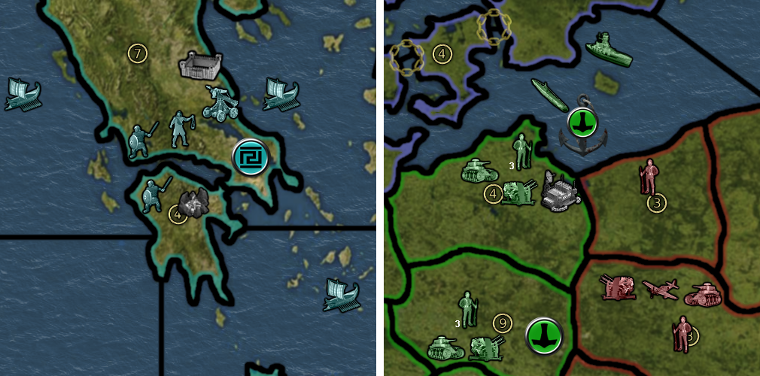
AT guns may be common, but they still have to be distributed in every territory across the front line. So this would turn the Light Tank into a unit that can be used opportunistically to punish an enemy player who leaves gaps in his defenses.
The 1:1 rule also means there’s opportunities to get the bonus even when the opponent does have AT defenses through concentration. Perhaps the Soviet player has 16 Anti-Tank Guns and I as Germany have only 8 light tanks. At first glance, sounds like he has me completely countered.
But the Soviet player’s front line is so large that he has to spread those guns out so that there’s only 2 or 3 AT guns in each zone. I pick one that has has only 2 of them, and rush all 8 of my light tanks there - now 6 of them are attacking at 50% greater strength and can tear up all the infantry and field guns there.
And because the Light Tank is speed 2 and the AT gun is speed 1, I can always move my tanks around to concentrate for an attack faster than my opponent can shuffle his guns together to mass a defense.
This sounds like it will make for some really fun dynamics since it turns the Light Tank into a unit that rewards smart tactics, and the AT Gun into something that actually plays a role befitting its name instead of just being a generic filler unit to use as cannon fodder.
You could even consider extending that dynamic to the Medium Tank - it gets +1 over its current stats, but reverts to its current ones if it gets fought by heavier tanks or by AT guns at a 1:1 ratio.
@cernel
I would recommend Jason Clower’s Type 56 - Story of the SKS YouTube channel as a very informative and entertaining source on how the Chinese army fought - he principally covers the PLA, but there’s a lot of overlap with the NRA in terms of the logistical struggles they had during WW2.China's best infantry units were the ones trained and equipped by the Germans prior to WW2, not by the Soviets. There were three elite divisions that were fully organized and equipped along European lines, and twelve others that had been reorganized and trained by them but didn't get the full array of imported artillery and equipment.
I implemented Guards Infantry and Shock Armies as Soviet unlockable bonuses in my TRO outline. Guards was a promotion mechanic where you replace up to two regular Infantry per turn with Elite Infantry for free if you win a battle. Shock Armies was one where Elite Infantry would pair with the Assault Gun and allow the AG to get one pre-battle bombardment shot at the enemy.
My policy was to avoid bloating the roster with adding a bunch of new unique units and instead use nation-specific techs to add new bonuses or synergies to the baseline units (or ways to get them cheaper).
-
Actually, you can have both. You could have that Soviet infantry can be upgraded to "guard_infantry" but that you can also buy "shock_infantry". They may be actually the same except that the former is an upgrade and the latter is purchased directly. Can you ask Claude what was the most elite between Guard and Shock armies in the Red Army during World War 2?
This is what Google AI says when asked that question:
In the Red Army during World War II, the Guards Armies were considered more inherently elite than the Shock Armies.
While both were highly formidable and significantly outperformed regular All-Arms field armies, they represented entirely different organizational philosophies.The Distinction Between the Formations
Guards Armies earned their status through battle merit.
The "Guards" designation was an honorary title awarded by the Soviet high command (Stavka) to existing units that had demonstrated exceptional courage, skill, and heroism on the battlefield. Over time, these highly decorated divisions and corps were clustered together to create whole Guards Armies. Because their status was a direct reflection of combat proficiency, they were universally viewed as the elite institutional backbone of the Red Army.
Shock Armies were defined by their structural role, not their prestige.
A Shock Army (Udrarnaya Armiya) was designated as such from its creation based purely on its specific tactical purpose. Built to execute the first phase of the Soviet "Deep Battle" doctrine, their purpose was to act as heavy battering rams to breach fortified German defensive lines. They were packed with massive amounts of field artillery, heavy mortar regiments, combat engineers, and assault infantry to create a breakthrough so that more mobile forces could flood through the gaps.Operational and Structural Realities
• Resource Priority: Both types of armies received equipment priority over standard armies. Shock Armies often received heavy emphasis on firepower (like heavy self-propelled guns and siege artillery) needed for breakthrough operations. However, by the later stages of the war, Guards Armies typically matched or surpassed Shock Armies in terms of qualitative artillery and armored support.
• Personnel Quality: Guards units attracted the best replacements and maintained an institutional culture of high morale and rigorous training. Shock Armies, while heavily reinforced with personnel, suffered devastatingly high casualty rates due to the brutal nature of frontal breakthrough operations, meaning their ranks were frequently replenished with regular conscripts.
• Perks and Incentives: Soldiers serving in Guards units enjoyed distinct institutional privileges, including a unique badge, specific uniform tailoring, and higher pay scales (double pay for enlisted men and 1.5 times pay for officers). Shock Armies did not automatically receive these systemic personal benefits unless individual sub-units within the army had also independently earned Guards status.
Ultimately, a Shock Army was a temporary or specialized tool designed for an incredibly violent tactical job, whereas a Guards Army was a permanently recognized elite force comprised of the Red Army's most proven veterans.